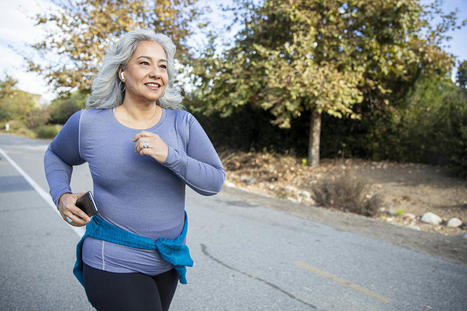
Read more about Ageism is getting old and it needs to stop.. In Australia’s ageing population, ageism is a significant issue in our healthcare and hospital systems — and it has deadly effects.
|
|
Revalued
How to enjoy every phase of life, particularly post-retirement: health, finances, culture, entertainment and intellectual activity. See my website at www.revalued.com.au for more succinct guides and charts to support your relationship with ageing. Celebrate your own life before others have to do it for you! Curated by Susan Myburgh |
Your new post is loading...
|
|
Scooped by
Susan Myburgh
May 2, 2021 1:12 AM
|
Read more about Ageism is getting old and it needs to stop.. In Australia’s ageing population, ageism is a significant issue in our healthcare and hospital systems — and it has deadly effects.
|
|
Scooped by
Susan Myburgh
May 2, 2021 1:11 AM
|
The mis-marketing of exercise for weight loss has turned millions away from physically active lifestyles. A new paradigm is needed to reverse the damage.
|
|
Scooped by
Susan Myburgh
May 2, 2021 1:11 AM
|
If you're trying to increase your fruit and vegetable intake to five, seven or even 10 portions a day, try our easy and delicious tips and recipe suggestions.
|
|
Scooped by
Susan Myburgh
May 2, 2021 1:10 AM
|
If you suffer from high blood pressure, or hypertension, focusing on diet and exercise is key.
|
|
Scooped by
Susan Myburgh
May 2, 2021 1:09 AM
|
Dr. Hoffman rounds out his review of the health benefits of a regular exercise routine.
|
|
Scooped by
Susan Myburgh
May 2, 2021 12:03 AM
|
Why do the countless public health campaigns encouraging people to be more active tend to fail?
|
|
Scooped by
Susan Myburgh
May 1, 2021 10:14 PM
|
Mend your clothes and do yourself some good Problem with this article? Report n today's society, many of us go through our whole lives without ever working with our hands; we live, we work, we eat, we buy, we repeat. Everything is made and delivered at a blistering rate, from fast food to fast fashion and, although this may keep the economy buoyant, it's not necessarily good for our mental health, or for our planet. But during the past year of lockdown, we have been forced to stay still. The hamster wheel has stopped, and for some of us - without young children to keep entertained - this has provided a unique moment of quiet contemplation. We have suddenly found ourselves with time to spare; time to tackle those half-finished projects and abandoned hobbies - and an increasing desire to be creative, and make things with our hands. There has been a wealth of online craft workshops popping up on everything from crochet, collage, charcoal drawing and flower-arranging to spoon-carving. On TV, programmes such as have encouraged everyone to paint, draw or sculpt their view from a window with whatever materials they have at hand. In the safety of our own homes, we have been able to try knitting for the first time, to have a go at oil pastels or attempt a pinch pot - without a teacher but also without the judgment of a teacher. The possibility of experimentation in the solitary environment of our own homes has spawned a new confidence in "having a go", the prerequisite for learning. Mastery, after all, starts with dabbling. The freedom to create on our own has offered an effective therapy for uncertain times. Like many of us during lockdown, my work was forced to go virtual. I am both an illustrator and textile repairer, specialising in delicate fabrics and traditional hand-sewing techniques. For the past few years, I have worked in collaboration with Toast, teaching customers how to care for and mend their garments, so that they might keep for longer. Normally, I would travel to their various stores around the country with a bag of cloth, needles and thread, to host workshops: four to five customers around a table practising their stitchwork over tea and conversation. It's an intimate affair. So, when I began teaching online via Zoom, I was unsure if this new set-up would work, but I was happily surprised to find a surge of interest from all corners of the world - from Italy, Iceland, Portugal, Lithuania, India and the USA. During the workshops everyone is given the chance to work on a stitch sampler, before tackling a repair. Taking inspiration from traditional techniques, such as Japanese sashiko and Indian kantha, tears are backed from the underside with a patch of cloth; then small rows of stabbing stitches form a rectangle of closely stacked rows of stitchwork, securing the tear and reinforcing the surrounding cloth, creating a pleasing mend that can be either visible or invisible, depending on the colour match. It can be so satisfying fixing broken belongings, stitch by stitch, finally tackling long-forgotten projects - a beloved broken cushion; a favourite suit jacket; an irreplaceable pair of jeans. Repairing an item of clothing can enhance the experience of wearing it and leaves the repairer with a renewed sense of closeness and ownership, but it's more than that. When we repair something by hand, our motor skills are honed and our head is fully engaged, leaving a sense of calm and balance. A recent study at Harvard Medical School discovered that repetitive hand-based actions, such as stitching, weaving and knitting, all create a measurable state of relaxation, slowing down the heart rate and lowering blood pressure. Here was the evidence. Repairing something by hand can't be rushed; it is inherently a slow process that requires concentration and care. In the past, much more emphasis was placed both in schools and at home on the basic skills to ensure self-reliance and resilience. Before mass production and readymade products, we had no choice but to repair and maintain the things we owned. Sailors and soldiers were equipped with sewing kits to darn their socks and broken sails. In the Second World War the Make Do and Mend movement implored families to help with the war effort by keeping new purchases to a minimum (clothes as well as food were rationed) and there was a general consensus to be mindful of the things that we owned; to care and repair. Today, most of us have no real connection to the things that we wear and the products we use - we don't know how anything works or how things are made in the first place. When things break, we often don't know how to repair them, but more than that, we don't see the need to repair them - and why should we, when everything is so cheaply made and so easily replaced? The by-product of this is that many of us have been left with a feeling of alienation and disconnection. Karl Marx believed that in order to feel fulfilled from work our work must be meaningful, honest, effective and robust. It is the same with our things - when we swap our well-made and uniquely crafted belongings with replaceable factory-made products, our connection to these things is diminished and our lives are somehow impoverished in the exchange. I grew up in a household where things were made and mended. My mum was a hat-maker and my father was a special effects model-maker. With a sewing room in the house, I was taught early on how to repair and alter the things I loved. For me, it all started with a pair of socks. My favourite pair, the heels had become thin and threadbare. As they were too precious to throw away, I decided to mend them (with the help of my mother). I remember the feeling of it: weaving my darning needle in and out of the surviving strands; making little bridges back and forth, like a lawn mower; slowly closing the hole. The process was instinctive and I can still recall the feeling of pride and achievement when I had finally finished. Certainly, my darn looked a little rustic, but I had given my socks a new lease of life, a second chance. It's this idea that drew me to the art of repair as a philosophy, but also as a helpful skill. It struck me early on that mending things yourself can instil a confidence in your own capabilities, which in turn increases our connection to the things we own. I've always been interested in the sentimental value we hold for things; how we carry memories of people and times gone by within a hand-me-down jumper or hand-knitted hat. These items are both priceless and irreplaceable, no matter how broken or tattered. There is a lesson within the broken fibres we are stitching back together that we might apply to our own lives. In the western world, we are actively encouraged to fight the process of ageing. We value youth and new things above all else. This worldview contributes to wasteful purchases which then contribute to the environmental emergency we all face. Fast fashion is a major player in ecological destruction and pollution. We are told that ageing is bad and unattractive, and that we must avoid it at all costs. The problem is, that like our clothes, we all age. Our bones become brittle, our skin carries scars (sometimes after stitches) from accidents along the way. Our hair becomes thin or grey and our joints begin to seize. We all break from time to time. But we also mend, with the help of time or a doctor. We carry the knocks of life on our bodies, like an old, much-loved and patched-up pair of trousers. Our wrinkles are a sign of time, of weather and of life. Old age is inescapable, but if we are honest about it, there can be grace and beauty in it. Surely, we can see that this must be so, and when we try to deny it by avoiding old things that are worn, rather than learning to love them, we somehow deny our own reality. To repair something (anything) is a defiant act, flying in the face of consumerist values and products. Slowing down and finding value and meaning in the smaller things in life can contribute to a more thoughtful approach to our clothes and the world we live in. As we emerge out of lockdown, my hope is that these newly learned skills will last and endure as the wheel starts turning again. Perhaps this time has given us the chance to recalibrate and reconnect, not just with our belongings but with ourselves.
|
|
Scooped by
Susan Myburgh
May 1, 2021 10:13 PM
|
Ageism is an attitude toward the aged in our midst that marks them out as a specific group demanding special recognition for their shortcomings and their demands. Old age is experienced individually; ageism removes that sense of individuality by insisting that the aged as a cohort are burdensome,...
|
|
Scooped by
Susan Myburgh
May 1, 2021 10:12 PM
|
Disclaimer Please note that the views expressed on this blog are the views of individual members of the British Society of Gerontology, and do not represent the views of the Society, or any part of the Society. This is a space for debate and discussion by the many academics, professionals and people with an interest in ageing issues that form the membership of the BSG. If you are a member of the BSG and would like to be added as a blog author, please contact info@britishgerontology.org
|
|
Scooped by
Susan Myburgh
May 1, 2021 10:12 PM
|
Researchers identify the mechanisms that support the brain's ability to adapt the way it processes information depending upon the environment we are in.
|
|
Scooped by
Susan Myburgh
May 1, 2021 8:10 PM
|
Stay On Your Feet Falls Prevention Online Learning for older adults....
|
|
Scooped by
Susan Myburgh
April 19, 2021 6:33 AM
|
From urban wellbeing and public health to urban planning and housing, RMIT researchers are helping to build age-friendly cities across Europe and Australia...
|
|
Scooped by
Susan Myburgh
April 19, 2021 6:33 AM
|
If you are determined to lose weight and stay fit, then age is just a number for you. People say the older generation just gains weight and they are not strong enough to lose it. Even friends and family accept this fact and avoid paying attention to fitness. But is there a proof?
|
|
Scooped by
Susan Myburgh
April 19, 2021 6:32 AM
|
Discover how to age well in this course on preventing common health problems in older adults, with a focus on reducing frailty as life expectancy gets longer....
|
|
Scooped by
Susan Myburgh
April 18, 2021 10:21 PM
|
Architecture is a critical element of “embedding a human rights-based and human-centred approach to care”, the focus of chapter 3 of the royal commission’s report. To understand the relationship between architecture and human rights, consider how human rights are taken away: look at prisons,...
|
|
Scooped by
Susan Myburgh
April 18, 2021 7:36 PM
|
If you could be one age for the rest of your life, what would it be? Would you choose to be nine years old, absolved of life’s most tedious responsibilities, and instead able to spend your days pla…
|
|
Scooped by
Susan Myburgh
April 18, 2021 7:36 PM
|
Measuring health is important for many reasons. It can help doctors and scientists understand the risk of medical problems and develop prevention strategies that can improve patient care. Monitorin…
|
|
Scooped by
Susan Myburgh
March 31, 2021 2:42 AM
|
Melbourne Design Week was established to shine a light on our local design community, explore the role design plays in everyday life, and showcase the ways design is helping to tackle the challenges of the future.
|
|
Scooped by
Susan Myburgh
March 31, 2021 2:40 AM
|
We asked a range of people, “Will aged care be way better in 10 years after the huge effort and exp...
|
|
Scooped by
Susan Myburgh
March 31, 2021 2:40 AM
|
Osteoporosis is a disease of bones that causes the bones to become fragile and brittle. The condition can affect anyone, but it is more likely to occur in people who are older than 50 years old.For your body to heal properly from an injury such as a fracture, it needs calcium and vitamin D3, Read...
|
|
Scooped by
Susan Myburgh
March 31, 2021 2:29 AM
|
Although our ability to easily pick up a new skill declines with age, harnessing a specific type of mindset can help you learn effectively as an adult.
|
|
Scooped by
Susan Myburgh
March 31, 2021 2:29 AM
|
Are you an enthusiastic PhD candidate with a passion for gut-brain research? In this project we will apply advanced in vitro (single cell, co-culture or organoid based) models simulating the gut, blood brain barrier and brain immune responses.
|
|
Scooped by
Susan Myburgh
March 31, 2021 2:28 AM
|
This webinar provides an in-depth understanding of ageism in the workforce and in the industry, by presenting examples of discrimination in the labour market....
|
|
Scooped by
Susan Myburgh
March 31, 2021 2:28 AM
|
What Are The Benefits Of Consuming Tea?Tea is full of antioxidants which work to prevent the body’s version of rust, and thus help to keep us looking yo...
|
|
Scooped by
Susan Myburgh
March 31, 2021 2:26 AM
|
Bimuno is shown to beneficially affect the human gut microbiome through its selective stimulation of bifidobacteria.