Last December, NASA officially announced that it was planning to send a robotic rover to Mars in 2020 as a follow-up to Spirit, Opportunity, and Curiosity. Obviously, we're pretty damn excited.
With breaking news about giant and expensive humanoid robots from DARPA, it's sometimes easy to forget that the world is full of other amazing robots, isn't it? Of course it isn't! That's exactly why we have Video Friday.
By now most of the people affected by winter storm Nemo have unburied themselves from the snow. I'm sure many of them won't want to see snow again for a very long time, let alone shovel it. Which i...
By 2050 robot "brains" based on computers that execute 100 trillion instructions per second will start rivaling human intelligence (Rise of the Robots--The Future of Artificial Intelligence http://t.co/apbbzoIxmP)...
Hans Moravec a chief scientist of Seegrid Corporation - a robotics company - believes that computer "intelligence" will continue to increase exponentially.
He hypothesises that "- by 2050 [computers] will be capable of executing trillions of instructions each second." His vision for such an increase in computing power is supported by Moore's Law which is the observation that, over the history of computing hardware, the number of transistors on integrated circuits doubles approximately every two years, which results in an increase in computational power.
This law has held true since the invention of the integrated circuit in 1958. If the "law" continues on that trend, not only will "smarter" machines begin to appear but the machines will become cheaper and more available.
Increasing the number of instructions per second a computer can perform allows the machine to peruse data faster, forecast it more effectively, and ultimately react to it in a way which will benefit humans by providing more accurate models in real-time.
Getting a robot into a car is one thing; getting it figure out how to turn a key or control a manual transmission is another… (.@garymarcus on a Pentagon agency's robot triathlon, designed to help researchers build robots for disaster zones:
Hurricanes are generally things that robots, humans, and everything else try to avoid. It's hard to study something, though, if you're constantly getting out of its way.
For most of us, insects are not particularly adorable. However, make a tiny insectoid robot, and suddenly the cute is off the charts. The Harvard Microrobotics Lab is working on a design for micro-bots called the Harvard ...
At some point, to be sustainable, research has to make a jump from "do it because it’s cool" to "do it because it’s actually useful and has some sort of practical application that people need and/or will pay for." That’s a big, big jump to make,...
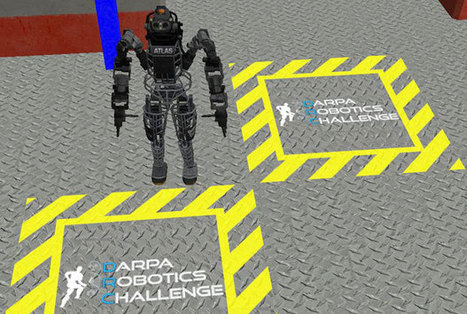
When DARPA unveiled the DRC ATLAS robot in the flesh steel earlier today, the agency also released 57 pages of task descriptions detailing the course and tasks that the teams will have to complete in December.
One of the longstanding goals in robotics is the mastery of motion, such that balance, precision, and control provide the same kind of all-terrain navigation seen in biological quadruped counterparts.
When DARPA's Virtual Robotics Challenge (VRC) wrapped last Thursday, we got all the results, but not much more. What we wanted was to see some of the actual competition runs themselves, especially the ones that went either very right or very wrong.
More than a thousand soccer playing robots from forty countries have descended on the Dutch technology center of Eindhoven this week with one goal in mind: b... (AP VIDEO: Soccer-playing robots hope to win man vs.
An automated grape counter will help growers see which parts of their vineyards need special attention (Robot winemakers: In California's fertile Central Valley, bots know best which grapes are healthy http://t.co/lNDyDKHZAm...
Scaremongers play on the idea that robots will simply replace people on the job. In fact, they can become our essential collaborators, freeing us up to spend time on less mundane and mechanical challenges.
Space. The Final Frontier. These are (or will be) the voyages of a star-shipped robot. Its mission of some unspecified duration: to chat up the astronauts: "Russia was the first to go outer space, the U.S.
Bio-inspired robotics has been all over the place. We've got robots that walk, run, climb, fly, crawl, and swim. We've been kind of missing out on a big domain, though, and that's animals that dig. You know, like moles.
To get content containing either thought or leadership enter:
To get content containing both thought and leadership enter:
To get content containing the expression thought leadership enter:
You can enter several keywords and you can refine them whenever you want. Our suggestion engine uses more signals but entering a few keywords here will rapidly give you great content to curate.


 Your new post is loading...
 Scoop.it!