Your new post is loading...

|
Scooped by
Gilbert C FAURE
February 6, 2019 1:37 AM
|
|
|
Scooped by
Gilbert C FAURE
November 13, 2018 9:02 AM
|
Objectives Autoantibodies against CD74 (anti‐CD74) are associated with ankylosing spondylitis. InterSpA is a multicenter study conducted to compare sensitivity and specificity of anti‐CD74 and HLA‐B27 in patients with non‐radiographic axial spondyloarthritis (nr‐axSpA). Methods Patients aged 18‐45 years with inflammatory back pain of ≤2 years duration and clinical suspicion of axSpA were recruited. HLA‐B27 genotyping and MRI of sacroiliac joints were performed in all patients. 149 patients with chronic back pain not caused by axSpA (CBP) served as controls, furthermore 50 patients with ankylosing spondylitis (AS) and 100 blood donors were analyzed. Results 100 patients with IBP received the diagnosis of axSpA by the investigators and fulfilled the ASAS criteria. Their mean age was 29 years and the mean symptom duration 12.5 months. The sensitivity of IgA and IgG anti‐CD74 related to the 100 axSpA patients was 47% and 17%. The specificity, per definition, was 95.3%, respectively. The sensitivity of HLA‐B27 was 81%. The positive likelihood ratios (LR+) were 10.0 (IgA anti‐CD74), 3.6 (IgG anti‐CD74) and 8.1 (HLA‐B27). Assuming a 5% pretest probability of axSpA in CBP patients of 5%, the posttest probability after consideration of the respective positive test results was 33.3% for IgA, 15.3% for IgG antibodies against CD74 and 28.8% for HLA‐B27. Combination of IgA antibodies against CD74 and HLA‐B27 provides posttest probabilities of 80.2%. Conclusions IgA anti‐CD74 may be a useful tool for identifying axSpA. The diagnostic value of the test needs to be further proven in daily practice. This article is protected by copyright. All rights reserved.
|
|
Scooped by
Gilbert C FAURE
October 13, 2018 2:19 PM
|
Both spondyloarthritis and uveitis are associated with HLA-B27 positivity. This Review discusses this overlap and how the intestinal microbiome and dysbiosis might contribute to the development of both diseases.

|
Suggested by
Société Francaise d'Immunologie
September 30, 2018 5:45 AM
|
Objective Clinical trials of the anti‐IL‐17A antibody secukinumab demonstrated a crucial role of the IL‐17A cytokine in the pathogenesis of spondyloarthritis (SpA), however its cellular source in this condition remains controversial. Group 3 innate lymphoid cells (ILC3s) have been recently identified in a number of different tissues as potent producers of proinflamatory cytokines, including IL‐17A and IL‐22. In this study we set out to characterize the presence and composition of ILCs and investigate whether these cells are an important source of IL‐17A in the synovial tissue of patients with SpA. Methods Matched synovial tissue (ST), synovial fluid (SF) and peripheral blood (PB) were obtained from SpA patients with actively inflamed knee joints. ILC subsets were characterised by flow cytometry. Gene expression analysis at the single‐cell level was performed directly ex vivo and after in vitro activation.. IL‐17A ELISPOT assay was used to detect IL‐17A‐secreting cells. Results Analysis revealed that ILCs, and particularly NKp44‐positive ILC3s, are expanded in inflamed arthritic joints. Single‐cell expression analysis demonstrated that ST ILCs are clearly distinguishable from ST T cells and from their PB counterparts. We detected expression of Th17 signature transcripts RORC, AHR and IL‐23R in a large fraction of ST ILC3s. These cells were capable to induce IL‐22 and CSF2 but not IL‐17A expression in response to in vitro re‐stimulation. Conclusions We demonstrate that ILC3s are absolutely and relatively enriched in the synovial joint of patients with SpA, however these cells are not a significant source of IL‐17A cytokine in this pathology. This article is protected by copyright. All rights reserved.
|
|
Scooped by
Gilbert C FAURE
August 13, 2018 2:50 AM
|
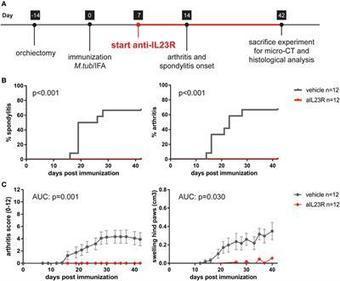
IL-17A is a central driver of spondyloarthritis, its production was originally proposed to be IL-23 dependent. Emerging preclinical and clinical evidence suggests, however, that IL-17A and IL-23 have a partially overlapping but distinct biology. We aimed to assess the extent to which IL-17A-driven pathology is IL-23 dependent in experimental spondyloarthritis. Experimental spondyloarthritis was induced in HLA-B27/Huβ2m transgenic rats, followed by prophylactic or therapeutic treatment with an anti-IL23R antibody or vehicle control. Spondylitis and arthritis were scored clinically and hind limb swelling was measured. Draining lymph node cytokine expression levels were analyzed directly ex vivo, and IL-17A protein was measured upon restimulation with PMA/ionomycin. Prophylactic treatment with anti-IL23R completely protected against the development of both spondylitis and arthritis, while vehicle treated controls did develop spondylitis and arthritis. In a therapeutic study, anti-IL23R treatment failed to reduce the incidence or decrease the severity of experimental spondyloarthritis. Mechanistically, expression of downstream effector cytokines, including IL-17A and IL-22, was significantly suppressed in anti-IL23R versus vehicle treated rats in the prophylactic experiments. Accordingly, the production of IL-17A upon restimulation was reduced. In contrast, there was no difference in IL-17A and IL-22 expression after therapeutic anti-IL23R treatment. Targeting the IL-23 axi
|
|
Scooped by
Gilbert C FAURE
July 13, 2018 11:11 AM
|
Evidence from genetic, experimental and clinical studies has accumulated to indicate a role for the IL-17 pathway in the pathogenesis of spondyloarthritis. This Review discusses how IL-17A and IL-17F and their cellular sources contribute to the immunopathology of these diseases.
|
|
Scooped by
Gilbert C FAURE
November 28, 2017 2:03 PM
|
The human leukocyte antigen class I gene HLA-B27 is the strongest risk factor for ankylosing spondylitis (AS), a chronic inflammatory arthritic disorder. More recently, the Endoplasmic Reticulum Aminopeptidase (ERAP) 1 and 2 genes have been identified by genome wide association studies (GWAS) as additional susceptibility factors. In the ER, these aminopeptidases trim the peptides to a length suitable to fit into the groove of the major histocompatibility complex (MHC) class I molecules. It is noteworthy that an epistatic interaction between HLA-B27 and ERAP1, but not between HLA-B27 and ERAP2, has been highlighted. However, these observations suggest a paramount centrality for the HLA-B27 peptide repertoire that determines the natural B27 immunological function, i.e. the T cell antigen presentation and, as a by-product, elicits HLA-B27 aberrant behaviours: (i) the misfolding leading to ER stress responses and autophagy and (ii) the surface expression of homodimers acting as ligands for innate immune receptors. In this context, it has been observed that the HLA-B27 carriers, besides being prone to autoimmunity, display a far better surveillance to some viral infections. This review focuses on the ambivalent role of HLA-B27 in autoimmunity and viral protection correlating its functions to the quantitative and qualitative effects of ERAP1 and ERAP2 polymorphisms on their enzymatic activity.
HLA-B27 predisposes to autoimmunity but also confers a superior surveillance towards several viral infections. This review discusses the recent findings intersecting the complex HLA-B27 biology with the functions of the Endoplasmic Reticulum Aminopeptidase 1 and 2 (ERAP1 and ERAP2) genetic variants focusing on the way the latters can impact the physiological and pathological features of the HLA-B27 molecules.
|
|
Scooped by
Gilbert C FAURE
May 22, 2017 1:54 PM
|
Objective To evaluate the effect of secukinumab, an interleukin-17A inhibitor, on clinical signs and symptoms and radiographic changes through 2 years in patients with ankylosing spondylitis (AS).
Methods In the phase III MEASURE 1 study, patients were randomised to receive intravenous secukinumab 10 mg/kg (at baseline, week 2 and week 4) followed by subcutaneous secukinumab 150 mg (intravenous 150 mg; n=125) or 75 mg (intravenous 75 mg; n=124) every four weeks, or matched placebo (n=122). Placebo-treated patients were re-randomised to subcutaneous secukinumab 150 or 75 mg from week 16. Clinical efficacy assessments included Assessment of SpondyloArthritis international Society 20 (ASAS20) response rates through week 104. Radiographic changes at week 104 were assessed using the modified Stoke Ankylosing Spondylitis Spine Score (mSASSS).
Results 97 (77.6%) and 103 (83.1%) patients in the intravenous 150 mg and intravenous 75 mg groups, respectively, completed week 104. In the full analysis set (intent-to-treat), ASAS20 response rates at week 104 were 73.7% and 68.0% in the intravenous 150 mg and intravenous 75 mg groups, respectively. Among patients with evaluable X-rays who were originally randomised to secukinumab (n=168), mean change in mSASSS from baseline to week 104 was 0.30±2.53. Serious adverse events were reported in 12.2% and 13.4% of patients in the 150 mg and 75 mg groups, respectively.
Conclusions Secukinumab improved AS signs and symptoms through 2 years of therapy, with no unexpected safety findings. Data from this study suggest a low mean progression of spinal radiographic changes, which will need to be confirmed in longer-term controlled studies.
Trial registration number NCT01358175.
|
|
Scooped by
Gilbert C FAURE
February 7, 2017 5:15 AM
|
Hyperactive secretion and pathogenic effects of interleukin (IL)-17 and IgA have been detected in different arthropathies. Recent evidence has revealed that TH17 cytokines regulate mucosal IgA secretion. However, it is unknown whether and how IL-17 mediates synovial IgA production. Here we aim to investigate the connection of synovial IL-17 with IgA production in the joint. In this study we included synovial fluids (SF) from patients with rheumatoid arthritis (RA; n = 66), spondyloarthritis (SpA; n = 18) and osteoarthritis (OA; n = 36). The levels of IL-17, IL-6, transforming growth factor (TGF)-β1, B-cell-activating factor of the TNF family (BAFF) and anti-lipopolyssacharide (LPS) immunoglobulin (Ig)A were investigated by enzyme-linked immunosorbent assay (ELISA). Total IgA was measured by radial immunodiffusion assay. Synovial fluid-derived mononuclear cells (SFMC) were stimulated with bacterial antigens or SF-conditioned media, and cytokines and IgA were analyzed in the supernatants. IL-17, IL-6 and TGF-β1 were increased in SF from both RA and SpA compared with OA patients. Concentration of IL-17 correlated with the disease activity score (DAS)-28, IL-6 and anti-LPS IgA levels. Bacterial-stimulated SFMCs from RA and SpA patients secreted higher IL-17 than vehicle-stimulated SFMCs. Conditioned media with SF containing IL-17 induced anti-LPS IgA production by SFMCs which was independent of IL-6 activity. Concentrations of synovial TGF-β1 and BAFF correlated with anti-LPS and total IgA levels, respectively. Blockade of IL-17 decreased the production of TGF-β1 and anti-LPS IgA by SF-stimulated SFMCs. This study reports a connection between IL-17 and IgA secretion in the joint. In addition, it demonstrates that enterobacterial antigens trigger synovial IL-17 production, and that TGF-β1 and BAFF may mediate the effect of IL-17 on IgA production. This circuit may contribute to the pathogenesis of inflammatory joint diseases.
|
|
Scooped by
Gilbert C FAURE
April 20, 2016 10:15 AM
|
Objective
In the spondyloarthritides (SpA), increased numbers of CD4+ T cells express killer cell immunoglobulin-like receptor 3DL2 (KIR-3DL2).
|
|
Scooped by
Gilbert C FAURE
April 2, 2016 6:47 AM
|
Objective
In the spondyloarthritides (SpA), increased numbers of CD4+ T cells express killer cell immunoglobulin-like receptor 3DL2 (KIR-3DL2).
|
|
Scooped by
Gilbert C FAURE
December 20, 2015 7:18 AM
|
Objective
To provide evidence-based recommendations for the treatment of patients with ankylosing spondylitis (AS) and nonradiographic axial spondyloarthritis (SpA).
|
|
Scooped by
Gilbert C FAURE
December 18, 2015 1:34 PM
|
Objectives. In spondyloarthropathies (SpA) increased numbers CD4+ T cells express the killer cell immunoglobulin-like receptor KIR3DL2.
|
|
|
Scooped by
Gilbert C FAURE
January 27, 2019 2:49 PM
|
|
|
Scooped by
Gilbert C FAURE
November 3, 2018 5:50 AM
|
Each dosing regimen of ixekizumab was superior to placebo for improving radiographic
axial spondyloarthritis signs and symptoms in patients not previously treated with
bDMARDs; the safety profile was consistent with previous indications of ixekizumab.
|
|
Suggested by
Société Francaise d'Immunologie
October 2, 2018 2:47 AM
|
The discovery of the association between spondyloarthritis (SpA) and HLA-B27 inevitably turned the spotlight on T-lymphocytes as the cells which recognize peptide antigens within the binding groove...
|
|
Scooped by
Gilbert C FAURE
September 28, 2018 2:12 PM
|
The IL-23–IL-17 signalling pathway has paradoxical effects on bone remodelling in psoriatic arthritis and ankylosing spondylitis. In this Review, Gravallese and Schett examine the evidence for and outline the reasons behind this paradox.
|
|
Scooped by
Gilbert C FAURE
August 5, 2018 10:44 AM
|
Innate-like T cells such as invariant natural killer T (iNKT) cells and mucosal associated T (MAIT) cells, characterized by a semi-invariant T cell receptor and restriction towards MHC-like molecules (CD1 and MR1 respectively), are a unique unconventional immune subset acting at the interface of innate and adaptive immunity. Highly represented at barrier sites and capable of rapidly producing substantial amounts of cytokines, they serve a pivotal role as first line responders towards microbial infections. In contrast, it was demonstrated that innate-like T cells can be skewed towards a predominant pro-inflammatory state and consequently are involved in a number of auto-immune and inflammatory diseases, like inflammatory bowel diseases (IBD) and rheumatic disorders such as spondyloarthritis (SpA) and rheumatoid arthritis (RA). Interestingly, there is link between gut and joint disease as they often co-incide and share certain aspects of the pathogenesis such as established genetic risk factors, a critical role for pro-inflammatory cytokines such as TNF-α, IL-23 and IL-17 and therapeutic susceptibility. In this regard dysregulated IL-23/IL-17 responses appear to be crucial in both debilitating pathologies and innate-like T cells likely act as key player. In this review, we will explore the remarkable features of iNKT cells and MAIT cells, and discuss their contribution to immunity and combined gut-joint disease.
|
|
Scooped by
Gilbert C FAURE
June 1, 2018 2:29 AM
|
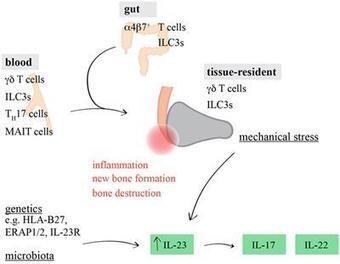
gd T cells, ab T cells, and innate lymphoid cells (ILCs) are capable of producing interleukin (IL)-17A, IL-17F, and IL-22. Among these three families of lymphocytes, it is emerging that gd T cells are, at least in rodents, the main source of these key pro-inflammatory cytokines. gd T cells were implicated in multiple inflammatory and autoimmune diseases, including psoriasis, experimental autoimmune encephalomyelitis and uveitis, colitis, and rheumatoid arthritis. Recent findings pointed towards a central role of gd T cells in the pathogenesis of spondyloarthritis (SpA), a group of inflammatory rheumatic diseases affecting the axial skeleton. SpA primarily manifests as inflammation and new bone formation at the entheses, which are connecting tendons or ligaments with bone. In SpA patients, joint inflammation is frequently accompanied by extra-articular manifestations, such as inflammatory bowel disease or psoriasis. In humans, genome-wide association studies could link the IL-23/IL-17 cytokine axis to SpA. Accordingly, antibodies targeting IL-23/IL-17 for SpA treatment already showed promising results in clinical studies. However, the contribution of IL-17-producing gd T cells to SpA pathogenesis is certainly not an open-and-shut case. Indeed, the cell types that are chiefly involved in local inflammation in human SpA still remain largely unclear. Some studies focusing on blood or synovium from SpA patients reported augmented IL-17-producing and IL-23 receptor-expressin
|
|
Scooped by
Gilbert C FAURE
November 21, 2017 11:41 AM
|
Objectives To develop and validate an outcome measure for assessing fears in patients with rheumatoid arthritis (RA) and axial spondyloarthritis (axSpA).
Methods Fears were identified in a qualitative study, and reformulated as assertions with which participants could rate their agreement (on a 0–10 numeric rating scale). A cross-sectional validation study was performed including patients diagnosed with RA or axSpA. Redundant items (correlation >0.65) were excluded. Internal consistency (Cronbach’s α) and factorial structure (principal component analysis) were assessed. Patients were classified into fear levels (cluster analysis). Associations between patient variables and fear levels were evaluated using multiple logistic regression.
Results 672 patients were included in the validation study (432 RA, 240 axSpA); most had moderate disease activity and were prescribed biologics. The final questionnaire included 10 questions with high internal consistency (α: 0.89) and a single dimension. Mean scores (±SD) were 51.2 (±25.4) in RA and 60.5 (±22.9) in axSpA. Groups of patients with high (17.2%), moderate (41.1%) and low (41.7%) fear scores were identified. High fear scores were associated with high Arthritis Helplessness Index scores (OR 6.85, 95% CI (3.95 to 11.87)); high Hospital Anxiety and Depression Scale anxiety (OR 5.80, 95% CI (1.19 to 4.22)) and depression (OR 2.37, 95% CI (1.29 to 4.37)) scores; low education level (OR 3.48, 95% CI (1.37 to 8.83)); and high perceived disease activity (OR 2.36, 95% CI (1.10 to 5.04)).
Conclusions Overall, 17.2% of patients had high fear scores, although disease was often well controlled. High fear scores were associated with psychological distress. This questionnaire could be useful both in routine practice and clinical trials.
|
|
Scooped by
Gilbert C FAURE
March 29, 2017 4:36 AM
|
This review is concerned with a number of recent publications that contribute to current thinking on the pathogenesis of spondyloarthritis. The areas covered include the lymphocyte population in the enthesis, which is thought to drive enthesitis, and hence clinical manifestations. The debate on how HLA-B27 is implicated in inflammation is also considered, together with recent and contradictory evidence on the effects of the peptide-trimming enzyme ERAP1 on B27 expression and hence susceptibility to spondylitis. Lastly, a recent report on the role of the gut microbiome in an important model of spondyloarthritis is considered.
|
|
Scooped by
Gilbert C FAURE
November 13, 2016 12:03 PM
|
Nilotinib shows biomarker, clinical benefits in peripheral spondyloarthritis
|
|
Scooped by
Gilbert C FAURE
April 15, 2016 1:39 PM
|
Objective
The HLA-B27/β2 microglobulin (β2m) transgenic rat is a leading model of B27-associated spondyloarthopathy and disease is dependent on the presence of intestinal bacteria.
|
|
Scooped by
Gilbert C FAURE
February 1, 2016 1:08 PM
|
Objective
To determine the proportion of patients with axial spondyloarthritis (axSpA) among those with chronic back pain and ≥1 of 3 SpA features in the United States (US).
Methods
The study was conducted at rheumatology practices...
|
|
Scooped by
Gilbert C FAURE
December 18, 2015 1:36 PM
|
Objective: The long-term outcome of patients with non-radiographic axial spondyloarthritis (nr-axSpA) is unclear, particularly whether few or most progress to ankylosing spondylitis (AS).
|


 Scoop.it!