
|
Rescooped by
Catherine Smyth
from Primary history
February 19, 2013 1:28 AM
|


No comment yet.
Sign up to comment


|
Primary history- British Colonisation
A range of teaching resources for the Stage 2 history topic 'British Colonisation'. Curated by Catherine Smyth |
 Your new post is loading...
|
|
Rescooped by
Catherine Smyth
from Primary history
February 19, 2013 1:28 AM
|
 Scoop.it!
|
|
Rescooped by
Catherine Smyth
from Primary history
February 19, 2013 1:27 AM
|
Scoop.it!
Look closely at the detail in Invasion 1 – An Aboriginal perspective.
|
|
Rescooped by
Catherine Smyth
from Primary history
February 19, 2013 1:26 AM
|
Scoop.it!
Trove: Find and get Australian resources. Books, images, historic newspapers, maps, archives and more.
If you are using primary sources in the classroom consider the following:
1. actively teach the document type (e.g. personal document, letter, diary, goal records...)
2. Look at the text in original form
3. students pick out one word or phrase in the original text
4. show students the transcription for easy reading
5. students identify names of people and places
6. look for words which mean something in particular
7. ask students what they think the overall document means from what they know so far
8. read the whole document with the class following the text
Turner-Bisset (2005)
|
|
Rescooped by
Catherine Smyth
from Primary history
February 19, 2013 1:25 AM
|
Scoop.it!

This documentary series traces the history of Australia from 1788 in seven episodes. It was produced in consultation with Aboriginal communities. Primary teachers could use video extracts when teaching about British colonisation or build their own professional knowledge about the topic.

An excellent resource for educators to use in their lesson planning.

A great resource to explain the origins of English culture and language of Australia.

Description of what is on this site:
Directed and produced by Rachel Perkins, an Arrernte woman from Central Australia, First Australians, specifically Episode 1, excellently 'explains changes in the community and family life' experienced by the Aboriginal peoples at the time of the arrival of the First Fleet and beyond. This episode 'evaluates the effects of these' changes 'on individuals' such as Bennelong. The information at http://www.sl.nsw.gov.au/discover_collections/history_nation/terra_australis/education/bennelong/bennelong_extracts.pdf could prove a useful follow-up resource. This is one of the resources selected using selection criteria such as whether the creator of the work is Aboriginal.
The effects of these changes on groups of Aboriginal people are illustrated, such as those experienced by the Aboriginal people of Warang (Sydney). It also enables the audience to evaluate the effects of these changes on 'environments' due to British settlement. Allen Madden from the Gadigal Clan, talking of Captain Philip, explains that "...immediately he orders trees to be chopped down and land to be cleared..." (Perkins, 2008).
A teaching idea:
Children could be asked to write down what stands out to them as they watch the episode, after which time they pair and share and then share their partners response with the class. Teacher can display mind-map of ideas on interactive whiteboard and students can research one of the first Australians mentioned in the episode and present some of the ideas in the mind map in relation to CCS2.2, from the perspective of that first Australian.
An idea for an assessment task:
In order to assess the learning of the students on how well they can fulfill the HSIE outcome CCS2.2, perhaps after giving them a few lessons to research the changes and their impacts, I would ask them to write a speech from the perspective of a particular Aboriginal person or group.
Literacy strategy/links to English KLA:
This could also fulfill some of the outcomes for the English K-6 Syllabus such as EN2-6B in that writing a speech requires students to 'distinguish between different forms of English' as they 'plan and deliver short presentations'.
References:
Hunter, J. (1788). The Taking of Colbee and Bennalong.
Retrieved from the State Library of NSW website: http://www.sl.nsw.gov.au/discover_collections/history_nation/terra_australis/education/bennelong/bennelong_extracts.pdf
Perkins, R. (Director and Producer). (2008). First Australians
[Motion picture]. Australia: Blackfella Films.
|
|
Rescooped by
Catherine Smyth
from Primary history
February 19, 2013 1:25 AM
|
Scoop.it!
These materials, located on the NSW Board of Studies website, can be used to teach history topics in the primary classroom. If you are using primary sources in the classroom consider the following:
1. Actively teach the document type (e.g. personal document, letter, diary, goal records...)
2. Look at the text in original form
3. Students pick out one word or phrase in the original text
4. Show students the transcription for easy reading
5. Students identify names of people and places
6. Look for words which mean something in particular
7. Ask students what they think the overall document means from what they know so far
8. Read the whole document with the class following the text
Turner-Bisset (2005)
|
|
Rescooped by
Catherine Smyth
from Primary history
February 19, 2013 1:25 AM
|
Scoop.it!
Library of Congress resources for teachers. Classroom materials. Using Primary Sources. Guides and Analysis Tools.

|
|
Rescooped by
Catherine Smyth
from Primary history
February 19, 2013 1:24 AM
|
Scoop.it!

Primary teachers may be familiar with Bloom's inquiry process but less so with HISTORICAL INQUIRY.
This British website draws on pedagogical research and explores how teachers can develop historical understanding in their classroom. The "Enquiry discussion" section is particularly useful.
|
|
Rescooped by
Catherine Smyth
from Primary history
February 19, 2013 1:24 AM
|
Scoop.it!
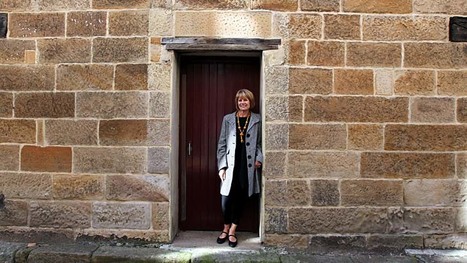
Read this article, featuring the historian Grace Karskens, if you are teaching topics about Aboriginal history, the First Fleet, British Colonisation, or our convict past.

we can not undo the past only deside how it influences us. deside how we came to be here influensess us now.
|
|
Rescooped by
Catherine Smyth
from Primary history
February 19, 2013 1:24 AM
|
Scoop.it!

This website is worth exploring! The website has a strong research base and each section has been developed in consultation with the local Aboriginal community. Teachers wanting information about a particular area in Sydney can find information relating to 'Place'. All events related to that area are described by a century and then decade. The website contains a timeline, various topics and a gallery.
|
|
Rescooped by
Catherine Smyth
from Primary history
February 19, 2013 1:23 AM
|
Scoop.it!
Throughout 2011 and 2012, the Board of Studies NSW developed new K–10 syllabuses for English, Mathematics, Science (incorporating Science and Technology K–6) and History that incorporate agreed Australian Curriculum content.
For syllabus links and support materials for teaching the topic "British colonisation" click on the history syllabus link then go to Stage 2 content.
Primary teachers in NSW should keep teaching HSIE K-6 in 2013 but, familiarise themselves with the new history syllabus and the support materials developed by the Board of Studies. If you have time, peruse and give the BoS feedback by clicking on the link. The NSW syllabus for history K-10 is slated for implementation in 2016.
|
|
Rescooped by
Catherine Smyth
from Primary history
February 19, 2013 1:21 AM
|
Scoop.it!

Decades of educational and cognitive research has found that there are 3 fundamental principles of learning. This book builds on this research and explores how these principles can be applied in teaching history in the primary classroom.
I highly recommend this book.

In my opinion this book can be a helpful as it can help me build my knowledge in the area of history. With knowledge comes power; if i feel confident enough with the subject i will be more comfortable with teaching it to my future students. As a student It would be a beneficial resource as it links to other principles such as the 3 fundamental that are mentioned. Knowing how childern acknowledge and learn the concept of 'history' is quite interesting.

As soon as I saw this I knew I'd found my last scoop. These simple three steps will help me greatly when teaching Humanities. Going even further, the book 'How Students Learn' is also very useful as it provides an overview of the best ways to teach history in the classroom. Obviously one of the most important things when teaching is teaching with understanding, and that has been emphasised in all three steps. I think I'd use this frequently in my teaching because by having these steps I would be able to keep focused on the end result (gives me continual guidance). I also know it's from a reliable resource - Catherine Smyth being an experienced primary educator herself.