Motivation of teachers at work
564 views | +0 today
Motivation of teachers at work
This topic brings together academic insights into the motivation of teachers at work, with a special focus on their motivation to engage in continuous professional development. The idea is that this topic will be co-curated with PhD and masters students at the Open Universiteit's Welten Institute.
Curated by Steven Verjans
Your new post is loading...
Scooped by Steven Verjans
June 8, 2016 7:12 AM
Scoop.it!

How job characteristics relate to need satisfaction and autonomous motivation: implications for work effort - De Cooman - 2013 - Journal of Applied Social Psychology - Wiley Online Library

How job characteristics relate to need satisfaction and autonomous motivation: implications for work effort - De Cooman - 2013 - Journal of Applied Social Psychology - Wiley Online Library | Motivation of teachers at work | Scoop.it

To explore the motivational potential of job design, we linked job demands and job resources, as defined in the job demands–resources model, to the motivational process defined in self-determination theory. Specifically, we introduced basic need satisfaction and autonomous motivation as consecutive process variables mediating the relationship between job design and work effort. We tested this model by means of structural equation modeling in a sample of 689 employees. The comparison of several competing models provided support for the hypothesized model. We conclude that job demands thwart and job resources promote the fulfillment of 3 psychological needs. High levels of need satisfaction, in turn, are associated with autonomous motivation and, therefore, with high levels of effort.


Steven Verjans's insight:
Brings together two major models in motivational research.
No comment yet.
Scooped by Steven Verjans
April 15, 2016 11:40 AM
Scoop.it!

Teachers' engagement in professional learning: Exploring motivational profiles

Abstract
This study investigated to what extent secondary school teachers are motivated to work on their professional learning. To this end, profiles of motivational dimensions from self-determination theory were explored in a sample of 2360 teachers by means of latent profile analysis. The motivational dimensions included external regulation, introjected regulation, identified regulation, and intrinsic motivation. Additionally, the study investigated to what extent teachers' profile membership was related to their autonomy, competence, and relatedness satisfaction, and engagement in professional development. Four profiles were distinguished in the sample and were labelled ‘extremely autonomous’, ‘moderately motivated’, ‘highly autonomous’, and ‘externally regulated’. Profile membership could be predicted by autonomy satisfaction and relatedness satisfaction, but not by competence satisfaction. Moreover, teachers having profiles that had higher manifestations of identified regulation and intrinsic motivation engaged more in professional development activities. Results show the application of self-determination theory in the field of teacher learning and provide insight into what may be done to motivate teachers for professional learning.
Keywords Teacher professional development; Teacher professional learning; Motivation; Profiles; Self-determination theory; Latent profile analysis
Steven Verjans's insight:
No comment yet.
Rescooped by Steven Verjans from All About Coaching
April 15, 2016 10:04 AM
Scoop.it!

What Maslow’s Hierarchy Won’t Tell You About Motivation

What Maslow’s Hierarchy Won’t Tell You About Motivation | Motivation of teachers at work | Scoop.it

Despite the popularity of Maslow’s Hierarchy, there is not much recent data to support it. Contemporary science — specifically Dr. Edward Deci, hundreds of Self-Determination Theory researchers, and thousands of studies — instead points to three universal psychological needs. If you really want to advantage of this new science – rather than focusing on a pyramid of needs – you should focus on: autonomy, relatedness, and competence.


Via Kenneth Mikkelsen, Ariana Amorim
Steven Verjans's insight:
Harvard Business Review article about Maslow's hierarchy of needs, and Deci & Ryan's self-determination theory.
Lauran Star's curator insight, November 28, 2014 4:06 PM

Understanding what motivates you brings greater success!


Sue Gaardboe's curator insight, November 28, 2014 4:55 PM

This struck such a cord with me.  I can pin point the moment when I recognised that my life was my responsibility, and can see the energy that flowed from that realisation and how it's influenced every decision and action in my life. We introduce the idea to our students in a general way, (Why is it your Mum's fault that you left your homework at home?Isn't it your responsibility?) but certainly don't help them to appreciate it deeply in their lives.

Jason Leong's curator insight, January 3, 2015 12:14 AM

"Despite the popularity of Maslow’s Hierarchy, there is not much recent data to support it. Contemporary science [...] instead points to three universal psychological needs. If you really want to [take] advantage of this new science – rather than focusing on a pyramid of needs – you should focus on: autonomy, relatedness, and competence."

Scooped by Steven Verjans
April 20, 2016 3:45 AM
Scoop.it!

Towards a unified theory of task-specific motivation

Towards a unified theory of task-specific motivation | Motivation of teachers at work | Scoop.it
This study aims to integrate the current proliferation of motivation theories in a Unified Model of Task-specific Motivation (UMTM). According to this model readiness for action results from an interaction between four relatively independent types of valences that can be classified as affective or cognitive, and positive or negative. Affective valences are expectations about feelings while doing an activity; cognitive valences are expectations about the value of the consequences of an activity. In current theories these types of valences are designated as intrinsic, respectively extrinsic motives. Valences, furthermore, can be positive, but also negative. Positive valences give rise to approach motivation, negative valences to avoidance motivation. Important factors that influence valences are autonomy, feasibility expectation, and relatedness, each of which can be distinguished in a personal and a contextual facet, and subjective norm. In conclusion, some theoretical and practical implications are suggested and some issues for future research are proposed.
Steven Verjans's insight:
An extension to self-determination theory and other approaches to task-specific motivation by my colleagues de Brabander & Martens. Also available on our DSpace repository: http://dspace.ou.nl/handle/1820/5688
No comment yet.
Rescooped by Steven Verjans from Digital Delights
April 15, 2016 10:00 AM
Scoop.it!

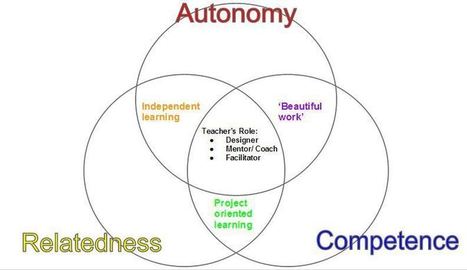
Autonomy – Relatedness – Competence: The Quick Teacher’s Guide to SDT

Autonomy – Relatedness – Competence: The Quick Teacher’s Guide to SDT | Motivation of teachers at work | Scoop.it
On a recent visit to Cannes, I found myself in conversation with an Ed Psych. Naturally, conversation drifted from the weather and supercars to Self Determination Theory. In short, SDT refers to the concept that intrinsic motivation comes out of a sense of Autonomy, Relatedness and Competence. Without these elements, the success of an individual's…

Via Ana Cristina Pratas
No comment yet.