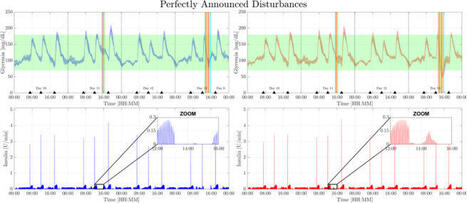
This paper has presented a comprehensive model of glucose regulation in type 1 diabetes that explicitly integrates physical activity effects into an artificial pancreas system. The proposed pulsatile Zone Model Predictive Control (pZMPC) strategy demonstrates robust performance across challenging scenarios that reflect real-world conditions, including variable exercise intensities, announcement errors, and circadian variations in insulin sensitivity. The integration of physical activity into the control system architecture through a dedicated linear model proves particularly valuable in preventing exercise-induced hypoglycemia while maintaining effective overall glycemic control. Our results quantify the benefits of exercise announcement, showing that when the physical activity event is programmed (i.e., foreseen in advance over the prediction horizon), time-in-range increases and hypoglycemic events decrease compared to non-programmed scenarios.


 Scoop.it!


 Your new post is loading...