
New York City Mayor Zohran Mamdani has announced a new policy today that will ban younger schoolchildren from using AI in classrooms.


|
Scooped by
Karen E. K. Hamiton
onto Math Education In the Digital Frontier September 6, 4:02 PM
|
 Scoop.it!
New York City Mayor Zohran Mamdani has announced a new policy today that will ban younger schoolchildren from using AI in classrooms.

 Your new post is loading... Your new post is loading...
Scoop.it!

From
www

The future is digital, and students must be equipped for that.
Karen E. K. Hamiton's insight:
This opinion piece argues that teaching goals, teacher preparation, and student needs should guide edtech use. He supports AI literacy and assessments that demonstrate problem-solving through projects, discussions, and presentations. A useful takeaway is that engagement alone does not establish whether a tool improves learning. For math teachers, that means examining whether students can explain their reasoning and apply ideas to unfamiliar problems after using it.
Scoop.it!
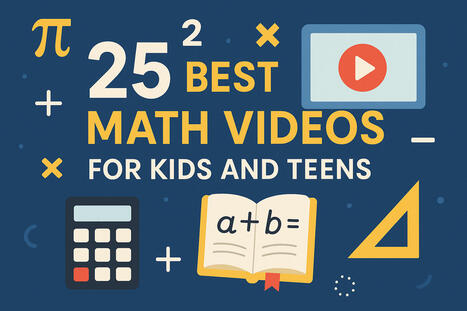
Spread the love“`html Mathematics can often be an intimidating subject for many kids and teens, but it doesn’t have to be. With the right resources, learning math can transform from a chore into an engaging adventure.
Karen E. K. Hamiton's insight:
What I find useful about this list is the range of approaches, including animation, storytelling, and everyday examples. I could see it helping teachers find a short supplement when a lesson isn’t quite connecting with students. Being able to pause and replay an explanation helps, too. I’d choose a video around one specific learning goal and follow it with a problem students work through themselves.
Scoop.it!
Math Games That Build Fluency While Kids Have Fun...
Karen E. K. Hamiton's insight:
Jennifer Bay-Williams and Gina Kling recommend games that help children practice facts and develop strategies without the pressure to answer first. Salute caught my attention because students use a known sum and a partner’s card to figure out their own missing number. There’s a lot of math in that simple setup. I loved and strongly agree with their point that listening as children play can help teachers understand which strategies students use and where they need support.
Scoop.it!

Teachers don’t need a confetti cannon to harness novelty in creating learning experiences that boost student engagement.
Karen E. K. Hamiton's insight:
Sometimes a small change is enough to get students curious. In this Edutopia article, Todd Finley shares ideas such as revealing a graph a little at a time or having students question a rule that sounds right but is wrong. A math teacher, for example, could present an incorrect solution and let students work out where it went off track. These are manageable ways to bring some life to a familiar lesson. What matters is where that curiosity leads—whether students start asking questions, explaining their thinking, or taking another look at something they thought they understood.
Scoop.it!

Students are up to eight years behind, professor says Calculus students at the University of California Berkeley don’t know how to work with elementary-level…...
Karen E. K. Hamiton's insight:
I’ve seen college freshmen and sophomores who took calculus in high school fail college algebra, so this article's concerns sound familiar. When we got to functions, you'd see mouths agape with confusion. I suspect some students learned to follow procedures, so gaps in fractions and basic algebra went unnoticed. Those gaps become harder to work around when college assignments require students to choose an approach on their own.
The professor’s examples reinforce my concern that students can move into advanced courses before the foundations are secure. I’d still be careful about blaming admissions policies alone, since the article doesn’t establish what caused those learning gaps.
Scoop.it!
![12 Of The Best Math Apps For Kids [Updated] | TeachThought | Math Education In the Digital Frontier | Scoop.it](https://img.scoop.it/IrBK5NN_JzJtdxo7EjTnVDl72eJkfbmt4t8yenImKBVvK0kTmF0xjctABnaLJIm9)
From
misryoum
The recommendations below prioritize instructional value rather than downloads or popularity alone. We considered the quality of the mathematical Read more global news and updates from MISRYOUM.
Karen E. K. Hamiton's insight:
DragonBox and Khan Academy Kids are standouts on this list. I like how DragonBox lets children explore mathematical relationships through puzzles before introducing formal notation. Khan Academy is always a winner and Khan Academy Kids offers a useful starting point for younger children, with spoken directions and visual activities for counting, shapes, and early operations, which matters when a child’s reading skills are still developing. With either app, I’d pause occasionally and ask children to explain what they noticed or show how they figured something out. (Caution: Lots of ads!)
Scoop.it!
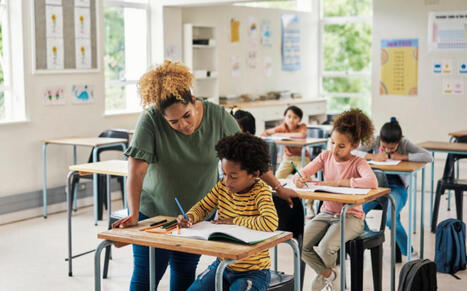
Black students continue to face large barriers to advanced mathematics education, limiting access to college pathways and high-demand careers...
Karen E. K. Hamiton's insight:
What's concerning in this article is how early the barriers begin for Black students. Limited access to Algebra I in middle school can make reaching calculus in high school much harder. Another obstacle is that schools serving large Black and Hispanic populations are less likely to offer advanced math courses at all.
I wonder how many students miss the chance to discover an interest or strength in mathematics simply because those classes aren’t available. Expanding course offerings, along with the teaching and support students need to succeed, seems like an essential place to start.
Scoop.it!
Karen E. K. Hamiton's insight:
I take the reported failures to recognize children in crisis seriously, and this article gives those concerns plenty of attention. It leans toward Common Sense Media’s child-safety perspective, although Mashable also includes Google’s objections to the testing. My reservation is that the assessment used selected test prompts, so its failure rates don’t tell readers how often children encounter these problems during everyday searches. That’s a limitation, but it doesn’t make the documented failures less concerning. I see a clear emphasis on risk and I’d want stronger testing and meaningful parental controls before making snap decisions.
Scoop.it!

From
nysfocus
Plans to deploy a "lifelike" robot and avatar teaching assistant at Salamanca High School have sparked debate over the role of technology in schools.
Karen E. K. Hamiton's insight:
A humanoid robot named Sally and an AI avatar from Realbotix, according to New York Focus. The district planned to introduce the tools in high school AI and robotics classes to support teachers and students. The avatar was intended to help with assignments during and after school, including feedback on uploaded homework. District officials said they would judge the pilot’s success mainly through feedback from students and teachers. The rollout hit a pause on July 24, when the district announced it would address student data privacy agreements.
Scoop.it!
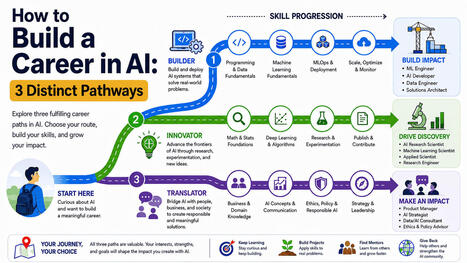
Three orientations, three different skill maps, and how to find the one that fits where you actually stand.
Karen E. K. Hamiton's insight:
Three potential AI career paths: building systems, researching new methods, and connecting AI tools with organizational needs. Engineering emphasizes coding and reliable systems, while research requires deeper mathematical preparation. Product, strategy, and ethics roles draw on subject expertise, communication, and an understanding of AI’s limitations. The author recommends comparing actual job requirements with existing strengths before committing to training.
Scoop.it!
New York City Mayor Zohran Mamdani has announced a new policy today that will ban younger schoolchildren from using AI in classrooms.
Karen E. K. Hamiton's insight:
This is a great approach. We simply don't know enough about AI to make a decision one way or the other. Calling this a ban, as many news agencies have, is inaccurate.
New York City announced a one-year pause on student use of generative AI through eighth grade for 2026–27, according to The Verge. Mayor Mamdani questions whether AI is necessary in early education, emphasizing human relationships and opportunities for children to solve problems independently. High school students will receive AI literacy lessons and limited supervised access, while companion chatbots are banned across grades. Teachers can still use AI for lesson planning, and exceptions allow certain uses for accessibility, multilingual learners, and specialized programs.
Scoop.it!

Mathematician Yang-Hui He explains why artificial intelligence is fundamentally transforming mathematical work—and why that’s a good thing...
Karen E. K. Hamiton's insight:
In Scientific American, mathematician Yang-Hui He argues that AI can encourage collaboration by helping researchers recognize patterns and communicate across specialties. He describes using a language model to find an older theorem that answered a difficult question. People still determine which questions matter and what the results mean. For classrooms, this suggests using AI to uncover connections that students can discuss, test, and explain together.
Scoop.it!

From
newrepublic
AI makes the dumbest seem smarter, the smartest seem dumber, while dragging the entire human average down in the process.
Karen E. K. Hamiton's insight:
I get the bias here, but I’m cautious about how this article pairs the Nobel laureates’ warning with its argument that AI is making society less intelligent. In the statement prize-winners signed, job displacement is a possible risk of AI, and improved living standards are a possible benefit. They call for policies and safeguards that help society manage those changes and make AI useful to people. That’s a more measured message. I agree that the risks deserve serious attention, but the laureates’ statement does not establish the article’s broader claim that AI is weakening human thinking.
|
Scoop.it!

From
misryoum
In many math classrooms, mistakes in math classrooms have been seen as something to avoid, hide, or quickly fix. Mistakes are something students try to Read more global news and updates from MISRYOUM.
Karen E. K. Hamiton's insight:
This TeachThought article shows how a wrong answer can reveal a student’s thinking. A wrong answer can tell a teacher quite a bit about how a student is thinking. When errors are handled patiently and discussed openly, students may feel more comfortable sharing an unfinished idea, questioning an approach, and trying again. A "work backward" problem, in which the student is given the wrong answer to a problem, is also a great way to challenge. Common error problems work because the brain can catch a math mistake before the student even realizes it. A brief electrical signal, known as error-related negativity (ERN), reflects this early recognition that something has gone wrong.
Scoop.it!
![[Lim Woong] The mathematics we need | Math Education In the Digital Frontier | Scoop.it](https://img.scoop.it/2RqZ95FC67PbgU3N5w7l1Tl72eJkfbmt4t8yenImKBVvK0kTmF0xjctABnaLJIm9)
Every summer, I teach an introductory machine learning course in an international summer program.This year, the class brought together students from more than...
Karen E. K. Hamiton's insight:
I wholeheartedly agree with Lim Woong’s concern in “The mathematics we need” that a heavy focus on exams can limit how students learn to think mathematically. In his machine-learning course, students with strong test records did not always transition well to connecting mathematical ideas. He describes students making progress by sketching, experimenting with code, asking questions, and trying again. The room given to students for being uncertain for a while can be transformative. It makes a strong case for lessons that give students time to explain why something works and explore what happens when their first approach falls apart.
Scoop.it!
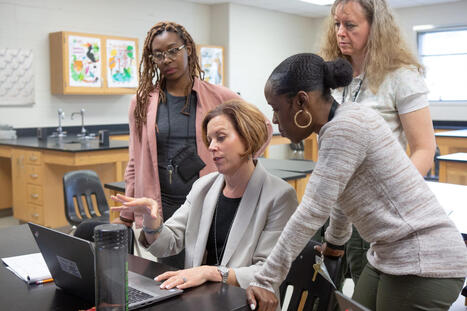
One of the first randomized controlled trials of AI in teaching found that it can undermine learning. Students felt less motivated to learn.
Karen E. K. Hamiton's insight:
I take the concerns in this article seriously, especially the drop in motivation and the achievement losses among students whose classes had lower prior scores. Overall achievement, though, did not decline.
I’m less convinced by the suggestion that teachers relied on unedited AI materials, since the researchers did not observe lessons or evaluate those materials. Teachers in the comparison group could also use other AI tools, so the study cannot neatly separate teaching with AI from teaching without it. To me, these findings support more careful classroom testing and teacher support, while leaving open the question of which uses of AI actually improve learning.
Scoop.it!

From
twit
Jacob Ward from The Rip Current joins the show this week! Looking into the fallout from an OpenAI model breaching Hugging Face.Winamp returns with a Deezer-powered streaming...
Karen E. K. Hamiton's insight:
This Tech News Weekly episode covers Apple’s device-leasing program, AI security concerns, and publicly published Claude chats appearing in Google searches. The leasing discussion offers a practical math activity: students could compare monthly payments, total costs, and whether they would own the device afterward. The privacy segment provides another teaching opportunity—examining how information shared publicly can reach unintended audiences. Together, these topics connect mathematical reasoning and digital literacy to everyday decisions.
Scoop.it!
/PRNewswire/ -- MIND Education, the leader in neuroscience-driven mathematics instruction, today announced that its Pre-K–8 supplemental program, ST Math, has...
Karen E. K. Hamiton's insight:
ST Math’s 2026 Math Learning Solution of the Year award was well deserved. Its visual puzzles give students room to test an idea, see what happens, and adjust their thinking. I also appreciate the reduced reliance on text, which is fantastic for English language learners. Connecting those visual experiences to mathematical symbols afterward makes sense to me because students have an idea to build on when the notation appears.
Scoop.it!
From
blog
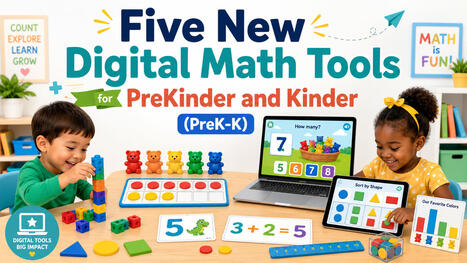
Explore five new digital, multi-lingual math tools for PreKindergarten and Kindergarten students that you can use right away.
Karen E. K. Hamiton's insight:
Count the Critters and Snack Shop Stories stand out in TCEA’s collection for making early number ideas visible. Children match numerals to groups of animals or move food items to model addition and subtraction. The article recommends pairing these activities with real objects and conversation. Recreating a digital snack story with counters could help teachers see whether children understand how quantities change and can explain that thinking to a partner.
Scoop.it!

Elementary school students who learn to calculate using a mental abacus tend to perform better on math tests than their peers. A new study suggests this advantage is partly explained by enhanced numerical processing, attention, and memory.
Karen E. K. Hamiton's insight:
A study of elementary students in China linked abacus training with stronger arithmetic performance. Students practiced with beads before learning to visualize an abacus for mental calculations. Memory and attention advantages were clearest among fourth- and fifth-graders. However, researchers compared existing classrooms without measuring students’ skills before training began, so the study cannot establish that abacus practice caused these differences.
Scoop.it!

Discover the best laptops for math students with our 2026 guide. We tested 12 models for MATLAB, Mathematica, LaTeX, and Python performance.
Karen E. K. Hamiton's insight:
Considerations include different applications, such as LaTeX (a math typesetting language), MATLAB and Mathematica (advanced math systems), and coding tools like Python. Many options suit STEM majors. Everyday details like a readable screen, decent battery life, and something comfortable to carry between classes are important and can be easy to overlook.
Scoop.it!

Looking for an edge in the job market? College students are adding this popular major and minor to their course loads as a way to stand out.
Karen E. K. Hamiton's insight:
Colleges are expanding AI courses beyond computer science to fields such as psychology, business, and music, according to Entrepreneur.
UT Austin and Northwestern are making AI classes more accessible to other majors. Eastern Mennonite University is planning a course combining music and computer science. While one student describes AI skills as a career advantage, the article offers no hiring data to support that claim.
Scoop.it!

From
www
From AI majors to traditional STEM degrees, here's what you should study if you want to work in artificial intelligence and set yourself up for a future-proof career.
Karen E. K. Hamiton's insight:
Forbes highlights computer science, mathematics, statistics, and engineering as routes into AI careers. Choosing a degree depends on a student’s interests and intended work. Mathematics provides a theoretical foundation, though students may need programming experience to apply that knowledge.
Scoop.it!
The Verge’s Robert Hart on why new AI discoveries have left the math world ‘shell-shocked.’...
Karen E. K. Hamiton's insight:
The Verge’s discussion describes impressive AI advances in mathematics, including an example of an undergraduate producing graduate-level work with AI assistance. Researchers also raise questions about human guidance, verification, and the future of mathematical discovery. For teaching, this suggests potential for students to explore more demanding ideas, provided they can question and explain the results. Getting an answer faster has value, but the educational benefit depends on what students understand and what they ask next.
Scoop.it!

A mathematician working at Anthropic says he used the AI model Claude Fable 5 to uncover a remarkably simple counterexample to the Jacobian conjecture, a famous problem that has resisted mathematicians for more than a century.
Karen E. K. Hamiton's insight:
ScienceDaily reports that mathematician Levent Alpöge used Claude to find a simple counterexample disproving the Jacobian conjecture in three or more dimensions. For students, this illustrates a powerful mathematical idea: one valid counterexample can overturn a general claim. AI could help students explore possible exceptions, with the learning coming from checking each example and explaining why it works.
|







This is a great approach. We simply don't know enough about AI to make a decision one way or the other. Calling this a ban, as many news agencies have, is inaccurate.
New York City announced a one-year pause on student use of generative AI through eighth grade for 2026–27, according to The Verge. Mayor Mamdani questions whether AI is necessary in early education, emphasizing human relationships and opportunities for children to solve problems independently. High school students will receive AI literacy lessons and limited supervised access, while companion chatbots are banned across grades. Teachers can still use AI for lesson planning, and exceptions allow certain uses for accessibility, multilingual learners, and specialized programs.