Your new post is loading...

|
Scooped by
SINTERMAT
November 16, 11:38 AM
|
The relationship between fine microstructures and mechanical properties of dense nickel prepared by Spark Plasma Sintering is investigated. Large-sized samples with a diameter of 85 mm and a height of 10 mm were sintered using different mechanically activated powders. Two types of tools (WC-Co and graphite) were used to study the both influence of the sintering temperature and the pressure on the mechanical properties of sintered materials.
|
|
Scooped by
SINTERMAT
November 15, 7:37 AM
|
This study utilized direct current fast hot-pressed sintering (FHPS) technique to compare two precursor systems: Mo/Al/B (M1) and MoB/Al (M2). The effects of sintering temperature (1050 °C–1250 °C) on phase composition, microstructure and densification were investigated. The M2 system produced nearly single-phase MoAlB at 1150 °C within 10 min, while the M1 system, in contrast, involved a more complex multi-step reaction pathway with intermediate phases such as Al8Mo3 and MoB, requiring a higher temperature of 1200 °C to achieve similar phase purity.
|
|
Scooped by
SINTERMAT
November 15, 6:39 AM
|
The feasibility of using ultrafast high-temperature sintering (UHS) as a pressureless sintering technique to fabricate dense B4C–SiC composites from B4C with Si aids was explored for the first time. For this purpose, powder mixtures of B4C containing 20–25 vol% Si were prepared, compacted by uniaxial or uniaxial+isostatic pressing, and subjected to UHS at temperatures between 1400 °C and 2000 °C with nominal dwell times of 1.5, 5, or 8 min, and the resulting materials were microstructurally characterised in detail.
|
|
Scooped by
SINTERMAT
November 15, 6:36 AM
|
The strong covalent bonding of SiC makes its densification difficult, typically requiring high sintering temperatures. Reaction sintering provides an effective approach to lowering the fabrication temperature of SiC ceramics. In this study, an Si–B4C reactive sintering strategy was developed for the low-temperature densification of SiC ceramics by spark plasma sintering.
|
|
Scooped by
SINTERMAT
November 15, 5:11 AM
|
Crise de l'aluminium de 2018, restrictions chinoises sur les terres rares, pénurie de magnésium : les risques d'approvisionnement en matières premières sont durables. Pour y répondre, l'État lance l'appel à projets « Métaux critiques 3 » dans le cadre du plan France 2030.
|
|
Scooped by
SINTERMAT
November 15, 5:08 AM
|
Formnext 2026, taking place in Frankfurt, Germany, November 17–20, will showcase the latest solutions across the Additive Manufacturing process chain, alongside an extensive supporting programme of expert presentations, panel discussions, showcases, awards and networking.
|
|
Scooped by
SINTERMAT
November 15, 5:05 AM
|
Le consortium du projet européen M2DESCO développe de revêtements multi composants écologiques non toxiques et durables, sans terres rares et avec une utilisation minimale de métaux critiques pour répondre aux enjeux économiques, environnementaux et géopolitiques. Un ambitieux programme.
|
|
Scooped by
SINTERMAT
November 15, 5:03 AM
|
Abrasive waterjet cutting (AWJC) is widely used for processing Kevlar-reinforced polymer composites; however, surface quality is typically assessed using amplitude-based roughness parameters like Ra and Rz, which offer limited insight into the overall morphology of the machined surface. This study investigates four complementary roughness descriptors—profile peak height, distribution, spacing, and slope—to characterize kerf wall morphology.
|
|
Scooped by
SINTERMAT
November 15, 5:01 AM
|
Traditionally, ultrafine powders are sought after for their enhanced sintering activity; however, their inadequate formability is frequently neglected. To disentangle these two critical factors, this study conducts a systematic investigation into the sintering behavior of YBCO superconducting targets utilizing powders with markedly different primary particle sizes (640 nm vs. 50 nm) and specific surface areas (1.41 m²/g vs. 11.84 m²/g).
|
|
Scooped by
SINTERMAT
November 15, 4:59 AM
|
Electron-beam physical vapor deposition (EB-PVD) thermal barrier coatings protect aero-engine hot-section components while accommodating cyclic strain through their separated columnar architecture. However, the connected gaps and feather-like substructures also provide pathways for molten calcia–magnesia–alumino–silicate (CMAS) deposits derived from ingested environmental particles. Infiltration couples coating dissolution and phase evolution to reduced optical scattering, increased stiffness, and interfacial damage, undermining thermal insulation and cyclic durability.
|
|
Scooped by
SINTERMAT
November 15, 4:55 AM
|
Infineon Technologies AG a transformé avec succès des plaquettes de carbure de silicium de 300 millimètres en dispositifs de puissance fonctionnels dans son usine de Villach, en Autriche.
|
|
Scooped by
SINTERMAT
November 15, 4:54 AM
|
Uncoated brazed wheels are as-such susceptible to bond-erosion and bond level grit-breakage due to brazing-induced tensile residual stress. While literatures are suggestive of stand-alone cationic peening for mitigating such stress, current study finds that TiAlN and TiAlSiN hard coatings when deposited by HiPIMS process, the residual stress not only gets mitigated during deposition process, but the coatings also make the soft bonding-matrix highly wear-resistant.
|
|
Scooped by
SINTERMAT
November 15, 4:52 AM
|
In this study, (TaTiNbWV)C5 high-entropy carbide was synthesized via a carbothermal reduction method, and Ti(C,N)-based cermets with varying carbide contents were fabricated via vacuum pressureless sintering. The effects of carbide content on phase composition, microstructure, mechanical properties, and room-temperature/high-temperature tribological behavior were systematically investigated. The results show that (TaTiNbWV)C5 can be obtained at 1500 °C, and the addition of high-entropy carbide promotes the formation of a complete black-core/white-inner-rim/gray-outer-rim structure, significantly refines the grain size, and reduces lattice mismatch at the core–rim interface.
|
|
|
Scooped by
SINTERMAT
November 16, 11:37 AM
|
Roland Lescure, ministre de l’Économie, des Finances et de la Souveraineté industrielle, énergétique et numérique, Sébastien Martin, ministre délégué chargé de l’Industrie, Anne Le Hénanff, ministre déléguée chargée de l’Intelligence artificielle et du Numérique, et Bruno Bonnell, secrétaire général pour l’investissement, en charge de France 2030, annoncent 13 nouveaux lauréats des dixième et onzième relèves de l’appel à projets « Première Usine ». Ces projets permettront l’ouverture de treize nouveaux sites industriels sur le territoire national.
|
|
Scooped by
SINTERMAT
November 15, 7:36 AM
|
MAB phases comprise a diverse family of layered ternary and quaternary transition metal borides and related 211-type MAX borides. Conventional MAB phases contain transition-metal–boron structural units separated by A-containing layers; in many Al-containing members, strong M–B and, where present, B–B interactions coexist with relatively weak A-related interactions, producing anisotropic mechanical and transport behavior. Selected MAB phases combine high hardness, damage tolerance, electrical and thermal conductivity, oxidation resistance, crack-healing capability, or radiation tolerance, although these properties depend on composition, structure, phase purity, and processing history.
|
|
Scooped by
SINTERMAT
November 15, 6:38 AM
|
Carrier concentration is a key parameter governing thermoelectric transport in Bi2Te3-based materials, but identifying processing-induced carrier modulation remains challenging because of concurrent microstructural evolution. Oxide-reduction-derived n-type Bi2Te2.5Se0.5 powders with suppressed platelet anisotropy reduced texture-related interference, enabling clearer evaluation of carrier modulation during spark plasma sintering.
|
|
Scooped by
SINTERMAT
November 15, 6:33 AM
|
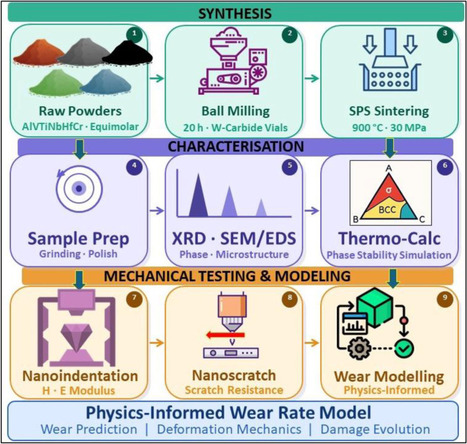
Understanding the relationship among microstructure, deformation, and damage evolution is essential for evaluating the scratch response of high-entropy alloys (HEAs). In this study, a TiVAlNbHfCr HEA fabricated by spark plasma sintering (SPS) was investigated to elucidate the influence of microstructure on nanoscale deformation and scratch-induced damage. CALPHAD (Thermo-Calc, TCHEA2) calculations predicted BCC_2 and HCP_A3 as equilibrium phases, with an Al3Zr4-labelled (Zr4Al3-type) intermetallic at lower temperature, whereas XRD of the SPS-consolidated alloy indicated a BCC matrix with NbAl3 and Ti3Al-type secondary phases; the calculation is therefore used as a qualitative guide to phase stability rather than as a prediction of the as-sintered constitution.
|
|
Scooped by
SINTERMAT
November 15, 5:11 AM
|
Le Centre de Transfert de Technologies Céramiques (CTTC) de Limoges confirme sa montée en puissance à l’échelle européenne. Créé en 1984 et labellisé Centre de Ressources Technologiques, le CTTC est aujourd’hui la principale structure française de soutien à l’innovation dans le domaine des céramiques techniques. Véritable interface entre recherche et industrie, il accompagne les entreprises dans le développement de matériaux et procédés innovants, du prototypage à l’industrialisation.
|
|
Scooped by
SINTERMAT
November 15, 5:07 AM
|
Quels sont les nouveautés et lancements prévus au salon Formnext 2026 ? Que faut-il aller voir ? On vous dit tout !
|
|
Scooped by
SINTERMAT
November 15, 5:04 AM
|
This study evaluates the applicability of laser cutting to 10 mm thick 5083-H111 aluminum alloy plates by comparing fiber laser cutting, waterjet cutting, and mechanical grinding. The cut-edge morphology, microstructure, tensile properties, and fatigue behavior were systematically investigated, with particular emphasis on the effects of laser-induced thermal input on the heat-affected zone (HAZ), grain orientation, precipitates, and residual stress.
|
|
Scooped by
SINTERMAT
November 15, 5:02 AM
|
Aluminium oxynitride (Al-O-N) thin films are of considerable scientific and technological interest due to their excellent optical, electronic, chemical, and mechanical properties. Despite the strong compositional dependence of its properties, comprehensive characterization of the entire Al-O-N compositional range remains lacking.
|
|
Scooped by
SINTERMAT
November 15, 5:00 AM
|
Electric propulsion spacecraft increasingly require alternative propellants such as krypton and argon due to xenon’s high cost, yet sputter yield data for these propellants remain limited for many spacecraft-relevant materials. This data scarcity makes empirical parameter fitting difficult, particularly near the low-energy threshold region that is important for plume-surface interaction modeling. We develop an LSS-informed Bayesian Markov Chain Monte Carlo framework for calibrating Eckstein sputter-yield parameters for krypton and argon systems.
|
|
Scooped by
SINTERMAT
November 15, 4:56 AM
|
Disposant de peu de ressources propres, les carburiers européens doivent s’approvisionner en Chine, ou recycler. Les appros en outils coupants subissent directement ces difficultés structurelles.
|
|
Scooped by
SINTERMAT
November 15, 4:54 AM
|
Onsemi a présenté EliteSiC M4, sa plateforme en carbure de silicium de quatrième génération fondée sur une architecture à tranchées, qui offre jusqu’à 30 % de densité de puissance supplémentaire et 35 % de pertes en moins par rapport à la génération précédente. EliteSiC M4 permet de concevoir des systèmes plus efficaces et plus denses en puissance pour les centres de données dédiés à l’intelligence artificielle (IA), les véhicules électriques (VE) et les infrastructures énergétiques.
|
|
Scooped by
SINTERMAT
November 15, 4:53 AM
|
Graphene-reinforced magnesium matrix composites are attractive lightweight structural materials, but their broader application is restricted by poor graphene/Mg wettability and insufficient interfacial stability. In this work, AZ31 matrix composites reinforced with electroless copper-modified graphene nanoplatelets (Cu@GNPs) were fabricated through a powder-metallurgy route combining surface metallization, powder mixing, hot compaction, and extrusion.
|