Your new post is loading...

|
Scooped by
HAS-veille
May 11, 2023 3:57 AM
|
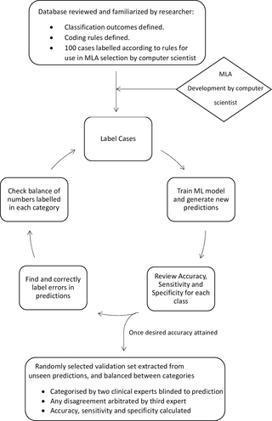
Classifying free-text from historical databases into research-compatible formats is a barrier for clinicians undertaking audit and research projects. The aim of this study was to (a) develop interactive active machine-learning model training methodology using readily available software that was (b) easily adaptable to a wide range of natural language databases and allowed customised researcher-defined categories, and then (c) evaluate the accuracy and speed of this model for classifying free text from two unique and unrelated clinical notes into coded data. A user interface for medical experts to train and evaluate the algorithm was created. Data requiring coding in the form of two independent databases of free-text clinical notes, each of unique natural language structure. Medical experts defined categories relevant to research projects and performed ‘label-train-evaluate’ loops on the training data set. A separate dataset was used for validation, with the medical experts blinded to the label given by the algorithm. The first dataset was 32,034 death certificate records from Northern Territory Births Deaths and Marriages, which were coded into 3 categories: haemorrhagic stroke, ischaemic stroke or no stroke. The second dataset was 12,039 recorded episodes of aeromedical retrieval from two prehospital and retrieval services in Northern Territory, Australia, which were coded into 5 categories: medical, surgical, trauma, obstetric or psychiatric. For the first dataset, macro-accuracy of the algorithm was 94.7%. For the second dataset, macro-accuracy was 92.4%. The time taken to develop and train the algorithm was 124 minutes for the death certificate coding, and 144 minutes for the aeromedical retrieval coding. This machine-learning training method was able to classify free-text clinical notes quickly and accurately from two different health datasets into categories of relevance to clinicians undertaking health service research.
|
|
Scooped by
HAS-veille
March 2, 2020 7:00 AM
|
In recent years, machine learning approaches have been successfully applied to analysis of patient symptom data in the context of disease diagnosis, at lea
|
|
Scooped by
HAS-veille
August 22, 2019 3:35 AM
|
Advances in machine learning and artificial intelligence (AI) offer the potential
to provide personalised care that is equal to or better than the performance of humans
for several health-care tasks.1 AI models are often powered by clinical data that
are generated and managed via the medical system, for which the primary purpose of
data collection is to support care, rather than facilitate subsequent analysis. Thus,
the direct application of AI approaches to health care is associated with both challenges
and opportunities.
|
|
Scooped by
HAS-veille
July 3, 2019 10:50 AM
|
Machine learning is increasingly used to predict healthcare outcomes, including cost, utilization, and quality.We provide a high-level overview of mac…
|
|
Scooped by
HAS-veille
May 15, 2019 3:18 AM
|
Catch the Latest AI For Healthcare Research
|
|
Scooped by
HAS-veille
May 6, 2019 11:42 AM
|
Analysis of big data by machine learning offers considerable advantages for assimilation
and evaluation of large amounts of complex health-care data. However, to effectively
use machine learning tools in health care, several limitations must be addressed and
key issues considered, such as its clinical implementation and ethics in health-care
delivery. Advantages of machine learning include flexibility and scalability compared
with traditional biostatistical methods, which makes it deployable for many tasks,
such as risk stratification, diagnosis and classification, and survival predictions.
|
|
Scooped by
HAS-veille
April 25, 2019 10:48 AM
|
|
|
Scooped by
HAS-veille
April 4, 2019 2:45 AM
|
Review Article from The New England Journal of Medicine — Machine Learning in Medicine
|
|
Scooped by
HAS-veille
March 28, 2019 12:32 PM
|
This study assesses the feasibility of using machine learning to automatically populate a review of systems of all symptoms discussed in an encounter between a patient and a clinician.
|
|
Scooped by
HAS-veille
March 25, 2019 11:15 AM
|
Heart failure is one of the leading causes of hospitalization in the United States. Advances in big data solutions allow for storage, management, and mining of large volumes of structured and semi-structured data, such as complex healthcare data. Applying these advances to complex healthcare data has led to the development of risk prediction models to help identify patients who would benefit most from disease management programs in an effort to reduce readmissions and healthcare cost, but the results of these efforts have been varied. The primary aim of this study was to develop a 30-day readmission risk prediction model for heart failure patients discharged from a hospital admission. We used longitudinal electronic medical record data of heart failure patients admitted within a large healthcare system. Feature vectors included structured demographic, utilization, and clinical data, as well as selected extracts of un-structured data from clinician-authored notes. The risk prediction model was developed using deep unified networks (DUNs), a new mesh-like network structure of deep learning designed to avoid over-fitting. The model was validated with 10-fold cross-validation and results compared to models based on logistic regression, gradient boosting, and maxout networks. Overall model performance was assessed using concordance statistic. We also selected a discrimination threshold based on maximum projected cost saving to the Partners Healthcare system. Data from 11,510 patients with 27,334 admissions and 6369 30-day readmissions were used to train the model. After data processing, the final model included 3512 variables. The DUNs model had the best performance after 10-fold cross-validation. AUCs for prediction models were 0.664 ± 0.015, 0.650 ± 0.011, 0.695 ± 0.016 and 0.705 ± 0.015 for logistic regression, gradient boosting, maxout networks, and DUNs respectively. The DUNs model had an accuracy of 76.4% at the classification threshold that corresponded with maximum cost saving to the hospital. Deep learning techniques performed better than other traditional techniques in developing this EMR-based prediction model for 30-day readmissions in heart failure patients. Such models can be used to identify heart failure patients with impending hospitalization, enabling care teams to target interventions at their most high-risk patients and improving overall clinical outcomes.
|
|
Scooped by
HAS-veille
March 11, 2019 9:10 AM
|
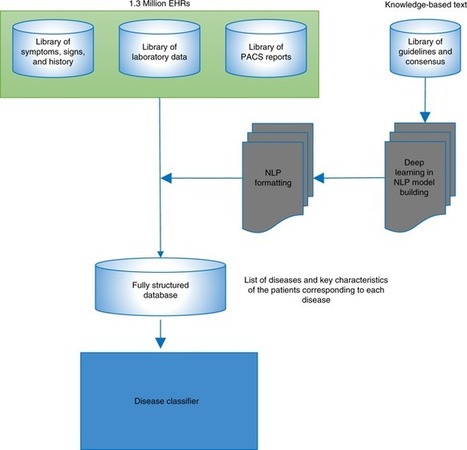
The past decade has seen an explosion in the amount of digital information stored in electronic health records (EHRs). While primarily designed for archivi
|
|
Scooped by
HAS-veille
February 20, 2019 8:41 AM
|
|
|
Scooped by
HAS-veille
February 12, 2019 3:23 AM
|
A natural language processing system can support physicians in diagnostic assessments by extracting clinical information from electronic medical records to accurately predict diagnosis in pediatric patients.
|
|
|
Scooped by
HAS-veille
September 9, 2020 5:33 AM
|
Hospital readmission is a main cost driver for healthcare systems, but existing works often had poor or moderate predictive results. Although the avai…
|
|
Scooped by
HAS-veille
February 12, 2020 11:26 AM
|
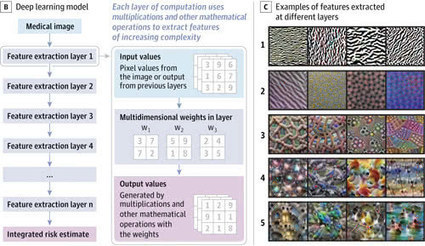
Explore clinical applications of machine learning in the JAMA Network, including research and opinion about the use of deep learning and neural networks for clinical image analysis, natural language processing, EHR data mining, and more.
|
|
Scooped by
HAS-veille
July 17, 2019 6:07 AM
|
|
|
Scooped by
HAS-veille
June 25, 2019 7:42 AM
|
Introduction This work describes the Medication and Adverse Drug Events from Electronic Health Records (MADE 1.0) corpus and provides an overview of the MADE 1.0 2018 challenge fo
|
|
Scooped by
HAS-veille
May 7, 2019 11:19 AM
|
There is a growing interest in using natural language processing (NLP) for healthcare-associated infections (HAIs) monitoring. A French project consor…
|
|
Scooped by
HAS-veille
April 29, 2019 7:33 AM
|
Leveraging a single-site surgical EHR data pipeline and repository, Kristin Corey and colleagues present a machine learning-based detection of high-risk surgical patients at their institution.
|
|
Scooped by
HAS-veille
April 16, 2019 11:47 AM
|
|
|
Scooped by
HAS-veille
April 3, 2019 8:41 AM
|
With its origins in the mid- to late-1900s, today, artificial intelligence (AI) is used in a wide range of medical fields for varying purposes. This r…
|
|
Scooped by
HAS-veille
March 25, 2019 11:16 AM
|
We examined the comparative performance of structured, diagnostic codes vs. natural language processing (NLP) of unstructured text for screening suicidal behavior among pregnant women in electronic medical records (EMRs). Women aged 10–64 years with at least one diagnostic code related to pregnancy or delivery (N = 275,843) from Partners HealthCare were included as our “datamart.” Diagnostic codes related to suicidal behavior were applied to the datamart to screen women for suicidal behavior. Among women without any diagnostic codes related to suicidal behavior (n = 273,410), 5880 women were randomly sampled, of whom 1120 had at least one mention of terms related to suicidal behavior in clinical notes. NLP was then used to process clinical notes for the 1120 women. Chart reviews were performed for subsamples of women. Using diagnostic codes, 196 pregnant women were screened positive for suicidal behavior, among whom 149 (76%) had confirmed suicidal behavior by chart review. Using NLP among those without diagnostic codes, 486 pregnant women were screened positive for suicidal behavior, among whom 146 (30%) had confirmed suicidal behavior by chart review. The use of NLP substantially improves the sensitivity of screening suicidal behavior in EMRs. However, the prevalence of confirmed suicidal behavior was lower among women who did not have diagnostic codes for suicidal behavior but screened positive by NLP. NLP should be used together with diagnostic codes for future EMR-based phenotyping studies for suicidal behavior.
|
|
Scooped by
HAS-veille
March 12, 2019 3:31 AM
|
This prognostic study compares standard readmission risk assessment scores with a machine learning score, the Baltimore score, for predicting 30-day unplanned hospital readmissions calculated in real time.
|
|
Scooped by
HAS-veille
March 8, 2019 7:15 AM
|
Combinations of healthcare claims data with additional datasets provide large and rich sources of information. The dimensionality and complexity of these combined datasets can be challengin
|
|
Scooped by
HAS-veille
February 20, 2019 8:36 AM
|
|