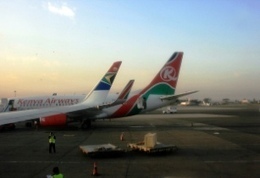
The government has said it is investing in a "first class" transport and logistics network to help it reduce the country's cost of doing business and improve competitiveness.
In the next financial year starting July, the government is targeting to raise Sh22.9 billion through the railway development levy that was introduced in the 2013/2014 budget read out last June.The money will be used to bolster the ongoing construction of the standard gauge railway.
Other than JKIA which is considered key to East Africa's transport system and connectivity as well as tourism; the government has allocated Sh1.65 billion to fund ongoing upgrade of Kisumu and Isiolo airports...Part of the money will also be used to build three new airports in Mandera, Malindi and Suneka in Kisii county....
Africa recently turned its eyes onto Kigali to follow deliberations of the African Development Bank meetings that were mainly centered on economic transformation and development of the continent as a whole using the available resources.
The summit also served as a precursor of what is expected from the regional business fraternity and policy makers at the East African business summit slated for June 4-6 in Kigali...
...The region still faces many challenges across its economic landscape even when efforts to secure common grounds to foster trade through an economic integration (custom union) have in the recent past come to reality.
Under the theme; "Positioning East Africa for Inclusive Prosperity in 2020 and beyond", the business summit shall definitely track and fuse development plans alongside regional economic visions.
It is therefore noteworthy that we all give attention to key strategic areas and grab opportunities therein...
African economies generally have the highest trade logistics costs in the world and the EAC is not an exception to this trend. In a recent study, estimates for Kenya, Tanzania and Uganda placed the average cost of trade logistics services at the equivalent of a tax of between 25 and 40% on value added.
The key factor for the ability of a country to participate in supply chains is the efficiency of local trade facilitation and logistics services. Improving logistics performance and facilitating trade have been estimated to have positive effects in expanding country trade, increasing trade impacts of lowering remaining border barriers by a factor of two or more. For landlocked countries to increase exports, infrastructure to facilitate rapid entry is required. However, landlocked countries are challenged by a lack of sites for production, low level of skills and high costs of power.
In light of this, Uganda Shippers Council, supported by TradeMark East Africa, is implementing a project to enhance competitiveness in the supply chain for importers and exporters (cargo owners) in Uganda...
As a landlocked country, regional trade is an essential ingredient of Rwanda’s future economic success. Recognizing this, officials from the United States Agency for International Development (USAID) and TradeMark East Africa (TMEA) signed a $ 5.7 million Cooperative Agreement affirming their partnership under President Obama’s Trade Africa Initiative under the USAID Trade Infrastructure Program – which will work to improve the efficiency of regional trade in Rwanda......The program is a three-year, $ 5.7 million activity that will seek to reduce the time it takes for goods to cross and clear Rwandan borders, reduce technical barriers to trade, and enhance Rwanda’s ability to export and import goods through increased regional integration.The partnership will also support East African Community (EAC) regional trade integration. Through Trade Africa, TMEA will broaden its regional integration program at the Ports of Mombasa and Dar-es- Salaam and key border posts along the Northern and Central Corridors, and will work with EAC Member States to remove barriers to trade....
Tanzanian President Jakaya Kikwete has called on partner states to promote the participation of the private sector in investing in infrastructure projects in the Central Development Corridor...
...The Central Corridor is located at the strategic geographical position, which makes it a natural choice as a major trade route for countries of the Eastern and Central African regions...
...Transport in the central corridor suffers from inefficiency, which contributes to prohibitively high transport costs, hence impeding the region's ambition to realise its overall vision for socio-economic development.
Tanzania has also carried out projects to upgrade operations at the Dar es Salaam port, which include dredging of the entrance channel to the port, construction of Berths 13 and 14 and strengthening and deepening of Berths 1-7 and development of the Roll on - Roll off (RO-RO) Berth at the port...
...Tanzania is expected to become one of the fastest-growing economies in the world with the key drivers being the recent natural gas discoveries, regional integration supported by an extension of transport infrastructure networks, reforms to ease of doing business in the country and long-term stable democracy.
According to the report which focused on ten selected economies in Africa, infrastructure performs fairly well compared to its African peers, but the quality is still too poor and has a negative impact on the economy's productive capacity.
Tanzania is already one of sub- Saharan Africa's most rapidly growing economies. It has registered a strong economic growth for over a decade with levels of growth reaching 7 per cent last year and projected to reach 7.3 per cent this year.
Recent discoveries of natural gas offshore and a broad number of planned infrastructure projects are expected to further boost to the economy.
...The construction of the port will also involve building infrastructure for a special economic zone and railway network. The new port will be able to handle 20 times more cargo than the Dar es Salaam port and is expected to relieve pressure of the Dar port once it begins operating in 2017...
One-Stop-Border Post (OSBP) means placing border officials of two adjoining countries at each other’s adjoining border post so that each border post controls only the traffic entering the country and not the exiting one.
Tanzania and Kenya have OSBP system at Holili –Taveta. Of late the post has produced desired results by reducing 30 per cent.
The Holili border currently serves between 40 and 50 trucks a day but the volume of traffic is likely to significantly increase up to between 400 and 450 trucks once the Voi -Taveta part of the road is upgraded. This is according to Trade Mark East Africa (TMEA) that funded the project The increase in traffic is likely because the distance by road from Mombasa to Himo junction in Tanzania is much shorter (by about 472 kilometres) compared to the much longer distance from Dar es Salaam to Himo junction (935 kilometres)...
The introduced system will take place at the border post of Taveta in Kenya and Holili border post in Tanzania, of which the Kenya Revenue Authority (KRA) and Tanzania Revenue authority (TRA) are the leading agencies in implementing the project....
The Global Service Centre is the operational arm of the United Nations Department of Field Support and, as such, it is the key enabler of the Global Field Support Strategy. From its two sites, Brindisi (Italy) and Valencia (Spain), it delivers expertise to field missions in the areas of logistics, information and communications technology and geospatial services, training and administrative support to peacekeeping missions.
The Logistics Service, based in Brindisi, provides global support throughout the entire lifespan of a field mission: from start-up, to sustainment, to major reconfiguration, to downsizing and liquidation. Here you can see an overview of the Logistics Service activities.
Hopes of Rwanda striking oil have been alive for some years now. The potential for the existence of the resource in the country is real, especially around the northern and central part of Lake Kivu, along the Rwanda-DRC border.
The Kivu area is a geological extension of Lake Albert region - described as the Albertine graben - where substantial amounts of oil deposits were discovered in 2006 in Uganda.
In anticipation of discovery, an oil exploration policy is already in place in Rwanda, and the upstream petroleum law is currently being drafted.
The prospects for Rwanda are not misplaced, especially if one compares the success rate for Eastern Africa against other regions on the continent.
While some 15,000 wells have been drilled in West Africa in the last two decades, only 500 or so have been drilled in East Africa with oil discoveries in Uganda and Kenya, as well as gas off the shores of Tanzania.
And earlier this month, more off-shore oil and gas deposits were discovered in Lamu at the Kenyan Coast. This is in addition to the oil deposits first discovered in Turkana in the country's northern region since 2010.
Massive gas finds in Tanzania's waters, along the East African coast, make the region one of the world's most active oil and gas exploration areas....
...Preliminary magnetic and gravity exploration and Synthetic Aperture Radar study on Lake Kivu has indicated possible occurrence of long chain hydrocarbons, which suggests there could be oil deposits in the vicinity.
Tanzania has made a big leap in logistics performance from the 138th position seven years ago to 88th today, according to the World Bank’s Global Logistics At least Performance Index.
At least 155 countries were ranked by the bank, according to a report released this month by Price Water House Coopers (PwC). The report shows that Tanzania is doing better in developing the transport infrastructure compared to most African countries, despite the quality still remaining poor and negatively impacting on the economy’s productive capacity. Titled: “Africa Gearing up: Future Prospects in Africa for the Transportation and Logistics Industry,” the report states that infrastructure in the East African nation has witnessed impressive investment in recent years. It says there is more to come as transport infrastructure projects worth USD19bn (roughly 3.04trn/-) are in pipeline. The report which gives an in-depth analysis of 10 economies’ transport and logistics indicators in Tanzania and Kenya in East Africa mainly to give investors and other interested stakeholders an insight into the key economic regions in the continent. The analysed indicators include agriculture, retail trade, manufacturing, transport, logistics performance, ports, aviation, railways and roads...
The World Bank has approved Sh17.7 billion additional financing for the emergency reconstruction of Jomo Kenyatta International Airport, which suffered a major fire disaster in August last year.
The new funding will not only support urgent repairs but also the ongoing expansion works at the airport.
The massive inferno destroyed the international arrivals terminal and caused major flight disruptions at Kenya's largest airport, which is also East Africa's busiest air transport and tourism hub.
Although domestic and international flight operations were quickly restored, some passenger services are being handled from temporary terminals.
Under the new funding, a new temporary international passenger arrivals terminal will be installed and terminal 4, which is under construction with the bank's funding, will be expanded to include permanent facilities for an international arrivals lounge...
The funds will be channeled through the Kenya Transport Sector Support Project (KTSSP) which will increase the total bank financing for KTSSP so far to Sh43.7 billion...
Meanwhile under KTSSP, the government plans to upgrade major sections of the Northern Corridor, which runs from Mombasa through Nairobi to the Kenya-Uganda border, and the Western Corridor, which extends from Kenya's border with Northern Tanzania through Kisumu, Eldoret and Kitale to the South Sudan border...
...The emergency and original project activities under KTSSP are being funded by the government and the Bank in partnership with other development partners, including the African Development Bank, the French Development Agency, the United States, the United Kingdom and the European Investment Ban
Improving road and rail systems in Africa will boost the transportation of goods and raw materials, facilitate transactions and negotiations, especially when face-to-face meetings are required, boost tourism and positively impact ordinary lives in diverse ways such as ensuring that people get to the hospital quickly during emergencies, for example. Countless other activities depend on reliable roads and rails.
Most of Africa's railway lines and roads are in bad condition and need huge investments, according to the African Development Bank (AfDB).
The proportion of paved roads on the continent today is five times less than those in developed countries, notes the Bank. As a result, transport costs alone are 63% higher in Africa than in developed countries,
hampering its competitiveness in the international and local markets.
The AfDB further points out that transport costs represent between 30% and 50% of total export value in Africa. These costs are even higher in 16 landlocked countries, including Zimbabwe, South Sudan, Mali, and Niger, and constitute up to three-quarters of their total export value.
Poor roads and railways also have a negative impact on intra-African trade, which is currently just 11% of total trade.
Development experts believe this figure might have been higher with better roads and railway lines. Trade among Southeast Asia's 10 countries, at 37%, is much higher than in Africa, for example...
...With Africa's economy growing at 5% a year on average, African leaders worry that without a good road and rail network, such impressive economic growth may not translate into real socioeconomic development for Africans.
In order to turn the situation around, they established the Programme for Infrastructure Development in Africa (PIDA) in July 2010. An initiative of the AfDB, New Partnership for Africa's Development (NEPAD), and the African Union, PIDA is an ambitious effort to boost African infrastructure, including rails and roads....
...In Kenya, a $25 billion infrastructure development plan, including a road construction that links Kenya to South Sudan and Ethiopia, was recently launched by the governments of the three countries. In addition, the AfDB is financing several roads projects in Central Africa...
...In a communiqué issued after bilateral talks in Addis Ababa, the two leaders [President Kenyatta and Prime Minister Desalegn] noted that the rapport between Kenya and Ethiopia had contributed to the progress achieved in the execution of the region’s largest infrastructure project – the Lamu Port and Southern Sudan-Ethiopia Transport (LAPSSET) Corridor...
...[They] also committed to work closely under IGAD’s framework, in support of the people of Somalia in their quest for lasting peace and stability in the Horn of Africa nation.
Noting that stability in Somalia was vital for success in the fight against terrorism, the Kenyan leader and his Ethiopian counterpart urged the international community to support peace initiatives in the country.Both leaders reaffirmed their commitment to the security, common values and fundamental interests of the region. Together, they set themselves to combat the region’s difficulties, among them drought, climate change, terrorism, piracy, money laundering, human and drug trafficking. President Kenyatta and Prime Minister Desalegn also supported proposals to inaugurate a Cooperative Framework Agreement that would establish a Joint Lake Turkana, Omo and Daua Rivers Basins Commission to manage their resources to international standards.
Kenya has launched an online cargo clearance system to boost operations at the port of Mombasa and the Jomo Kenyatta International Airport (JKIA). The Electronic Single Window System, also known as Kenya TradeNet System, is expected to make it easier and cheaper for traders to clear their goods in the east African country...The software integrates over 24 government agencies and provides various payments modes, including mobile money and 24 commercial banks.
AYDIN Logistics, a Turkish company based in the country has pledged, as part of the company's long term plan of investment, to invest over 15 million US Dollars in a span of six years or less.
In a statement issued by the company, this investment is aimed at the strategic positioning of Aydin Logistics at the port of Dar es Salaam which serves a number of land-locked countries.
"With over 3 million US Dollars already invested in this market in resources and in heavyduty equipment and transport logistics whereby Aydin Logistics provides machines and trucks on hire to customers, heavy load transportation and warehouse management.
Rwanda 's small trucking industry hasn't had much to shout about recently, unless it was to complain about interminable roadside delays due to bureaucracy, corruption and paperwork.
Until now. Some neat diplomatic footwork with neighbouring Tanzania has given Rwandan truckers some good news in an industry where time is money, costs are high, and margins small and the playing field tilted towards the regional giants and their huge trucking sectors...
East African leaders have launched an electronic single window system to speed up cargo clearance and position Nairobi as a regional gateway.
The system, officially known as Kenya TradeNet provides a single point of access for the Kenyan trading community to electronically submit and receive approvals from regulatory agencies.
President Uhuru Kenyatta who spoke during the launch in Nairobi said the benefits of the single window will be realized when the supporting infrastructure is in place to ensure efficient evacuation and movement of goods once they have been cleared at the ports of entry.
With the country’s annual trade volumes exceeding 22.4 billion U.S. dollars, Kenya TradeNet is a flagship project under Kenya’s Vision 2030 program to position the country as a key trading hub in Africa. .
In line with its prospects of acheiving regional transportation hub status, Tanzanian President, Jakaya Kikwete says his country’s plans to hike its cargo volumes by 40 percent over 2013 levels through the country’s main Dar es Salam port...
...Tanzania like Kenya, who is building a new port at Lamu, North of Mombasa port, which is now East Africa’s main transport link to Uganda, Rwanda and other land-locked states, is capitalizing on a long coastline and upgrading existing rickety railways and roads to serve growing economies in the land-locked heart of Africa from Uganda to Malawi in the south.
...According to President Kikwete, the projects include developing a port at Mtwara south of Dar es Salam that could serve northern Mozambique and Malawi. It also involves upgrading the rail network – which could involve building new wider, standard gauge lines instead of the existing – and slower – narrow gauge.
Last month, a PwC report on the World Bank’s Global Logistics At least Performance Index ranked Tanzania as 88th, signifying the country’s progress in developing its transport infrastructure compared to some other African countries...
Some 192 Ugandan clearing agents received East African Customs and Freight forwarding practicing certificates to signify an improved competence in their jobs.
Speaking at the ceremony, the Federation of East African Freight Forwarders Association (FEAFFA) President Mathieus Bizimana said besides equipping values desirable in customs and freight forwarding operations, their new skills will also reduce the time and cost of cargo transport in East Africa.
There is expected to be a reduction of errors and faster submission of reports, all which will change the sector positively...
President Uhuru Kenyatta has challenged African governments to accelerate reforms that will encourage more private sector investment in infrastructure projects.
Citing Kenya as an example, the President said the country has taken steps through enactment of Public Private Partnership (PPP) legislation, to facilitate the private sector in the development of projects in transport, energy, water and ICT.
He said the establishment of the Africa 50 Fund - an initiative of the African Development Bank that was endorsed by African leaders - to address the inadequacy of resources for infrastructure development in the continent required African countries to undertake requisite reforms geared towards facilitating private sector to invest in infrastructure development and maintenance...
...The East African infrastructure projects include the rehabilitation and expansion of the Northern Corridor connecting the port of Mombasa with Kampala, Kigali, Bujumbura and the Eastern parts of the Democratic Republic of Congo (DRC) and the improvement of the Central Corridor connecting the port of Dar-es-Salaam with Bujumbura, Kigali and the DRC.
Other infrastructure projects are the Lamu Port South Sudan Ethiopia Transport (LAPSSET) project - a transport corridor that will form important transport connectivity between Eastern Africa and Western Africa countries further promoting intra-Africa trade and investment...
The crisis in Syria has - over three years - touched almost every community in the region as more people flee across borders. Meeting the needs of millions of vulnerable people, and coordinating this humanitarian response in the most challenging circumstances, means making sure the right equipment is in the right place, at the right time.
The Global Logistics Service of the International Federation of Red Cross and Red Crescent Societies (IFRC) provides logistics support through it Dubai-based hub, which is part of the International Humanitarian City of Dubai and is supported by the government of the United Arab Emirates. This is the world’s largest and busiest logistics hub for humanitarian aid, and is home to operations for more than 55 non-governmental organizations.
The facilities and strategic location, from which two-thirds of the world’s population can be reached in eight hours, have helped to deliver assistance in some of the worst humanitarian crises of the past decade, including the 2004 tsunami in Southeast Asia, drought in the Horn of Africa, civil unrest in Afghanistan and Darfur, and the 2010 earthquake in Haiti. Organizations working in the city have also been heavily engaged in the emergency responses to Syria and the Philippines.
Given the complexities of conflict and mass migration, supply chains in the region are affected by operational constraints. The Global Logistics Service in Dubai pursues multiple delivery options and calculates risks to ensure flexibility in supply chains, as well as a smooth flow of goods on the ground including food, temporary shelter, household kits, hygiene items, vehicles and other supplies...
The chairperson of the East African Community (EAC) Summit, President Uhuru Kenyatta, has called on partner states to be vigilant about the remaining trade barriers that impede the free movement of goods, services and labour.
The Kenyan head of state said this while giving the state of EAC address to the East African Legislative Assembly (EALA) on Tuesday in Arusha, Tanzania. He said though there were some positive achievements in eliminating regional trade barriers, more continue to exist. "In the previous year, we have significantly reduced police roadblocks along the main EAC transport corridors but other non-tariff barriers still remain," Kenyatta said.
"Vigilance in the removal of the bureaucratic red tape that chokes our trade and movement of goods, services and people must be the watchword," he added. Some of the challenges that truck drivers have always cited include insecurity especially along the central corridor that connects regional countries to Dar Port in Tanzania.
However, the days a truck takes from Mombasa Port in Kenya to Kigali have significantly reduced to about five, down from 22 days previously, after removing some non-tariff barriers. The President maintained that it was important for the region to fully embrace the EAC Customs Union and the Common Market Protocols. He challenged the Assembly to be steadfast in service delivery....
While Africa’s trade with the rest of the world – such as with China and India – has been on the rise in recent years, trade between African countries still lags, especially when compared to other regions in the world.
In an article published last month by Dr Álvaro Sobrinho, a leading business figure in Angola and chairman of emerging bank Banco Valor, intra-Africa trade today is at roughly 12%, around half the share 15 years ago. This compares to Europe where trade between regional borders is estimated at 70%, and Asia at 50%.
It has been argued that one reason behind low intra-regional trade in Africa is poor transport and logistics infrastructure, and the resulting high cost to transport goods. However, according to Edward George, head of soft commodities research at Ecobank, while formal trade flows between African nations might lag, informal intra-regional trade is more advanced than one might expect....
..."It’s a lot easier when you speak the same language … and we need to understand the local language in some of the countries because that is where the trust is built, if you are speaking the same language. If you don’t speak the same language then clearly there is a significant complication involved and you have to rely on interpreters; it’s just not the same"...
“And then, sometimes between the two trading companies, one will have to sort of make more concessions than the other because you can’t have two different applicable laws in the same contract. It has to be one law. These are different issues that keep coming up”...
African countries need to introduce credible industrial policies and promote effective industrial policy organizations to enhance the structural transformation of the continent, says a new report jointly produced by the United Nations Economic Commission for Africa and the African Union Commission.
Transforming Africa's industrial landscape has failed partly because countries used industrial blueprints characterised by lack of dynamism and high level coordination, as well as inadequate consultations with stakeholders, according to this year's Economic Report on Africa...
...The report builds on the previous work of the 2011 edition--on the role of the state in economic transformation--and last year's--on leveraging Africa's comparative advantages in commodities to industrialize.
A new report, Transport for Health, quantifies for the first time the combined impact of road crashes and air pollution from vehicles, and in doing so raises the annual death toll linked to motorized transport to more than 1.5 million worldwide. Together, the number of lives lost to road crashes and pollution from vehicles now exceeds the global totals for HIV/AIDS, tuberculosis, malaria, or diabetes, based on Global Burden of Disease data.
--The annual death toll linked to road transportation is higher than many policy makers realize, reaching at least 1.5 million people worldwide and rising, according to a new analysis.
--The report, Transport for Health, counts the number of lives lost to road crashes and, for the first time, also quantifies deaths related to vehicle pollution.
--It offers practical actions countries can take now to improve transportation, air quality, and road safety data.
To get content containing either thought or leadership enter:
To get content containing both thought and leadership enter:
To get content containing the expression thought leadership enter:
You can enter several keywords and you can refine them whenever you want. Our suggestion engine uses more signals but entering a few keywords here will rapidly give you great content to curate.


 Your new post is loading...