Your new post is loading...

|
Scooped by
Kamoun Lab @ TSL
August 5, 2017 1:04 PM
|
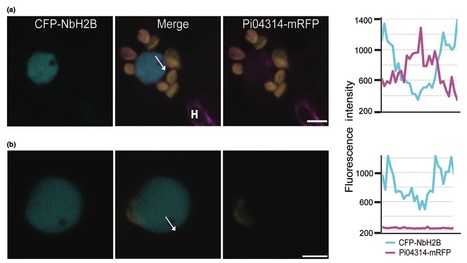
- The potato blight pathogen Phytophthora infestans secretes effector proteins that are delivered inside (cytoplasmic) or can act outside (apoplastic) plant cells to neutralize host immunity. Little is known about how and where effectors are secreted during infection, yet such knowledge is essential to understand and combat crop disease.
- We used transient Agrobacterium tumefaciens-mediated in planta expression, transformation of P. infestans with fluorescent protein fusions and confocal microscopy to investigate delivery of effectors to plant cells during infection.
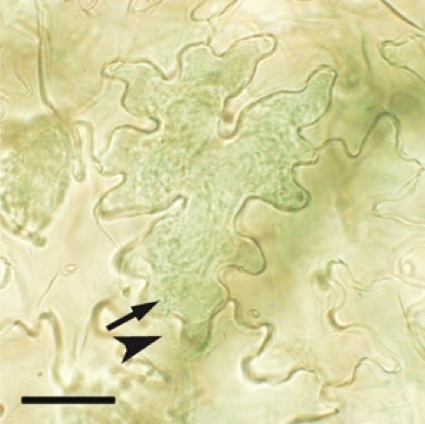
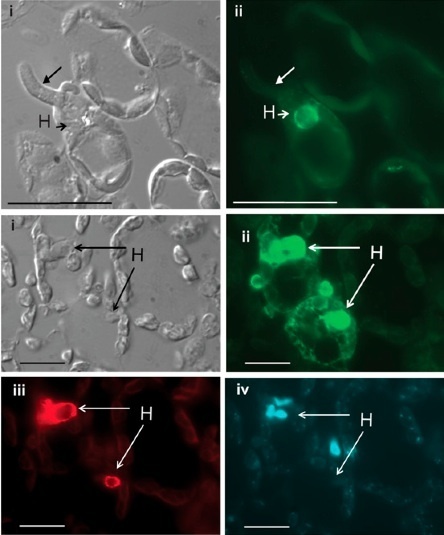
- The cytoplasmic effector Pi04314, expressed as a monomeric red fluorescent protein (mRFP) fusion protein with a signal peptide to secrete it from plant cells, did not passively re-enter the cells upon secretion. However, Pi04314-mRFP expressed in P. infestans was translocated from haustoria, which form intimate interactions with plant cells, to accumulate at its sites of action in the host nucleus. The well-characterized apoplastic effector EPIC1, a cysteine protease inhibitor, was also secreted from haustoria. EPIC1 secretion was inhibited by brefeldin A (BFA), demonstrating that it is delivered by conventional Golgi-mediated secretion. By contrast, Pi04314 secretion was insensitive to BFA treatment, indicating that the cytoplasmic effector follows an alternative route for delivery into plant cells.
- Phytophthora infestans haustoria are thus sites for delivery of both apoplastic and cytoplasmic effectors during infection, following distinct secretion pathways.
|
|
Scooped by
Kamoun Lab @ TSL
October 13, 2011 7:25 PM
|
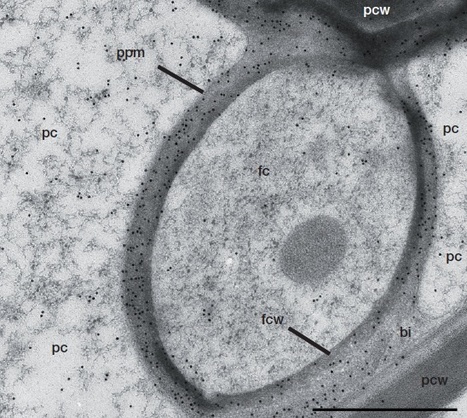
To localize Cmu1 during biotrophic growth, plants were infected with SG200Dcmu1-cmu1–HA, which carries a cmu1–HA fusion gene inserted in single copy under control of its native promoter. Plants infected with SG200 or with SG200 Pcmu1GFP–HA expressing cytoplasmic green fluorescent protein (GFP) under the cmu1 promoter served as negative controls. Freeze-substituted and resin-embedded sections of maize tissue harvested 3 days after infection with these strains were incubated with anti-HA antibodies and gold markers. Cmu1–HA could be detected inside the fungal hyphae, in the biotrophic interface as well as inside the plant cytoplasm but rarely in the plant cell wall (Fig. 2A and Supplementary Fig. 7). The distribution of gold particles was quantified (Fig. 2B). Gold labelling of plant tissue infected with the parental strain SG200 was negligible (Supplementary Fig. 8), whereas non-secreted GFP–HA was absent from the biotrophic interphase, showed strong accumulation in the fungal cytosol and weak background labelling in the plant cytosol (Supplementary Fig. 9 and Fig. 2B).
|
|
Scooped by
Kamoun Lab @ TSL
October 13, 2011 7:36 PM
|
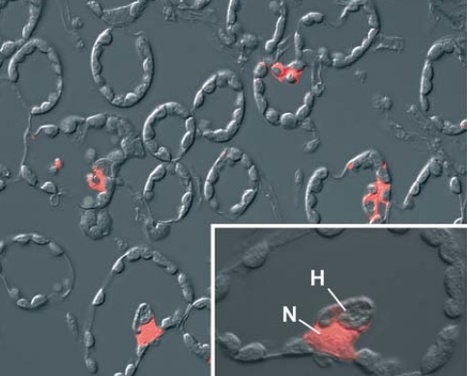
PWL2 and BAS1 (for biotrophy-associated secreted protein 1), BIC-localized secreted proteins, were translocated into the rice cytoplasm. By contrast, BAS4, which uniformly outlines the IH, was not translocated into the host cytoplasm. Fluorescent PWL2 and BAS1 proteins that reached the rice cytoplasm moved into uninvaded neighbors, presumably preparing host cells before invasion.
|
|
Scooped by
Kamoun Lab @ TSL
October 13, 2011 7:22 PM
|
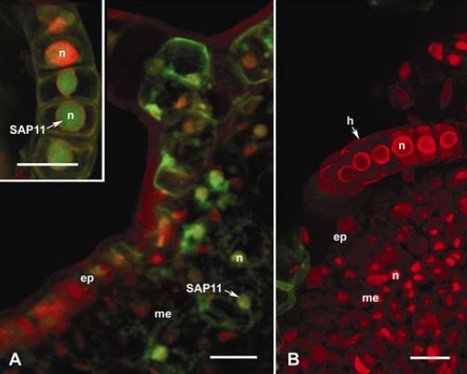
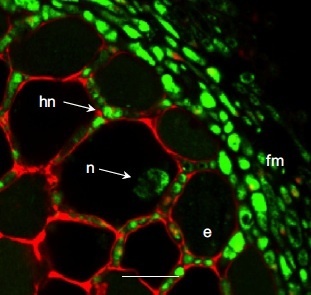
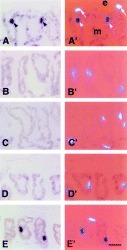
SAP11, contains an N-terminal SP sequence and a eukaryotic bipartite nuclear localization signal (NLS). SAP11 was detected by immunocytology in nuclei of young sink tissues of China aster plants infected with AY-WB.
|
|
Scooped by
Kamoun Lab @ TSL
October 13, 2011 7:10 PM
|
To investigate further the translocation of Avr3a from haustoria into the plant cell, the signal peptide (SP)-RXLR-EER-encoding domain of Avr3a, and a version in which the motifs were replaced with alanine residues (SP-AAAA-AAA) were fused to the amino terminus of the Escherichia coli gusA gene, which encodes β-glucuronidase (GUS), and stably expressed in P. infestans. GusA was chosen because its product is active within plant cells but inactive in the apoplast19, and is thus an ideal reporter for translocation of proteins to the inside of plant cells. SP-RXLR-EER–GUS and SP-AAAA-AAA–GUS transformants were selected that expressed and secreted high levels of active GUS into culture medium (Supplementary Fig. 6). However, when infecting potato, GUS activity was observed only with the SP-RXLR-EER–GUS transformants, and only within plant cells in contact with haustoria (Fig. 3 and Supplementary Fig. 7). No GUS activity was observed within plant cells or in the apoplast in the case of the SP-AAAA-AAA–GUS transformants (Fig. 3 and Supplementary Fig. 7), indicating that GUS was not translocated into the plant cell.
|
|
Scooped by
Kamoun Lab @ TSL
October 13, 2011 7:06 PM
|
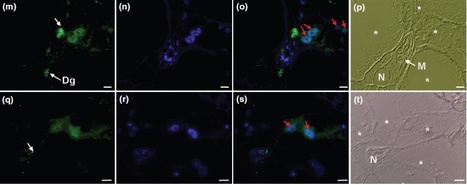
Immunofluorescence investigations in combination with a specific anti cryptogein antibody clearly showed that the P. quercina elicitin quercinin was located within the hyphal cell wall and seems to be released into invaded cells. In addition, immunogold labelling showed that quercinin was found in the intercellular spaces as well as in penetrated cells.
|
|
Scooped by
Kamoun Lab @ TSL
October 13, 2011 7:01 PM
|
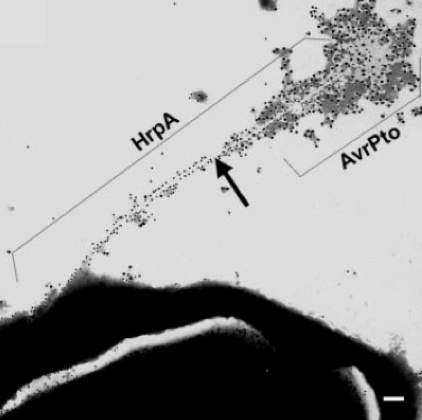
We used an in situ immunogold labeling procedure to visualize the extrusion of an effector protein, AvrPto, from the tip of the Hrp pilus, providing direct evidence that a bacterial pilus can function as a conduit for protein delivery.
|
|
|
Scooped by
Kamoun Lab @ TSL
May 5, 2012 9:50 AM
|
• Root-knot nematodes (RKNs) are obligate endoparasites that maintain a biotrophic relationship with their hosts over a period of several weeks and induce the differentiation of root cells into specialized feeding cells. Nematode effectors synthesized in the oesophageal glands and injected into the plant tissue through the syringe-like stylet certainly play a central role in these processes.
• In a search for nematode effectors, we used comparative genomics on expressed sequence tag (EST) datasets to identify Meloidogyne incognita genes encoding proteins potentially secreted upon the early steps of infection.
• We identified three genes specifically expressed in the oesophageal glands of parasitic juveniles that encode predicted secreted proteins. One of these genes, Mi-EFF1 is a pioneer gene that has no similarity in databases and a predicted nuclear localization signal. We demonstrate that RKNs secrete Mi-EFF1 within the feeding site and show Mi-EFF1 targeting to the nuclei of the feeding cells.
• RKNs were previously shown to secrete proteins in the apoplasm of infected tissues. Our results show that nematodes sedentarily established at the feeding site also deliver proteins within plant cells through their stylet. The protein Mi-EFF1 injected within the feeding cells is targeted at the nuclei where it may manipulate nuclear functions of the host cell.
|
|
Scooped by
Kamoun Lab @ TSL
October 13, 2011 8:29 PM
|
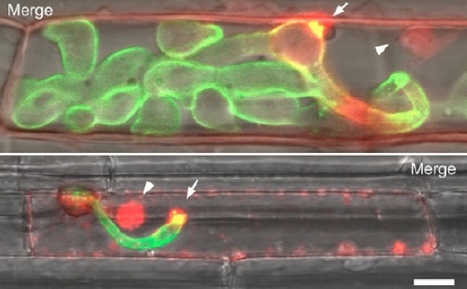
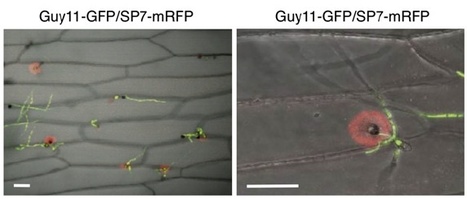
We show that Glomus intraradices secretes a protein, SP7, that interacts with the pathogenesis- related transcription factor ERF19 in the plant nucleus. SP7-mRFP is secreted by a Magnaporthe oryzae GFP-expressing strain, translocated into the onion cell, and localized to the nucleus. No red nuclei were detected when the infection assay was performed using the GFP control strain (Guy11-GFP). Images show maximal projections of several confocal planes. Scale bars represent 10 mm.
|
|
Scooped by
Kamoun Lab @ TSL
October 13, 2011 8:24 PM
|
MiSSP7 was computationally predicted to be secreted into the plant apoplastic space [3]. Its localization after secretion was further investigated here. Using immunofluorometric labeling, we found that MiSSP7 enters plant cells and accumulates in the plant nuclei (Figure 1C).
|
|
Scooped by
Kamoun Lab @ TSL
October 13, 2011 8:03 PM
|
We show by immunolocalization that the flax rust AvrM protein is secreted from haustoria during infection and accumulates in the haustorial wall. Five days after inoculation, the AvrM protein was also detected within the cytoplasm of a proportion of plant cells containing haustoria, confirming its delivery into host cells during infection.
|
|
Scooped by
Kamoun Lab @ TSL
October 13, 2011 7:15 PM
|
Rust transferred protein 1 from Uromyces fabae (Uf-RTP1p) was not only detected in the host parasite interface, the extrahaustorial matrix, but also inside infected plant cells by immunofluorescence and electron microscopy. Uf-RTP1p does not exhibit any similarity to sequences currently listed in the public databases. However, we identified a homolog of Uf-RTP1p in the related rust fungus Uromyces striatus (Us-RTP1p). The localization of Uf-RTP1p and Us-RTP1p inside infected plant cells was confirmed, using four independently raised polyclonal antibodies. Depending on the developmental stage of haustoria, Uf-RTP1p was found in increasing amounts in host cells, including the host nucleus.

|
Suggested by
dromius
October 13, 2011 7:48 PM
|
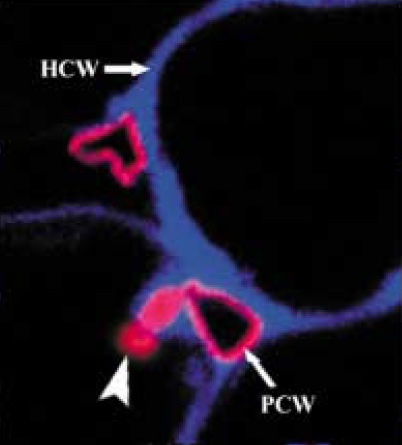
Using an immunocytochemical approach, we demonstrate that the type III effector AvrBs3 from Xanthomonas campestris pv. vesicatoria localizes to nuclei of infected pepper leaves. Importantly, AvrBs3 translocation was observed in situ in native tissues of susceptible and resistant plants. AvrBs3 was detected in the nucleus as soon as 4 h post infection, which was dependent on a functional TTSS and the putative translocator HrpF. N-terminal AvrBs3 deletion derivatives are no longer secreted by the TTSS in vitro and could not be detected inside the host cells, suggesting that the N-terminus of AvrBs3 is important for secretion.
|