ETF Research & Solutions
3.1K views | +1 today
Follow
ETF Research & Solutions
portfolio construction, factors, smart beta, risk mitigation
Your new post is loading...
Scooped by ETF Research & Solutions
July 13, 2016 12:07 PM
Scoop.it!

Is Your Minimum Volatility ETF a Crowded Trade? | ETF Trends

Is Your Minimum Volatility ETF a Crowded Trade? | ETF Trends | ETF Research & Solutions | Scoop.it
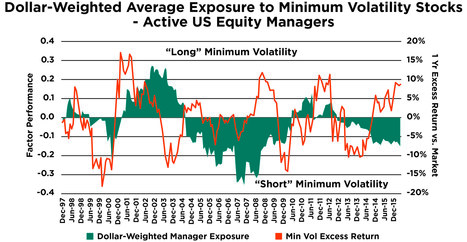
So far in 2016, we’ve seen a large amount of net inflows into minimum-volatility ETFs as investors seek shelter in lower-risk stocks. These smart beta ETFs are designed to target the factor premium that has been attributable to favoring lower-risks stocks over their higher-risk counterparts.

Recent press, articles, and whitepapers have sharply criticized the minimum-volatility trade, and some have said that the higher valuations associated with these types of stocks are evidence of overcrowding by investors. This type of behavior suggests the premium investors harvest for owning such securities is likely to come tumbling down sooner rather than later.

Like all investment strategies, minimum volatility cycles through outperformance and subsequent underperformance over periods of time. Based on the conditions described above, should investors be thinking about rotating back out of minimum-volatility ETFs?
No comment yet.
Scooped by ETF Research & Solutions
July 7, 2016 6:31 AM
Scoop.it!

AQR - How Can a Strategy Everyone Knows About Still Work?

AQR - How Can a Strategy Everyone Knows About Still Work? | ETF Research & Solutions | Scoop.it

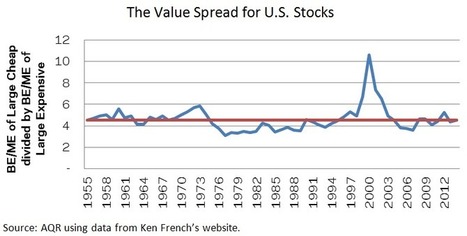
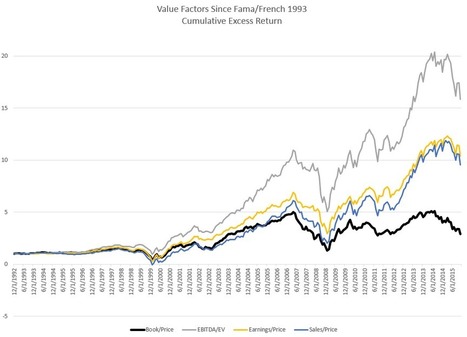
Some assert that once a strategy is “discovered” it can’t work anymore. Others, often implicitly, assume the future will look as wonderful as the past. Perhaps not surprisingly, we stake out a middle ground. We’re going to argue that certain well-known classic strategies that have worked over the long term will continue to work going forward, though perhaps not at the same level and with different risks than in the past.[1] We will focus on classic “factor”-type strategies.[2] Our favorites won’t shock anyone. They are things like value, momentum, carry and quality/defensive.[3] Of these, we’ll use value investing as a common example throughout this discussion.


We don’t consider these classic strategies to be “alpha” in the traditional sense. However, there can be better or worse versions of them, and creating new, better versions is certainly a form of alpha (this can lead to great semantic battles).[4] Still, to be real alpha something has to be known to only a modest number of people/organizations (one being optimal). By this definition, classic strategies defined in well-known ways don’t fit. But, presumably sometime in the past, when they were much less well-known, they were indeed at least closer to “alpha” in all senses of the word. This brings us to the title question — now that they are “classics” and known to many, why should they still work?

No comment yet.
Scooped by ETF Research & Solutions
July 7, 2016 3:48 AM
Scoop.it!

Alpha or Assets

Alpha or Assets | ETF Research & Solutions | Scoop.it

More and more investors are buying “factor” based strategies which invest using measures like valuation and low volatility, but the most popular strategies are applying factors in the wrong way. Strategies should be built for alpha, not scale—but the asset management industry has gone in the opposite direction.
Most factor-based strategies—commonly called Smart Beta—have hundreds of holdings and high overlap with their market benchmark. The far more powerful way to apply factors is to use them first to avoid large chunks of the market and then build more differentiated portfolios of stocks with only the best overall factor profiles. While not as scale-able as smart beta, this alpha-oriented approach has led to much better results for investors.

No comment yet.
Scooped by ETF Research & Solutions
July 7, 2016 6:50 AM
Scoop.it!

When Measures Become Targets: How Index Investing Changes Indexes

When Measures Become Targets: How Index Investing Changes Indexes | ETF Research & Solutions | Scoop.it
Indexes are affected and changed by asset flows into strategies which target those indexes. This is true when hundreds of billions of dollars seek low price-to-book strategies, and for the entire market as a whole. Fund flows affect everything, especially when those flows have T after them. To this point, this has worked in one direction, for the most part. Portfolios with decent valuations, by historical standards, are only achievable today through portfolios that are very different from the S&P 500. Costs are very important. But there are management fees and there are valuation multiples. At the very least, I urge you to consider both.
No comment yet.
Scooped by ETF Research & Solutions
July 7, 2016 6:30 AM
Scoop.it!

AQR - The Siren Song of Factor Timing aka “Smart Beta Timing” aka “Style Timing”

Everyone seems to want to time factors. Often the first question after an initial discussion of factors is “ok, what’s the current outlook?” And the common answer, “the same as usual,” is often unsatisfying. There is powerful incentive to oversell timing ability. Factor investing is often done at fees in between active management and cap-weighted indexing and these fees have been falling over time. Factor timing has the potential of reintroducing a type of skill-based “active management” (as timing is generally thought of this way) back into the equation. I think that siren song should be resisted, even if that verdict is disappointing to some. At least when using the simple “value” of the factors themselves, I find such timing strategies to be very weak historically, and some tests of their long-term power to be exaggerated and/or inapplicable.
No comment yet.
Scooped by ETF Research & Solutions
July 7, 2016 3:43 AM
Scoop.it!

How Can "Smart Beta" Go Horribly Wrong?

How Can "Smart Beta" Go Horribly Wrong? | ETF Research & Solutions | Scoop.it

If investors don’t wise up soon that rising valuations are responsible for most of the “alpha” produced by smart beta, the inevitable mean reversion to historical valuation norms threatens to unleash a smart beta crash.

 1. Factor returns, net of changes in valuation levels, are much lower than recent performance suggests.

2. Value-add can be structural, and thus reliably repeatable, or situational—a product of rising valuations—likely neither sustainable nor repeatable. 

3. Many investors are performance chasers who in pushing prices higher create valuation levels that inflate past performance, reduce potential future performance, and amplify the risk of mean reversion to historical valuation norms. 

4. We foresee the reasonable probability of a smart beta crash as a consequence of the soaring popularity of factor-tilt strategies.

No comment yet.