

"Measure the wrong things and you'll get the wrong behaviors." This simple statement succinctly characterizes why the American education system continues beating its head against the wall.
Via Mark E. Deschaine, PhD, Gust MEES


|
Rescooped by
terry clarke
from 21st Century Learning and Teaching
onto Education May 16, 2015 5:02 PM
|
 Scoop.it!
"Measure the wrong things and you'll get the wrong behaviors." This simple statement succinctly characterizes why the American education system continues beating its head against the wall.


 Your new post is loading...
 Your new post is loading...
Your new post is loading...
Scoop.it!

A new DARPA project seeks to teach artificial intelligence to play jazz -- and suggests military generals may have more in common with musicians than chess masters.
Scoop.it!

“The College Board released its new Advanced Placement U.S. History teaching guidelines Thursday, following a year in which the previous framework was attacked for being anti-American.”
Scoop.it!

I have taught over 10,000 students over 63 years, the oldest now in their 80s. My primary focus has always been: What preparation leads to a meaningful and fulfilling life--and what does not?
terry clarke's insight:
Excellent article on an education topic that deserves more consideration.
Scoop.it!

Sarah Blaine is the author at the excellent and thoughtful Parenting the Core blog. She recently explored the question of whether or not teaching is a profession, recounting a law professor who ar...
Scoop.it!

A 16-minute film on the life of Uttarakhand’s Makar Singh, his economic hardships and his efforts to uplift his community has won several awards and become a key teaching tool in universities across UK, US, Canada and Australia.
Scoop.it!

6 characteristics at the heart of great teaching: http://t.co/SZ0s07cWLc. http://t.co/rEk4MpbPeY
Scoop.it!

To develop a class of risk takers, administrators need to encourage faculty to try new teaching strategies so they model for their students risk taking, flexibility, and resilience when failure happens. Via Patti Kinney

Tony Meehan's curator insight,
June 14, 2015 6:51 AM
As educators we have to embrace as many, proven-to-be-effective teaching strategies as possible in order to be able to respond to the multiple ways learners learn. Restricting ourselves to one tried and tested - usually decades old - strategy risks alienating many learners who are growing up in a society with immediate access to information. Educators need an understanding of latest developments in cognitive psychology and neuroscience to inform just how we learn and from there what strategies to employ to meet the learning needs of all learners in our charge.
Scoop.it!

The Seattle Times: Bellevue schools teach emotional smarts to help boost academic success
Scoop.it!

Science teacher Rick Teather explains how his previous career as a salesman influences his approach to teaching – and why the job is much harder in England than elsewhere in the world
Scoop.it!

Students would prefer lecturers to have teaching qualifications and industry experience
Scoop.it!

David Levine Via Edwin Rutsch
|
Scoop.it!

The recent UK budget announced plans to allow universities that exemplify good teaching to increase their caps on fees, meaning they will be financially rewarded for good teaching practice. But how do you measure this?
Scoop.it!
In Harper Lee's To Kill a Mockingbird, Atticus Finch teaches his daughter, Scout, empathy.
Scoop.it!

Cross-curricular lesson plans can break down the walls between science, English, mathematics and art. Here are some ways to use STEM and STEAM learning.
Scoop.it!
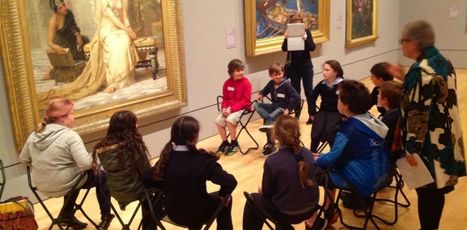
It has been a good week for philosophy. The results of a year long study on the benefits of teaching philosophy to primary school aged children has just been published in the UK and the reports are positive…
terry clarke's insight:
Every instructor understands the importance of teaching "critical thinking" skills to his/her students, but unfortunately the term has been relegated to the status of platitude, ensuring the educational status quo of students merely memorizing facts solely for the purpose of achieving high marks. Hopefully programs like the one discussed in the article will reverse this disturbing trend.
Scoop.it!

From
wgntv

Police brutality against African American men has played out across the country in recent months. So a local man is teaching a class to help people avoid these confrontations. He’s also showing you...
Scoop.it!
The Challenges of Teaching When Silicon Valley Doesn't Care ...
Scoop.it!
What if teaching online was simple, affordable and yet, very effective?
Scoop.it!

American history classes teach us a lot about whose perspective we value. Often, South Carolina lesson plan examples show us that slaveowners' perspectives are given way too much legitimacy.
Scoop.it!

If I was going to summarize the fundamental problem in higher education in one phrase, I'd say that teaching is easy, but learning is hard.
Scoop.it!
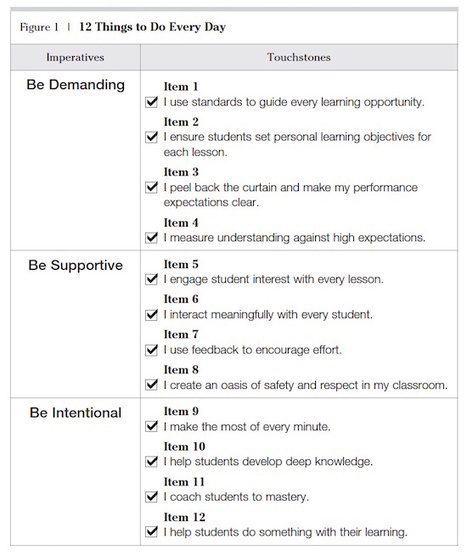
Goodwin and Hubbell fill this useful book with common sense, easy-to-apply tips and techniques, framed by a checklist of the 12 Touchstones of Good Teaching. Via Patti Kinney
Scoop.it!

In their quest to produce efficient readers and writers, Virginia education officials are neglecting the most important part of young children — their minds [“What is making a first-year Fairfax teach...
|






Throughout education, an increasingly rigid, closed loop of assessment is systematically making schools worse: Define things children should know or be able to do at a certain age; design a curriculum to instruct them in what you've decided they should know; set benchmarks; develop tests to see if they have learned what you initially defined; rinse and repeat.
This narrow, mechanistic approach to education does not correspond to the reality of child development and brain science, but the metrics and assessment train charges down the track nevertheless.
So what's wrong with that, you might ask? Isn't school about teaching kids stuff and then testing them to see what they've learned? In a word, "No." It simply doesn't work, especially with young children.
As Boston College Professor Peter Gray wrote in a recent Psychology Today article:
Perhaps more tragic than the lack of long-term academic advantage of early academic instruction is evidence that such instruction can produce long-term harm, especially in the realms of social and emotional development.