Paul Fanlund: On racial disparities, a top goal is to help you sort things out Capital Times Topics planned are the “achievement gap,” the oft-used term for the under-achievement of African-Americans in our schools; high incarceration rates of...

 Your new post is loading...
 Scoop.it! Paul Fanlund: On racial disparities, a top goal is to help you sort things out Capital Times Topics planned are the “achievement gap,” the oft-used term for the under-achievement of African-Americans in our schools; high incarceration rates of... 
No comment yet.
Sign up to comment
Scoop.it!
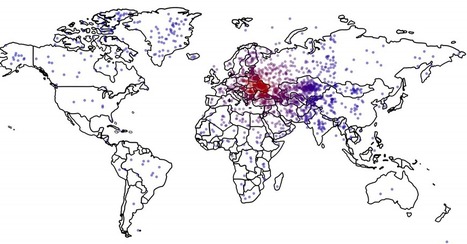
84% of Americans are unable to locate Ukraine on a world map; those that can't are more likely to support military intervention.

Rach Brick's curator insight,
April 13, 2014 10:45 PM
This says so much about ignorance and aggression... Do they even know that they'd have to come up with a catchy name because the Crimea has already got a war names after it?
Scoop.it!

Great presentation design can be difficult to master because it requires the coordination of many elements, including colors, fonts, images, icons and background. While there are a lot of pieces to the presentation design puzzle, don’t be overwhelmed. Via Baiba Svenca

Baiba Svenca's curator insight,
April 8, 2014 1:25 PM
A nice list of dos and don'ts in presentation design. The article suggests what you should avoid doing and what you should do instead to achieve the best result. 
Judih Weinstein Haggai's curator insight,
April 9, 2014 12:13 AM
Great visual reminders of how to prepare effective presentations
Scoop.it!

A teacher in Massachusetts who has spent more than a quarter century in the classroom is drawing attention after she quit her job over her growing frustration with the school system’s emphasis on standardized testing.
Because of “so many things that pulled me away from the classroom and fractured my time with the children,” kindergarten teacher Susan Sluyter quit last month.

Lon Woodbury's curator insight,
March 27, 2014 6:36 PM
Her concern is right in line with those who fear we are taking their childhood by eliminating play time. -Lon 
Sushma Sharma's curator insight,
March 30, 2014 12:32 AM
The way to go .... Totally in agreement .. The joy of learning creates wisdom 
Aunty Alice's curator insight,
April 6, 2014 3:25 PM
Have a very similar mindset but short of opening one's own school we are stuck with it. I have just published a book leading teachers to the more fertile ground for real progress, in literacy acquisition, of analysing student work, giving them an authentic voice, and goal setting. It puts listening and speaking at the centre.
Scoop.it!

The proportion of female chief executives around the world is growing but women’s overall share of senior business roles has stalled, research has found. Via Annabel Kaye
Scoop.it!

Kirsten Wilson's curator insight,
March 25, 2014 11:54 AM
Great ideas and creates an opportunity for the reflective educator to evaluate instructional practices. 
Teresa Barclay's curator insight,
March 26, 2014 5:37 PM
Has insights that could help anyone, especially me as I go through my own education journey
Scoop.it!

Top mapmakers split on recognizing Crimea as part of Russia.
The U.S. and other Western governments may doggedly refuse to recognize Crimea’s annexation by Russia, but one prominent American mapmaker will. “We map de facto, in other words we map the world as it is, not as people would like it to be,” Juan José Valdés, the National Geographic’s geographer and director of editorial and research for National Geographic Maps, tells U.S. News. “As you can only surmise, sometimes our maps are not received in a positive light by some individuals who want to see the world in a different light,” Valdés says. Via Seth Dixon
Scoop.it!

Drawing on data from the 2010 U.S. Census, the map shows one dot per person, color-coded by race. That's 308,745,538 dots in all.
White: blue dots; African American: green dots; Asian: red; Latino: orange; all others: brown Last year, a pair of researchers from Duke University published a report with a bold title: “The End of the Segregated Century.” U.S. cities, the authors concluded, were less segregated in 2012 than they had been at any point since 1910. But less segregated does not necessarily mean integrated–something this incredible map makes clear in vivd color. The map, created by Dustin Cable at University of Virginia’s Weldon Cooper Center for Public Service, is stunningly comprehensive. Drawing on data from the 2010 U.S. Census, it shows one dot per person, color-coded by race. That’s 308,745,538 dots in all–around 7 GB of visual data. It isn’t the first map to show the country’s ethnic distribution, nor is it the first to show every single citizen, but it is the first to do both, making it the most comprehensive map of race in America ever created. Via Seth Dixon, Michael Miller, Skuuppilehdet, Deanna Dahlsad

Whitney Souery's curator insight,
May 28, 2014 6:41 PM
We can use maps to think spatially,make connections, and find patterns. Maps can also be used as a way to compare change over time, as in this particular case where maps from the present were compared with maps from over fifty years ago when racial segregation was plainly obvious. Now, however, when we compare past maps with those of the present, the change over time factor becomes clearly evident, revealing why maps are so useful in determining continuities or changes.
Scoop.it!

danah boyd (she doesn’t capitalize her name) is a Principal Researcher at Microsoft Research and a Fellow at Harvard’s Berkman Center, where she looks at how young people use social media as part of their everyday lives. She has a new book out called It’s Complicated: The Social Lives of Networked Teens, and she’s made it available as a free PDF. On her website she writes, “I didn’t write this book to make money. I wrote this book to reach as wide of an audience as I possibly could. Via Nik Peachey

John A. MacDonald's curator insight,
March 10, 2014 6:38 AM
An interesting book with a progressive publishing concept. 
Tricia Adams's curator insight,
March 10, 2014 7:06 AM
Social history and reflection on today's connected youth - looks interesting 
gawlab's curator insight,
March 16, 2014 9:01 PM
a téléchargé la copie libre du livre de danah boyd.
Scoop.it!

How many yards will a team lose if one of its players says the word during a game? And will this curb overall use of the word?
Scoop.it!

A news service on social justice, human rights, environmental justice, and progressive activism.
Scoop.it!

In 1963, kids in the 10th percentile of income fell behind children in the upper echelon of wealth by about a year or so. Today, that gap is closer to four years.
Scoop.it!

The hashtag 'NotYourMascot', a protest against the Washington Redskins and other offensive teams, took Twitter by storover the Super Bowl weekend.
|
Scoop.it!

Washington Post School districts say new school finance bill will widen disparities Lawrence Journal World Topeka — The Legislature's new school finance bill will continue to widen the funding gap between wealthy and poor districts, attorneys...
Scoop.it!

The Guardian (blog) Sexism, double discrimination and more than one kind of prejudice The Guardian (blog) "Double discrimination" (or, indeed, triple or quadruple) has proved to be a major recurring theme within the project and is a crucial focus... Via Annabel Kaye
Scoop.it!

Psychologists and eLearning professionals ahave always been interested in how we consume information online.Here' re some relevant points.
Scoop.it!

Indian Americans The first major influx of immigrants arrived in the early 1900s to work as farmhands. After initially being considered Caucasian and
Scoop.it!

Study: Community College Transfers as Likely to Earn a BA as Four-Year Students, Despite Credit Transfer Roadblocks
Scoop.it!

Blogs, papers and other projects have prompted wider discussion of “microaggressions,” remarks with a basis in racial, gender or other stereotypes.
Scoop.it!

Racial minorities are more likely than white students to be suspended from school and be taught by lower-paid teachers with less experience, according data released by the Department of Education.
Scoop.it!

What does National Council of La Raza President and CEO Janet Murguía think Obama should do to slow the number of deportations?
Scoop.it!

You won’t believe who Dr. James David Manning believes is responsible for unleashing this ‘devastation’ on the Black community.
Scoop.it!

Diversity, Multicultural, Cultural Competence, & Inclusion Education Training
Scoop.it!

by Larry Ferlazzo and Katie Sypnieski
"Helping English-language learners develop proficiency in academic language has always been a priority for K-12 educators, and its importance has only been heightened with the advent of the Common Core. To better understand academic language, let's examine the distinction between two terms introduced by Jim Cummins, basic interpersonal communicative skills (BICS) andcognitive academic language proficiency (CALP), that have impacted both policy and practices in second-language education:" Jim Lerman's insight: Article contains numerous practical recommendations. Via Jim Lerman

Juan Camilo G Montoya's curator insight,
February 17, 2020 3:01 PM
When we start teaching English as a second language, we have to differentiate BICS and CALP in order to guarantee success in learning processes destined to students who never had a previous contact with any second language. The next article is intended to distinct BICS and CALP´s principles allowing teachers to effectively work integrating these methods.
|