en la década de los 70 del siglo pasado se consideraba popularmente que México era “el cuerno de la abundancia”, y se decía popularmente que sólo alguien “muy flojo” podría llegar a tener hambre. Todo esto ha cambiado, y hoy la pobreza y la inmovilidad social se han convertido en el destino inevitable para prácticamente la mitad de la población.
Once close to the levers of power, matters were different. He wished to become Paul Volcker’s successor as Fed chairman, and he knew that firm opposition to Fed policy would hurt his chances for the job. Going against his earlier analysis, he supported the “largest bank bailout in U.S. history,” the rescue in 1984 of the Continental Illinois National Bank. He admitted the dangers of the bailout, but it was, as Mallaby summarizes his position, “necessary and appalling.” Appalling, one suspects, because of its effects on the free market; but necessary to advance Greenspan’s career. By the time he became Fed Chairman, the transformation was complete. By 1989, his “libertarian rejection of bailouts was long gone; what he wanted above all was the space to fight inflation.”
Greenspan wanted to fight inflation; but the best way to do it was no longer acceptable. A gold standard, he had long ago recognized, would bring with it monetary stability; but to replace the Fed with a commodity standard not subject to control by the government would erode his power. Accordingly the gold standard had to go.
He cast aside the gold standard with a transparent sophism: “A necessary condition of returning to a gold standard is the financial environment which the gold standard itself is presumed to create. ... But, if we restore financial stability, what purpose is then served by a return to a gold standard?” (quoting Greenspan). Why a gold standard cannot help create a stable financial environment, but instead presupposes it, Greenspan left unclear. Even less clear was how the Fed was supposed to preserve stability in the absence of the gold standard. Evidently we were to rely on his supreme powers of judgment in steering the economy.
Greenspan in his long career as Fed chairman gained the power and acclaim he coveted; but the crash of 2008, two years after the end of his tenure in office, led to a sharp decline in his reputation.
In their attitude toward compromise, Greenspan is the polar opposite to Murray Rothbard. Rothbard could have tailored his views to win the favor of Arthur Burns, who was a family friend, but he refused to do so. He never abandoned his principles, and he took the measure of Greenspan. Writing about him in 1987, Rothbard observed: “Greenspan’s real qualification is that he can be trusted never to rock the establishment’s boat. He has long positioned himself in the very middle of the economic spectrum. He is, like most other long-time Republican economists, a conservative Keynesian, which in these days is almost indistinguishable from the liberal Keynesians in the Democratic camp.”
In looking over Greenspan’s fall from free-market grace, the melancholy first lines of Browning’s The Lost Leader, addressed to Wordsworth, come to mind: “Just for a handful of silver he left us,/Just for a ribbon to stick in his coat. ...”
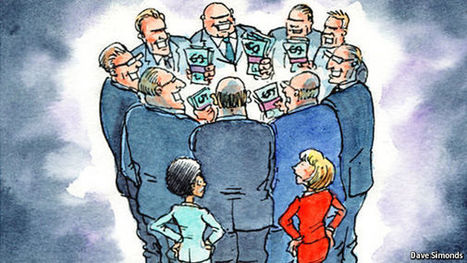
Excessive inequality has gone up in most countries in the last 30 years. It is detrimental to growth but not inevitable. With properly designed policies from health and education to income redistribution, governments can help reduce it.
Catherine Mongina is the founder of “E-Tech Africa” a website that aims to inform and empower young entrepreneurs in Africa to embrace e-commerce as a way to either start or grow their business. Catherine believes e-commerce is a core competence…
El fundador del portal de comercio electrónico sugirió cambios para lograr que los robots y la automatización de los trabajos no reemplacen a los humanos.
Banks are faced with the problem how to deal with communications in the digital age. Gone are the days they only had to monitor e-mails and tap their phones. Chats aren’t limited to Bloomberg anymore, instead many new channels can be used to communicate with peers and clients nor do their employees want to be constrained to use their company phones. However, these new channels present new challenges for banks to comply with their regulatory obligations. Some are trying to turn back time, but we will look at why this isn’t really an option and how financial institutions should respond in the 21st century.
Advances in technology pose huge challenges for jobs. Productivity levels have never been higher in the United States, for example, but income for the bottom 50% of earners has stagnated since 1999 (see 'Job shifts'). Most of the monetary gains have gone to a small group at the very top. Technology is not the only reason, but it is probably the most important one.
A report published on 13 April by the US National Academies of Sciences, Engineering, and Medicine details the impacts of information technology on the workforce1. We co-chaired the report committee and learnt a great deal in the process — including that, over the next 10–20 years, technology will affect almost every occupation. For example, self-driving vehicles could slash the need for drivers of taxis and long-haul trucks, and online education could enrich options for retraining of displaced workers.
“BOOBER” is the nickname Travis Kalanick, the boss of Uber, used to describe the effect that the ride-hailing startup had on his attractiveness to the opposite sex. Mr Kalanick’s wisecrack seems to have been emblematic of a deeply macho culture.
"...where are chatbots now? Do they still have a role to play? Here is how they are set to transform enterprise, and why they are the future of big data."
We stand on the brink of a technological revolution that will fundamentally alter the way we live, work, and relate to one another. In its scale, scope, and complexity, th
To get content containing either thought or leadership enter:
To get content containing both thought and leadership enter:
To get content containing the expression thought leadership enter:
You can enter several keywords and you can refine them whenever you want. Our suggestion engine uses more signals but entering a few keywords here will rapidly give you great content to curate.


 Your new post is loading...
 Scoop.it!