


A non-profit journalism website reporting on key education issues in California and beyond.


 Your new post is loading...
 Your new post is loading...
Your new post is loading...
 Scoop.it!
A non-profit journalism website reporting on key education issues in California and beyond. 
No comment yet.
Sign up to comment
Scoop.it!

A researcher has found that asking young children why things happened in a story that's been read to them helps them discover the moral lesson an author was trying to convey.
Scoop.it!

A pair of new studies, taking different approaches, say the $8.6 billion federal preschool program has measurable continuing benefits in a number of key areas.
Scoop.it!

A program in downtown LA seeks to get young children ready for school by addressing family trauma holistically.
Scoop.it!

From
ww2

Teaching 5-year-olds how to read and count, while molding them into kind, confident students isn't easy. In kindergarten, every day is a surprise, says teacher
Scoop.it!

A non-profit journalism website reporting on key education issues in California and beyond.
Scoop.it!
Marjorie Wechsler, Principal and Research Manager of Learning Policy Institute on The Building Blocks of High-Quality Early Learning Programs
Scoop.it!

In today’s competitive global economy, dual language learners enter our education system with an incredible intellectual, social, and personal asset that can improve our national economy and security: their home language.1 Dual language learners...
|
Scoop.it!

Early childhood education programs across the United States are more academic than ever before. Although new research shows that this “academization” produces positive performance gains, experts de…
Scoop.it!
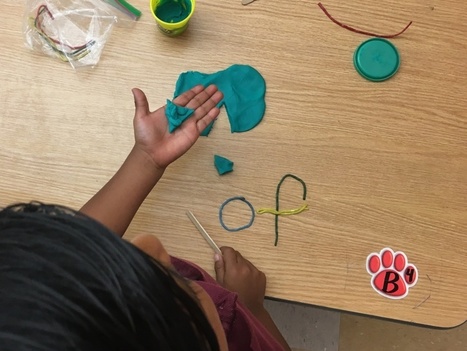
Teaching reading in kindergarten can be creative, and one South L.A. teacher believes playful learning works better than rote memorization.
Scoop.it!

Deborah Phillips at Georgetown University has spent more than a decade studying preschool programs in Oklahoma. Her latest research found strong gains in some areas, but slow progress in others.
Scoop.it!

Supporting Children's Learning Through Play
Scoop.it!
Our mission is to build capacity for quality early childhood education (ECE) programs by sharing knowledge abou
Scoop.it!
The disciplinary use of suspension and expulsion for the nation’s youngest students—particularly African American students—has long-term damaging effects on children, as well as society as a whole.
Scoop.it!

San Antonio's $248 million program for preschoolers from poor and working-class families is off to a mostly smooth start, even as administrators do some fine-tuning.
Scoop.it!

Quality early childhood education from birth to five helps families raise stronger children and grow a more prosperous America.
|






