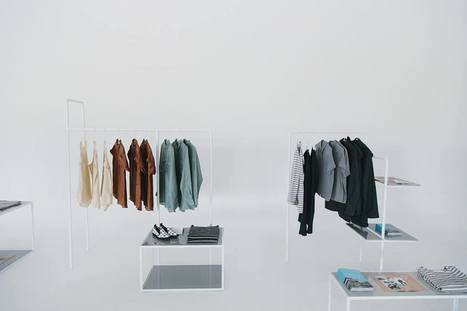
Timberland is trying to merge online and offline shopping with its first digitally connected store, equipped with tablets that customers can use to learn more about the retailer’s products.
The New York City Herald Square store (one of Timberland’s 13 full-price retail shops in the U.S.) made the feature available on Saturday, Jan. 14. Products in the store carry with a tag that, when tapped with one of three mini tablets in the store, brings up product information similar to what you’d find on an online product page. The tap also pulls up related items and items recommended based on the initial chosen product. Shoppers can add items to a personal “collection” on the tablet, make notes and save the collection for later by emailing it to themselves.
How is one to make online shoppers feel as if they are having a differentiated “luxury” experience — and justify luxury prices — if there is no physical store in which to immerse them? How can Hermès distinguish itself from H&M on the screen of a tablet?
While the channel may be different, the guiding principles remains the same: the entire shopping experience must be a seamless journey in which customers feel luxury at every turn, from swiping through products on their iPad to unboxing their purchases.
In partnership with Google, Burberry has launched "The Burberry Booth" at its Regent Street flagship store in London. (Yes, that's the same store with thespecial screens that interact with the RFID chips embedded in the clothes.) Via real-time video-stitching technology, customers can film their own versions of the brand's current ad campaign. As you may have seen seen, the Festive campaign sees famous people — Romeo Beckham, James Corden, Naomi Campbell and others — jumping Billy Elliott-style against a green-printed background. Via Burberry Booth, holiday shoppers can create a 15-second edit of the campaign in which they appear alongside such celebs. The clip is instantly sent to the user, who can then share it with their friends. Surely Burberry hopes those friends will want to see what fun there is to be had at the store, too.
Fashion ecommerce platform Farfetch is making holiday shopping accessible 24/7 with shoppable window displays at more than 100 of its boutiques around the world.
Leveraging QR codes, the displays allow passersby to purchase the items seen in the window regardless of whether the shop is open. This effort is poised to reach local consumers who may not usually be accustomed to shopping these boutiques online, sending them to a new channel to buy.
New technology promises to allow retailers to beat online players at their own game, transforming the customer experience and dramatically improving their positioning.
One of the most exciting areas of development is the marrying of mobile apps, location sensing technologies (e.g., GPS), and data analytics to improve the in-store experience for customers. Location sensing technologies in retail typically involve customers using the retailer’s app, or a third-party app, and ceding permission to track their location in return for a better experience or reward. The customer’s location can be determined through the phone’s GPS capability — or more accurately within the store via WiFi, light-based triangulation or beacons.
Sephora continues to pioneer digital innovations with an exciting new shopping experience, opening the first connected beauty store. Sephora Flash is a disruptive concept that blends beauty and technology.
The first of these revolutionary boutiques recently opened at 66, rue de Rivoli in Paris. The 100-square-meter store (compared with the average 400 sq. meters for the brand’s boutiques) offers an unprecedented bridging of physical and digital shopping channels. A selection of best-selling makeup and cosmetics products is proposed directly in the store, alongside a digital catalogue of more than 14,000 products from 150 brands. If a product is not in stock, customers can supplement their physical shopping basket by adding it to their digital basket, represented by a digital tag.
The online giant is launching an Uber-like program, called Flex, that uses on-demand independent contractors to deliver Amazon packages. The service is now available only in Seattle (and only to members of Amazon’s Prime Now same-day delivery service), but the company expects to roll it out to other cities where Prime Now is offered, including Manhattan, Baltimore, Miami, Dallas, and Chicago.
“There is a tremendous population of people who want to work in an on-demand fashion,” Dave Clark, Amazon senior VP of world-wide operations, told the Wall Street Journal. “This is another opportunity for people to work with the company.”
According to speakers from The Future Laboratory at the U.S. Retail and Luxury Futures Forum 2015 on Oct. 21, millennials’ coming-of-age and entrance into the luxury market have caused new trends in retail to emerge to meet consumer demands.
The rise of digital and mobile commerce necessitates a new approach to in-store experience, and consumers’ tendency to interact with brands across many different devices likewise demands a “total retail,” or omnichannel, experience. New technology offers a number of opportunities for brands to take advantage of this shift.
Four Seasons Hotels & Resorts is responding to consumers’ increased connectivity with the launch of global complimentary WiFi for unlimited devices.
Now with a single click, all guests, including those enjoying a day at the spa or drinks with friends, will be able to connect to the now-faster WiFi network. Luxury hotel chains are increasingly rolling out free Internet access, thinking of it as a necessary service for consumers rather than a chosen add-on.
Uniqlo has launched UMood, an installation in its Sydney store that analyses customers’ brainwaves to match them with a perfect T-shirt.
Customers put on a headset that uses a single sensor on the forehead to measure brain activity, as people watch seconds-long video clips that each represent up to 10 moods such as "dandy" and "stormy." The technology's algorithm then employs five metrics — interest, like, concentration, stress and drowsiness — to measure the user's response to the videos and tries to best match a design with the user's mood. Uniqlo used surveys to map its more than 600 T-shirt styles and colours to various mood territories.
Nearly a year after its opening, Rebecca Minkoff’s flagship store in New York City’s Soho neighborhood is a hotbed of consumer data. The “connected store,” which is the first of three to open in the U.S., has given the designer brand some key takeaways: The team can find out which items are taken into the fitting room, what’s being purchased or left behind, and what new directions it should be heading in as an emerging name in retail.
Rebecca Minkoff, one of Fast Company's Most Innovative Companies in Fashion this year, has just introduced virtual reality (VR) headsets into its product line, along with clothes, bags, and accessories. The headset requires some assembly—it's a fashion-friendly spin on Google's VR platform, Cardboard—but allows consumers to pop their iOS or Android phones into the box and watch a stream of VR content.
Rebecca Minkoff and her brother, Uri, have already garnered a reputation for merging fashion with technology. Since last year, in partnership with eBay, they have beenoutfitting Rebecca Minkoff stores with interactive touchscreen mirrors that allow shoppers to order items to be delivered to dressing rooms along with a beverage of choice. The brand's products also include a number of tech-friendly accessories, like sexy mobile chargers and bracelets that alert you to messages.
For consumers, in-store pickup combines the ease of shopping online with the promptness of purchasing from a local retailer.
But while it's been revealed that this method isn't any more efficient than just buying in-store, that hasn't stopped brick-and-mortar shops from adopting and promoting this service — nor has it dissuaded customers from using it. According to a recent survey conducted by Boston Retail Partners company, 78% of retailers plan to implement in-store pickup service within the next three years; currently, 41% already do.
Like pretty much every location-based marketing startup, Notify Nearby uses beacon technology and location data to show you nearby deals, but the key here is that you’re following the brands that you choose — companies currently in the app include Tory Burch, Saks Fifth Avenue and Levi’s.
Once you’ve opted in, you should be able to follow all the fashion brands that interest you. Some of those brands are actively posting, while in others have given Notify Nearby permission to post content that they’ve shared elsewhere.
When we think of augmented reality, we think of the interaction of superimposed graphics, audio, GPS data and other sensory enhancements converging within a real-world environment displayed in real time. We might associate AR with future-facing products like HoloLens or Fashion3D, which offer interesting consumer and business experiences.
But this kind of technology has not realized its full commercial potential. As scientists are busily developing AR with commercial use in mind, we hear claims that AR technology will completely change the way we see the world.
“Integrated commerce” is retail’s newest buzz term — and Polo Ralph Lauren is diving right in.
The brand unveiled last week the Oak Fitting Room at its flagship on Fifth Avenue here, an interactive touchable mirror created by six-month-old tech startup Oak Labs that delivers advanced yet unobtrusive technology to the offline retail world. Shoppers can tap on the mirror to request a different size, corresponding items or to seek assistance from an associate.
It’s clear the shopping scene is rapidly evolving with advents in technology and changing consumer behaviors, so it’s no surprise that new players in the retail game are aiming to spice things up. In PSFK Labs’ ongoing research, we’ve discovered startups that aren’t just doing something cool, but completely innovating the shopper experience and raising the bar for consumer expectation of service. Existing companies—from global retailers to growing brands—can aim to mimic these new offerings and practices.
Below is PSFK Labs has identified five key players redefining the retail landscape. From an always-on virtual assistant to a grocery shopping platform, these startups are setting the bar for consumer expectations of service
Many publishers add product links to articles to try to get readers to buy online. With a new shopping gambit, Elle magazine is driving consumers into actual physical stores.
For the program, called Shop Now, Elle is making its editors’ product picks available to ShopAdvisor’s and RetailMeNot’s apps. (ShopAdvisor is a mobile proximity service and RetailMeNot is a mobile coupon app.) The apps’ users (25 million combined) who have opted in to get push notifications will get a push if they are within a mile of Levi’s, Vince Camuto, Barnes & Noble or Guess stores letting them know Elle’s suggested buys are near. If the customer opens the notification and goes to the store, she’ll get another notification with a promotion. One recent one gave shoppers $25 off their Camuto purchase if they bought the same day. Swirl is providing the beacon technology.
Tommy Hilfiger became the first major retailer to make virtual reality a fixture in its stores this week, offering its shoppers a virtual trip, via aSamsung GearVR headset, to the label’s fall fashion show in New York this year.
The virtual reality headsets, which Tommy Hilfiger began renting out at its Fifth Avenue store in New York on Tuesday, give shoppers a three-dimensional, front-row view of the show, held at New York’s Park Avenue Armory.
Ten years after the launch of its online e-commerce site, the French-based cosmetics retailer is making headlines with the inauguration of its first connected beauty store Wednesday. Situated at number 66 of Paris's shopping axe rue de Rivoli, the first Sephora Flash boutique opens its doors to a new, digital and decidedly contemporary beauty shopping experience.
Interactive terminals, mural tablets, digital shelves, selfie mirrors and even phone chargers: without a doubt, Sephora is breaking with conventional shopping codes, ushering in the 3.0 boutique concept.
Beacons provide marketing offers in real-time - literally as you walk past the product or retail location - andare viewed by customers as a service rather than intrusion. Since mobile is such a powerful part of the way people experience brands today, marketers are eagerly using beacon data to understand what people need "in the moment."
Take a look at a few examples of how beacons are being used to help you determine if it's a good opportunity for both your business and your customers.
Uber has rolled out UberRush to three cities — New York, Chicago and San Francisco — and partnered with six e-commerce and delivery platforms, like Bigcommerce, Shopify and Delivery.com, to enable small merchants to provide same-day deliveries.
The goal is to help the merchants expand without spending on more delivery drivers, according to Bigcommerce’s chief product officer Tim Schulz. He said that Uber, with its existing team of on-call drivers, “has been building a massive delivery network in plain sight.”
Retailers, marketers and agencies have the same goal when it comes to connecting with consumers: To build a passionate community of customers that engage regularly with a brand.
The word “community” came up often during Advertising Week as industry executives spoke about how to target consumers today. A brand’s community comes out of two trends that have dominated retailer marketing in recent years: authentic storytelling and cross-channel capabilities.
A Swrve executive at the Mobile Marketing Summit: Wearables and Holiday Focus 2015 advised retailers with a strong bricks-and-mortar presence to leverage location-based targeting such as geofencing and beacons to drive consumers in-store and prevent their stores from becoming showrooming locations.
During the session, Swrve: Location Meets Context: Geofence Your Mobile Retail Marketing, the executive offered examples of some brands’ successful geofencing efforts and highlighted how bricks-and-mortar can still offer advantages over purchasing from online retailers. Marketers must leverage consumers’ constant connectivity to best use geolocation to send relevant messages to the right target users.
For at least a year, Uber has experimented with transporting packages in addition to people. Now it’s ready to make the arrangement more formal.
The popular ride-hailing service is planning a partnership announcement this fall with big retailers and fashion brands that could number in the dozens, as it looks to make Uber an express delivery option for shoppers on a wide range of shopping websites and apps, according to three sources. Uber could announce the partnerships as soon as late September or early October, these people said.
To get content containing either thought or leadership enter:
To get content containing both thought and leadership enter:
To get content containing the expression thought leadership enter:
You can enter several keywords and you can refine them whenever you want. Our suggestion engine uses more signals but entering a few keywords here will rapidly give you great content to curate.


 Your new post is loading...