


The first 'Decision Engineering' product from Absolutdata, NAVIK Converter identifies users who are primed for conversion and recommends how and when to target them with marketing messages and/or product changes.


|
Decision Intelligence News
Decision Intelligence (DI) is the discipline concerned with how organizations and individuals design, support, and improve decision making at scale. It connects actions to outcomes in context by integrating human judgment, data, models, text, and AI into coherent decision systems. Decision Intelligence News curates developments across DI and related fields, including AI, machine learning, governance, enterprise architecture, orchestration, measurement, and decision modeling. Learn more at www.opendi.org and www.learn-di.com. Curated by Decision Intelligence |
 Your new post is loading...

|
Scooped by
Decision Intelligence
January 30, 2015 10:22 AM
|
 Scoop.it!
The first 'Decision Engineering' product from Absolutdata, NAVIK Converter identifies users who are primed for conversion and recommends how and when to target them with marketing messages and/or product changes.
|
|
Scooped by
Decision Intelligence
January 22, 2015 6:40 PM
|
Scoop.it!
Sally's got a tough decision to make. She's overwhelmed with charts and graphs and spreadsheets. But they don't answer the question: "If I make this decision today, given this data, what will happen?". See how she solves the problem.
A good quick summary about what's different about decision intelligence: systems models and cause-and-effect give us "Data from the future."
|
|
Scooped by
Decision Intelligence
January 19, 2015 3:51 PM
|
Scoop.it!

Paul Ormerod, from Volterra Partners (London), discussed how are decisions made, at the NESS Policy-Oriented Conference in London, October 2014.Source: www.youtube.comSee on Scoop.it - Non-Equilibr...
What a terrific talk by Paul Ormerod at the NESS conference last October. Check out this image from the talk: even Keynes knew that, when the future was not like the past, we tended to fall back on conventional wisdom. The only solution imho, is an explicit systems model of the future, so that we get away from superficial copycat modeling, which gets us into trouble again and again. Please check out a free evaluation copy of World Modeler (http://www.quantellia.com); in honor of Omerod's work, I've told our support staff to triple the usual evaluation period for any economists interested in giving it a spin, who signs up by 1/26.
|
|
Rescooped by
Decision Intelligence
from Non-Equilibrium Social Science
January 19, 2015 2:29 PM
|
Scoop.it!

NESS organised a policy-oriented conference in London on October 2014, where there were discussed practical implications of policy making.
Videos from the conference are now available at NESS:
* Charles Bean, Former Deputy Governor, Bank of England, discussed Macro-prudential Regulation http://www.nessnet.eu/2015/01/19/charlie-bean-at-the-ness-policy-conference-macro-prudential-regulation/
* David Tuckett, Director of the Centre for the Study of Decision-Making Uncertainty Psychoanalysis, University College London, discussed Psychological Foundations of Macro-prudential policy http://www.nessnet.eu/2015/01/19/david-tuckett-at-the-ness-policy-conference-psychological-foundations-of-macro-prudential-policy/
* Mike Batty, Centre for Advanced Spatial Analysis (CASA) at University College London, discussed infrastructure, decision-making and cities http://www.nessnet.eu/2015/01/19/mike-batty-at-the-ness-policy-conference-cities-are-far-from-equilibrium/
* Paul Ormerod, Volterra Partners LLP, London, discussed how are decisions made http://www.nessnet.eu/2015/01/19/paul-ormerod-at-the-ness-policy-conference-how-are-decisions-made/
* Bridget Rosewell, Volterra Partners LLP, London, discussed transport infrastructures and economics http://www.nessnet.eu/2015/01/18/bridget-rosewell-at-the-ness-policy-conference-transport-infrastructures-and-economics/
* Greg Fisher, Chief Executive of Synthesis, discussed uncertainty and policy making http://www.nessnet.eu/2015/01/18/greg-fisher-at-the-ness-policy-conference-uncertainty-and-policy-making/
Non-equilibrium social sciences model the dynamic nature of things: systems in motion instead of the simplifying assumption of traditional modeling where we only consider equilibrium states. Non-equilibrium modeling applies to decision making, transportation, economics, policy-making, and more.
|
|
Scooped by
Decision Intelligence
January 15, 2015 9:44 AM
|
Scoop.it!

To take power out of Big Data and use it to make better engineered business decisions will be the next big thing in 2015…And there will be plenty of high paying jobs too!! Big Data is currently at the peak of the hype cycle. A lot is being talked, written, researched and reported around it. …
An excellent short article from the IndiaTimes people about Decision Engineering (aka Decision Intelligence).
|
|
Scooped by
Decision Intelligence
January 5, 2015 8:50 PM
|
Scoop.it!

We help organisations think more effectively about almost anything by bringing to bear our unique range of methods, tools and insights, and drawing on our extensive experience.
With deep expertise in argument mapping as well as offerings in critical thinking, process analysis, wicked problem solving, and more, vG&M is an important company in the decision intelligence space. Worth a look.
|
|
Scooped by
Decision Intelligence
January 3, 2015 8:34 PM
|
Scoop.it!

Big data analysis is great if your information is in formats that are easy for computers to read, such as spreadsheets with numbers, or responses on a scale from one to five. But a lot of information isn't organized like that. Instead, it's in presentations, memos, reports, comments or just plain e-mail. Analysis of that kind of information -- often called "unstructured" or "dark" data -- is really tough to do by computer
A good quick read on new technology for unstructured data analysis, including case study about following ARRA money
|
|
Scooped by
Decision Intelligence
December 23, 2014 6:04 PM
|
Scoop.it!

Slide from Jonathan Trent's talk at #eaba
Quantellia built this decision intelligence model to support econometric analysis of an integrated water / food / solar / biofuels system. Thanks to Informed Decisions for sponsoring this important work!
|
|
Scooped by
Decision Intelligence
December 21, 2014 11:37 PM
|
Scoop.it!

Datasets for challenges on causality
Challenges every year to discover causation in data.
|
|
Scooped by
Decision Intelligence
December 21, 2014 11:33 PM
|
Scoop.it!
Statisticians have always thought it impossible to tell cause and effect apart using observational data. Not any more.
In the face of overwhelming spurious correlations from really big data sources, this could be very important.

|
Suggested by
Vincent Granville
December 9, 2014 1:14 AM
|
Scoop.it!

The purpose of this article is to clarify a few misconceptions about data and statistical science.
I will start with a controversial statement: data science ba…
Very important to read. There's a lot of confusion around statistical learning, traditional statistics, data science. This article is part of the untangling.
|
|
Scooped by
Decision Intelligence
December 6, 2014 9:42 PM
|
Scoop.it!

VIDEO: Mathematically sound but instinctively insane.
The core building block of Decision Intelligence is the cause-and-effect link, preferably supported by good data. But without a good understanding of the underlying system, things can go a little nutty. Thanks to Sara Silverstein!
|
|
Scooped by
Decision Intelligence
December 6, 2014 5:54 PM
|
Scoop.it!
The decision as to whether to rent or buy a house used to be straightforward: homes appreciated in value, and renting was a "black hole". But in many world e...
Here's a Decision Intelligence analysis of this important question. I hope you find it valuable.
|
|
Scooped by
Decision Intelligence
November 30, 2014 9:04 PM
|
Scoop.it!

Businesses make thousands of routine decisions a day. But what happens when the time comes for a business to shift course and how can data and analytics help? Explore our survey findings to learn more.
PWC is rapidly becoming one of the world's decision intelligence thought leaders, and arguably the most influential of us all. If you read one report this year, Dan DeFilippo and Paul Blase's "Gut and gigabytes" should be it.
This report is based on interviews with 1,135 senior executives, over half of which (54%) are C-level executives or board members. Some excerpts:
|
|
Scooped by
Decision Intelligence
November 28, 2014 9:14 PM
|
Scoop.it!

"The purpose with this study is to get an understanding of what the respondents perceive as challenges around decision making and /or consequences of decisions (both good or bad). "
Looks like an interesting global survey. Looking forward to hearing the results!
|
|
Scooped by
Decision Intelligence
November 26, 2014 3:17 PM
|
Scoop.it!
So often, we use machine learning for a limited set of use cases, in customer experience, marketing, advertising, and finance.
In this talk, we step back to understand how big data and machine learning can serve a new class of problems: those for which users need to know "what will be the impact of today's decision, tomorrow?"
Friends, if you watch one decision intelligence video this year, please make it this one. Slides for this talk are lower down on the scoop.it page, or at this link. Note that the talk didn't get through every slide, so that's a good place to go next if you want a "deep dive". Then call me.
|
|
Scooped by
Decision Intelligence
November 20, 2014 11:52 PM
|
Scoop.it!

Providence, RI (PRWEB) November 19, 2014 -- Former CIA executive Carmen Medina and marketing strategist Lois Kelly – both lifelong rebels at work – have written the book to help people learn how to cut through corporate politics and bureaucracy to create positive change at work. While most business books are written for the 10% of the workforce who are managers, Rebels at Work, the first business book with a CIA Disclaimer, is written for the 90% that can make the biggest difference.
Anyone trying to get Decision Intelligence going will have to rock the boat from time to time.
A few years back, I sat down at a conference lunch table full of strangers, and Carmen Medina was next to me. So some of the early Decision Intelligence ideas came from her - like the importance of a visual map that goes beyond text. She's awesome, and her book looks like it is, too.
If you read it, please post something in the scoop.it comments, thanks!
|
|
Scooped by
Decision Intelligence
November 19, 2014 1:31 AM
|
Scoop.it!

Creating an integrated pipeline for big data workflows is complex. Read about several factors to consider.
The explosion of big data analytics is creating a need for something to stitch them together: ""The challenges for many organizations working with their own big data pipelines is finding the 'glue' to stick all of these different skills and toolsets together into a cohesive fabric," said Ion Stoica, CEO of Databricks and a University of California Berkeley professor. "When you use Hadoop, Storm, GraphLog, and other big data solutions, each comes with its own set of tools.
|
|
Scooped by
Decision Intelligence
November 19, 2014 1:26 AM
|
Scoop.it!
Slides from INFORMS Presentation, Nov. 11, 2014
The number of decision engineering talks around the world seems to be taking off lately. Here's a great one from Steve Barrager, a decision engineering long-time expert with comprehensive experience in many industries.
|
|
Scooped by
Decision Intelligence
November 18, 2014 4:14 PM
|
Scoop.it!
So often, we use machine learning for a limited set of use cases, in customer experience, marketing, advertising, and finance. In this talk, we step back to …
Here are my slides from Friday in San Francisco. Targeted especially at machine learning people, to understand where ML fits into DI.
|
|
Scooped by
Decision Intelligence
November 12, 2014 3:30 PM
|
Scoop.it!
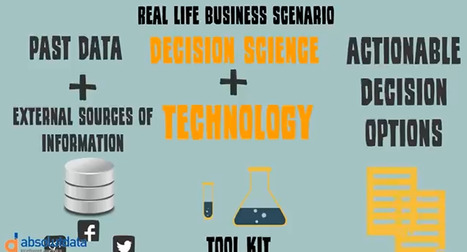
A great way to learn the essence of DI from Absolutdata
|
|
Scooped by
Decision Intelligence
November 12, 2014 3:12 PM
|
Scoop.it!

Gaurav Rastogi: "We were all doing it wrong— the bridge from 'data' to 'decisions' should be built decision first. "
I'm thrilled that AbsolutData is positioning around Decision Engineering! "Decision Engineering" is what we called Decision Intelligence in its previous incarnation.
|
|
Rescooped by
Decision Intelligence
from Non-Equilibrium Social Science
November 12, 2014 2:13 PM
|
Scoop.it!

When designing an agent-based simulation, an important question to answer is how to model the decision making processes of the agents in the system. A large number of agent decision making models can be found in the literature, each inspired by different aims and research questions. In this paper we provide a review of 14 agent decision making architectures that have attracted interest. They range from production-rule systems to psychologically- and neurologically-inspired approaches. For each of the architectures we give an overview of its design, highlight research questions that have been answered with its help and outline the reasons for the choice of the decision making model provided by the originators. Our goal is to provide guidelines about what kind of agent decision making model, with which level of simplicity or complexity, to use for which kind of research question.by Tina Balke and Nigel Gilbert
For those note familiar with agent-based social simulation, the idea is to simulate the individual decisions of many "agents", each representing a person, in some situation. For example, we might model decisions that people make as they move through a train station or amusement park, in order to design those places to best handle traffic flow.
This is a terrific, comprehensive review article, covering a number of ways of approaching the task of modeling those individual decisions made by simulated agents. Each is designed with somewhat different constraints in mind. For instance, some models like SOAR, are meant to mimic certain cognitive processes.
From a Decision Intelligence point of view, these approaches are complementary. If we want a sophisticated model of the emergent behavior of a large number of people, as one building block in a decision model for what to do about it, an agent-based simulation can be very helpful. For instance, we might be trying to decide which new medicine to launch, taking into account our competitors, our price to produce the medicine, and its impact on disease. Part of that decision model might be based on an agent-based simulation of the decisions that people make to take the medicine, and their behavior that leads to contracting the disease.
To continue the example, we could either use an agent-based simulation to learn from the agent-based simulation, or have it run in the same simulation as a decision model. For an example of the first, an agent-based simulation might show that the disease is expected to grow geographically according to a certain pattern. That spread pattern would then be an external input to a decision model.
The second way to use this is to use the decision model to interactively move certain assumptions about the decision-making process, and to immediately observe the impact on agents. For instance, we may adjust the number of dollars invested in a public health campaign and observe how that impacts the emergent properties of an agent-based simulation. There are a lot of possibilities here!
|
|
Scooped by
Decision Intelligence
November 10, 2014 6:17 PM
|
Scoop.it!

Seminar Information
Professor Jay Forrester, in the fall of 1999, conducted a seminar series for Ph.D. students in system dynamics. Each of the eleven three-hour sessions is devoted to a different stand-alone topic, which should be of benefit to any student or practitioner in the field. The series is not a progressive tutorial for learning system dynamics, but covers related concepts and philosophy.
This looks like a great resource!
|
|
Scooped by
Decision Intelligence
November 10, 2014 5:55 PM
|
Scoop.it!

Here the abstract for my talk on Friday in SF: Decision Intelligence is an emerging discipline that unifies machine learning, complex systems, predictive analytics, causal reasoning, optimization, and more into a unified framework that overcomes limitations of the current data stack that are faced by organizations worldwide. Just as the Unified Modeling Language (UML), along with associated tool companies like Rational, brought the discipline of design to software development, decision intelligence is a methodology, supported by software, that overcomes a number of barriers that have limited the practical use cases of the analytic / data stack. In particular, Decision Intelligence brings engineering practices to decision making, treating the “decision” as an engineered artifact. This means that best practices from design, agile development, and more can now be used to evolve decisions over time, creating a continuous “organizational learning” framework in diverse settings such as the US government and transnational corporations.
I hope to see you there!







Congratulations to Absolutdata for its first Decision Engineering product! Truly a milestone.