Your new post is loading...

|
Scooped by
heather dawson
January 12, 6:31 AM
|
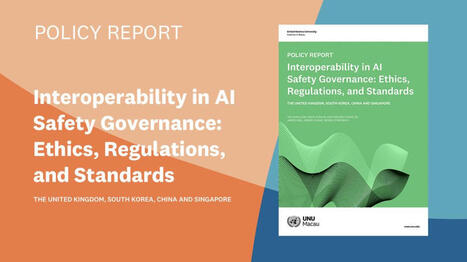
The United Nations University Institute in Macau has released this new policy report offering critical recommendations to strengthen global AI safety frameworks through enhanced interoperability. Drawing on country studies from China, South Korea, Singapore, and the United Kingdom, the report identifies effective tools and key barriers to interoperability in AI safety governance. It highlights practical ways to build a governance ecosystem that is globally informed yet locally grounded.
|
|
Scooped by
heather dawson
December 18, 2025 11:31 AM
|
UNESCO developed these new guidelines in response to the rapid, uneven adoption of AI across justice systems worldwide. The Guidelines provide practical principles, safeguards and recommendations to ensure AI strengthens, rather than undermines, human-led justice.
|
|
Scooped by
heather dawson
December 18, 2025 11:14 AM
|
to explore benefit and problems that AI could bring to public private partnerships PPP in relations to sustainable development goals The items are still being added but will follow the project life cycle including Planning & Project Identification; Financial Modelling & Investment; Stakeholder Engagement and Procurement & Tendering.
|
|
Scooped by
heather dawson
December 18, 2025 4:53 AM
|
However we feel about it, artificial intelligence (AI) is here to stay. The technology
is advancing rapidly and will have implications for many aspects of our lives –
from healthcare to education to employment. However, the impact of AI on
society is not predetermined; it depends on the choices we make today. At The
London School of Economics and Political Science (LSE) in the UK, social
scientists are exploring the future of AI and the critical decisions we need to
make to ensure it serves the greater good
|
|
Scooped by
heather dawson
December 17, 2025 5:08 AM
|
|
|
Scooped by
heather dawson
December 11, 2025 2:49 PM
|
This study examined how AI-generated summaries, which have become visually prominent in online search results, affect how users think about different issues. In a preregistered randomized controlled experiment, participants (N = 2,004) viewed mock search result pages varying in the presence (vs. absence), placement (top vs. middle), and stance (benefit-framed vs. harm-framed) of AI-generated summaries across four publicly debated topics. Compared to a no-summary control group, participants exposed to AI-generated summaries reported issue attitudes, behavioral intentions, and policy support that aligned more closely with the AI summary stance. The summaries placed at the top of the page produced stronger shifts in users' issue attitudes (but not behavioral intentions or policy support) than those placed at the middle of the page. We also observed moderating effects from issue familiarity and general trust toward AI. In addition, users perceived the AI summaries more useful when it emphasized health harms versus benefits. These findings suggest that AI-generated search summaries can significantly shape public perceptions, raising important implications for the design and regulation of AI-integrated information ecosystems.
|
|
Scooped by
heather dawson
December 10, 2025 2:17 PM
|
UNU Macau launched a new policy report proposing actionable pathways to bridge global AI safety governance
|
|
Scooped by
heather dawson
December 3, 2025 3:24 AM
|
The tool is for Australian Government teams working on an artificial intelligence (AI) use case. It helps teams identify, assess and manage AI use case impacts and risks against Australia's AI Ethics Principles. Understanding and managing AI use case impacts and risks is critical for effective AI governance. The tool is available as a fillable template.
|
|
Scooped by
heather dawson
November 19, 2025 4:40 AM
|
AI plan for the Australian Public Service Government of Australia | 12 Nov 2025 The plan sets out how the Australian Public Service will harness artificial intelligence (AI) to deliver better services. It provides the platform for every public servant to have the foundational training and capability support, access and the guidance needed to use AI tools safely and responsibly. It sets out 15 initiatives across 3 pillars.
|
|
Scooped by
heather dawson
November 13, 2025 5:02 AM
|
The advent of LLMs has given rise to a new type of web search: Generative search, where LLMs retrieve web pages related to a query and generate a single, coherent text as a response. This output modality stands in stark contrast to traditional web search, where results are returned as a ranked list of independent web pages. In this paper, we ask: Along what dimensions do generative search outputs differ from traditional web search? We compare Google, a traditional web search engine, with four generative search engines from two providers (Google and OpenAI) across queries from four domains. Our analysis reveals intriguing differences. Most generative search engines cover a wider range of sources compared to web search. Generative search engines vary in the degree to which they rely on internal knowledge contained within the model parameters v.s. external knowledge retrieved from the web. Generative search engines surface varying sets of concepts, creating new opportunities for enhancing search diversity and serendipity. Our results also highlight the need for revisiting evaluation criteria for web search in the age of Generative AI.
|
|
Scooped by
heather dawson
November 12, 2025 5:30 AM
|
The growing ubiquity of conversational AI highlights the need for frameworks that capture not only users' instrumental goals but also the situated, adaptive, and social practices through which they achieve them. Existing taxonomies of conversational behavior either overgeneralize, remain domain-specific, or reduce interactions to narrow dialogue functions. To address this gap, we introduce the Taxonomy of User Needs and Actions (TUNA), an empirically grounded framework developed through iterative qualitative analysis of 1193 human-AI conversations, supplemented by theoretical review and validation across diverse contexts. TUNA organizes user actions into a three-level hierarchy encompassing behaviors associated with information seeking, synthesis, procedural guidance, content creation, social interaction, and meta-conversation. By centering user agency and appropriation practices, TUNA enables multi-scale evaluation, supports policy harmonization across products, and provides a backbone for layering domain-specific taxonomies. This work contributes a systematic vocabulary for describing AI use, advancing both scholarly understanding and practical design of safer, more responsive, and more accountable conversational systems.
|
|
Scooped by
heather dawson
November 7, 2025 7:03 AM
|
- Read the report by Robin van Kessel, Jelena Schmidt, Stephanie Winitsky, George Wharton, Elias Mossialos: Introduces a new taxonomy and eight policy recommendations to guide evidence-based adoption
|
|
Scooped by
heather dawson
November 1, 2025 2:34 PM
|
AI Tools Radar
https://radar.ircai.org/en/
Created by UNESCO this portal is designed to provide a catalogue of innovative and impactful AI tools from around the world, focussing on applications in the public sector, media, and judiciary. It is not intended to be exhaustive. They are selected for usefulness, accessibility and ethics. It is possible to browse items by sources, country of origin. All have descriptions
|
|
|
Scooped by
heather dawson
January 5, 7:28 AM
|
Students and faculty are increasingly beginning their research by asking AI systems for explanations rather than by searching library resources. Chatbots and AI enhanced search tools now deliver fluent answers before users ever see a list of sources. This commentary argues that this “answer first” environment changes the starting point of academic inquiry and calls for a corresponding shift in academic librarianship. Librarians need an answer first mindset that recognizes AI responses as texts that require interpretation. I propose two related constructs to support that stance, a brief “answer typography” that helps librarians notice what kind of work AI answers are doing, and the CARE approach (Classify, Assess, Review, Enhance), which articulates a critical way of engaging those answers with users. Together, these ideas position librarians as leaders in helping their communities read, question, and build upon AI generated answers in ways that keep human judgment and scholarly evidence at the center of inquiry.
|
|
Scooped by
heather dawson
December 18, 2025 11:15 AM
|
find more information about the Synthetic Pasts research project. Which is practical resource supporting cultural organisations considering the use of AI to ‘revive’ collections and engage visitors. Its website has resources including case studies of the use of AI to recreate historical figures in museums and to see interviews with holocaust survivors
|
|
Scooped by
heather dawson
December 18, 2025 11:13 AM
|
AI Deals and disputes tracker the Tow Center for Digital Journalism has developed a tracker which can be used to monitors developments between news publishers and AI companies—including lawsuits, deals, and grants. Sources for this are listed and in the public sphere . trace news relating to Meta, OpenAi and more. Updates once a month
|
|
Scooped by
heather dawson
December 18, 2025 4:52 AM
|
New paper published in Science provides the most comprehensive evidence to date on the mechanisms of AI persuasion and their implications for democracy and AI governance. Authors include Dr Kobi Hackenburg, UK AI Security Institute Oxford University’s Oxford Internet Institute (OII), DSI Faculty Affiliate Dr Ben Tappin, Assistant Professor in the LSE Department of Psychological and Behavioural Science, and Professor Helen Margetts, Senior Adviser at the DSI and Professor of Society at OII.
|
|
Scooped by
heather dawson
December 11, 2025 2:49 PM
|
The use of large language models (LLMs) in scholarly publications has grown dramatically since the launch of ChatGPT in late 2022. This usage is often undisclosed, and it can be challenging for readers and reviewers to identify human written but LLM-revised or translated text, or predominantly LLM-generated text. Given the known quality and reliability issues connected with LLM-generated text, their potential growth poses an increasing problem for research integrity, and for public trust in research.
This study presents a simple and easily reproducible methodology to show the growth in the full text of published papers, across the full range of research, as indexed in the Dimensions database. It uses this to demonstrate that LLM tools are likely to have been involved in the production of more than 10% of all published papers in 2024, based on disproportionate use of specific indicative words, and draws together earlier studies to confirm that this is a plausible overall estimate.
It then discusses the implications of this for the integrity of scholarly publishing, highlighting evidence that use of LLMs for text generation is still being concealed or downplayed by authors, and presents an argument that more comprehensive disclosure requirements are urgently required to address this.
|
|
Scooped by
heather dawson
December 11, 2025 2:46 PM
|
|
|
Scooped by
heather dawson
December 10, 2025 2:15 PM
|
This paper critically examines the use of AI in human resource management, showing how flawed objectives, biased data, and opaque programming undermine its effectiveness. It challenges the optimism surrounding AI’s promise of efficiency and fairness in recruitment, pay, scheduling, and performance management.
|
|
Scooped by
heather dawson
December 2, 2025 4:47 AM
|
The adoption of generative AI for REF-related work is “relatively shallow and/or patchy” across higher education institutions, according to a report from the University of Bristol’s Centre for Higher Education Transformations and Jisc. The report, funded by Research England, is based on interviews with pro vice chancellors for research and institutional REF leads, as well as a survey of more than 350 university staff. It finds that only a few institutions are in the process of developing AI tools for REF purposes – but there is a “broad consensus” that REF will become increasingly “AI-infused”.
|
|
Scooped by
heather dawson
November 13, 2025 7:48 AM
|
This study proposes a conceptual framework for understanding how generative artificial intelligence (GenAI) affects university students’ learning journey.
|
|
Scooped by
heather dawson
November 13, 2025 5:02 AM
|
With the advent of large language models (LLMs), there is a growing interest in applying LLMs to scientific tasks. In this work, we conduct an experimental study to explore applicability of LLMs for configuring, annotating, translating, explaining, and generating scientific workflows. We use 5 different workflow specific experiments and evaluate several open- and closed-source language models using state-of-the-art workflow systems. Our studies reveal that LLMs often struggle with workflow related tasks due to their lack of knowledge of scientific workflows. We further observe that the performance of LLMs varies across experiments and workflow systems. Our findings can help workflow developers and users in understanding LLMs capabilities in scientific workflows, and motivate further research applying LLMs to workflows.
|
|
Scooped by
heather dawson
November 12, 2025 5:28 AM
|
AI Competencies for Academic Library Workers Approved by the ACRL Board of Directors, October 2025 PDF Version Contents Foreword Guiding Mindsets Competencies
|
|
Scooped by
heather dawson
November 3, 2025 9:48 AM
|
1. Evidence synthesists are ultimately responsible for their evidence synthesis, including the decision to use artificial intelligence (AI) and automation, and to ensure adherence to legal and ethical standards. 2. Cochrane, the Campbell Collaboration, JBI and the Collaboration for Environmental Ev …
|


 Scoop.it!