The aim of this paper is to highlight the situation whereby content generated by the large language model ChatGPT is appearing in peer-reviewed papers in journals by recognized publishers. The paper demonstrates how to identify sections that indicate that a text fragment was generated, that is, entirely created, by ChatGPT. To prepare an illustrative compilation of papers that appear in journals indexed in the Web of Science and Scopus databases and possessing Impact Factor and CiteScore indicators, the SPAR4SLR method was used, which is mainly applied in systematic literature reviews. Three main findings are presented: in highly regarded premier journals, articles appear that bear the hallmarks of the content generated by AI large language models, whose use was not declared by the authors (1); many of these identified papers are already receiving citations from other scientific works, also placed in journals found in scientific databases (2); and, most of the identified papers belong to the disciplines of medicine and computer science, but there are also articles that belong to disciplines such as environmental science, engineering, sociology, education, economics and management (3). This paper aims to continue and add to the recently initiated discu
Maintained by the Emerging Technology Observatory (ETO (a project of the Center for Security and Emerging Technology at Georgetown University):This website provides free access to a searchable collection of AI-relevant laws, regulations, standards, and other governance documents from the United States and around the world. Updated regularly, AGORA includes summaries, document text, thematic tags, and filters. USA has federal and state laws. There are also Chinese laws and corporate documents
Department forScience, Innovation& Technology AI Opportunities Action Plan: government response Presented to Parliament by the Secretary of State Science, Innovation and Technology by Command of His Majesty. Ordered by the House of Commons to be printed on 13 January 2025.
In recent months, several publishers have announced that they are licensing their scholarly content for use as training data for LLMs. These deals illuminate how major publishers are grappling with their strategy amid uncertainty. To understand the dynamics around this fast-developing market, Ithaka S+R has launched a tracker of these licensing deals. In it, we catalog (when the information is available), the publisher, the purchaser, the deal type and size, and the impact of and strategy behind the deal. Roger Schonfeld provides more analysis about these deals in his Scholarly Kitchen piece, “Tracking the Licensing of Scholarly Content to LLMs.”
So far, several major publishers have announced deals. For them, there is a substantial near-term revenue upside. The basic idea behind these deals is to generate revenue for the publishing house in exchange for easy, reliable, and legal access to the content for the LLM. A number of companies are in the hunt for this content, including not only OpenAI and Google but also Apple and more specialized providers.
Thus far a standard set of terms or overall model from which to build these deals has yet to emerge. Pricing of course is at the top of mind for everyone, but there are many other considerations as well. There are technical and reputational questions about how corrections or retractions will propagate through an LLM and whether an author can opt out, and there are business model issues such as whether provenance will be tracked through the output from an LLM such that a citation or link can be provided back into the scholarly record, just to take several straightforward examples.
We will update the tracker periodically. You may also access the tracker as a Google Sheet. If you are aware of other deals that we have not yet documented in this tracker, please contact us using the form below.
This primer gives data curators an overview of the licenses that are commonly applied to datasets and code, familiarizes them with common requirements in institutional data policies, and makes recommendations for working with researchers who need to apply a license to their research outputs or understand a license applied to data or code they would like to reuse. While copyright issues are highly case-dependent, the introduction to the data copyright landscape and the general principles provided here can help data curators empower researchers to understand the copyright context of their own data.
A successful transition to open access (OA) is one where everyone can read and reuse scholarly work, and everyone can publish OA. OASPA’s recommendations are made on this basis. This work is a practical listing of suggestions for publishing organisations, and also for those who purchase, pay for, or invest in scholarly publishing. Coverage focuses on reducing inequity by addressing financial and workflow barriers impeding OA publishing. There are five headline goals, details under each goal, and a definitions section. The work also carries links, throughout, to real-life examples. These are recommendations, driven by community inputs and open consultation, and offered as a toolkit of suggestions and ideas to support OA, and the transition to OA, in ways that include the work of all scholars. This is important because OA publishing is about disseminating the work of people - not nations, not institutions, not organisations, but individual researchers and author-groups.
Produced by UNICRI’s Centre for Artificial Intelligence (AI) and Robotics and with the financial support of the European Union (EU), the report explores global public perceptions of AI in law enforcement. It is based on a survey conducted across six continents over a period of eight months. The findings reveal cautious optimism about AI’s potential in policing, in particular when it comes to investigating serious crimes. However, significant ethical concerns persist, particularly regarding privacy, discrimination, and real-time decision-making. Trust emerged as a key factor, with transparency, human oversight, and robust legal frameworks deemed essential for fostering public confidence. Part of UNICRI’s Toolkit for Responsible AI Innovation in Law Enforcement, the report underscores the importance of collaboration between law enforcement, policymakers, and the public to ensure AI use aligns with justice, fairness, and societal values. This publication calls for ethical AI practices, ongoing public engagement, and further research to guide responsible innovation and maintain public trust.
In a world increasingly shaped by digital transformation, AI and data science present new opportunities to change policymaking in nearly all areas of policy. Yet the capabilities of these emerging technologies are still unfolding and need to be better understood, both in terms of their benefits and their limitations.
This event launches the publication of the most recent issue of the LSE Public Policy Review, which brings together contributions from a range of disciplines - from philosophy to statistics, government and law - to reflect together on future directions, applications, and consequences of the use of AI in public policies. Join our panellists as they discuss how emerging technologies can transform evidence-based policy development through their analytical capabilities, predictive powers, and real-time monitoring, while also bringing questions around regulation, transparency, accountability and ethics to the fore.
Speakers: Professor Helen Margetts Professor Andrew Murray Dr Dorottya Sallai Chloe Smith
Chair: Professor Kenneth Benoit
#AI #Events #London
Full details/attend: https://www.lse.ac.uk/Events/2024/11/202411051830/AI-in-public-policy-opportunities-and-challenges?_gl=1*iw8p76*_gcl_au*MTc5MzY5OTg0NS4xNzE4MDk4Mjc4*_ga*NTgzNzc1NTkxLjE2NTQ1MTM3NzU.*_ga_LWTEVFESYX*MTcyNDc2MjY2My40OTEuMS4xNzI0NzYzMjc5LjYwLjAuMA..
To turn on captions, go to the bottom-right of the video player and click the icon. Please note that this feature uses Automatic Speech Recognition (ASR) technology, or machine generated transcription, and is not 100% accurate.
The Artificial Intelligence Disclosure (AID) Framework: An Introduction The purpose of the Artificial Intelligence Disclosure (AID) Framework is to provide brief, targeted disclosure about the use of AI systems based on the range of activities used for research writing. The AID Statement is appended to the end of the paper (similar to an acknowledgments section), detailing the AI tools used and the manner in which they were used, based on the possible points of engagement through the writing process, as captured in the headings below. As generative AI tools may not be an author of scholarly work, overlap in categorization between CRediT and AID Framework have been edited as necessary to reflect this distinction. The formatting is intended to be both human- and machine-readable, and uses the following structure:
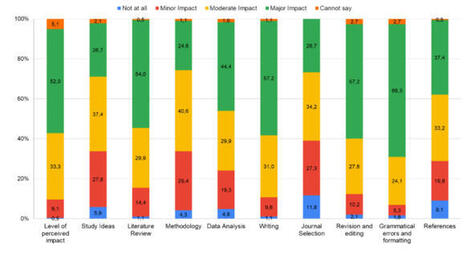
With breakthroughs in Natural Language Processing and Artificial Intelligence (AI), the usage of Large Language Models (LLMs) in academic research has increased tremendously. Models such as Generative Pre-trained Transformer (GPT) are used by researchers in literature review, abstract screening, and manuscript drafting. However, these models also present the attendant challenge of providing ethically questionable scientific information. Our study provides a snapshot of global researchers’ perception of current trends and future impacts of LLMs in research. Using a cross-sectional design, we surveyed 226 medical and paramedical researchers from 59 countries across 65 specialties, trained in the Global Clinical Scholars’ Research Training certificate program of Harvard Medical School between 2020 and 2024. Majority (57.5%) of these participants practiced in an academic setting with a median of 7 (2,18) PubMed Indexed published articles. 198 respondents (87.6%) were aware of LLMs and those who were aware had higher number of publications (p < 0.001). 18.7% of the respondents who were aware (n = 37) had previously used LLMs in publications especially for grammatical errors and formatting (64.9%); however, most (40.5%) did not acknowledge its use in their papers. 50.8% of aware respondents (n = 95) predicted an overall positive future impact of LLMs while 32.6% were unsure of its scope. 52% of aware respondents (n = 102) believed that LLMs would have a major impact in areas such as grammatical errors and formatting (66.3%), revision and editing (57.2%), writing (57.2%) and literature review (54.2%). 58.1% of aware respondents were opined that journals should allow for use of AI in research and 78.3% believed that regulations should be put in place to avoid its abuse. Seeing the perception of researchers towards LLMs and the significant association between awareness of LLMs and number of published works, we emphasize the importance of developing comprehensive guidelines and ethical framework to govern the use of AI in academic research and address the current challenges.
We brought together over 45 experts and practitioners in AI to advance practical approaches to AI safety that embody the values of openness, transparency, community-centeredness and pragmatism.
Literature reviews are an essential component of scientific research, but they remain time-intensive and challenging to write, especially due to the recent influx of research papers. This paper explores the zero-shot abilities of recent Large Language Models (LLMs) in assisting with the writing of literature reviews based on an abstract. We decompose the task into two components: 1. Retrieving related works given a query abstract, and 2. Writing a literature review based on the retrieved results. We analyze how effective LLMs are for both components. For retrieval, we introduce a novel two-step search strategy that first uses an LLM to extract meaningful keywords from the abstract of a paper and then retrieves potentially relevant papers by querying an external knowledge base. Additionally, we study a prompting-based re-ranking mechanism with attribution and show that re-ranking doubles the normalized recall compared to naive search methods, while providing insights into the LLM's decision-making process. In the generation phase, we propose a two-step approach that first outlines a plan for the review and then executes steps in the plan to generate the actual review. To evaluate different LLM-based literature review methods, we create test sets from arXiv papers using a protocol designed for rolling use with newly released LLMs to avoid test set contamination in zero-shot evaluations. We release this evaluation protocol to promote additional research and development in this regard. Our empirical results suggest that LLMs show promising potential for writing literature reviews when the task is decomposed into smaller components of retrieval and planning. Further, we demonstrate that our planning-based approach achieves higher-quality reviews by minimizing hallucinated references in the generated review by 18-26% compared to existing simpler LLM-based generation methods.
Artificial Intelligence is not only a generational technology, but also a general purpose technology—one that has outsized potential to transform societies and economies globally. How should we use AI to not only better understand the world, but organise, develop, and elevate it?
Reid Hoffman, Co-Founder of LinkedIn and Inflection AI, and author of Superagency, will be discussing all of this and more with LSE President and Vice Chancellor Professor Larry Kramer.
To turn on captions, go to the bottom-right of the video player and click the icon. Please note that this feature uses Automatic Speech Recognition (ASR) technology, or machine generated transcription, and is not 100% accurate.
Artificial Intelligence (AI), like any transformative technology, has the potential to be a double-edged sword, leading either toward significant advancements or detrimental outcomes for society as a whole. As is often the case when it comes to widely-used technologies in market economies (e.g., cars and semiconductor chips), commercial interest tends to be the predominant guiding factor. The AI community is at risk of becoming polarized to either take a laissez-faire attitude toward AI development, or to call for government overregulation. Between these two poles we argue for the community of AI practitioners to consciously and proactively work for the common good. This paper offers a blueprint for a new type of innovation infrastructure including 18 concrete milestones to guide AI research in that direction. Our view is that we are still in the early days of practical AI, and focused efforts by practitioners, policymakers, and other stakeholders can still maximize the upsides of AI and minimize its downsides. We talked to luminaries such as recent Nobelist John Jumper on science, President Barack Obama on governance, former UN Ambassador and former National Security Advisor Susan Rice on security, philanthropist Eric Schmidt on several topics, and science fiction novelist Neal Stephenson on entertainment. This ongoing dialogue and collaborative effort has produced a comprehensive, realistic view of what the actual impact of AI could be, from a diverse assembly of thinkers with deep understanding of this technology and these domains. From these exchanges, five recurring guidelines emerged, which form the cornerstone of a framework for beginning to harness AI in service of the public good. They not only guide our efforts in discovery but also shape our approach to deploying this transformative technology responsibly and ethically.
Artificial intelligence (AI) is transforming the way we live, work, produce and trade. As it further develops, AI is expected to unlock unprecedented economic and societal opportunities.
To get content containing either thought or leadership enter:
To get content containing both thought and leadership enter:
To get content containing the expression thought leadership enter:
You can enter several keywords and you can refine them whenever you want. Our suggestion engine uses more signals but entering a few keywords here will rapidly give you great content to curate.


 Your new post is loading...
 Scoop.it!