 Your new post is loading...
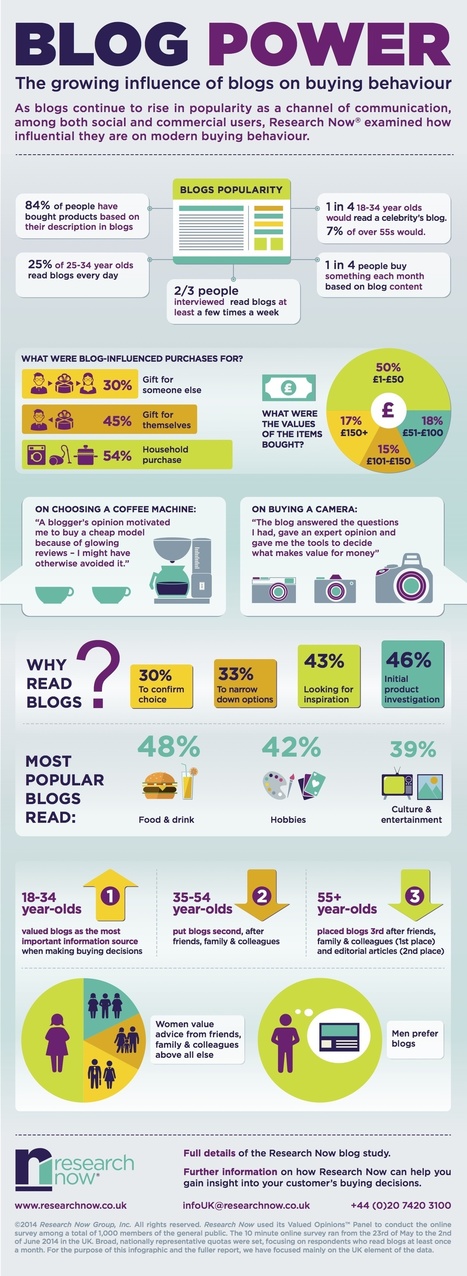
The power of blogs in influencing consumer purchase decisions is stronger than you might realize. According to data from a research study conducted by Research Now, nearly nine in 10 consumers (84%) make purchases after reading about a product or service on a blog. Among consumers between the ages of 18-34, blogs ranked as the most important source of information to make buying decisions. Among consumers between the ages of 35-54, blogs ranked as the second most important source behind friends, family, and colleagues. Even older consumers (55 and older) value blogs when making purchase decisions ranking them third in terms of importance behind friends, family, and colleagues and editorial articles.
For brands, this data is critical. The research found that blogs influence household purchase decisions for 54% of the survey respondents, gifts that consumers are buying for themselves (45%), and gifts they’re buying for other people (30%). In fact, 25% of respondents indicated that they buy something each month based on blog content!
Consumers are turning to blogs for specific reasons as they travel through the path to making a purchase. Nearly one in two (46%) use blogs for initial product investigation, and 43% use blogs for inspiration. One in three consumers (33%) use blogs to narrow down their purchase options while 30% use blogs to confirm their purchase choices. In other words, blogs play a role at every stop along the marketing and sales funnel....
Via Jeff Domansky

|
Rescooped by
Darcy Bevelacqua
from Social Media Useful Info
November 28, 2014 12:47 PM
|
If you’re creating content to help market your business, you know there’s a ton of competition for your prospects’ attention.
There are two critical steps to creating a content strategy that helps your brand get noticed and converts: developing buyer personas AND determining what questions they will ask at each stage of the sales cycle.
Via Ivo Nový
Before deciding to read this topic, ask yourself first – What are the things you wished was there in your last visit to a shopping site?
Should there have been more scope for interaction? Should there have been a price comparison facility? Did the web design communicate what it promised to sell? Would you purchase more if they offer seasonal discounts / free delivery next time?
Being 'user friendly', is the focal point of all e commerce sites. A design that is user focused, generates more conversions. So, if you were given the opportunity to make some improvements to the last visited shopping website, what would you have added or changed?
This post will bring to you a set of five best shopping site names, which try to maintain the key marketing principles, together with a beautiful web design....
Via Jeff Domansky
L2 conducted a study to assess the digital performance of 382 leading consumer brands in the world, drawing them from eight verticals across 17 platforms and concluded that they are active, on an average, on seven social platforms each.
The researchers also found out that presence across lots of social platforms does not guarantee greater engagement from fans. It was also observed that local networks are capable of delivering better results in areas where they have a strong social presence instead of bigger sites like Facebook and YouTube....
Via Jeff Domansky
Search engine optimization experts share tips and tools to help you manage your company's online reputation.
A handful of companies offer free and paid online reputation management services for consumers and businesses, including Reputation.com and Brand Yourself. In addition to using these services, or in lieu of them, both small and midsize businesses and enterprise digital marketers can take strategic steps to ensure their companies' online reputations are solid.
The following 15 tips and eight tools are all valuable and effective ways to help manage your organization's corporate reputation online....
Via Jeff Domansky
|
|
Scooped by
Darcy Bevelacqua
November 14, 2014 10:14 AM
|
Customer engagement management (CEM) is the practice of optimizing the lifetime value of customers. CEM is significantly influenced by customer communication practices and has seen rapid growth and adoption in recent years.
|
1) Following the money.
Brands rely on campaigns targeting bloggers and influencers to organically build buzz among followers on image-based social networks, and it’s a tactic that works incredibly well. But now, Pinterest and Instagram are introducing advertising with the goal of dramatically monetizing their currently-bare bottom lines. There are several recent reports that show Pinterest is pricing CPMs at $30-40 and that Instagram’s CPMs will also be on the high-end, with month-long campaigns starting at $350,000 and up. In 2015, you can expect to see major brands diverting advertising spends from traditional channels like TV into image-based social networks to up their game and stand apart from the competition. After all, glossy and gorgeous imagery is easily transferred to digital and social campaigns. Where there’s money spent, there is always the need for analytics and measurement in order to optimize and prove ROI.
2) Brand protection
Brands have enormous vested interest in knowing where and how their images are being used and shared – deliberately or otherwise — and to glean insights about people’s relationships with, and reactions to, their content. Equally important, visual listening will help brands ensure that other parties are not misusing their images.
3) Serendipitous insights
Visual listening will open up a world of insights and new business opportunities by discovering more about the moments in which branded images are used in relation to other images, content, and social markers. Using visual listening, you’ll be able to spot patterns and correlations that could lead to serendipitous discoveries, fuel new under-the-surface campaigns, reveal untapped audiences and stimulate product development ideas. For example, imagine the type of campaigns a sneaker brand can create after discovering that consumers are frequently sharing photos of their latest kicks while drinking coffee at Starbucks.
4) Tech innovation
Data science has come a long way. I believe that in 2015 the industry will innovate to make it possible to train a computer to recognize the difference between an image of a dog and a cat. It could even be sophisticated and powerful enough to discern a highly nuanced brand signal, like the crown within the Starbucks logo or the leaf at the top of Apple’s logo. Word on the street is that Facebook is already using some pretty advanced image recognition technology to identify faces in photos and images posted. These kinds of leaps in technology will unleash the potential and sophistication of visual listening.
5) Emotions front and center
Emojis, emoticons, and stickers are an integral part of our social vernacular as well as everyday conversations on text and chat. Earlier this year, the Unicode Consortium introduced approximately 250 brand new “pictographic symbols,” including such recognizable additions as the middle finger and the Vulcan salute. In 2015, more racially diverse emojis will be released. Since emojis are technically code, not images, they can today be measured through standard textual tools but for brands, the visual listening (and learning) opportunity lies in understanding how emojis are used contextually, alongside their logos and images.
6) Command centers as real-time visual listening sources
As the social environment matures in 2015, I anticipate that command centers will spread as a mainstream business tool. By tapping into unified views of textual and visual listening in a totally engaging way, marketers will create a compelling source of social intelligence and action.
Via Eric_Determined / Eric Silverstein
The customer landscape is shifting. It always does. This time, however, the door to Digital Darwinism has been kicked off its hinges. Technology and society are evolving faster than the ability to adapt. Consumers are becoming more connected. As such, they’re more informed. With information comes empowerment. And with new found connectedness and power, customer expectations begin to shatter current sales, marketing, and support models.
Social, mobile, and real-time each contribute to a new reality for customer experiences and engagement.
Via Eric_Determined / Eric Silverstein
Automotive finance providers cannot focus their efforts on only one or two areas of the lending process and expect to have satisfied customers; they need to excel in all areas throughout the life of the loan or lease according to the J.D. Power 2014 U.S. Consumer Financing Satisfaction StudySM released today.
Via Jörg Höhner
Businesses are transforming their service, marketing, sales, and commerce organizations in order to accommodate the “new rules” of omni-channel engagement
Via Pantelis Chiotellis
|
|
Scooped by
Darcy Bevelacqua
November 17, 2014 11:53 AM
|
Ask anyone who works in social and they’ll inevitably tell you that they want deeper, richer customer engagement. But look at the activities that companies undertake in social and it’s not at all clear that they are engaging in the right places.
|















Very useful for marketing and brand enhancement
Some really interesting statistics on how blogs are influencing consumer behaviour when it comes to buying choice.
Interesting information #blogging