Your new post is loading...

|
Scooped by
Edwin Rutsch
April 13, 2012 3:27 PM
|
A new study suggests the hidden costs of callousness. We’ve all had our moments of stinginess: We pass a homeless person and spare no change, or decline an appeal from a charity. We might feel a pang of guilt, but you can’t be nice to everyone, right?
A new study suggests there might be hidden costs to our callousness: It might harm our self-image and chip away at our commitment to morality.
By Brylyn Stacy
|
|
Scooped by
Edwin Rutsch
April 9, 2012 2:52 PM
|
Dr. Esposito identified the lack of compassion as manifestation of violence, terrorism, undetected exploitation, reckless capitalism, dogma, combat, religious exclusionism, self-righteousness, intolerance, anti-Semitism, Islamophobia, and anti-immigrant sentiments. He stressed there could be no dialogue without investigation into the foundation of any religion, resounding his belief that universal humanitarianism and universal altruism were the paths to universal compassion. He emphasized that life was supposed to be a positive, happy experience, and humanity should be able to look forward to a future with a healthy, multi-cultural, multi-ethnic world view. by Nazli Siddiqu
|
|
Rescooped by
Edwin Rutsch
from Empathy Movement Magazine
April 9, 2012 1:05 PM
|
Talk: "The Place for Compassion in a Modern Age" Jim Doty, CCARE, speaks at the 2012 Wisdom 2.0 Conference.
|
|
Scooped by
Edwin Rutsch
April 5, 2012 2:41 PM
|
Week of compassion will be April 2nd-6th. Join us as we get a glimpse into the everyday struggles of people around us so that we can love them and be moved to help alleviate those struggles. Monday: Socks – Kickoff Day: Wear only socks. Kickoff the week by kicking off your shoes! Kickoff @ 9 am at the Campanile next to the Student Center. (You may want to carry an extra pair of sandals or flip flops in case you need to go somewhere that requires shoes. Alternatively, you could wear an extra pair of shoes over your shoulder or on your bag to represent the theme of the day.)
|
|
Scooped by
Edwin Rutsch
April 1, 2012 2:41 PM
|
What happens when you bring together a bunch of neuroscientists, psychologists, educators, medical researchers and a scholar of Eastern religion who happens to be the Dalai Lama’s own editor in the creative, academic setting of Stanford University? You get CCARE, the Center for Compassion and Altruism Research and Education. Founded by Dr. James R. Doty, a clinical professor of neurosurgery at Stanford, CCARE is at the forefront of a growing number of research centers where scholars, researchers, and philosophical and contemplative thinkers are turning their attention to the science of compassion.
|
|
Scooped by
Edwin Rutsch
March 29, 2012 4:22 PM
|
National compassion occurs when a country's policies give high priority to relieving peoples' suffering.? It also occurs when a majority of the people hold compassionate values and seek to help one another, even if their government does not enact compassionate policies "It is lack of love for ourselves that inhibits our compassion toward others. If we make friends with ourselves, then there is no obstacle to opening our hearts and minds to others."
-Anonymous
|
|
Scooped by
Edwin Rutsch
March 22, 2012 3:59 PM
|
The interfaith gathering was one of the coalition's first projects, she said, and over the years has been hosted by Roman Catholic, Episcopal, United Methodist, Lutheran, Church of Jesus Christ of Latter Day Saints and Presbyterian churches as well as a Jewish synagogue. "It's a great experience of diversity," Ms. Orlando said. "We came together to reflect how we can live together. We found a lot of discrimination around faith groups as well as color.
|
|
Scooped by
Edwin Rutsch
March 18, 2012 4:45 PM
|
Where is Jesus calling you to grow in compassion as He transforms you from the inside out? Here are a couple of areas to consider: Compassion in your relationships – Who are the people who are closest to you? Your family, your friends, your classmates or workmates? Do you live a lifestyle of compassion with them? Are you sacrificially generous (time, talent, touch and treasure) with them? Are you struggling with compassion in any of these relationships? If so, ask Jesus to give you insight and discernment on why you’re struggling with compassion? Then ask Him to give you compassion for that person and in that relationship.
|
|
Scooped by
Edwin Rutsch
March 18, 2012 4:39 PM
|
I’ve suffered a lot in my life. From a young age, I was so busy figuring out how to survive, that looking compassionately—with love, warmth, and kindness—upon myself was simply too hard to come by. When I was introduced to Buddhism at 16, I began in my brain to grapple with healing from within, and started to believe, intellectually at least, in the power of compassion to soothe life’s hurts. Oh how I loved this idea of compassion!
|
|
Scooped by
Edwin Rutsch
March 16, 2012 4:03 PM
|
Muslim-Christian dialogue will take center stage at the statewide gathering next weekend of the Catholic social justice organization, Pax Christi.
The “Compassion Conference” will be held at the University of the Incarnate Word and will feature academic experts on Islam as well as an array of local Muslim leaders and groups. Other religious leaders also are taking part, but Muslims were asked to play a key role in planning this conference, organizers said. By Abe Levy Councilors http://charterforcompassion.org/learn/council
|
|
Scooped by
Edwin Rutsch
March 15, 2012 3:04 PM
|
"“Compassion will be the new intelligence that will guide humanity into an expansive state of existence beyond the illusion of choice that currently pervades human thought… It is no longer a theory or a prediction, it is possible now. The future has arrived,” writes David Coles, author of The Insanity of Humanity. In this short video clip Coles shines a stark light on the modern day slaughterhouse, an institution of mass killing of animals, that stands in stark contrast to his vision of the future of humanity and the intelligence of compassion that must guide us into the future."
|
|
Scooped by
Edwin Rutsch
March 12, 2012 4:48 PM
|
|
|
Scooped by
Edwin Rutsch
March 8, 2012 1:44 PM
|
Taking care of someone else, especially someone with special needs, day in and day out can create Compassion Fatigue. Watch to hear how psychotherapist, author, and professional speaker Barbara Bartlein deals with Compassion Fatigue in her own life, and her advice for others.
|
|
|
Rescooped by
Edwin Rutsch
from Empathy Movement Magazine
April 12, 2012 12:26 PM
|
Compassion, like all emotions, is a feeling state that serves as an engine for action. Once we feel an emotion, it increases the likelihood that we'll engage in certain behaviors. ...compassion can also be studied scientifically, and one of the foremost researchers on compassion is Professor David DeSteno, author of the book "Out Of Character: Surprising Truths About the Liar, Cheat, Sinner (and Saint) Lurking in All of Us" and the director of the Social Emotions Lab at Northeastern University. On April 15 at 4 p.m., Professor DeSteno will be speaking about the science of compassion at Temple Beth El of Northern Westchester. I had an opportunity to ask him some questions about how the the science of compassion can inform our religious and ethical outlooks: by Rabbi Geoffrey A. Mitelman
|
|
Rescooped by
Edwin Rutsch
from Empathy Movement Magazine
April 9, 2012 1:05 PM
|
Compassion:
Tracking Values and Behaviors Online Actively caring for Self & Others
Dr. Yotam Heineberg: CCARE - Center for Compassion and Altruism, Research and Education,
|
|
Scooped by
Edwin Rutsch
April 6, 2012 5:57 PM
|
Here is a situation that comes up often: groups A and B have some kind of issue with one another. By ‘group’ I could mean family, community, culture, race, nation, religion, etc. By ‘issue’ I could mean anything from some persistent gripes to major threats, violence, and hostilities. These issues could be on one or both sides, and to varying degrees of balance. In both of these groups you have individuals who are very hateful, suspicious, distrusting, or otherwise disfavor members of the other group for things they may have done. The actions could have been done by the group ‘officially’ as a group, or some individuals could have taken the actions without it officially being a ‘group’ action.
|
|
Scooped by
Edwin Rutsch
April 4, 2012 3:40 PM
|
Here is a situation that comes up often: groups A and B have some kind of issue with one another. By ‘group’ I could mean family, community, culture, race, nation, religion, etc. By ‘issue’ I could mean anything from some persistent gripes to major threats, violence, and hostilities. These issues could be on one or both sides, and to varying degrees of balance. In both of these groups you have individuals who are very hateful, suspicious, distrusting, or otherwise disfavor members of the other group for things they may have done. The actions could have been done by the group ‘officially’ as a group, or some individuals could have taken the actions without it officially being a ‘group’ action. The Spiritual Naturalist
with Humanist minister DT Strain
|
|
Scooped by
Edwin Rutsch
March 31, 2012 2:36 PM
|
Mike Austin offers a brief sketch of compassion as a virtue, along with some recommended work to develop in this area... Compassion is in. Celebrities champion compassionate causes. Bono, U2’s lead singer, has been instrumental in bringing attention and aid to those in Africa who suffer deeply due to grinding poverty, AIDS, and unfair trade policies. Other celebrities such as Julia Roberts, George Clooney, and Tom Brady have joined in this fight through their involvement with the ONE campaign. A Christian account of compassion will focus on the sick and the poor.
|
|
Rescooped by
Edwin Rutsch
from Empathy Movement Magazine
March 22, 2012 4:03 PM
|
A neuroscience team at Stanford University is exploring whether compassion can be learned. This has potentially great use for all sorts of places where violence and aggression cause problems — schools, prisons, streets and war zones. Dr. James Doty The research by Dr. James Doty and his team is simply fascinating. They are asking whether altruism and compassion actually reside concretely in the human brain. Can humans be taught to be more compassionate? The answers to these questions could have major impacts for our violence-prone society. Doty will be presenting a public lecture in Seattle April 4 at 3 p.m. at the University of Washington, sponsored by the Compassionate Action Network International.
|
|
Scooped by
Edwin Rutsch
March 21, 2012 9:00 PM
|
Many caregivers of wounded, ill and injured Service members, such as Recovery Care Coordinators and AW2 Advocates, as well as family members and friends, can sometimes experience what is known as compassion fatigue or burnout, which can lead to feelings of hopelessness, exhaustion, anger and depression. To help address and combat these feelings, last week’s RCC training, sponsored by the Office of Wounded Warrior Care and Transition Policy, included a new presentation called Resiliency 101.
|
|
Scooped by
Edwin Rutsch
March 18, 2012 4:42 PM
|
True Compassion is a collaborative workshop series, ephemeral mural and video. Organized by Intersection for the Arts, artist Evan Bissell worked with staff and clients of Larkin Street Youth Services (LSYS) to define and investigate the nature and limitations of compassion.
|
|
Scooped by
Edwin Rutsch
March 18, 2012 4:30 PM
|
"Compassion is such a powerful emotion. It's been called a moral barometer," study researcher Daryl Cameron, of the University of North Carolina at Chapel Hill, said in a statement. The researchers had study participants look at 15 images of people, including victims of war, crying babies and homeless people. The study participants were split up into three groups: the first was told to try and suppress feelings of sympathy, the second was told to try and suppress feeling of distress, and the third was told to just feel whatever emotions came to them. by Amanda L. Chan
|
|
Scooped by
Edwin Rutsch
March 15, 2012 3:07 PM
|
It's normal to not always act on your sense of compassion—for example, by walking past a beggar on the street without giving them any money. Maybe you want to save your money or avoid engaging with a homeless person. But even if suppressing compassion avoids these costs, it may carry a personal cost of its own, according to a new study published in Psychological Science, a journal of the Association for Psychological Science. After people suppress compassionate feelings, an experiment shows, they lose a bit of their commitment to morality.
|
|
Scooped by
Edwin Rutsch
March 15, 2012 3:01 PM
|
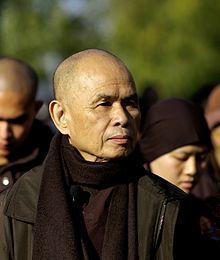
On the 29th March, Buddhist Zen master, Thich Nhat Hanh, will arrive in London for the start of his short UK tour guiding followers in spiritual reflection and peaceful protest. I’ve been interested in Thich Nhat Hanh for a number of years, not just for his peace activism but also because his poem Call Me By My True Names seems to really encapsulate the ethos at the heart of The Forgiveness Project – namely that good and evil exists in us all. Thich Nhat Hanh’s life of reflection has led him to believe that forgiveness is the key to creating a peaceful, just and sustainable world, and that “only when compassion is born in your heart, is it possible to forgive.” img http://en.wikipedia.org/wiki/Thich_Nhat_Hanh
|
|
Scooped by
Edwin Rutsch
March 10, 2012 10:41 AM
|
"Animals help patients keep their mind off their problems," says Jean S. Uehl, the director of nurses. "The love the patients get from the animals is unconditional." www.facebook.com/pages/The-Forgotten-Ones-Compassion-for-the-Elderly One particular stroke patient was withdrawn and rarely smiled, until she began to play with the resident cat. The patient and the cat became closely bonded to each other, and when the cat had kittens, "they became like the patient’s babies," according to Uehl. The kittens played and slept on a tray on the resident’s wheelchair and slept in a chair near her bed whenever they could. The kittens brought the resident out of her shell and she began to talk and smile. "The kittens in particular get all the residents’ attention," says Uehl. "Everyone always wants to know where they’re at and what they’re doing." When there are kittens in the building, a number of residents stay busy all day, following them, playing with them, and keeping an eye on them. ~ From HealthyPet.com Consider taking your pet to visit residents at a nursing home or an elderly neighbor. They do NOT have to be registered therapy animals. Call your l
ocal nursing homes and ask about their policies. Usually only updated shots are required for your pet. Don't have a pet? Go hold a residents hand instead. ♥ (photo added by page owner)
|