Your new post is loading...

|
Scooped by
Aditya Patkar
August 26, 2016 12:54 PM
|
Trade Show Tips to the Beat of the 2010s The Keys to a Successful Trade Show: The Follow-Up Advicertainment by M. Christine Delea The two biggest mistakes regarding trade shows? People not planning ahead of time, and people not following up once they get home. Some people claim trade shows aren’t worth the cost — but if you don’t continue the relationships you start at shows, you haven’t fulfilled the potential of the show. No wonder some people get so stressed out. Your Lips are Moving So open your email, pull out your phone, and say hello to those people you met a few days ago. No hard sell, just a friendly greeting. Get your lips moving and connect with potential customers — remind them who you are. Send an actual handwritten note to loyal customers. I’m not the only one who will tell you that leaving a blank space is a huge mistake. Nothing fancy is necessary. Just get ahead of the wave, and you will stand out. The fact that business tools are changing is one of the few rules of business that doesn’t change. Use every aspect of technology at your disposal to show off how incredible you were at the trade show and to reconnect with people who attended as well as those who did not (those who had to stay home can get some cheap thrills vicariously, as well as learn from your great photos and notes). As usual, all of your business correspondence should have as its underlying principle: I would do anything for you.
Act as if there is a countdown clock for the ideas and inspiration you learned at the trade show, and share those as soon as possible with colleagues who weren’t there. Tell them everything at once if need be. Shared ideas can spur more innovations, and you need to look ahead to the next trade show. And speaking of those colleagues, be sure you thank and congratulate all those who made the trade show so successful. It’s not tacky to let folks know that you really like them. Everyone likes to be appreciated. Make your trade shows pay off. Follow up and follow through once you get home. You can be the Queen or the King of trade shows if you keep up with others after the show is over. Your customers will appreciate you remembering them.
|
|
Scooped by
Aditya Patkar
August 25, 2016 12:50 PM
|
Your booth is your front line when it comes to winning the hearts and minds of would be customers, so don’t skimp. Making every effort to rock your trade show booth could mean the difference between adding an extra zero onto your bottom line and looking for a new job. Here are seven important tips to bear in mind when building a successful trade show booth presence: Tip 1 – Red Light/ Green Light. The Art of Attraction image: http://cdn.business2community.com/wp-content/uploads/2016/08/dont_walk_tradeshow.jpeg.jpg Recommended for YouWebcast, August 25th: Leveraging Your Existing Customers For Growth Simply put, you can’t pitch it if “they” don’t stop. Using trade show accessories like custom props, signage or using trade show printing of an unusual and visible color in an odd place will give you that valuable few seconds to make your visual case to convention-goers. Like flies on … Tip 2 – Check Your Entrance Is your booth cluttered, hard to get in and out of, noisy or filled with obstacles? Does your exhibit have “flow”? Rock your trade show booth by clearing the way so that guests aren’t skittish about coming in. Having inviting trade show counters with the right booth staff can also go a long way if your target audience tends to be shy. Tip 3 – Right Exhibit at the Right Show Trade show planning is essential in making sure your exhibit is not a waste of money and time. At the very least, ensure that your trade show presentation isn’t sub-par in comparison to the competition. The wrong research could drive you into a tiny trade show kiosk when a large booth could have been more lucrative. Don’t bring a knife to a gunfight. Tip 4 – Fit and Finish Matters Trade shows and expos are expensive, period but the last place you should be looking to cut costs is on trade show equipment and supplies. Exhibit appearance is a direct indication of your product or service. Stained or torn trade show furniture, broken trade show racks, crooked trade show walls or uneven trade show flooring will at the very least turn away potential customers. Worst-case scenario, you’re looking at a lawsuit. Tip 5 – Incentive in the Form of Comfort image: http://cdn.business2community.com/wp-content/uploads/2016/08/trade_show_stress.jpg.jpg If budget allows, trade show games and giveaways that expressly appeal to the immediate needs of an attendee work well. Branded versions of inexpensive objects like cold bottled water, packets of aspirin or grand prizes in the form of a massage will bring in guests walking the trade show floor and allow you a few moments to chat them up. Tip 6 – Attention to Attention If your booth guest doesn’t find something to engage within a few seconds, they’ll wander off to your competitors, guaranteed. A trade show display showing a video on a loop – sound turned down to prevent overwhelming conversation – is a great way to hold their eyes. Tip 7 – Better Safe than Sorry Although not for everyone, trade show management becomes increasingly important as you scale your booth. Being in the business of trade shows, we see way to many confident exhibitors go from bright eyed and bushy tailed to “PTSSD” (Post Trade Show Stress Disorder): by the end of the show. Wishing we could have helped from the start, the end of the convention is of course, not the time for custom trade show planning.
Read more at http://www.business2community.com/strategy/7-tricks-becoming-trade-show-rockstar-01621848#U2vTeXM3ZfYsaugY.99
|
|
Scooped by
Aditya Patkar
August 24, 2016 12:38 PM
|
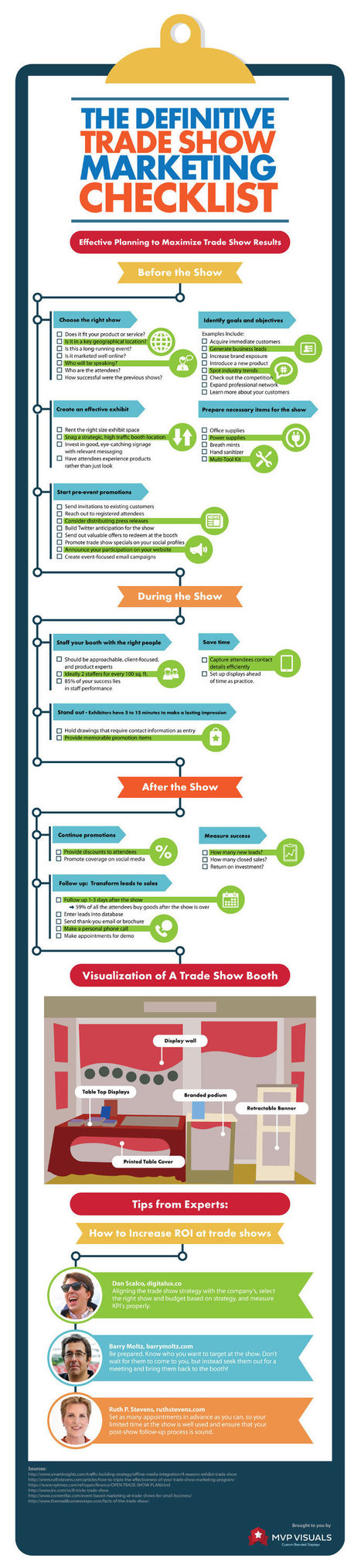
Did you know that 59 percent of trade show attendees buy after the show is over? This is the reason why many businesses do trade shows wrong. Let me explain. Trade show rocks – but… I attended trade shows, particularly those related to real estate, tech, and business opportunities. I enjoy looking for opportunities (and something to buy!) while observing the current state of the industry. As I visit booths after booths, I can’t help noticing that not all the staffs are engaging, knowledgeable and helpful. I end up getting boring pitches – including those that seem to come from a snake oil salesman, to be honest with you. Eventually, I pass on such booths. For the booths’ staff who successfully engage my interest, I happily give my contact information to them. Now, here’s where the problem lies: To my surprise, only less than half of them follow up within three days after the trade show. Perhaps they’ve lost my contact; perhaps they don’t think I’d be that interested; perhaps their calls or emails failed to reach me for one reason or another; I don’t know. What I know is they might have lost a potential buyer. I wonder how many leads that they fail to follow up… The moral of the story: Plan your trade show well from start to finish – or else Let’s go back to the beginning: Most trade show attendees intend to buy after the show – not while in the show. If trade show participants fail to engage attendees and follow them up with whatever they’re offering (plus special promotions,) then they should expect a poor ROI, even a negative one. You don’t want your trade show participation ends up as a negative ROI, in term of sales and branding. So, what should you be doing to make sure that your booth rocks the trade show – and bring in monetary and brand value to your company? Well, you could start with tips that you read from the Internet, or ask your fellow business owners on how to ace a trade show. But I think the best way to get started with a successful trade show marketing campaign is by having a road map, or a checklist. Fortunately, I have found a checklist that I would like to recommend to you. It’s created by MVP Visuals, a company that makes custom branded displays like booth tents, banners, tablecloths, retail displays, and other customizable trade show items and equipment. The list covers everything from pre-show to post-show. You can use it as a guide, as well as a to-do list. Here it is (please click to enlarge):
|
|
Scooped by
Aditya Patkar
August 23, 2016 12:36 PM
|
ncreasingly, face-to-face exchanges and networking is becoming of greater significance at Trade Shows in spite of the growing popularity of online communication and virtual events. Studies reveal that though virtual events and other technologies are growing popular, few marketing methods can compete with the potential of Trade Shows. By combining exposure to prospective leads with the ability to network with existing customers, Trade Shows offer an experience for both businesses and attendees that other forms of marketing cannot. Often under-utilized, Trade Shows offer the perfect platform to nurture customer relationships, grow industry knowledge and develop cost-effective leads. Read more at: http://blog.dazzletoday.io/networking-at-trade-shows-key-to-strengthening-business-relationships/
|
|
Scooped by
Aditya Patkar
August 22, 2016 12:36 PM
|
Trade shows and conferences are generally quite costly to attend, but they also continue to be a gold mine for businesses that understand how to best utilize them to meet their needs. Here is a six step plan for making sure that you utilize your appearance at your next trade show or conference to maximum effectiveness. 1. Decide in advance exactly what you want to accomplish In almost any industry, there are any number of trade shows or conferences that a business can make an appearance at. Understanding what your ultimate goals are will help you not only narrow down which conference or trade show you want to attend, but will help you plan for maximum impact once you are there. A trade show is about marketing and just like any other marketing, you will have a target demographic. Are you looking for new clients or consumers; to attract new talent into your entry level ranks; or for new leadership to fill out your executive staff? Understanding what your goals are will help you plan the most effective strategy for meeting those goals. 2. Set up appointments in advance Don’t wait until the trade show or conference starts to begin reaching out to people. Find out who is going to be there and start setting appointments. Some businesses don’t even attend a conference unless they set up enough appointments in advance to make it worth their while to attend. Many trade show organisations offer to invite prospects on your behalf to the event. So you have a high chance to meet them there. 3. Make it worth people’s time to talk to you You don’t have to give away a new car or a weekend getaway to get people to talk to you, but you can offer them pastries, chocolates, water, coffee or maybe even sandwiches. Whatever you offer, however, offer the best. If it’s worth paying the high cost of attending, then it’s worth paying to make sure that what you have to offer is the best. Regardless of whether you are trying to attract new clients or executive personnel, show them from the first moment you meet them that you want to treat them well. Think of the people you are meeting with as guests and treat them accordingly. 4. Respect people’s time and be aware of their cues Going into a trade show or conference having an agenda is a great thing, but pretty much everyone there will also have an agenda. Pressuring them to abandon their agenda so that you can meet yours is not a good thing. Some people will be excited about what you have to offer and will genuinely want to hear more – and that moment may be their only chance to meet with you for some time to come. Other people are just not interested, while other people are interested but also have other meetings scheduled and don’t have the time to listen to an entire pitch. It is in the best interests of you both for you to pay attention to the cues the people you are meeting with are giving off. Are they asking a lot of questions, paying close attention to what you are saying and not fidgeting or looking at what’s going on around them? Then you have their attention and they are not anxious to be elsewhere – so use that time wisely and carry on. If they are fidgeting, repeatedly looking at their watch, phone or what’s going on around them, then they are not interested. Rather than trying to push your product or service on someone who is not interested, you could be using your time more effectively to pitch to someone who is genuinely interested. If you come across someone who is not interested, give them contact information for the future in case they become interested, wrap things up quickly and move on to someone who is more interested. Here I want to mention that you compete with 2 main challenges: 1.) the 20 other vendors fighting for every lead and 2.) the short attention span of prospects in the noisy environment of a trade show. Be aware of it. Organize a separate room for demo or in-depth talk, or – and that’s my preferred solution – plan a cool side event. I once invited the most interesting leads on a trade show to a dinner-boat-tour on the Amsterdam canales. Something every lead will remember and associate positive to you. 5. Plan a great booth to attract new leads and contacts While it is important to reach out ahead of time and secure as many appointments as possible, it’s also important to leave some time and have a plan in place for attracting anyone you missed ahead of time. 6. Do immediate follow up The best outcome is to set up an appointment for the days immediately following the conference or trade show, but otherwise, have people on hand to immediately start keying in business card information or other information gathered at the show (like from a prize giveaway or drawing). Have them send out a follow up email and make a LinkedIn connection on the spot. Being at the trade show put you on the radar, it’s important to then “strike while the iron is hot” and do everything you can to stay there.
|
|
Scooped by
Aditya Patkar
August 21, 2016 12:35 PM
|
In a marketing world dominated by technology and online engagement, trade shows still prove to be a successful marketing technique for most organizations. Nothing compares to being face-to-face with your target market and encouraging engagement with your brand. Planning a trade show exhibit or event display can be overwhelming, but keeping the following three tips in mind will not only help to simplify the process, but will also help ensure a successful event. 1. Plan ahead: Define your marketing goals and establish deadlines
The first question you and your team should address is: “Why are we exhibiting at this event?” Knowing the answer to that question will help you focus your marketing goals and plan a strategy to better help you reach those goals. Need more leads? Focus on customer engagement with in-booth activities such as a contest or social media engagement. Need to highlight a new product? Consider a display that boasts large graphic images of the product and space in the booth for product display or demonstrations.
Once your goals are established, you can plan for your event accordingly. Take note of show deadlines such as an advanced warehouse shipping date if the event is out of town, or a set up/move in date for your display. Create a schedule with deadlines such as finalizing graphic design and finalizing booth configuration, while also making time for booth staff training, printing of marketing materials, or creating video to run on in-booth monitors. Try using a trade show planning checklist like the one provided by Best Displays & Graphics to help you stay on track.
2. Create a functional display that engages your target audience
Your trade show display is more than just a backdrop – keeping in mind your marketing goals for the event, use graphic and architectural elements to highlight your brand, creatively display your product, and stand out from the crowd. Include clean graphics, technology such as monitors, iPads and lighting, and functional architectural elements such as recessed shelving. Also consider the modularity of the display, and whether or not it can be used in larger or smaller configurations. A versatile display increases the number of marketing opportunities because you won’t be limited by exhibit space. Do your research when looking to work with a trade show display company, and find one that can offer a variety of display options as well as turn-key services like booth shipping, set up and dismantle or graphic design. Working with a company that offers these kind of services can help you streamline the planning process and save you time, money and resources. 3. Train booth staff and consider lead generation techniques
A strong trade show display presence will attract your target audience, but once they’re at your booth it’s up to your staff to generate qualified leads. Ensure your team are aligned with your marketing goals, are confident in their brand and product knowledge, and equip them with the tools to gather information such as laptops or iPads. Consider running a contest that requires a customer email submission to participate or encourages engagement on your social media platforms through content sharing or page likes and follows. Most importantly, ensure there is a follow up strategy in place to further explore the potential of the leads gathered at your event. Have a team dedicated to acting on qualified leads within a reasonable amount of time after the event when your brand experience will still be top of mind.
|
|
Scooped by
Aditya Patkar
August 20, 2016 12:33 PM
|
My company has begun using Twitter to promote our presence at trade shows and events. But I fear our tweets are already becoming too dry and corporate. How do we marry our marketing objectives with personal communication to create a loyal Twitter following?
Unless you're well versed in social-media marketing, it's easy to think of this tool as just another channel to broadcast your marketing messages. But social media is an entirely different medium with unique norms of engagement. After all, what makes the medium so powerful is that it provides an opportunity for your brand to interact with its community. And just like any community, social media is built on a give-and-take relationship. That means a long-winded, one-sided conversation is not the way to create an ongoing dialogue with trade show and event attendees.
So to make sure you're not turning your new social-media tool into a corporate jackhammer, your first and most important step is to analyze the type of Twitter accounts you're using. There are different schools of thought on whether to use a corporate Twitter account (@Company), which is what most companies use straight out of the gate, versus a more personal account (@BobSmith) that is hosted by a
specific individual from within your company. So here are some pros and cons for each type of account.
Corporate Versus Individual Accounts
Corporate accounts are good for broadcasting information, e.g., links to press releases, last-minute event announcements, your booth location, etc., as they can reach a large number of followers immediately. As such, they're a decent way to tell attendees about what's happening in your booth or at your event.
However, they usually lack transparency, as followers often wonder who's behind the corporate "Twitter curtain." Plus, this type of account usually doesn't offer the personal connection to which followers respond. So while followers may pay attention to your tweets during your show or event, without genuine, personal, ongoing connections, they'll likely stop paying attention after the event.
If you want to develop long-term, mutually beneficial relationships, consider an individual account that provides more one-on-one interaction between your company and its followers. Individual accounts (e.g., @DougStar), which can be hosted by execs or employees with social-media savvy, give the company a personality, and create a greater sense of connection with followers. However, it's critical that people who agree to tweet about the company also agree to common-sense guidelines (and your corporate social-media guidelines, assuming you have some). In addition to occasional company and/or product updates, tweets should also provide personal opinions about industry trends, speakers at your events, or can't-miss happenings in your booth on the show floor.
To give you an idea of how this works, it's best to look at some examples. Some organizations allow employees to tweet about the company and their day jobs on their personal Twitter accounts. Zappos.com was an early adopter of this tactic, and 499 employees currently tweet about the company (seehttp://twitter.zappos.com/employees). Additionally, some companies' employees have developed large followings on Twitter because they tweet about a mix of personal, industry, and company insights. Scott Monty (@scottmonty), the head of Ford Motor Co.'s Social Media department, and Padmasree Warrior (@padmasree), Cisco Systems Inc.'s CTO, are great examples of company employees that act as brand ambassadors and provide authentic one-to-one engagement with the community. Sure, they retweet corporate tweets and promote their companies and events, but they also reveal unique insights about the company and themselves. By doing this, they send a message that they are approachable, accessible, and want to hear from their customers.
But more and more people are opting for a sort of hybrid strategy that mixes corporate and individual accounts. In this case, you create one or several corporate Twitter accounts (e.g., one account for corporate news, one account for trade shows and events, another for specific product lines, etc.) with somewhat generic names, such as @FordTruckNews or @TradeShowsIBM. Then you identify a few employees for each account who can regularly tweet about your company, events, and more.
This approach allows potential followers to use the account names (e.g., @CiscoEvents) to identify which accounts will be valuable to them. Plus, by engaging with individual tweeters from your company, they gain one-to-one connections and insights into your company culture and your brand.
Tweet by Example
Perhaps the best way to hone in on the type of account that is right for you is to look at some real world Twitterati. Check out these accounts to see how different brands and their representatives create an authentic Twitter presence that truly engages and dialogues with their followers. (Visit Twitter.com and search for the account names below.)
Corporate Accounts
@oldspice - This deodorant has more than 120,000 followers. Enough said.
@zappos_service - Who thought that customer service was this much fun?
@delloutlet - One of the first corporations to show direct revenue from Twitter, Dell Inc. offers exclusive deals to its 1.5 million followers.
@comcastcares - This is considered by many to be the technical-support gold standard on Twitter.
@jetblue - Here's proof that there is social-media life after PR disasters. (Remember the 2007 "stuck on the tarmac" crisis?) JetBlue Airways execs monitor customers' tweets to alert them of issues and respond to questions.
Individual Accounts
@scottmonty - Ford's head of social media, Scott Monty, tweets about the auto industry, social media, and his love of Sherlock Holmes.
@padmasree - Cisco's CTO proves you can represent a Fortune 500 brand effectively by being personable, insightful, and funny.
@LionelatDell - This Dell blogger shares insights and responds to customers' kudos and grievances.
@AlecJRoss - Alec Ross, the senior advisor of technology for Secretary of State Hilary Clinton, proves that even government organizations can personalize their mission.
Selecting the right type of Twitter approach - including the tweeters behind those accounts - is the first and most important step to creating an effective social-media presence. Without the proper foundation, you'll likely end up talking at your community, as opposed to building a relationship with your community.
|
|
Scooped by
Aditya Patkar
August 19, 2016 1:30 PM
|
Technology has infiltrated every aspect of modern business, and trade shows are incorporating innovative techniques, like never before. Companies are now in direct competition to see who can offer the latest and greatest trends in their booth, while still getting their message across. Technology allows most exhibitors to benefit from fresh leads, and 82% of surveyed marketers stated trade shows generate leads of “good,” or “excellent” quality. There are a variety of platforms and strategies that exhibitors can take advantage of to make a difference in their booth. When designing marketing strategies for an event, engagement is the key phrase, and technology not only keeps people interested, it helps enhance brand recognition. There are a few top technology trends that are seeing much success at trade show events, and the number is growing every day. Booth operators are devising creative ways to keep people coming back for more, and track their marketing strategies. Trade Show Technology Trends Event Planning SoftwarePrior to setting up your booth, the entire planning process can be streamlined with the use of event planning software. These types of tech platforms offer full project management capabilities, and the ability to oversee the entire event, from start to finish. Whether it is booth design or managing your mobile apps, event planning applications can help provide an optimal timeframe for project managers and organize team communication. The software should also have data analysis capabilities, which can be used to track important metrics before, during, and after, an event. Recommended for YouWebcast: The Secrets of Deep Networking Charging StationsWith mobile devices being the key means of communication at a trade show, people are desperately searching for outlets to keep them up and running. By providing charging stations at your booth, you create several marketing opportunities. While consumers are charging their device, you can incorporate visual media about your product or service, in the form of a TV screen or touchscreen monitor. In addition, many companies will post hashtags and other social media calls to action, that users can incorporate into their posts, as they’re charging their phones. Mobile AppsSmartphones dominate trade shows. Adding to the idea of mobility, a successful form of marketing your trade show booth, is by creating a mobile application to use in conjunction with the event. Capitalizing on the short time frame of the show is critical, and a mobile app that incorporates geo-location, can help visitors easily identify where your booth is located. You can even design an app to send push notifications when your stand is nearby. Touch TechnologyA common element to many trade shows is one-on-one engagement. There is no better way to hold the interest of an individual, than interactive touch screens. Tailored presentations can be delivered via this form of technology, at surrounding kiosks and stations. A user can be prompted to enter data that can personalize the brand experience just for them. This type of deep engagement, allows the visitor to go on an entire journey, directly related to their needs— all with the use of touch technology. Digital SignageGone are the days of printing and hanging up signs. Those practices are considered archaic, at best. Digital signage isn’t the newest of trade show technology, but it is one of the least expensive marketing tools. An LCD monitor can provide versatility to your brand message, and can easily take the place of wasteful and expensive brochures. You can adapt the content from show to show, and it takes minimal maintenance to do so. WearablesThe latest in trade show technology has to do with altering the classic name tag to track attendee information. Small data collection devices, much like those in the fitness industry, can interact with an exhibitors device to instantly collect lead data. For convenience, the exhibitor devices can be placed anywhere within the booth. Wearables allow for a hassle-free way of collecting visitor data, without interrupting the process of disseminating product information. Other forms of these devices contain RFID chips that can track various data sets (like wait times and consumer behavior) to improve marketing strategies. Order Writing Software Many exhibitors are taking advantage of mobile order writing software solutions that house digital catalogs, an order writing interface, customer contact information, order history, and more at trade shows to write orders more quickly and reduce wait times due to queuing in the booth. This allows exhibitors to have more meetings with attendees, display the entire range of their catalogs with high-resolution images on a tablet, and ultimately make more sales. It also helps the back office process orders much more quickly by eliminating the need for data entry. Due to innovative steps in technology, the trade show industry has seen a recent revival. With $25 billion spent on exhibits and displays, the industry is slowly increasing each year to the rate of 4%. Applying these tech trends not only enhances the visitor experience with your brand, but it engages them on a deeper level. Incorporating technology into your trade show plan, will improve the efficiency and effectiveness of your overall marketing strategies.
Read more at http://www.business2community.com/tech-gadgets/top-trade-show-technology-trends-transform-next-show-01600772#2uds4Wq05uqQ71sI.99
|
|
Scooped by
Aditya Patkar
August 18, 2016 2:29 PM
|
Pre-show 1. Best foot forward: No matter what, see your booth as a miniature store that is a reflection of your brand. Does it tell a story or give the feeling of your brand? 2. Be ready for anything: bring extra of everything. Although it may seem too much, you never know when you may have to give a sample to an important new client, or if something is damaged, you may need to replace it. I have to travel by plane and load all of our products and pieces on the plane in a very heavy carry-on bag. What do I choose…anything that cannot be easily reproduced or purchased in NY. The rest of our items are packed in large suitcases and travel with us. Waiting for them at the baggage claim is nerve-wracking but I know if my luggage is lost, I can replace anything in those bags. 3. It’s not cheap…although you can trade up or down where you spend your money. Since I do not live close, I chose to pay to have my booth set up and ready by my favorite display company: Manny Stone. Some people send a crate with everything in it. From Florida, that is very expensive and by myself, I cannot put up the walls of my booth on my own. So once I arrive, my booth is painted and ready to go. I chose to buy my own foam flooring, shipped to my hotel and then we installed it, easy peasy. After the show, we gave it away to another vendor who could use it. My cost? $124. My shelves were pre-made with stained strips of wood, and L-brackets already attached and shipped in my suitcase. Easy to install and looked great. Cost? $16. Décor: I rented vintage furniture from a local company in NY; this was my splurge but I think it separated our look from the generic offerings from display companies and I saved money. The pieces were delivered and picked up by a courier service. Show time 4. All feet matter: take care of your feet with good shoes and a foam floor. Last year we ached all day, this year we were just perfect! You literally stand four days for 8 hours a day. We have always been told never to sit in your booth, not to be on your phone or to eat in your booth… all good advice. If our booth was larger, we probably would have a table for writing orders, but not so this year. 5. Make new friends: your “neighbors” around your booth are a great part of the show. We are all creative, all trying to grow our business and all from different places, and yet, we all are different in style and process. You can learn so much from each other about production, labor and business practices that are helpful. Plus, they will be able to help you if you take a mini break from your booth. 6. Show up with swag: We did new buttons and mini journals that people liked so much that they are now a part of our new products. It added excitement to the conversations and a good way to share new ideas and designs. 7. Be nimble: If you are talking to a prospective vendor, find out what they are interested in and if you don’t have the product but it is easy for you to do, try it! We picked up a whole new category of products using existing designs that met a need for several new vendors. 8. Recharge at night: This is the only time you really get to relax. We were purposeful in going to different parts of the city, seeing the sites and trying new spots for dinner. Every night was different and we stayed in an area that was still close but not as congested. Last year, we were in the Times Square area and found it fun but very congested, hard to find transportation and created unneeded angst. This year, we stayed in the garment district and could still walk to the Javits Center or catch Uber or taxi much easier and cut down on unneeded stress. Post show 9. Do nothing for 48 hours: Literally, nothing. Last year, I tried to hit the ground running and start filling orders and emailing too soon right when I returned. Not good. This year, I took 48 hours of nothingness and then was recharged to get the back-side of the show complete: filling orders, writing thank yous, sending emails and unpacking. 10. Be patient: I think we all envision a big client ready to swoop us up for the “next new greatest thing” and that may happen to some. However, if it doesn’t happen right away, be patient and see where the road takes you. We have learned so much about the business, the trends, the endless logistics and at the end of the day, some things arrive when you least expect it from a company you would least expect and it all works together. The exposure you get from a show like NSS is invaluable and the intrinsic value cannot be measured right away. I will fill our new orders, try to stay connected to potential clients and keep painting all the way. So interesting and helpful, thank you, Leslie! I have a bonus for you today! 14 stationery companies shared their own trade show packing lists with us, and we’ve compiled it into a master list. You can also peek and see each business’ exhaustive list, with things like how many catalogs they bring, etc. The one thing everyone agreed on was to bring at least four different kinds of tape! Want this? Sign up and nab it below:
|
|
Scooped by
Aditya Patkar
August 17, 2016 1:27 PM
|
Of all the types of event data we deal with at Bear Analytics, attendee verification data is one of the least exciting, but failure to understand who truly attends your trade show, conference or event robs your logistics and marketing teams of critical insights that can fuel event growth and more sophisticated forecasting and marketing. Do you know how your event’s AOV coding is generated? Do you know, for sure, which registrants actually attended your last show? Most large trade shows adhere to the Advance/Onsite/Verified (AOV) framework when it comes to verifying that a registrant actually attended the show: People who register in advance have several ways to get “verified” onsite, including at badge pick-up or check in, security checkpoint scans, education session scans, and exhibitor lead scans from the show floor. Often, event registration companies will combine several sources of verification data to make a final pronouncement on whether or not each advance registrant attended or not. Here are the three reasons your organization should be placing an emphasis on the quality and utility of your attendee verification data.1. Better forecasting and planning While we’d like to be able to count on every registrant converting and coming to our events, we know life gets in the way via competing business priorities, family emergencies, even inclement weather or traffic snarls on the day of the event. This no-show behavior is especially prevalent at large trade shows, where certain segments of attendees often pay a nominal (or nonexistent) fee to only walk the exhibition floor. Without trade show and event verification, there’s no way to distinguish registrants from actual attendees, and your projected attendance numbers could be significantly off from the real number. If you plan for 100% of registrants to attend, but historically only 80% have come, you could end up over-budgeting and losing money over these no-show registrants. 2. Sending different messages to attendees and no-shows Sending the same message to all of your past trade show and event registrants assumes that they all attended your event, and you lose an opportunity to tell no-shows that their absence was noted and their presence missed. Despite the fact that we know the “no show” component exists, event marketers often ignore the difference between registrants — people who committed to attend an event at some point in the past — and attendees — people who actually showed up on site, had experiences, and made valuable connections. If you’re looking to increase attendance numbers, focus on targeting attendees and no-shows with distinct, targeted messages – encourage attendees to return, and get the past year’s no-shows excited enough to follow through and attend next year. No-shows are a warmer prospect pool than entirely new registrants – they have already taken the time to register once. 3. Verification data from multiple sources gives you insights on your attendees’ behavior Beyond just telling you who’s coming to your show, event verification can show you what your attendees are doing once they arrive. Scanning attendees in at different locations can show how many people are actively visiting the exhibit floor or attending breakout sessions, and can also highlight which parts of your event are lacking in attendee involvement. With this scan information, you can see what’s working, what’s not, and which aspects of your event need the most attention to enhance its success.
|
|
Scooped by
Aditya Patkar
August 16, 2016 12:26 PM
|
When was the last time you analyzed your targeted consumers? Absolutely yes. We understand how it important it is to know who you’re selling too. We also realize that you probably already know that. We just want to emphasize that when developing a trade show strategy, you must keep your target market in mind. Especially if you attend the trade show, and find out later that barely any of your targeted consumers were actually there. Imagine how much of your investment goes down the drain? Therefore, focusing on your targeted consumers is essential to developing the most beneficial trade show strategy. To help guide you in the right direction, here are a few questions to consider when creating the best trade show strategy ever. How do you reach your target market at a trade show? This should be broken down into how you get trade show attendees flocking to your booth with marketing tactics you already use, and could use. Also, how does your product or service actually reach your consumers physically outside of a trade show? Next, think about the characteristics of your target market. What is their buying behavior? What is their preferences and needs? You are more than likely aware of this. With having a hold of that information, you can then use it to better develop your trade show strategy for the event. Last but definitely not least, think about what you discovered in part one. What key words emphasize the most meaning about your company? - What words explain things best?
- What is your mission?
- Why do you believe these products or services are important to have?
- Are those qualities able to be illustrated through graphics?
- Can they be used for marketing content related to the trade show?
You want to make sure that if people are learning about your company for the first time, you don’t want them to leave confused. You also want to become memorable so that when they realize they need a product or service like yours, the first thing that comes to their mind is your company, (since you made such a good impression on them at the trade show).
|
|
Scooped by
Aditya Patkar
August 15, 2016 1:17 PM
|
Startups often lack the credibility and legitimacy required to convince customers. Trade show appears as an easy way to face these prospects and demo the efficiency of a product, even though it is among the most expensive and complex marketing & sales strategies. This is why, as a startup founder, you must carefully plan early on for your next trade show and pick the right strategy and tools to reach your goals. Here are the top 10 reasons why you should upgrade your trade show strategy: 1. You can’t be a tech startup and use pen&paper It doesn't matter how loud you claim being a tech startup, you will lose all credibility if you take notes in your booth with a pen & a notebook. Upgrade your tools right away and record your prospects details digitally – it is not just about credibility, it is also about efficiency. 2. Better planning You cannot dedicate three complete days of your busy schedule being at a show and not have planned anything ahead. Pick the right booth location, design catchy decorations, arrange additional lighting, plan a few meetings in advance, inform your friends, partners and customers you will be there, get your samples ready for demos, have a backup plan in case things go wrong, etc. 3. More sharing Have all your marketing collateral (flyers, leaflets, brochures, catalogs, etc.) uploaded to the cloud and have a list of links ready for easy sharing. Dropbox and Google Drive offer you sufficient free space to have all your files on the cloud. Have some QR codes ready to make it easy for your visitors. 4. Lower expenses A better strategy means lower expenses. Make good use of "early bird" prices: confirm your booth early on, book your electrical sockets, furniture and internet a couple of months in advance. If your event is abroad, get plane tickets, hotel rooms and samples shipment ready, you could save hundreds of dollars easily! 5. Better communication Trade shows are not just about what happens at the event – the weeks before the exhibition count as well. Update your team's email signature with information about your booth number, inform your partners, customers, friends and family, post announcements on Social Media, etc. Traffic drives traffic: if you can have a small flow of people you know come to your booth it will tickle people's curiosity and bring you additional visitors. 6. Better lead capture The two most important resources for a startup are time and money – this is exactly what you are about to spend in large amounts. If your objective is to generate new business, you will need to capture leads. Do it the right way! Collecting business cards is a bad idea: you won't remember anything about their owners. Take complete digital notes including who they are, what they want, why they need it, do they seem serious, etc. Add as many details as possible and use a business cards scanner to make it faster: Camcard can be a good solution to achieve that. 7. Less resources If you get all your leads in a digital format immediately, you will save lots of resources. You will save time (no need to spend days trying to read your handwritten notes and re-enter all details in a excel sheet) and money (no need to employ a part-timer to sort out all your leads). If you had carefully budgeted your expenses ahead of time, you should not overspend and therefore save quite some money as well. You can use Excel or OpenOffice to manage your budget and record your expenses. 8. Faster follow-up The key to success at trade shows lies in the quality of your leads capture and your ability to follow them quickly and thoroughly. If your leads were captured digitally, you will have no difficulty sending a follow-up email within 48h. Keep in mind buyers have talked to tens of people, visited hundreds of booths and seen thousands of products – chances are they won't remember you after 48h. Make it count by being fast! If you can, automate the process with email templates – you can use SendInBlue, as efficient but much cheaper than MailChimp! However, remember that a customized message always feels better than an auto-response. Also make use of a CRM to manage your sales funnel efficiently. HubSpot offers a good and free basic CRM. 9. Better data Having a good trade show strategy and being prepared also means you will be able to capture data. Data is essential if you want to estimate your results and be objective about the outcome. You can't exhibit at trade shows just because "others do it too". You must make data-driven decisions. Get a clear picture of your expenses, number of leads captured, contracts signed after the show and gross revenue generated within 6 months after the show. Such information will enable you to make data-driven decisions, compare your events and know where you should put your focus. 10. You save the planet! While this might not be your main concern, trade shows waste tons and tons of paper each year. All the lead cards, brochures, flyers, leaflets, catalogs that are printed, distributed then trashed represent a huge waste and a burden for our planet. Early planning and good exhibition strategy will enable you to do digital lead capture and digital marketing material distribution, reducing your use for paper. And don't worry, it isn't only great for the planet! It will reduce your expenses (less printing, less logistics) and increase your visitors' satisfaction (no-one wants to carry tons of pamphlets around a trade show).
Exhibiting at trade shows is not an easy task. It isn't just about showing up on the event day and returning to the office. There are plenty of elements to consider and plan for and your job doesn't stop after the show – following-up is the most important part of your job and all your efforts are wasted if you do not manage this step correctly. And keep in mind: plan your trade show 6 months in advance if you want to be in control and remain on top of things!
|
|
Scooped by
Aditya Patkar
August 14, 2016 1:14 PM
|
Exhibiting at a tradeshow event is a great way to showcase your business. However, your stand will just be one small dot on a huge map of engaging and exciting attractions. You need to draw people in to get your message heard. Here are our top 8 tips on how to increase footfall to your stand: 1. Pushing your brand pre-event Don’t wait until attendees are walking past your stand to get noticed; target them before they even enter the venue. Most venues will have a central destination that delegates will travel through: an airport, tube or train station for example. Get on their radar early in the day by having well-placed advertisements or guerrilla style tactics to draw attention to your brand before they even get to the show. Disney achieved this by packing out Custom House tube station with posters for Star Wars: The Force Awakens ahead of Comic Con convention at London ExCel in October 2015. Branded shuttle buses, taxis or tuk tuks to transport delegates from the airport/train station to the tradeshow is a great way to increase brand awareness before they even get there. If you’ve got a lower budget, research the list of tradeshow delegates from the previous year and drop them an email or LinkedIn message inviting them to your stand. Similarly, engage in conversations on the event’s social group. But don’t just say, “Come to our stall”, show some genuine interest and insight in your prospects, perhaps offer an incentive for the first 50 delegates to visit the stand. 2. Guerrilla marketing Once attendees are inside the venue, the mission is to get people to stop at your stand. But when you’re a small fish in a big pond this can be challenging, so you need to go one step further and bring your product to life, literally. For example, to stand out at gaming conference Unite Europe, The Walking Dead advertised their game by hiring actors decked out in full zombie makeup to roam amongst the crowd. It’s a great talking point and a brilliant way to get your brand shown on social media as people snap pictures to share the crazy moment. 3. Your own branded barista Everyone needs a caffeine fix at full day event. If drinks are on offer at the event, it’s usually basic, boring, instant coffee and water. Entice people over to your stand with your own personal barista: nobody can resist the smell of fresh coffee. Then when they take the coffee away, ensure it is in branded cups: a perfect bit of free advertising as delegates walk around sipping their coffee and the one instance when littering may be a good thing if the branded cups don’t make it to the bin. MG Design Associates set up a coffee stand with a barista and branded coffee station at EXHIBITORLIVE in 2015, calling the stand’s café The MuG. MG served over 600 coffees and exceeded their lead count from EXHIBITORLIVE 2014 by 24% and conducted 25 one-on-one meetings with clients and prospects during the show. If coffee’s not your thing, then you can perhaps offer branded phone charging stations. 4. Use the latest technology to bring your product to life It’s essential to make sure that you have a live demo of your product at your stand, but you should be using the latest technology to enhance interactivity and engagement. Siemens Healthcare Services interactive iPad wall at the Healthcare and Information Management Systems Society Exhibition in 2014 helped launch their new CareXcell system. This is a fantastic example of using technology to enhance a demo. The CareXcell software they were promoting worked on an iPad, and attendees saw a live demo of the product in action on the tablets. The iPads were then added to a magnetic wall on the stand and when the individual iPad screens all joined up to form one large screen which showed a presentation on ‘connections’: as CareXcell programme was promoting connecting healthcare professionals and allowing them to share information with ease. The stand attracted 800 targeted contacts and earned 43 media mentions and 20 media interviews. 5. Virtual and augmented reality Allowing delegates to try out the latest technology at your stand is a great way to get people queuing up. The VR and AR trend has well and truly launched, with the VR market estimated reach a value of $1billion dollars this year with 2.5 million devices expecting to be sold. But don’t jump on the bandwagon and offer a VR or AR experience just because it’s popular. It needs to have a genuine link to your brand, and add some value to your stand, and demonstrate your offering. For example, Land Rover incorporated it into their exhibition stands by allowing users to wear a VR headset while sitting down that gives you a 360 degree look around the inside of the car. It allows users to experience the car even if there isn’t space for one at the exhibition. 6. Interactive and ongoing activities Give delegates a reason to return to your stand later on in the day. Offer some sort of interactive activity that they can contribute to and will come back to see the finished result of at the end of the day. For example, a digital graffiti wall, where each delegate writes or draws a message on a laptop or tablet and each square is uploaded onto a projection on the wall. You can encourage them to write their own brand name or something about your brand, which can make for great PR, especially if it’s shared on social. EWI Worldwide used the StoryBoard Experience at the stand at EXHIBITOR2013 to attract attendees to their booth. Their brand’s tagline is ‘Your Story. Alive,’ so this was incorporated into their exhibit by getting attendees to tell them something unique about them and draw it onto the wall. All images drawn onto the walls were recoded digitally and people were sent a QR code so that they could save an image of their artwork. The stand helped EWI meet its goals for post-show client meetings and exceed lead objectives by 50%. 7 . Social engagement You should be engaging with your social media followers before the event and promoting it to raise brand awareness. On the day encourage social engagement at your stand by using a hashtag on your banners and displaying a social media wall that shows all tweets, Instagram and Facebook posts that use the hashtag. You can further encourage people to share photos and information from the stand by running a competition through social media. Photobooths and GIF machines are also popular and create instant virality. 8. CompetitionsCompetitions are a great way to get people’s contact details. You can transform your stand into a real-life landing page by offering a valuable prize in exchange for their details. To draw people in to your stand for a prize draw or competition, you can take a leaf out of GoodGame’s book and do as they did at Unite Europe 2016. Flyers were distributed to delegates as they enter the exhibition in the goody bag. Each flyer contained a press-out cardboard key and the flyer will tell delegates to come to their stand and try their key in the treasure box. If the key fit the lock then the delegate won a prize inside. For the 2000 delegates, there were 10 winning keys to ensure that good word of mouth spread throughout the conference. After the eventJust because everyone is packing up their stands at the end of the day doesn’t mean that you have to stop the client schmoozing at that point. Offer to take your top prospects from the day out for dinner or drinks so that you can get some valuable face-time in with them in a more relaxed atmosphere. - See more at: http://www.digitalradish.co.uk/thoughts/8-tips-how-maximise-your-tradeshow-investment/#sthash.42suvN9S.dpuf
|
|
|
Scooped by
Aditya Patkar
August 26, 2016 6:54 AM
|
The trade show season is quickly approaching. It is the time to look at venues and start getting your company set up for the event. Here are a few things to consider before you load up your company truck. ROI of a Trade ShowA trade show can produce red-hot leads for your business even months after the event is over. If you make a lasting impression on your audience, the venture is well worth the expense. In terms of effective marketing, trade shows are great for: - Reaching potential clients looking for your service
- Inform potential clients of your products who were previously unaware of your company
- Meaningful face-to-face interaction that could win a life time customer
- Reinforce or create a upstanding reputation
- Increase brand recognition
- So much more
There is no end to the value trade shows can bring to your business. However, with all profitable ventures in life, there is a price. Trade shows can be a costly arena. A battlefield between what could be thousands of vendors, hundreds of potential clients, and a nosy background to boot. You have to stick out in the crowd or your trade show efforts and budget is useless. To help make sure you effectively spend your budget for optimal results we’ve come up with a few things that we’ve learned. Where to Begin?As trade shows can go horribly wrong or amazingly right, it can be nerve wracking to even know where to begin. But worry not. Your team at Bootstrap & Co. Creative Studios just so happen to be trade show experts. Bootstrap & Co. will be with you every step of the way. Finding the right budget is a key foundational step in your trade show journey. From there, we can help you find tradeshows in your area that are appropriate and profitable for your business. Part of making trade shows lucrative, is making sure that you’re conveying a message that is brand right. This brand consistent message is portrayed throughout your trade show from print, giveaways, to the booth, and more. Getting the Right Look for your Trade Show BoothAttract attention towards your booth and away from other companies. Break through the noise. Our goal is to make your company look like trade show rockstars when you enter the venue. You can’t help but notice rockstars right? So, that’s the level we aim for. To create the perfect aesthetic for your trade show venture, we recommend a slamming trade show booth design. A unique booth design that is brand right can help draw in your potential clients and make them stay a little longer. Once you’ve lured the clients to your booth, it’s best that they are met by a unified team. Your company can feel more professional with company branded apparel. We can get company jackets, hats, shirts, really anything you can wear—we can brand it for you. Trade Show Giveaway and SWAGThe collateral you choose will become a tangible reminder of your company. Make sure that whatever you choose is something that will stand out, be useful, and draw attention in the right way. The items they take away might just sit on their desk and remind them from time-to-time of your company. After they met other vendors, your collateral could make the difference if you get the call or not. Here are some giveaway tips. Dos: - Useful Items: Something that clients might want around, but they wouldn’t think of purchasing necessarily. Think stress balls.
- Practical Items: These giveaways will be used and visible.
- Delectable Treats: Who doesn’t love food? Delights could attract clients and a logo label will remind them of your company.
Don’ts: - Tacky: People don’t want these items and your image will only be seen dropping into a garbage bin or the lonely, untouched part of the booth’s table.
- Too Expensive: Sure, these might be amazing products, but out of budget. There are other options.
- Not in Your Realm of Business: It might be a useful product, but it has nothing to do with your company. It portrays the wrong brand image.
- Obscure or Hard to Identify Objects: Don’t leave your potential clients wondering what you just handed them.
Print Services to think aboutThere is a wide range of print services. Here is just a taste of what can be done: - Business Cards
- Note Pads
- Pens
- T Shirts
- Car/Truck Wrap
- Personalize Coffee blends
- Or Something More Personalized To Your Company
Follow UpDon’t let your red-hot leads grow cold. It is pointless to go to a trade show unless it results in real business. We can help you manage your leads. There are many ways to reach out. Let us help you contact your leads through: - Phone calls
- Emails
- Letters
- Or a other brand right, unique ways
|
|
Scooped by
Aditya Patkar
August 25, 2016 5:51 AM
|
Hey, that’s what trade shows are all about! They are opportunities to show off the very best your company or business has to offer. And, when a trade show booth has mojo, everyone knows it! The buzz about exhibitors with mojo begins early. Their booths are busy and you see their logos on the bags that everybody seems to be carrying around. If you sense that your company has lost its ability to show off its best qualities at trade shows, it’s time to get your mojo back! The best way to start is to begin planning for the upcoming trade show season right now. First things first:Pull out your display materials. Do they look tired too? Maybe they simply need a sprucing up or perhaps your company will be served best by a complete upgrade. An attractive, up-to-datebooth display gets people interested in who you are and what you do. Pull the team together with a cool look:Your most congenial and magnetic team members will look even smarter in color coordinated,branded uniforms. That could be a cool polo shirt embroidered with your logo or tagline. Create convincing collateral pre- and post show:Strategic collateral with a compelling offer before and after the show works well to draw prospects to your booth. Once there, you can have drawings for special prizes when attendees bring their mailings with them. Be prepared with post-show correspondence too. Maybe you can highlight an after show special. Of course, these more traditional methods can be enhanced with social media too. The gift is in the bag: Convention Air-Tote Make sure your give-away shows your tradeshow savvy. Nice tote bags are always popular. Other items that will be useful at the trade show are nice notebooks and pens, first-aid kits that include band-aids for the inevitable blister, aspirin for the tradeshow headache and sanitizer wipes. Yummy treats with your logo on them are great too. They can be taken away to be enjoyed in the hotel room or taken home for the kids to enjoy.
|
|
Scooped by
Aditya Patkar
August 24, 2016 6:38 AM
|
So many of you are extremely engaged in the data discussions related to your equipment and the info that is shared with your customers. But an area where you can own in-depth info on your customers or better yet, prospective customers, is left out in the cold. I’m specifically referencing your access to data regarding one of the largest spends your company might have – on face-to-face events. Yes, I felt the collective eye roll (again) and your immediate reach for your wallet. But what I’m referencing is not a call-out for you to spend more money on what you’re already doing. Instead, I’m urging you to spend smarter and redefine your plan for how you utilize trade shows, specifically regarding data. Size Doesn't Matter The value of a trade show (specifically within the realm of face-to-face interaction opportunities) is not how big your space is or how tall your structure might be. It’s not in how many signs you buy through sponsorships or how many staff you bring all in the same logo’d shirt. Instead, it’s about what your plan is for introducing yourself to prospective new customers, how you’re continuing your relationship with your existing customers, and when you will continue to utilize the show brand (reminder -- AEM members through the Association own CONEXPO-CON/AGG, ICUEE, CONEXPO Latin America, part of World of Asphalt and IFPE and bauma CONEXPO India and Africa and working toward equity within Commodity Classic). Why did I remind you about your ownership stake within the AEM portfolio of shows? Because there is more opportunity for you through engagement with the above mentioned brands if you consider yourself an owner as opposed to an exhibitor. And as a member of AEM, you are supporting the events that represent your industries. When not planned for appropriately, trade shows by their nature are expensive and can offer questionable return on your investment. But with all of you as the driver of our events, we strive to offer you ways to track your return, see the value and participate in the direction-setting of the events. Cozy Up to the Data Data offers one of the best ways to increase your return at trade shows as well as to know who your audience is or who they might be. I borrowed some insight from Reagan Cook, manager, strategy & MarketWorks at GES. Reagan outlines some great ways to harness the power of data that you may already have or that you can obtain from AEM as show owner/organizer. According to Cook: You need to know what’s important to people when they decide to attend (as well as leading up to the event, during the event, and after). Here’s how you can befriend data to increase engagement and make meaningful improvements to your offering: 1. Digest the data Your first step should always be to get cozy with the data set available to you. For example, you can download the Center for Exhibition Industry Research’s (CEIR) “2016 Digital Toolkit to Enhance the Attendee Experience” report, which helps both organizers and exhibitors answer questions around attendee preferences. It covers crucial segments of the visitor’s journey: the decision to attend, pre-show planning and registration, attending the event, and post-show follow-up. It also illuminates the different preferences between members of your industry segments and special attendee groups, like frequent attendees, final decision makers, women, and young people. Without data, your crowd is a sea of faces. With data, it’s a room full of friends. 2. Plot your engagement story Map your attendees’ journeys, marking the points where they already engage with your brand. Now, plot new points of engagement. Make use of opportunities to influence attendance and spur interest, especially with the technologies and channels they tap most frequently. Use what you’ve learned from the data to step into your attendees’ shoes and predict where and when they’ll want to connect with you. 3. Sponsor up a storm Attendees are more likely to attend and engage with your brand if they associate good things with you. Take a targeted approach to how you present your brand at an event. Identify sponsorship opportunities — use the data to discover what organizers can offer you, how you can use sponsorships to add value for attendees, or how you can gain traction by attracting a larger attendee share. Don’t make it hard for attendees to find you — get in front of them. 4. Galvanize your existing channels Using data to enhance your brand story around an event will fall flat if you neglect your existing channels, such as your website, partner websites, editorial content, and social media. Activate your brand in those channels. Candidly assess the effectiveness of your messaging in light of what you know about your customers and prospects. If your brand experience isn’t punching you in the face, you’re not making the most of those channels. 5. Measure, improve, repeat You should collect data on traffic, revenue, and leads raised during and after the show. Track the results across shows and years to measure changes. Beyond that, constantly re-evaluate your target markets because they are subject to constant change. How else are you going to guarantee a better show next time? Reagan’s concepts probably sound familiar to you as you use these tactics in evaluating your brand with your customers in other marketing tactics. But so many are not utilizing these concepts when participating in trade shows. If you are just buying a booth, setting out product and sitting back and waiting for traffic in the aisle, you will not see value in trade shows. If instead you are promoting yourself on your own as well as through the show brands, you are already a step ahead. Now take that next step (or leap) and utilize the data we can provide or that you can provide on your own and speak to your customers or prospective customers the way they want to be spoken to, and then add in that extra flair you all have within your show plans to give them the Wow factor they weren’t expecting.
|
|
Scooped by
Aditya Patkar
August 23, 2016 7:29 AM
|
Trade Show exhibiting is all about marketing your products or services at expositions, conferences, and trade shows. However, if you are new to exhibit or event marketing, you will be faced with more questions than answers: What size booth do I need? How much should I budget for show expenses? What the heck is freight drayage? The following articles explore a wide range of trade show topics, such as Exhibit Marketing, Flooring Choices, and Booth Etiquette. Want to know more? Give us a call or send us an email. Whether you are a trade show novice or a trade show warrior, we look forward to turning your next event -- into an EVENT!
|
|
Scooped by
Aditya Patkar
August 22, 2016 6:35 AM
|
If your company already exhibits at trade shows, you know how impactful they are for your firm’s industry-wide profile. If not, or if you’d like to maximize your trade show presence, keep reading! This Innovative Company blog will focus on all the different ways a trade show can benefit your bottom line – and make your company’s public profile shine at the same time! We talked with a few industry experts about effective trade show marketing, along with the major benefits of hosting a booth or exhibit. One common theme we noticed is a memorable trade show presence. Roughly half of all trade show attendees plan on visiting only one or two booths, so it pays to stand out in a crowd. With that in mind, let’s review how trade shows can help build your business brand (and profits, too), and some things your company can do to make every trade show second count. Tricks of the Trade (Show) Like any semi-regular event, trade shows have their own particular culture. While every trade show is a little bit different, they all have the same goal: to allow like-minded companies to tell their own story. How memorable will your company’s story be? The answer to that question influences public image, sales numbers and much more. So what are some major reasons your company should consider an exhibit at the next trade show? Establish / strengthen business relationships. In our email-is-everything world, it’s refreshing to actually meet clients face-to-face. Many companies who host booths at trade shows benefit from an unexpected surprise: trade shows are ideal for building rapport with existing customers. And they’re the perfect environment for allowing customers to get up close and personal with new products and designs. Some marketing experts call it the “kids in a candy store” effect, and its real-life impact on profit margins can’t be ignored! Build more business. As single events go, a trade show has few rivals for getting maximum return on investment (ROI). Trade shows offer endless methods for measuring your ROI, from actual leads to follow-up calls with clients to foot traffic at your booth. Thus, it helps to have a scorekeeper of sorts at your company’s trade show booth – somebody that can collect real-time data for future use. If your accountant or analyst needs a trip away from the office, the next trade show is a great opportunity! Get a jump on your competitors. You never get a second chance to make a first impression, and serious firms take full advantage of the front-and-center aspects of a trade show exhibit. To optimize visibility and make your customers remember your company long after a trade show has ended, some professional assistance is highly recommended. For example, ExpoMarketing specializes in custom-built, eye-catching exhibits that resonate with potential customers. The trade show company’s calling-card is putting your firm’s best foot forward. The next time you attend a trade show, pay attention to the quality of all the exhibits. The ones that stand out not only convey a keen marketing ability, but also seriousness about their craft. ExpoMarketing’s expertise means the difference between “just another company” and one that everyone remembers. Keep an eye on the competition. It’s always good to get a gauge on how you currently stack up against the competition. But other than black-and-white sales figures, market share analysis and a few other top-level statistics (which always don’t tell the entire story), let’s face it – finding out what the “other guys” are up to isn’t the easiest business task. That’s why trade shows are so incredibly effective at getting a glimpse into your major competitors’ projects. Expanding on the previous points, trade shows are a place where companies like to exhibit current products and services, and also offer a tease at what’s coming up around the corner. See what solutions your major market competitors are offering – how you adapt and adjust will help in the long run. These are just a handful of reasons your company can benefit from a trade show exhibit. Whether you’re a trade show rookie or a 20-year veteran, one thing to keep in mind is that innovation matters. Be different. Stand out. Make each and every trade show an opportunity to tell your company’s story!
|
|
Scooped by
Aditya Patkar
August 21, 2016 6:34 AM
|
Exhibiting at trade shows and conventions offers an important opportunity to build your brand and connect on a personal basis with new prospects as well as current customers. It also requires a significant investment of time and money and careful planning in order to achieve your marketing goals. If your company is exhibiting for the first time, the following strategies will help you stage a successful exhibition while laying a solid foundation for future shows.
Choose the right show for your business.
Not every trade show or convention offers a good fit for your business, so before plunking down thousands of dollars for the entry fee, study the show you’re considering to make sure it’s right for you. This includes:
- Attending the show before committing to booth space
- Observing other exhibitors and attendees
- Getting a feel for the flow of the show
- Reviewing attendee profiles in the show’s exhibitor kit to make sure they fit your target market
Prepare a detailed, flexible budget.
Budgeting for a trade show can be a lot more complex than many first-time exhibitors expect. To assure a smooth and successful trade show, be sure to include all individual items and show services in your itemized budget. Items to consider in your budget include:
- Booth space
- Exhibit rental or purchase
- Graphics design and production
- Shipping to and from show
- Show services (electrical, drayage, etc.)
- Travel and hotel accommodations for your staff
For help in assembling an accurate working budget, download our Trade Show Budget Worksheet .
Market your exhibition before the show.
As a first-time exhibitor, you probably won’t get a prime space at your first show. As a result, you may not get the foot traffic you need for a successful exhibit. To increase traffic, let your customers and prospects know ahead of time that you will be exhibiting at the show and where they can find you. Use email, social media, advertising, and other marketing tools to reach as many people as possible.
Ask the right logistical questions.
Nothing will put the brakes on a successful trade show exhibit faster than poor lighting, inadequate power, or other logistical problems. To keep things running smoothly during the show, go over all logistics before the event, asking questions like:
- How much electrical power do you need?
- How far away are the outlets?
- How long will it take to set up and dismantle your display booth?
For assistance with planning and logistics before, during, and after the show, you can download our free eBook, The Essential Guide to Trade Show Planning . Aim for a big splash.
To justify the trade show expenditures, you need to make a real impact at your first show. To attract foot traffic and connect with your booth visitors, design your display with eye-catching colors and graphics that present your brand style with personality and flair. Engage the audience with crisp marketing messages, and use drawings, promotions, and giveaways to get them excited about your product or service. The first time out, you may want to consider using a trade show professional to man your booth. Finally, keep in mind that it’s okay to start small by using a portable exhibit . These versatile booths are easy to ship and assemble, require a smaller investment, and are easily adjustable to different types of shows and space configurations. And, most important, they enable you to maximize your marketing budget and still make a strong impact at the show.
|
|
Scooped by
Aditya Patkar
August 20, 2016 6:32 AM
|
Trade shows provide businesses with a wonderful opportunity for promotion. Never forget that the success of every business depends of consumer knowledge. Customers need to know about your business and there are many forms of collateral that can help to promote your business. Promotion experts know that customers are drawn to businesses that are known, familiar, accessible and visible. Social media and the digital marketing is effective, but many printing and branding experts such as The Print Group ( click here for their website) will also correctly advise you that traditional forms of promotion and advertising remain crucial to effective business promotion, particularly at events such as trade shows. A WORD ABOUT TRADE SHOWS: Business trade shows provide fabulous opportunities for the promotion of your business, brand, products and services. Trade shows also offer an effective platform from which to directly engage with existing and prospective customers, as well as opportunities to network and establish worthwhile business relationships. Be cognisant of the fact that people in attendance at trade shows come with an interest in the businesses and the products and services that you are showcasing. For this reason, you should tailor your marketing at a trade show to capture leads and potential sales. SO, WHAT ARE FIVE OF THE BEST WAYS OF PROMOTING YOUR BUSINESS AND BRAND IN A TRADE SHOW?#1: BANNERS AND SIGNAGE There’s often hundreds or thousands of businesses exhibiting at a trade show, so you need to stand out. You definitely need an eye-catching banner and other prominent signage that will immediately draw people to your stand. It can be effective to have a unique theme for your booth. If appropriate, pick a theme that is both fun and engaging. #2: BUSINESS CARDS Business cards remain a very important vehicle for promotion. Ensure that your business cards communicate your most important contact details in a way your target market will find engaging. High quality, effective business cards provide you with a way to stand out from the competition and be remembered. A business card should be given out during or following all conversations. Ensure that you take business cards from the people you met as well. Write a few notes about the contact on the back of the card – this makes it easy to remember what to follow up on after the event. #3: FLYERS Flyers are a useful tool to give to potential customers and contacts you meet at trade shows. Flyers should include key information about what your business does, the products and services it offers, and any special offers you have for your customers. Create an interesting and informative flyer that will motivate customers to engage with your business. At trade shows, flyers are a tangible way to leave people with a reason to find out more about your business after the event wraps up. #4: PRIZES, COMPETITIONS AND GIVEAWAYS Everyone loves to win something. Prompt engagement with your business and drive people to your stand by running a competition with an exciting prize. Or develop a range of promotional giveaways – pens, caps, iPhone covers – that your target market would love to take home with them. It’s best if the prizes and giveaways relate somehow to your business. #5: COLLECT CONTACT DETAILS The value of a trade show is often evident after the event. Capitalise on the effort you put in to your booth and networking by developing a strategy for engaging everyone you have met. It is fundamental that you promote your business, but similarly critical that you collect the details of contacts. By all means collect business cards, but also ask visitors to provide their details, perhaps by writing them on to your list or directly entering them in your database via electronic means. Add these contact details to your database or CRM – it’s invaluable to have ongoing engagement with potential clients that you know already have some interest in or understanding of your business.
|
|
Scooped by
Aditya Patkar
August 19, 2016 8:23 AM
|
All around the world, eyes will be on Rio and Olympic athletes as they compete to bring home the gold for their country. There are many tips and tricks exhibitors can take away from the Olympics to ensure they bring home the gold from their next trade show. Read on to learn how to exhibit like an Olympian. Assess your Health Before training for the Olympics, athletes first take stock of their physical health. For example, if a sprinter has knee or foot injuries, they take the proper measures to heal and rehab their body to ensure peak performance and to reduce chances of injuring themselves further. Likewise, exhibitors should take stock of their trade show program’s health before they plan for their event to make sure they are able to perform at the top of their game. Tips for assessing your trade show health: - Broken spokes, flat tires and loose handlebars can throw off a cyclist. Similarly, broken or missing pieces of your exhibit can be costly on the show floor. Evaluate the condition of yourtrade show display well before your event. Do you need replacement parts or repairs, or do you need a brand new display?
- Chronic back and joint pain prevent back an Olympic lifter from performing to their fullest potential. Identify any chronic issues you have in your trade show program and make sure you treat and address them early and often.
- An unhealed injury is tough to overcome, no matter the will of the athlete. If your company has suffered revenue loss or reductions to your marketing budget, it may be wise to pass on participating at a certain shows until you are able to exhibit at full-strength.
Setting Trade Show Goals athletes set specific and measurable goals in order to improve their performance. Just as a high jumper sets a certain height they want to achieve, you want to make sure that you set concrete goals heading into your next event. Tips for setting trade show goals: - Olympians have years of history and records on which to base their goals and benchmarks. You should set goals with a historic basis behind them. For example, if your company averages a certain number of leads each show, make sure your target number is greater than but realistic to previous performances.
- Every great athlete has a plan of attack to help them reach their goal. Devise a concrete plan for reaching your goals on the show floor.
Training your Staff World-class athletes are not born, but made through hard work and dedication. Similarly, effective trade show programs owe their success to proper training and pre-event preparation. To make sure you get the best performance from your booth staff, and in turn ensure your greatest trade show ROI, it is important to have a well-trained and knowledgeable team. Tips for training your booth staff: - An elite basketball player trains to perfect every facet of their game. Likewise, your booth staffers should be comprehensively trained, from how to engage and inform visitors to selling prospects on the show floor.
- Whether they are running a 4 x 100 relay or are rowing crew, Olympians need to work together to grab the gold. Your booth staffers should also develop a strong sense of teamwork to win at your trade show.
Traveling to your Trade Show Athletes and spectators from all over the globe have journeyed to Rio to take part in and witness the world’s premiere athletic event. Just like ambitious Olympians and their eager fans, exhibitors and show attendees travel to the convention hall. Travel can be daunting and tiring, but with the right groundwork, you can make your time away from home less stressful. Trade show travel tips: - Missing a flight to the games can spell disaster for an athlete. Make sure you know all of the travel times and accommodation information so you do not get left behind.
- Elite athletes get enough sleep to ensure their bodies are well-rested before their event. While on the road, make sure that you and your booth staffers get adequate rest so that you are all fresh on the show floor.
- Eating properly is key for fueling top-level athletes, but getting healthy food can be difficult while on the road. You can help your team stay properly fueled by scouting out restaurants near your hotel that serve nutritious foods.
Bring Home Trade Show Gold Even though there are not medals for high performing trade show exhibitors, standing out on the show floor and outshining your competitors is a reward in itself. Tips for winning at a trade show: - Soccer players who follow the rules and know how to play to the officials get more favorable calls. Understanding your venue/event rules can help you have a more successful event.
- A fencer can better parry and counter an attack if they understand their opponent. Equally, by studying your competition, you will learn their strengths and weakness and how you can best take advantage of them.
- A false start or stumbling out of the blocks can ruin a runner’s chance in the hurdles. Self-inflicted setbacks like forgetting supplies, partying too much or forgetting to clean your booth space are all ways to sabotage your hard work.
Get your Free Trade Show Playbook Looking for more tips for scoring big at your next trade show? Download Nimlok’s free ROI Playbook and learn how you can maximize your trade show return.
|
|
Scooped by
Aditya Patkar
August 18, 2016 6:28 AM
|
Take a look at a list of 12 things a trade show booth does for you
|
|
Scooped by
Aditya Patkar
August 17, 2016 6:27 AM
|
So, you’ve decided to rent your trade show exhibit. Deciding between buying and renting was an easy decision. By renting you will be saving yourself a lot of stress and your company a lot of money — which will hopefully be reflected in your per diem, right? The average company allocates just over 31% of its total marketing budget to events and exhibiting, and more than $24 billion is spent annually on trade show displays. However, a whole 70% of these exhibitors set no specific objectives for their trade show exhibits. Hoping for the best isn’t a strategy, especially since events like trade shows are the second largest area of growth in media spending, just behind digital. But here’s the thing: you are hiring a team of professionals in custom exhibit design services to help craft a unique booth that meets your needs, and you are saving money by renting! So now that you have a beautiful trade show booth rental, how do you best put it to use? What’s next? Every company will require their own marketing strategy, but we can help you with the logistics. Managing Your Exhibit Rentals - Plan for the future
Now it’s time to take the next step and develop a long-term plan for your exhibit rentals. By doing this and committing to a multiple-show rental contract, you could save thousands of dollars. It would be wise to plan a trade show schedule that covers the next two to three years.
- Customize as you go
Exhibit rentals are more flexible than you may think. A quality trade show exhibit design company will offer customization so that you can achieve your individual marketing goals. The best companies will allow you to make changes throughout your contract, customizing your exhibit to adapt to unexpected challenges.
- Coordinate shipping
About 50% of the largest trade shows in the United States take place in just three cities: Las Vegas, Chicago, and Orlando. That means that you and your exhibit will be on the road frequently. Fortunately, when you rent, you do not have to manage your own exhibit property. You can work with your rental company to coordinate shipping for every show. After all, this is one of the reasons you chose to rent in the first place. Why deal with the headache that comes with dragging a trade show booth back and forth across the country?
There is more to trade show success than an attractive booth design. To really get the most out of your next show, make sure your staffers are fully prepared to represent your brand as well as your booth does.
|
|
Scooped by
Aditya Patkar
August 16, 2016 7:24 AM
|
Question business-to-business (B2B) companies on what they do, and most would tell you that they provide products and services to other companies, and that doing this at the lowest possible price is key to success. This is true. Quality service and products at a reasonable price is a basic component of B2B companies.* However, this strategy cannot be pursued long-term if sustainable growth is desired. The success of organizations hinges largely on nurturing strong client relationships. This is especially true for B2B companies where a single customer is often worth a million dollars. Building strong bonds with customers ensures that the company is able to transition from being a vendor to a trusted advisor. Read more at: http://blog.dazzletoday.io/nurturing-relationships-essential-for-b2b-sales-success/
|
|
Scooped by
Aditya Patkar
August 15, 2016 3:15 AM
|
Are you maximizing the impact of your hanging sign? Does it draw trade show attendees to your booth? Integrate with your exhibit design? Speak to your product and brand? We’ve been watching what’s been happening overhead at the trade shows we attend, and we’ve noticed a few techniques for hanging signs that really stand out. Here are six things your hanging sign can accomplish beyond identification and wayfinding: 1. Connect the sign to the exhibit. Rather than treat its hanging sign at Mobile World Conference in Barcelona as an independent object, Sonus integrated—and visually connected—the sign with its exhibit. The cylindrical, illuminated sign originated from a slightly larger diameter circular cutout in the exhibit’s cantilever ceiling. This visual connection between sign, canopy and exhibit led visitors’ attention from the sign to the exhibit graphics and workstations beyond, drawing them deeper into the exhibit. Exhibit design and fabrication: 3D Exhibits.
2. Demonstrate corporate hierarchy. Benelli employed multiple color-coded hanging signs to highlight itself as the parent company and to promote its relationship with its component brands. The approach, employed at SHOT Show, worked well—especially because Benelli used one size and shape of sign for itself and like cubes for its component companies. Exhibit design and fabrication: 3D Exhibits. 3. Lead attendees in. At CES, Casio’s hanging sign placed its logo on the outermost of a series of spot-lit concentric ribbons. The arrangement functions like a bulls-eye, drawing visitors toward the demo and product display located in the circles’ center. 4. Get dimensional. Also at CES, Voxx made its sign more interesting (and therefor more eye-catching) by selecting an atypical shape and by pegging off the panels that display its identity. This creates an effect where the blue background functions as a frame to accent the white identity panels. 5. Select an unexpected material. Zevia, a no-calorie soda, created its hanging sign by stringing iridescent discs (representative of its products’ bubbles) from a metal frame. The unusual upside-down wedding cake shape of the structure stood out on the show floor—and was highlighted even further by the shimmering effect of light bouncing off the iridescent discs as they floated and shifted with fluctuations in the airflow from the convention center HVAC system. We’re not sure if that subtle movement was on purpose or a happy accident—but either way, the result was a mesmerizing and impactful sign. 6. Integrate iconic imagery. Most companies go with a solid color for the background of their signs. But not Boulder Brands. Instead, Boulder stood out at Natural Products Expo by dramatically emblazoning the non-logo area of its hanging sign with Flatirons—the iconic rock formation depicted in the Boulder Brands logo. This approach communicated Boulder’s healthy, outdoor brand persona, which helped Boulder attract like-minded attendees to its exhibit. Exhibit design and fabrication: 3D Exhibits.
|