Trade shows continue to be one of the most efficient ways to introduce new products to large groups of existing and potential customers—because thousands of qualified buyers come together to hear what you have to say. And trade shows are a great opportunity to make connections and interact one-on-one with customers. For many companies, trade shows are about nurturing relationships with existing customers and generating leads to create new relationships.
Making the most of trade shows takes significant resources—time and budget. You’re already investing in being at the show, but the question is, how can you make sure you’re making the most of this investment after the show?
Here are four tips to build stronger relationships through strategic trade show follow-up:
Quickly connect after the show
Once the show is over and your customers have returned home, it’s back to the grind. Your customer’s attention will be on a variety of job concerns and purchasing your product or service may be at the bottom of the list. Maintain the momentum you’ve built during the show—and keep your company top of mind—by making contact with customers within two weeks of the end of the show. This can be with a direct mail piece that’s been designed and is ready to print, an email that you’ve pre-built in HTML or phone calls from sales reps for a select group of customers. In fact, it’s likely to be some combination of these tactics depending on the customer.
Take action: Develop a communication plan before you head to the show so you’re ready to keep the conversation going.
Get personal for better returns
Trade shows attract thousands of attendees to visit hundreds of exhibitors covering tens of thousands of square feet of convention center space. Make your customers feel like more than just a number by showing them they stood out to you. A good lead retrieval device will allow you to capture additional data when scanning a visitor’s show badge. Some devices even have voice-recording functionality. Take an extra 10 seconds to make note when a customer is attending a specific booth event, such as a happy hour or presentation. Then use this information to personalize the follow-up communication; according to a Pardot study, businesses that use personalized messages see a 19% increase in sales.
You can make it really personal with one-to-one connections via social platforms such as Twitter and LinkedIn. The information you gather on booth activities and event attendance can give you a conversation starter.
Take action: Set the expectation with employees at the booth and those coordinating events that you want better data. Request that every badge be scanned at every opportunity.
Make it relevant
Customers go to trade shows looking for information and are open to conversation. It’s a relaxed, fun environment. But after the show, they’re back to business and you’re encroaching on their precious time. Make sure your follow-up includes valuable information and is more than a thank you for visiting your booth. When you offer relevant content they can’t get elsewhere, such as a white paper on a hot industry topic, you increase the likelihood your communication will be read.
Take action: Take your connection one step farther by making your follow-up personally relevant. If you know a set of customers attended a specific presentation in the booth, send a more targeted follow-up piece specific to that topic.
Have a long(er)-term plan
As you’re developing your communication plan prior to the show, make sure you think beyond a single follow-up piece. Create a cadence of information, and plan your next three to five customer touch points. It’s much easier to continue a conversation than to rekindle one that has died out.
Take action: Consider a marketing automation tool that will help track, score and prioritize leads and take some of the burden off sales—allowing reps to focus on the hottest prospects prime for business.
You invest a lot of time and money on trade shows; they’re a big investment for a big opportunity. Consider these four tips as ways to extend the reach of a trade show and make the most of this opportunity to forge new customer relationships, deepen those that exist—and drive an ongoing conversation about your brand.
If you have questions about anything here, or need help getting started or getting it done, just ask. We’re standing by to help.
How much time do you spend preparing to sponsor a trade show event?
If you’re in marketing, this question is probably a no-brainer: a lot. Preparing booth signage, finding session speakers, ensuring you have sufficient staff and that everyone is where you need them to be can mean a number of late nights (and maybe a few sleepless ones as well).
How much time do you spend on an event after it’s over?
If your answer to this question is a little less definite, keep reading. Post-event reporting and follow-up is as crucial a part of event marketing success as any of your pre-event preparations. If this sounds like very bad news to your tired brain, here’s the good news: marketing automation can greatly simplify this process. Let’s take a look at the following four steps for post-event follow-up with marketing automation.
Step 1: Import Leads
Remember all those great connections you made with potential prospects? Make sure you get all their information into your system. There are two ways that leads get added to your marketing automation system at trade shows: through landing pages or through a scanner.
If you’re relying solely on landing pages for data collection, leads will automatically be added to your database and attached to a campaign (in this case, “trade show XYZ”) once the form has been submitted—which means (good news) no manual import is needed post-event.
For trade shows that use a scanning system for data collection, leads will need to be imported after the trade show ends. The information obtained from leads is stored by the company providing the scanners, and will either be sent to you post-trade show or will need to be retrieved by logging into the company’s system. Once you have the spreadsheet of lead data, it can be imported into your marketing automation system and attached to a campaign. Attaching leads to a campaign allows you to associate them with their point of origin, making it easier to attribute ROI (and making step four a cinch).
Step 2: Assign Leads
You’ve started the conversation—don’t let it die here! Once leads are imported, you can assign them to your sales reps for follow up. To assign leads, first check any notes that were made when the leads were imported or scanned into your system. Leads who spoke to specific sales reps at the trade show should be assigned out to the same sales rep to continue the relationship building process. Once those leads have been taken care of, the remaining leads can be distributed among your sales team.
Step 3: Set Up Drip Campaigns
Once you’ve assigned out all of the leads you collected at the trade show, you’re ready to start nurturing leads with relevant post-conference information via drip campaigns. Start with a short introductory email that reinforces how great it was to meet them at the conference. Restate your value proposition and tie it to some of the key takeaways from the trade show (maybe something you heard from one of the keynote speakers). Provide links to supporting materials like product demo videos and data sheets, and finally leave them with the offer to touch base if they’re interested in learning more.
From there, drip valuable content (think blog posts, case studies, webinar recordings, etc.) to your prospects over time to keep your business top-of-mind, and keep topics as relevant to their specific interests and needs as possible.
Step 4: Record ROI
Because prospects are attached to campaigns within a marketing automation system, it’s easy to attribute revenue to its source. With this insight, you can see how many trade show-generated leads were converted to customers. You can use this information to calculate the ROI of your event presence and forecast future event attendance and budgets.
Trade shows can be a grind. Pre-show set-up, manning the booth, and post-show tear-down is just the start.
During the show you talk to dozens of people (prospects and customers alike) and collect even more business cards. Then, you’re expected to follow-up with everyone afterwards.
I have attended trade shows and been genuinely interested in a particular product but never heard from the sales person afterwards.
Conversely, I have received calls from people who simply collected cards via the “Win a Prize” fishbowl and then called every person to see if they were interested in receiving information about the company.
Here are a few tips and strategies to get the best results from your efforts and follow-up effectively after trade shows.
First, forget about collecting as many business cards as you can
Trying to connect with everyone after the show is a complete waste of time and a fast way to get demotivated. It is much more effective to leave the show with contact details from a dozen people who are seriously interested in your product, service or solution, than to collect 157 business cards.
You have a limited number of hours in a given day and you need to make the most of your time. Calling every Tom, Dick and Harry is not effective.
That means you need a system to determine who to call.
Therefore, you need to categorize people.
Categorize each person as an A (high-value), B (mid-value) or C (low-value) contact after the conversation (while the conversation is still fresh).
Make brief notes of the conversation, level of interest and next steps. These notes and comments help you determine who to call first after the trade show.
However, I strongly suggest that you determine and agree on next steps when you have a high-value prospect in front of you.
Don’t leave it open!
Try to secure a specific day and time to contact that person afterwards. Most executives and business people carry a smartphone so they have their calendar available which means you can schedule a follow-up call or meeting on the spot.
Then when you make the follow-up call, you can open with, “Mrs. Jones, Bob Martin from Big Corporation calling as promised…”
Make the follow-up a priority.
When you return to work after the trade show, it is essential to contact people as fast as humanly possible. The longer you wait, the greater the likelihood of losing that sales opportunity.
Contact your “A” prospects first, preferably within 24 hours of the show. If the trade show is a multi-day event, schedule time at the end of each day to reach out to the people you met that day unless you have already agreed on a follow-up day and time.
The worst way to open the follow-up call is to say something lame like, “Hi Mr. Smith. It’s Art Roberts calling from Big Dumb Company. You stopped by our booth today and I wanted to see if you were interested in any of our products.”
Instead, reference your conversation (you did have a conversation, didn’t you? Not just a sales pitch?) and give the other person a reason to return your call.
“Ms. James, Kim Holland calling from Smart Telephone Systems. During our conversation this afternoon, you mentioned that your call centre was experiencing an increase in abandoned calls. I have a few ideas that may help reduce that figure without increasing your head count. My number is 555-555-1212.”
Then make a note of the next time you will contact that person.
Focus your attention on the big fish first. The most important prospects, customers and leads. The people who are seriously interested in your offering.
Being veterans of numerous trade shows across several different industries, venues, and continents, we have run the gamut of experiences. From unexpected success, to grand disappointment, we have seen both consistency and irregularity in the shows we continue to attend. Though we are now inclined to live by the motto “expect the unexpected” at most events, there have been some lessons learned and cues picked up over the years that have helped us make the most of every trade show. From what potential clients say about your materials or designs, to what they say about your competition, the exhibit you’re attending, or general trends they see, every piece of information you gather can and should factor in to how you move forward once the show is over.
Here are a few of the most significant tips we’ve gathered from our experiences at trade shows that have aided in the success and growth of our company.
Expect to Meet New and Interesting Contacts
One of the single best things you can get out of attending a trade show is the contact information for anyone interested in your brand. This is perhaps an obvious point, but it can sometimes be forgotten amidst the rush of an event. While trade shows are great for getting orders, the personal interactions you have often have a longer lasting impact on potential partners or buyers. A potential customer that leaves your display after having met and talked to you is more likely to remember your brand and order from you in the future than someone to whom you just throw a sales pitch. If you take an interest in the patrons of an event, they’ll be more likely to return the favor.
“Pay attention to negative and positive feedback. It’s just as important to know what people do like and are excited about.” via
Expect Trade Shows to be Long-term Investments
When attending trade shows for the first time, one of the primary mistakes you can make is expecting an immediate return on the time, money, and effort put into the preparation. It can be disheartening, especially for those with newer brands, to come away from an event with only a few solid orders for the products you have spent months or years designing or fabricating.
Nevertheless, as the old adage puts it, good things come to those who wait, and patience and perseverance can be invaluable traits for the survival of your brand. Follow through and contact people who showed interest in your designs or materials; strong business relationships are created over time as customers learn how you work and become more confident and comfortable with your work.
“Good things come to those who wait. Patience & perseverance are invaluable traits for the survival of your brand” #startupadvice
Expect To Sell Less, and More, Than You Estimate
No matter how much you plan for a show, there is still, unfortunately, no way to predict just how successful you’ll be. And though this might sound discouraging (or untrue) to some, it is meant to motivate you to prepare for all outcomes.
Before a show, take some time to run through a few scenarios of potential outcomes, considering everything from not selling much of any product to selling large amounts of all of your offerings. Think of how you would move ahead with a brand or new product if they aren’t received well. Would you continue to push that product or design or decide to shelve the idea in favor of something different. Additionally, consider how you would ramp up production of individual or multiple lines if demand runs high; could your suppliers keep pace, and if not, how could you work around it? This exercise not only gives you a rough strategy on how to proceed after a trade show, but also keep the whole process from becoming too overwhelming during and afterwards.
Expect to Size Up Your Competition
A big part of trade shows is being able to see what is currently available in your industry, from materials to designs to style or color trends. This may be another obvious point for most, but sometimes, either due to scheduling problems or not having enough people to man your booth, one can often realize that at the end of a show, they haven’t actually gotten the chance to see what else was on display.Make sure to walk around the show at least once while you’re there to take stock of what else is being offered. Though trends and materials are often covered by industry newsletters or blogs throughout the year, seeing current designs and styles first-hand can give you a much more visceral impression of what other brands and designers are working on.
Most Importantly, Expect to Get Feedback On Your Products and Learn from Customers
It is vital, for both new and longstanding brands, to be aware of what consumers are saying about you and what you are making. And as a venue, there is no better atmosphere to interact with potential customers than a trade show, where they have direct access to you and your designs and products.
Take particular notice of how people describe and connect with your goods; the words they use and the manner in which they talk about your brand is a great signifier of their enthusiasm or indifference. Be sure to pay attention to everything that is being said about your brand, both the positive and negative sentiments. While it can be helpful to hear what styling cues aren’t appreciated about a design or material, it’s just as important to know what you are doing that people do like and are excited about.
“It is vital for both new and longstanding brands to be aware of what consumers are saying about you and what you are making” via @MakersRow
I was recently browsing through my LinkedIn updates and came across an article where the title suddenly made me stop in my tracks and click through to read! The author had made a very compelling argument entitled ‘5 Reasons To Stop Exhibiting at Trade Shows’
Now as a trade show organiser I know I’m biased, but after six years organising trade shows for hotels, venues and destinations, it did make me think that it’s not always the trade shows that are to blame. Perhaps due to the huge growth in marketing channels that we now have, we have forgotten the art of ensuring we do get that all important ROI from our investment. So before you go running to your Finance Team reallocating your marketing spend, here are my five top tips to consider when thinking about exhibiting at a trade show.
1) Always do your research
Are you attending the right trade shows with the right audience and are there others you should be considering? Just because a trade show operates in your industry, doesn’t make it right for you. What are the demographics of the visitors, how are they qualified, what are the expected number of people? Check out our recent blog: 7 questions to ask your trade show organiser for more information.
2) Set your objectives
Trade shows aren’t always just about ‘selling more stuff’. Make sure you set quantifiable goals before you participate in a show and remember that your trade show goals should be derived from your marketing goals, which should be derived from your company goals. Here are a few examples: Achieve 30 sales appointments for quarter three Research on a new product - gain 100 completed questionnaires, Raise brand awareness by 10%, Be on the preferred supplier list for three key companies who you want to do business with.
3) Send the right people
I see this time and time again when Sales or Marketing Directors book a stand/booth at a show, do all of the pre-event marketing and then either don’t send the sales team to the show or don’t train them effectively. At the very least, make sure your representatives have a clear understanding of what the objectives are and are confident that they know what they need to do both individually and as a team to achieve the objectives. At best, invest in some formal trade show training.
4) Integrate your trade show presence with other marketing activity
Find out what opportunities exist at the show (hosting a networking event for key buyers, pre-show communications, speaking opportunities, the list is endless). Then think about incorporating your presence into your own marketing strategy, can you write blogs about what you expect you learn at the show, can you arrange appointments with key buyers
5) Follow up
So many people invest thousands of pounds at trade shows, generate plenty of leads but then don't schedule the time to follow up. I cant stress enough that when attending a trade show you need to plan in the time after the show to follow-up each and every lead. My top tip - put some time in your diary before the show and stick to it in the same way that you would if it was an appointment with your CEO or a major client!
Finally, don’t forget to track and measure your ROI and don’t forget that some things have longer lead times than others. It's great when you can convert a piece of business immediately, but it's also important to know what business might come 6-12 months down the line too. It's not until you measure your results that you will truly understand the value of trade shows.
The U.S. trade show industry is BIG. In 2012, there were 10,900 trade shows that drew 27 million attendees. While the overall industry has grown 2-3% in 2014, not all shows have seen this increase. Many are not growing and/or seeing a decrease in their margin/profit. Part of the challenge today for trade show marketers is to cost effectively attract attendees.
Traditional marketing approaches such as direct mail and email are becoming less effective due to both clutter and poor targeting. This is evident by declining response and sign-up rates when sending communications to last year’s attendees list. Little, if any, in-depth data analysis of campaign effectiveness is done even though the show organizer has the data in their registration system. Unfortunately these systems are nothing more than repositories of registration data, and do not provide the capability to perform analytics on the campaign results of cross channel and multiple communications.
Therefore, trade show marketers are missing the boat to analyze what has not worked, and most of all what has produced the most cost effective results. To meet attendance goals, satisfy exhibitors, and increase profits; trade show marketers frequently just “send more” to make up for the decrease in registration rates. In essence, they are using last year’s registration as just a list, and not transforming it into a marketing database that allows analytics to improve their marketing campaigns. Here are 5 of the most common marketing mistakes from looking at last year’s trade show campaigns with input from Steve Juedes, President of Direct Hit Marketing in Longmont CO, a trade show marketing and analytics firm that services over 35 shows.
Not creating a marketing database
The data in the registration file is only a response list. If, in the registration process, a few other questions are asked, then they are only a few, as attendees do not want to fill out long registration forms. The value of this data is its recency and accuracy, which is usually a problem with B2B data and lists. That’s a good thing, and by enhancing this accurate list with other demographic data, the opportunity for profiling and segmentation is dramatically enhanced. This leads to better targeting and future outside list selection which will undoubtedly increase registration rates.
2. Looking only at cost per impression and not cost per registration
This is the classic activity vs. result trap. Many marketers choose to judge and select their marketing communication tactic based on cost per impression or CPM. This does not take into account the multiple contacts and media trade show marketers launch before the show. As an example, this last October I attended the DMA Annual Conference in San Diego. I received 5 brochures and multiple emails, all sent to generate one registration. I’m sure the DMA knows how much each communication cost, but do they measure how much in total was spent on me to generate one registration? Probably not! It is now incumbent for trade show marketers to measure across all communication channels to determine both the combination that worked, but also the total cost per registration.
3. Not segmenting the registration list creatively
Segmentation comes from two sources – existing knowledge of the market segments or data analysis that identifies new ways to segment. Don’t get me wrong, trade show marketers do know the general segments their show attracts, as frequently the show is organized around industry groupings. An example is the largest US trade show – ConExpo-Con/Agg convention, also referred to as the equipment show, is held in Las Vegas every two years. Logically, their campaigns are focused on potential attendees by past attendance and industry definitions. While that’s fine, it could go much further by using some creativity based on the existing registration list and data. Here are other segmentation approaches that they could consider:
Registration type by date and discount for early registration
How many attendees are from same company and/or location
Conference behavior such as educational seminars attended
Analysis by titles
Other demographic data from an enhanced registration list
Combinations of the above
A direct marketing truth – the more relevant the message the higher the response rate.
4. Not analyzing the results of cross channel communications
As mentioned in number 2 above, most trade shows calculate cost per impression of the outbound communications as the primary criteria for media selection. Therefore, we see a continual shift to lower cost digital and e-mail communications. Unfortunately, this misses the real issue, as unless a cross-channel attribution model is built, the actual cost per registration is not tracked or known. Two significant results from 30 trade shows held in 2014 that Direct Hit Marketing has analyzed found:
Multi-channel and multi-touch communication produced a most cost effective registration vs. only e-mail.
Direct mail outperformed e-mail by a 3 to 1 in verified registrations and related revenue. Direct mail, as a single direct channel, has been more effective than an e-mail only approach.
In other words, cost per impression is the wrong criteria for media selection.
5. Not up-selling educational events to increase value per registration
Many shows offer educational seminars for an extra fee, and can produce very significant incremental revenue. While there is a focus on the educational content in the initial communications and brochures, marketers are often missing the opportunity to dynamically up-sell upon an individual’s registration. Two recommendations are:
Quickly follow up in the confirmation a special offer for the seminars – discount, two for one, etc.
Determine if more than one person per company is attending, and offer a company discount to the most senior title, communicated by a capable telemarketer.
In essence, don’t stop selling when the individual registers!
While there are more than 5 mistakes, start with these and pocket the profit!
If you’re concerned about how to sell to a skeptical prospect, it is possible, but it’s not always easy. You must consider some selling tips to help you sell to these types of prospects. Here are some of our suggestions that may help you if you’re in one of these difficult selling situations. Identify Needs When you identify the needs of your customers, you know what problem you can solve for your customer. When you speak of the advantages of your product that will solve a particular need, you’ll be in a better position to sell your product to a skeptical client. Your pitch will be tailored to your customer’s needs, and you’ll have the leverage you need to sell the product. Identify Objections When you identify objections early in the process, you’ll know how you need to tailor your pitch to convince your skeptical prospect that your trade show exhibits are superior to the competition. Not all people recognize how good a product is until they know how it can benefit their lives. Show them why their objections are not really objections at all. They may not fully understand the benefits, which will eliminate the objections. Whether the objections are price, fit, or timing, you should have an answer to each objection once they are identified. Listen Listen to your prospects. If you just pitch to your prospect without listening, they will be less likely to buy your trade show exhibits. What are their concerns? How can your product address their concerns? You should always listen to you customers to ensure that you can do whatever it takes to provide them with a quality product that will meet all of their needs. Listening is an important skill to have when selling trade show exhibits. Find Out Who Your Competitor Is Always find out whom your customer considers your competitor and what they like and dislike about the product. Indicate how your product can meet some of the preferences that they like and how it’s not like the preferences they don’t like. Is your product superior to the competitor’s product? How can you prove that you stand out above and beyond your competitor? With these questions answered, you’ll be better poised to handle your customers. Adhere to Providing the Best Customer Service Always provide the best customer service. When you’re busy making the sell, your prospects are also evaluating how you treat them as customers. When you treat them well and your trade show exhibit is equal to the competitor’s, they are more likely to choose you over the competitor because you gave them good customer service. Many salespeople think good customer service is under-rated, but it’s simply not true. How to Sell Your Trade Show Exhibits to a Skeptical Prospect When you keep these tips in mind, you’re more likely to sell your trade show exhibits to a skeptical prospect. While it’s not always a “slam dunk,” it will put you one step closer to selling your product or service. Try incorporating some of these tips to improve your chances of selling to a skeptical prospect. You’ll be surprised at the outcome.
I’m often asked about the best way to determine your Unique Selling Proposition (USP) for a trade show booth. Simply put, how do you quickly grab someone’s attention and show them how you’re different than the other guy?
Wikipedia has quite the in-depth definition. But I prefer to summarize it in layman’s terms:
Who are you?
What do you do?
How can you help someone (better than everyone else)?
Write down the answers to these 3 questions and you’ve now started to determine your unique selling proposition.
To successfully convey your USP at a trade show, you’ll need to focus on a few steps:
Design your trade show graphics to answer the 3 questions listed above.
Create a pre-show marketing campaign to pique interest and give prospects a reason to stop by and hear about your USP (a drip-marketing campaign before the show).
Train booth staffers to ask the right questions and provide information that conveys your USP.
Tie together at-show and post-show campaigns to expand upon your USP message.
Give booth staffers a “go or no-go” option when engaging with prospects — Is this someone we want to meet with soon? If so, scan the badge and agree upon a next step (such as a phone call next Monday to schedule a meeting). If not, should we scan the badge and add to our B or C lead list (they might need more nurturing).
So, determining your USP for a trade show doesn’t have to be a scary and arduous task. With time, focus, and input from your team, you can easily develop a strong USP!
hen your company spends the money, time, and effort to display a booth at a trade show, it is vital to make the best of it.
Careful planning and research can go a long way towards ensuring a successful showing at your next trade show.
This article will highlight ways to attract visitors to your booth, detail ways to plan out a successful trade show exhibition, and explore some of the best ideas for trade show giveaways.
Attracting Prospects to Your Booth A trade show is a place where buyers and sellers meet. The benefit is that buyers come to a trade show looking to buy and wanting to learn about the latest and greatest that you have to offer.
Recommended for You Webcast: The Art of Community Development: Turning Brand Awareness Into Sales The problem is the amount of competition you have in the direct vicinity. The way to overcome the problem is to take steps to ensure that buyers won’t miss your booth.
Here are 10 ways to make sure visitors stop by your trade show booth:
1/ Booth Location
Of course, the old business adage “location, location, location” stands here just like anywhere else. Most trade shows will offer prime location booths for an extra charge.
If you are willing to pay extra, look into this early. Most trade show’s prime locations sell out fast; some prime locations are even grandfathered in, so you may need to think even further in advance, like next year.
It also is something to consider when negotiating your contract. If you plan on attending a trade show long term, year after year, prime location is something you can try to leverage at that time.
2/ Get the Look
Buyers are attracted to good looking booths. Use bright colors and put effort into the design of your booth. It will make all the difference between visitors stopping or walking by.
Make your messaging clear and able to be seen from every direction as well as near and far. Use clear signs and optimum lighting.
colors
3/ Make Your Booth Approachable
In addition to having that ‘right look’ and appealing design, your booth should be approachable. Smiling faces of professional booth attendants are important.
Have a variety of different display options to appeal to different people. Some people like flyers, pamphlets, and reading materials.
Other attendees are visual and would like to see a video demo on an HD screen or tablet.
Many will want to engage with the booth staff and ask questions. Make sure that plenty of booth staff is available at all times.
specials
4/ Booth Hosts
Consider having a booth host who is trained to answer some simple questions and direct buyers to the appropriate staff member in the booth.
You could try using entertainers such as a model, a magician, singer, or other type of entertainer that goes along with your company persona or theme of the booth or trade show.
5/ Offer Show Specials
Make sure to highlight your show specials so that buyers know that they need to buy at the show in order to receive the discount or special offer. Make sure your show special is posted and very clear.
ef60c95e465110fadcdd3661208b50ed
6/ Contests and Promotions
Everyone likes to win something and contests, special promotions, or prize drawings will attract people to your booth.
Be sure that you require something of attendees in order to enter the drawing or qualify to win a prize such as a business card, or filling out a contact form or questionnaire.
7/ Snacks and Drinks
Trade show attendees are usually not used to all the walking around.
Offering snacks and drinks will be much appreciated. Your drinks or snack offer should be in line with your company culture or theme. Water bottles and any packaging should come with your branding or business card attached to help remind them where they received it from.
7e50c2cb6bf6901fe39051dfbce9e79b
8/ Show Your Expertise
Offer something of value to trade show attendees. This can be something like a white paper on the state of the industry, top 10 lists of products, newest trends. If most people who attend a particular trade show are from out of the area, you can offer information about the local area, such as top places for dinner.
9/ Reach Out on Social Media
You should already have a social media marketing plan in place for your trade show. One way to use social media is to engage with people who have checked in at the venue or mentioned the trade show on social media. Invite them to your booth and offer a special incentive through social channels.
specials 2
10/ Promotional Products
Promotional products and branded gift giveaways are a staple at trade shows.
However, choosing the right promotional products to giveaway will ensure that your investment is worthwhile.
Make sure that the promotional product giveaway that you choose is something that is relevant to your brand and useful to the consumer. That is the best combination to ensure that they are kept for long periods of time.
Some of the most popular promotional products for trade shows include:
Pens: A good old standby. They may be a bit mundane, but everyone still needs a pen to have handy. Pens are kept for a long period of time and even have a transfer value since recipients might give them to others. Bags: Everyone always needs something to carry all that stuff they pick up at a trade show. Reusable bags are kept much more often now than in the past for their environmental benefits. Electronic Gadgets: USB or thumb drives always rank among the type of promotional item that people would like to receive. Mobile device cases are also always well received. Cups & Mugs: Cups and mugs are kept for long periods of time and get a lot of use. For the trade show attending crowd, though travel mugs are probably a better choice for usability. Badge Holders: Even though some might only be used during the trade show, handy ones with extra pockets will often be kept and reused at other events. Folders, Binders, Notepads: These come in handy both during the trade show and after, they will often make it back to the office for use by the receiver and other staff members. To Sum Up Carrying off a successful trade show involves a great deal of planning. Since trade shows are often a risk because of the cost involved and the short term, one shot deal nature of them, it is imperative to do enough to ensure their success.
Many of the 10 points we illustrated to attract buyers require research and planning ahead of time. If you regularly attend trade shows, you will form a routine; but even if you have a routine, be sure to constantly continue to innovate and improve it.
How to Sell at a Trade Show. If its a busy trade show use the Bounce Technique I describe here. Trade Show Selling is easy with this sales technique. Closing...
If you're not showing marketing ROI, chances are, your CEO isn't happy. And you're the one feeling the pressure. "Robust analysis is the key to understandi
Be aware of deadlines and schedules. It is more than likely that you will have established your plans for a trade show months in advance of the show date itself. If the event staff has given you a specific registration deadline or similar times to keep in mind, make sure that you adhere to these so that the rest of your plans do not get derailed.
Hold a company meeting before the trade show. Before your team heads out to the site of the trade show, hold a meeting to review your plans. Make sure that everyone knows what his or her specific job will be once you arrive; this will cut down on any confusion or miscommunication.
Double-check your travel plans. If you are traveling out of town for your trade show, give yourself some peace of mind and call to verify your flight information. You can also verify with your hotel or other lodgings to ensure that your reservations are in place.
Don’t overlook the details. Small yet vitally important details can often get overlooked in the hustle and bustle surrounding a trade show. Set up your away messages for voicemail and email before leaving your office space, make sure to pack plenty of business cards to distribute, and coordinate with your colleagues on arrival plans to make your trade show experience a successful one.
Have your expo logistics taken care of! The most important thing on your trade show checklist? Taking care of the logistics! With a comprehensive service like AFP Expo provides, all of your shipping, set-up, and storage needs will be taken care of, leaving you free to focus on the trade show.
Richardson has perfected trade show logistics. She says her advice may seem like common sense, but the most practical tips are also the ones least implemented.
Here are Richardson’s best practices for planning a trade show:
1. Book a hotel in advance
According to Richardson, most companies don’t know who they are going to send to a trade show until 4-6 weeks out from the show date. If you wait until then to secure hotel rooms, the show block will already be sold out.
“Securing a block of rooms in advance, then changing the names when the show staff is finalized, will save you the headache of searching for rooms away from the show hotel and paying a lot more than you need to!” said Richardson.
2. Package booth pieces correctly
“I can’t tell you how many booth pieces have gone missing over the years, and what a hassle it is to deal with,” said Richardson.
If you are shipping a portable-style booth, she suggests getting a template made of your company’s logo and spray painting it in white on the outside of each black case of booth equipment. Then, order industrial-style baggage tags, secure them to each handle, and make sure the correct contact’s business card is clearly displayed. Finally, take a photo of each case.
3. Put together a “supply kit"
Richardson recommends putting together a comprehensive kit that travels with the booth and that contains supplies for the show staff members. This kit is made up of two parts: one is a bin with a lid that holds a complete set of office supplies (stapler, paper clips, pens, etc). The other is a bin with a lid that holds a range of cold and allergy medication, lint rollers, stain pens, mints, lotion, finger clippers, etc.
Your Booth Didn’t Show up Correctly. Now What?
No matter how many tips and tricks you read, something will inevitably come up that you’re not prepared for. For example, what do you do when an item doesn’t arrive, hours before the trade show is scheduled to start?
According to Kelly Anthony, marketing communications manager at Smartsheet and resident trade show expert, “Having every single trade show detail in one master sheet, on my smartphone, has saved my bacon more than once.”
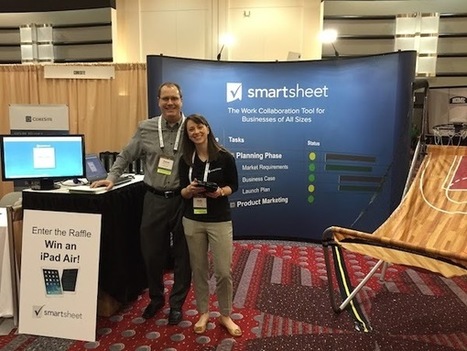
Steve Woodworth (left) and Kelly Anthony (right) representing Smartsheet at the Colliers International Trade Show
Anthony was at the Colliers International Trade Show in Denver, Colorado last month, and a table that was part of her booth didn’t show up. Because she had stored every trade show detail in Smartsheet, which was accessible on her iPhone, she was able to quickly pull up tracking numbers to find out what happened and launch calls directly from the Smartsheet app to get in touch with vendors and colleagues.
“Things go really fast on the trade show floor. And when something goes wrong, because that always happens, you don’t want to be hunting through your inbox or trying to remember who emailed you last,” said Anthony. “You need to know exactly where to turn to find the key information.”
So, instead of planning for every possible thing that could go wrong, your best bet is to organize all phone numbers, tracking numbers, vendor information, and trade show details in one easy-to-access spot, so you can quickly get to critical information when you need it most.
Anthony’s Best Practices to Save Time on the Trade Show Floor
The day of the trade show can feel like a blur. The last thing you’ll want to think about is tracking metrics and proving the success of the show. But, as Anthony has learned, “the more detailed you are and the more information you track during the trade show, the easier it is to prove the ROI of something that can be pretty costly.”
Smartsheet's Trade Show Planner with Budget template.
Stay on top of trade show details with Smartsheet’s Trade Show Planner with Budget template. Then, connect to three Smartsheet apps to automate your workflows and make it easy to track leads, follow up with contacts, and organize signed documents.
One of the most overlooked aspects of trade shows is following up on all leads obtained from the event in a timely manner and conducting a post show evaluation. Follow up activities are where most trade show exhibitors fail for a couple of reasons.
You return to the office to find your inbox full of emails, your voicemail is overflowing and you need check on your current projects and sales.
There is an automatic assumption that all the people you met at the trade show will call you because yougave them a brouchure and they are certain to remember you.
No doubt, you will have some catch up to do after the trade show but the key to success is to prioritize your post trade show activities. First, follow-up with all urgent issues immediately. Second, deal with issues that have come up with existing clients while you were away. Do not sacrifice existing clients for potential new clients. Lastly, put all non-critical functions aside and start your trade show follow-up.
Follow-Up - Immediately!
Post-show planning includes a multiple contact plan. Call the most serious prospects first. You should follow-up with all your leads within 48 hours of the show by email or phone. Continue to execute good prospecting and sales techniques to develop a professional relationship.
Email all booth attendees who provided contact information (regardless of whether they are good prospects or not)
Say "Thank You" for stopping by your booth
Extend the offer of the trade show
Offer your product/service solutions
With qualified prospects, still send an email, but also state that you will call to arrange a time to meet or discuss next steps.
Trade Show ROI
Your trade show follow-up process should be planned just as well as your pre-show planning. Consider that each trade show lead has a cost, a cost you have already spent. If you spend $5000 on your trade show and came away with 500 leads, then every lead cost you $10. If on average you convert 25% of those leads, then each new customer cost you $50. On the other hand, if you don't manage your trade show leads and 75% of them aren't followed up on quickly, your conversion can cost you four times as much. $200?? That's expensive!
Categorize Trade Show Leads
If you've done the trade show properly, you should have notes about certain hot prospects...what they want, connections that you've made and important things to do. Seperate these from the rest of the leads and start with these first. If you have indeed made that connection at the trade show, you will likely be remembered the next day. Something most trade show exhibitors forget is that not all leads can or should be followed-up in the same way. Prioritize them.
What happens if a trade show reaps you too many leads? That's a nice problem to have. You still want to touch bas ewith them, to preserve as much business opportunities as possible. Consider a post-show letter or email follow-up. By using an integrated system like Word or Constant Contact, you can turn out a pretty nice "personalized" note to each of them. You might tell the reader that you will be in contact in the next couple weeks, but if they need you before that to not hesitate to call.
Trade Show Evaluation
In addition to following up with leads obtained at your trade show, one of the most important post show activities is to conduct a post show analysis. By answering some basic questions you will identify things that will help you when planning future events. Some of the key questions to ask are:
What worked?
What didn't work?
Was the booth functional?
Was the booth in the right laocation?
Was this the right trade show for my business?
Did I meet the right people?
What did I learn from others?
What did I learn about the competition?
At some point you will be able to call the effect of the trade show complete and measure your results against your initial objectives. This is when you have exhausted all leads and closed all the business that has resulted directly from the trade show itself. If you kept good records of this activity, you should now be able to eveluate the effects of this particular show. After all, if you are going to put this much work and money into anything, don't you want to make sure that it's worth it?
Although ROI is one of the ways to measure your success, you should always consider the other benefits as well. These benefits can include establishing your brand, community awareness, educating the public and building new relationships and alliances with other companies. You will have to do your own analysis on these non-monetary benefits.
How Much Business Did You Close?
What is the monetary benefit of the closed from your trade show? You should measure in 1-month, 3-month, 6-month and 12-month increments when looking at the value of this business. If you have made your investment back in new business in the first month, you've done reasonably well. At the very least, you should have made your money back plus 50% by the end of three months.
The six and twelve month measurements are to dtermine the long range profitability of any given trade show. At some point, you have to determine that you cannot participate in every trade showthat comes along. Therefore, it is imperative that you determine over the long run, which trade shows give you the best performance that you can build your long term business goals on.
Having a solid follow-up plan is one of the most important parts of your overall trade show strategy. Your follow-up strategy should directly correlate with the original goals and objectives set during the initial planning process. Too often we find exhibitors don’t have the necessary sense of urgency or a well thought-out plan to successfully follow-up on the leads obtained at the show. In fact, according to Center for Exhibition Industry Research (CEIR), 80% of tradeshow leads receive no follow up at all, which is why having a good follow up plan is imperative to your company’s success at the show.
There are several different ways to capture a lead on the show floor and the follow-up method will be the same no matter how they were collected. The most important thing to keep in mind is that leads are time sensitive.
Common Lead Follow-up Methods
Phone call
Email — this can even be directly from the show floor if you are using interactive technology
Direct mail
Mail follow-up packets — include a thank you letter, catalog, informational brochures, special offers and maybe even a company branded give-away (people love freebies). Have these prepared before the show to get them out quickly after.
Schedule appointments directly from the show floor.
Keep in mind that the follow-up process starts on the show floor with making sure the leads are organized and qualified correctly. Having the booth staffers make good notes on what the lead was interested in, buying timeline, and purchasing credentials will help identify leads as hot or cold. Using a score card is also a good way to make sure they are being qualified correctly. Hot leads need to be followed up on immediately, within 48 hours of the show.
Lead Follow-up Timeline
Send a simple thank you email 1-2 days after the show.
Follow up with a phone call to schedule a face to face appointment 1-2 weeks after the show.
Extend a personal invite to an open house or corporate seminar at your facility 2-3 months after.
Send special offers to earn their business 6-12 months after the show.
Lead Follow-up Tips
Have a meeting with follow up staff to clearly communicate timeline and expectations.
Emails should have a recognizable subject, such as "Here is the information you requested at (show)."
Emails should also include the value your company will add to their program, your solution to a problem they are currently having, why your product/service/company is superior, a call to action, and a product/service overview.
Put all potential leads into the CRM tool your company uses for future use.
Hold your sales reps accountable for actually following up with the qualified leads generated on the trade show floor.
Don’t start the follow up conversation with a sales pitch. Start with referencing the conversation you had with them on the sales floor (this is where those notes will really come in handy)
Lead Response Management states that the best day to contact leads is on Wednesday or Thursday between the hours of 4pm and 6pm.
When following up, doing so in a short amount of time is crucial. Prompt follow up should lead to more sales. Also, organizing your leads into categories based on importance will help you get the most return on investment from your trade show.
Sure, a great booth is, well…great! We love designing and building creative, clever, affordable and memorable trade show displays. However, it takes more than just the display to have a successful trade show. Here are a few thoughts on how to make your next event a success.
Don’t over do it. Simple, straightforward messages and designs work best. Don’t try to tell your entire story with your display. Clearly define what you do and emphasize your unique selling proposition. Your display should entice your potential customer to stop to learn more, giving you the opportunity to talk with them. Once they stop, the display has done its job. Now, it’s your turn.
Keep your message up high. Whether your booth contains a full backdrop, retractable banner stands, or a tabletop display and table drop, be sure to keep your message up high. Type at the bottom of your display will most likely be obscured once set up in your booth. Even tabletop displays often become less effective by having objects such as handouts, brochures, card racks and other materials placed on the table in front of the display. A good rule of thumb is to avoid placing text below the bottom quarter of any display.
Do a practice set up. Set up your booth in advance of getting to the show. A complete dry-run will point out any adjustments that may need to be made, and will remind you of the small things you’ll want to bring with you, like pens, zip-ties, masking tape, trash bag, etc. Make a list of things that would come in handy while setting up, and then bring a small kit of tools and accessories to make the set up easy. A dry-run will save you much anxiety when setting up, and will highlight opportunities to make your display even better.
Trade shows are a team sport. One person working in a booth for an entire show is very difficult. You need breaks to gather energy, return phone calls, run to the rest room, grab something to eat. All of which should not be done in your booth (especially the rest room part.) Make arrangements for at least two people, and perhaps a team for a multi-day event. Remember, these may be your best potential customers who made an effort to come to the show. Don’t miss the opportunity for your company to be at its best when attendees walk into your the booth.
Set up early. Break down late. Be sure to get to the show early and be completely set up and ready to welcome clients when the show opens. Setting up while patrons are walking the aisles makes an impression about your company, and probably not the impression you want to make. Same with the break down. You’re tired and want to go. However, breaking down during show hours shows you are more interested in getting out than making the sale. You’ve invested a lot of time and money in being at the show. Stay focused and selling right to end. In fact, an extra 10 minutes could land you the best client of the entire show.
Work the booth, and the crowd. I believe the biggest mistake many exhibitors make is not working the crowd. Sitting behind a table in your booth says, “move along” to attendees. Be sure your booth has room for people to step out of the aisle and into your space. Be standing and welcoming. Sitting implies you are tired and patrons are likely to keep walking and not interrupt your break. Practice your “elevator pitch,” your 15-second description of your business, service or offer. Be sure the benefit to the consumer is clear. Once they understand how much you can help them, they’ll give you more time and attention.
A big portion of my work comes from clients in the tactical and law enforcement industry. This past week I attended a trade show for my industry. I knew this was going to be an amazing opportunity to network, make connections, and, fingers crossed, make some new clients. I realized I needed to come up with a strategy that would set me up for success and assure that I got the most out of my experience. A made a list of ideas to try out. I took the ones that worked the best and developed this simple five step plan that will make your next trade show visit a beneficial one. Industry trade shows are pretty intense and can be intimidating. If you are going to one with hopes of promoting yourself and strumming up new business, you don't want to do so blindly. The beauty of going to an industry trade show as a photographer is that every company or brand there is a potential client because everyone uses images to market themselves. Without a positive strategy you could end up spending a ton of money and walking around for miles and miles a day with nothing to show for it in the end. Obviously, the quality of your work will play a part in your success, but everyone knows that your business skills also play a major role in your success as well. Hopefully you can take these tips and apply it to your next trade show visit.
Plan, Plan, and then Plan Again I think one of the most crucial things in anything business related is planning. Having a plan gives you structure and gives you something to work towards. Without a plan you may very well end up wasting hours, if not days, at a trade show. Most large trade shows have a list that show you every exhibitor that will be in attendance. These list are usually available long before the actual event is held. What I do with this information is make my own list of potential clients I want to try to connect with. The first list I make is based on location. Most companies would much rather work with a photographer that is local to their area so they don't have to pay out as much in travel cost. My first list is always potential clients in my state. By mentioning to them that I also live in Georgia, I instantly create common ground with them. My second list is made up of "dream clients." These are usually clients that I know are a long shot but having the opportunity to work with them is worth taking the risk. Once you have created these lists it's a good idea to go ahead and try to reach out to someone at the company via email or a phone call. It's always going to be better to set up a meeting beforehand rather than to try to get one at the actual event. It is, however, sometimes difficult to get a response this way, so don't be discouraged if they seem to ignore you. You'll get another chance at the show.
You are also going to want to set up your travel arrangements and hotel arrangements as far in advance as possible. If you try to book a hotel last minute at a large event that will bring in thousands of travelers, you may find there aren't many, if any, rooms available. You could end up having to stay in the next city over and that is just going to cost you more money and time. Trade shows often have official event hotels that offer discount for show attendees and exhibitors. These hotels will often offer free transportation to and from the event as well. This can end up saving you a good bit of your hard earned money.
Create A Memorable Leave Behind Business cards are great and serve a purpose, but they are somewhat lacking. The truth is, you may only get 15 to 30 seconds to speak to someone. If all you have is a business card to give them it's just going to get lost in the stack of the other 500 business cards they get during the week. We are creatives, so let's be creative! What I did was create a small eight page booklet. It was basically a mini-portfolio. I wanted to make sure that it was visually intriguing as well as informative. I wanted to get across what I bring to the table and what makes me good at what I do. Below you can see my cover and some of the spreads from my booklet. I was able to design my own booklet for the most part, but I also used some template pages that I got from graphicriver.net. If you aren't too savvy when it comes to graphic design, it would definitely be worth the investment to get a graphic designer to put something together for you. I was able to get 1,000 8.5x5.5 inch booklets printed for less than $700, including shipping, using nextdayflyers.com. You don't have to make the exact same thing I did, but definitely create something memorable. Almost every person I talked to would ask me if I had a card. The great thing about my booklet was I would say, "I have something even better," and give them my booklet. Eighty percent of the time this would cause them to spend an extra 2-5 minutes talking to me and asking me questions. This was great and allowed me to build even more rapport. The more face time you can get with someone, the more memorable you will be. That's the key here. You want to be remembered.
*Don't pass out your leave behinds like they are flyers for a rock concert. You don't want to solicit. Hand these out when someone ask for a buisness card.
Make Sure You Are Speaking To the Correct Person If you aren't able to set up a meeting in advance, you always have the option of approaching a company at their booth. There will usually be someone at a booth who will come up and greet you and ask if they can help you with anything. The majority of employees at these events are in sales and have absolutely nothing to do with their companies marketing and photography. The last thing you want to do is give your pitch to someone and then have them say, "I'm not really the person you need to be talking to, I'm in sales." Or even worse, they hear you out, take your information, put on a nice face, and then throw it away when you walk off. You want to make sure you are connecting with the right person. After many failed and babbling attempts, I finally developed an opening sentence that I can use every time. First, I always smile and introduce myself. Then I say, "Is there anyway that I could speak to someone or get some contact information for someone in marketing? Preferably whoever is in charge of your photography. I am a photographer and I would love to say hello and introduce myself." This question will usually get you connected with the director of marketing, art director, creative director, or whoever happens to handle photography for the business. More often than not, I was able to speak directly with them and tell them about myself and what I do. You always want to end the conversation by asking them if you can get a business card or contact information so you can follow up after the show. This is all about networking. Unless you are a vendor, you most likely don't want to be doing officlal business at a show. You just want to introduce yourself, get some contact info, and give your contact info.
Be Confident If you are an introvert, the previous tip is going to be one of the hardest things you'll ever do. It's extremely intimidating to walk up to a massive trade show booth filled with employees, most of them already engaged in conversation with well-dressed business men and women in suits and ties. If you are like me with piercings and tattoos, you can sometimes feel out of place or out of your element in situations like these. The truth is you're just going to have to suck it up and do work. If you can't approach someone with confidence you might as well go home. Being confident can be your best selling point. Don't come off cocky, but be sure to show how passionate you are about what you do. Make them believe in you, because you believe in yourself. When you are stumbling over you words and unsure about what you are saying, they are going to assume you are unsure about the services you can provide. This all gets easier over time. This past week I bit the bullet and walked up to one of the largest companies at the trade show, one from my "dream client" list, and ended up being told they wanted me to come to their office and talk to their creative team. The only reason that happened is because I showed them that I believe in myself and feel like I have a lot to offer. Confidence can be one of your greatest tools.
Always Follow Up Last but not least, always follow up. Most likely they forgot about you 20 minutes after you left. Always follow up with an email and then possibly a phone call. They won't even think about contacting a photographer until the need for one arises. It could end up being months later before that need happens. The best thing you can do is follow up once things have settled down a little so you are on their mind during a less hectic time. Don't get crazy or annoying, but keep in contact with them. The idea is to build relationships. People like working with people that they know and trust. Understand that this isn't an overnight process, but you should embrace the possibility it holds.
I hope these tips help you in the future. I'm sure they can be applied to other areas outside of trade shows. As always I'd love to hear your thoughts or questions in the comments below.
Participating in a tradeshow is a common component of most business development efforts. The experience can be fun – the crowd, excitement, change in scene, and new product info are all stimulating, and there is the lure of developing new sales leads.
You might even sell something!
But lots of sales managers and business leaders will tell you that “shows” can be expensive, and in many cases fail to yield tangible results.
One frustrated VP of Sales also expressed disappointment with his group’s after-the-show effort. “We had a pile of business cards that nobody really knew anything about and similar registration data; as a result, any attempted follow-up was ineffective.”
Are tradeshows worth the effort? Can the costs be justified? Is there a way to make productive use of floor time?
Planning, goal-setting, proactive behavior and follow-up are all required, and the key to tradeshow success is to properly deal with the known and unknown attendees.
The planning and goal setting steps take place before the show. Begin by estimating total number of attendees and the number of potential prospects or influencers (those who might refer or impact decision makers). Then set reasonable, attainable goals for the number of prospects you’d like to meet and the number of post-show activities you’d like to schedule, such as appointments, meetings, telephone calls, etc. Try to arrange for social media connections as well.
Once you arrive at the trade show, everyday sales presentations are best left at the office, as it becomes more important to:
Proactively interact with as many “unknown” attendees as possible (you can contact the people you already know any time… the key objective is to meet NEW prospects!)
Spend most of your time asking good questions that will enable you to qualify each of the unknown attendees (i.e., determine if they are, or are not, prospects)
Once a true prospect is identified, follow the following strategic communication guideline:
Assess their situation, objectives, needs (more questions… and listening!)
Confirm what you’ve learned
Present a concise value proposition (the show is not the best place for an in-depth selling presentation!)
Based on what you’ve learned, and due to the reality specified in item #3, try to schedule a specific follow-up activity as noted above
Politely disengage and “repeat…” until you have achieved your goals
Since debuting their cloud-based coordination and communication platform for senior-care providers at a regional trade show in 2012, Asif Khan and Fahad Aziz have raised $2.5 million, won multiple awards and acquired more than 100 U.S. facilities as customers. But that doesn't mean they've outgrown the exhibition halls. To this day, they trumpet their web and mobile health solutions at trade conferences around the country, hitting an event devoted to assisted living every month or two--and paying up to $4,000 per show in registration fees alone.
"That's where we get most of our leads," says Khan, founder and CEO of Caremerge, which is based in Chicago and San Francisco. "If you're a regular at these trade shows, you start to become a household name. You start to generate the buzz you want."
Exhibitionist: Asif Khan of Caremerge.
Photography by Kevin J. Miyazaki
This isn't just about PR, though. For Khan, industry expos are the best possible venues for zeroing in on Caremerge's ideal prospects and partners. Rather than spend countless days and dollars flying around the country to meet with customers--current and potential--Khan relies on trade shows to bring the long-term care providers who are most motivated to solve their technology problems to him, all under one roof.
"You get so much done in two days that you could not imagine getting done in six months or a year," he says.
Of course, you can't just pull up to the nearest trade show with a laptop and samples in hand, expecting to wow the crowd. If you want to ace it as an exhibitor--and nab awards, press mentions, new accounts or distribution--some advance planning is in order. Consider this your checklist.
1. Do the recon.
Before coughing up those exhibitor fees, scout out the show as an attendee. (If possible, start with a local show to save on travel and lodging.) That's what Khan and Aziz did before launching Caremerge. Besides getting the lay of the land, they gained valuable intel about their industry and competition.
"People love to talk at trade shows," Khan says. "By spending $300, you can answer a lot of questions."
Once you register for a booth of your own, it's strategy time. Scour the exhibitor list and session lineup for potential customers, partners and advisors you'd like to meet at the event, then reach out to them. Follow the lead of Pacific Grove, Calif.-based Romy Taormina, CEO and co-founder of Psi Bands, an acupressure wristband for nausea relief sold in more than 10,000 stores. Once a conference releases the list of attendees, she sends an e-mail to companies with which she'd like to connect, including her booth number and a request to set up a day and time for a meeting.
2. Create an irresistible pitch.
At his first hurricane-preparedness trade show in 2007, David Dodgen tried to demo his AquaPodKit, a bathtub bladder that stores 65 gallons of fresh water, using only a poster. It's not surprising that no one stopped at his booth.
"I thought, This is not working," says Dodgen, who is based in Austin. So mid-show, he bought a bathtub at Home Depot, lugged it back to the venue, lined it with an AquaPodKit and filled it with water. "The media went crazy," Dodgen recalls. "There was a line of people at my booth."
A great demo is nothing without a spirited, engaging pitch that presents the solution to a specific customer need--preferably in a minute or less. Dodgen has several taglines he uses at shows. Among them: "Stores 14 days of fresh water for all the basic needs of a family of four!"; "Much cheaper than stockpiling 65 gallons of bottled water!"; and "Much easier than getting to the store during an emergency!"
A video demo also can work well, says Amy Wenslow, CEO of Products to Profits, a consultancy in Pasadena, Calif., that helps 'treps and small businesses develop, sell and market their wares. It's a great way to show off your product on your phone or tablet, if you need to do an impromptu demo outside the booth. However, Wenslow warns, a video should be kept under three minutes and, most important, "it's got to have conviction and energy."
3. Make your booth inviting.
A big mistake newbies make is overpacking their booths with furniture and inventory. "You have to leave enough space for people to engage with you," says Wenslow, whose clients' products sell in Walmart, Target, Lowe's, Bed Bath & Beyond and Big 5 Sporting Goods. That means leaving room for your team, your demo and show attendees, many of whom will be toting large swag bags. To ensure you don't overcrowd the booth, map it out ahead of time in your office using tape on the floor, Wenslow advises.
Another no-no: placing a rectangular table across the front of your booth. "That's basically saying, 'I don't care if you come in,'" Wenslow says. Instead, position large tables against the back or side of the booth. If you need a place to park your literature (and yourself), try a small, bar-height table and stools toward the front of the space.
Taormina agrees that less is more. "A simple, clean booth that's bright and eye-catching is important," she says. "Sometimes people have been on their feet all day and just want to sit down." Be that welcoming beacon of calm amid the chaos where people can relax, and they may stick around to chat a bit longer.
4. Cut costs, not corners.
It's essential to know where you should (and shouldn't) scrimp. To minimize cash burn, Khan negotiated a 25 percent discount and a three-installment payment plan when registering for his first conference booth for Caremerge. He tapped university students for help with his logo, brochure and banner designs. Once his business gained traction and he was attending shows regularly, Khan made an online purchase of a fold-out booth display from a Chinese company for a fraction of what he would have paid to a U.S. manufacturer.
Make sure you spend wisely when it comes to assembling your team for the show, too. "The people who go should be outgoing and able to ignite a conversation coming down the escalator," Khan says. He doesn't buy a full conference pass for each team member in attendance; if booth registration includes only one or two passes to the entire conference (sessions and expo hall), he leaves it at that. For extra hands on the trade-show floor, Wenslow recommends tapping temp marketplaces such as TaskRabbit and Fiverr to hire students willing to do odd jobs such as booth setup.
5. Know where to splurge.
Taormina is a believer in buying as much visibility as one can afford. When she launched Psi Bands to the travel industry at the 2012 International Travel Goods Show, she paid about $250 more to display the bands in the new-products pavilion--and landed the show's coveted Buzz Award, selected by retailers and media.
"For media and awards, you definitely want to be in the new-product showcase," Wenslow agrees. Same goes for businesses looking to woo big retail chains.
Taormina is also a fan of renting a badge scanner when available--an expense she says runs about $250 to $300 per event. Rather than do the business-card dance with new contacts, you simply scan the person's badge, type any additional notes into the device and download all the digital data after the show.
"It makes it a lot more efficient," she says. "The follow-up is so much more streamlined, and we don't have to rely on memory."
Another worthwhile investment once you have a couple of exhibitions under your belt is purchasing booth furniture (as opposed to renting)--even if it means shipping it to out-of-state shows. Just be sure to buy furniture that's light and easy to pack, Taormina advises, noting, "Think about what can you invest in for the long haul that will save you money over time."
6. Network, network, network.
Talk to everyone, everywhere--even in line for the restroom. "I've met two or three sales reps we use now in elevators at a show--just by being nice and saying hello," Wenslow says.
Go out of your way to befriend show organizers and staff. Tell them what you're looking for, be it customers, investors or publicity. "If they know, for example, that we're looking to hit up certain media publications, they may drive those people to our booth," Taormina says.
Get to know exhibitors in the neighboring booths, too. They can watch your turf when you need to sneak away for a minute or help keep an eye out for buyers you're hoping to meet.
When exploring the show, don't roam aimlessly. "Go to the welcome reception," Wenslow says. "Think about which sessions the buyers and contacts you're looking for would attend." Check the show's website and Twitter feed for last-minute program changes and other highlights.
Never leave your booth unattended, not even for a minute during lunch, and not late in the day when the event's winding down. That might be when the buyer you most want to meet visits your booth. In fact, Wenslow says, if you're in the new-products pavilion, that is precisely when buyers for the big-box stores will stop by.
7. Follow up and evaluate.
Your post-show checklist should include more than merely reaching out to new contacts. Look for other opportunities to communicate with your industry. For example, Taormina likes to include any breaking news--an award, a hot new customer--in Psi Bands' newsletter. She'll also send a press release announcing big wins to relevant trade publications, a move that has garnered her multiple write-ups.
Follow-up isn't just about closing sales. It's also about gauging an event's return on investment. It's wise to attend a show with preset goals in mind (think: media hits, investor interest or retail leads).
"With trade shows, you can see, How many leads have I gotten? How many customers have I closed from those leads?" Khan points out. "This is pure, back-of-the-envelope ROI that you can track."
The ability to be seen and be heard by prospective clients is one of the greatest needs of any small business. In today’s rapidly changing business environment, small businesses need to be more and more creative with how they reach their target market.
Once upon a time, cold calls were an efficient way to make contact, but that method has fallen out of favour and you’ll unlikely find willing ears on the other end of the line, and messages are rarely returned. Likewise, the new Canadian Anti-Spam Legislation (CASL) has made attempts to contact prospects via email more challenging than ever. Without explicit consent, this marketing tool is virtually useless.
PRODUCT TESTWe give the Myo gesture-control armband a try
CROWDFUNDINGPhotos: 3-D printer attachment and B.C. school top crowdfunding list
DESIGNER SPOTLIGHTA crafty way to show off your boyfriend (or celebrity crush)
That’s why now more than ever, participating in a trade show is important. Trade shows offer a captive, interested audience of like-minded prospects and current customers right at your fingertips, and an efficient way to get more out of your marketing dollars. Here are ten other reasons why your small business should get involved:
1. Connections. Most trade shows encourage both delegates and exhibitors to establish a year-round working relationship by connecting them using LinkedIn, blogs, newsletters, matchmaking and webinars.
2. Face-to-face contact. Both prospects and current customers frequent trade shows, so it’s an efficient and personal way to network, market, and sell directly to your target audience. Make sure to ask the show management for their target audience or the delegate list from the previous year to ensure it’s the right event for you.
3. Product demonstration. People attend trade shows to seek out new products and services, so it’s the perfect opportunity to put those new products directly into their hands – literally. Attendees are able to touch, feel, hear and see how your product or service can fulfill a need that their business has.
4. Stronger relationships. Attending receptions and other networking event gives you the opportunity to engage in relationship building with others in your industry – including influential decision makers – and a chance to collect useful intelligence to take home with you.
5. Educational opportunities. Education sessions can help you better understand the challenges and trends in your industry, strengthen your business strategy, better position yourself to your clients, and move your business forward.
6. Free media exposure. Most trade shows generate a significant amount of media coverage. Work with show management and their public relations team to determine any opportunities for your booth to be featured. The result can be additional free exposure in trade magazines, television and radio.
7. Share expertise. Explore opportunities for your company to participate as a speaker. You will automatically be positioned as a thought leader in the industry by attendees looking for trustworthy and knowledgeable industry experts.
8. Hype generation. Trade shows give you another opportunity to reach out via social media to talk up your company. You can tweet about the offerings at your booth or post a message on your Facebook page about what new service or product you’ll be promoting. It’s also an opportunity to let your social media following know about other learnings.
9. Buying power. According to a report from the Center for Exhibition Industry Research, 81 per cent of trade show attendees have buying authority. That means more than 4 out of 5 delegates visiting the show floor have money to spend.
10. Good PR. Participating in a trade show tells current customers and prospects that your company is financially strong, innovative, and actively reaching out to share your successes with them. It also demonstrates your drive and competitiveness – you’re not sitting back and letting the competition grab the spotlight.
A few weeks ago, I shared some thoughts on Trade show ROI and a few key strategies to make sure you have a successful trade show. While my main focus atstarfunding is working with companies to improve their cash flow, there are steps you need to first take before looking at cash flow issues like sales and driving revenue into your company. More often than not, the answer to cash flow struggles is more and gaining better ROI on your major marketing and sales investments.
Over the last few weeks, I visited The Toy Fair, Agenda, and Magic trade shows. There were so many great brands, beautiful booths and tons of energy in the air. What I also noticed was that there are a lot of people struggling to connect, build relationships and close sales. The struggles I noticed were mostly avoidable with a little awareness and preparation. Since it’s trade show season, I figure why not piggy-back on my prior article and share 3 great tips for selling at a trade show.
1. Train your booth personnel and practice selling skills
Trade shows are your time to shine as an industry expert. It’s true, first impressions are everything. When a prospective client stops by your booth, they need to know that you are on top of your game. This not only comes across with the information you share or how you present the product, but also how you work with prospects. Are you asking the right questions? Are you listening to the thoughts and concerns of your prospective clients? Are you connecting on a personal level?
Selling a product is always more about what you know about your prospect, not just marketing or demonstrating your product. You can sell for days sharing all that you love about your offering, but if you are not demonstrating that you can meet the needs of your customers your presentation will fall flat.
2. Qualify interested parties quickly
Your job at a trade show is to speak with as many qualified customers as possible. This doesn’t mean that you can’t be friendly and meet people that may not be in your target market. However, it does mean that you need to make sure you limit the time you spend with people who won’t buy. The trade show may only be 2-3 days long, so time with qualified buyers is limited. Be sure to gauge whether or not they are genuinely interested, their purchasing influence or decision making capacity and purchasing budget. If you can determine their value as a prospect within the first 1-2 minutes of speaking with them, you can politely guide the conversation to be over within 3-4 minutes in the case they are not qualified.
For Example: If you are selling to retail stores, ask the prospect these simple questions to instantly know if they are your target customer. 1. Where is your retail store? 2. What other brands do you carry in your store? 3. Why are you interested in our brand?
With all of the competition at the trade show, what are you doing to make yourselves memorable and make your booth visitors feel comfortable? Of course you will have a bowl full of chocolate, but you need to make sure to shake hands, maintain eye contact, and ask thoughtful questions so your visitors feel you are genuine.
If you are booking appointments in advance make sure you are on time for those appointments even if your customers are not. You need to manage your appointments so that nobody feels rushed, but everyone appreciates your punctuality.
Trade shows can be some of the most costly marketing and sales efforts any company can make. A strong focus on customer experience can be everything while exhibiting at a trade show and successful trade show execution can make or break your sales for the upcoming season or year. Make sure to pay close attention to practicing selling skills, spending your time wisely with qualified customers and making your visitors feel special.
Following up on sales leads from your trade show marketing can be tough.
While you want to initiate action and get the sales process moving forward, coming off as too pushy can backfire and cause your lead to back out altogether.
Much has been written about closing the deal, but there’s surprisingly little detailed information out there on taking your leads from cool or simply lukewarm to the end of the sales process.
In this guide, we’ll share seven strategies that you can use to follow up on sales leads without coming off as the pushy, desperate, hard-selling salesperson every business owner dreads having to listen to on the phone.
Follow up on inbound leads as quickly as possible
There are two types of sales leads: inbound and outbound. Outbound leads are leads you generate through advertising and trade shows. Inbound leads are leads that get in touch with you, either over the phone, in person or via your website.
Sometimes, it’s strategically advantageous to wait before contacting outbound leads, especially if you know their time is occupied. But with inbound leads, you should act as quickly as possible to capitalise on their interest in your product or service.
Follow up trade show leads quickly – the next day if possible. Whenever a new enquiry comes in from your website’s email form, follow up within the hour. The faster your response, the higher your close rate will be, since most of your customers will associate a quick response with high quality service.
Get to know your leads before picking up the phone
Far too many sales representatives take the spray and pray approach to direct sales, firing off hundreds of calls per day and getting very few sales. It’s far better to take a slow, calculated and highly targeted approach to following up on your sales leads.
Pretend you’re the owner of an advertising agency that’s just exhibited at a trade show. You have a stack full of hundreds of business cards of companies that could very well be interested in your advertising services.
Do you call them straight away without doing any research? Or, do you search for their latest advertising campaigns to learn more about what they’re already doing and how you could help them?
When you know your prospect, you can approach them not just with a sales pitch – something they’ve undoubtedly heard before – but with real advice that’s tailored to their situation. The more personal your call, the less selling you’ll need to do.
Build rapport with prospects using social media
Social media is a wonderful tool for connecting with prospects when used the right way. When used the wrong way, however, it’s a disastrous sales method that often leaves you with alienated prospects and a reputation as a spammer.
Instead of using social media platforms like Twitter and LinkedIn to push your sales message on other people, use it as a tool to directly connect with your prospects and have a conversation. Like their posts, share their content and be… well, social!
Think of social media as a priming method for your sales call: you’re not selling over Facebook or LinkedIn itself – that’s extremely difficult – but simply reminding leads that you exist, that you have something to offer and that you care about them.
Use custom Facebook Ads to make them remember you
Here’s a cool way to strengthen your brand before a follow-up sales call: create an advertising campaign using Facebook Ads targeted only towards the people you’re interested in reaching.
Facebook’s Custom Audience feature lets you display News Feed and Sidebar ads to people on your email list. This means you can display ads only to leads you’ve gotten from a recent trade show, networking event or digital marketing campaign.
One of the most difficult parts of following up on a sales call is establishing trust in your brand. If your prospects have already been reminded of your brand through a Facebook Ad, they’re more likely to respond positive to your follow-up sales call.
Call to solve their problems, not just sell your product
Do you follow your leads on social media? If not, you should. Many companies post to their Twitter and Facebook Pages about what they’re working on, new products and, on occasion, the problems they’re facing as a business.
When you spot an opportunity to help someone in your professional network, act on it by following up with a problem-solving call. This way, instead of selling them your service, you’re simply offering them a solution to a problem they’re facing.
This is a great way to frame the sales process if you want to avoid the hard sell. You don’t have a product or service to sell; what you have is a solution to a problem, and your job as a salesperson is to discover how it can help your prospects succeed.
With warm sales leads, always have a reason to follow up
Not all sales leads are cold. Some sales leads – such as people you meet at industry networking events and trade shows – are warm. They’re people you already know, at least as acquaintances, and have plenty to talk about.
The key to following up effectively is to provide a reason for your call before the call itself. At the end of your interaction with a prospect at a trade show, tell them you’ve got some information to share with them and that you’ll be in touch.
Or, tell a prospect that you’ll send them a discounted price list. Or a sheet of special offers you don’t offer other customers. Bait the hook a little and give yourself a good reason to follow up, making the inevitable “just checking in” call less awkward.
Have a real conversion – after all, there’s a person on the line
When you think of sales as a volume game – a mentality that far too many sales reps have – it eventually transfers into your dealings with people. Prospects aren’t other people on the line to you – they’re just opportunities to get a “yes” or a “no”.
This mentality might work in high-pressure sales environments, but it’s a recipe for disaster in B2B sales. Businesses are made up of people, and being good at talking to people is what will help you close deals, make sales and make progress.
Instead of thinking of follow-up calls as an opportunity to close a deal, think of them as an opportunity to connect with someone. Have a real conversation – about what their business is up to, recent events or anything else – instead of just product talk.
As an aside, people remember great conversations they have with businesses and occasionally blog about them. Last year, Netflix received a massive amount of free coverage after one of their customer service conversations went viral.
The quality of your product matters a huge amount in sales, but people are often swayed not by features, but by personal service. Show that you care by talking to your leads about more than just your product and you’ll eventually close the sale.
Try these 5 proven tactics at your next trade show or conference. Try these 5 proven tactics at your next trade show or conference. You will win more leads and brand advocates.
Unlike the famous Woody Allen quote, you cannot get 80% of success at trade shows by just showing up. Trade shows and conferences bustle with eye-catching distractions and highly-caffeinated attendees. They are hyper competitive arenas for attention. Marketers need more than the cookie-cutter booths and ubiquitous keychain giveaways to get - and keep - the attention of attendees and press at events today.
Creativity and planning are key, but marketers don’t need a big budget to deliver ROI. Try these 5 proven tactics at your next trade show or conference. You will win more leads and brand advocates.
1) Host a Side Event
Pick a restaurant nearby the venue and invite customers, partners and social media followers to a semi-private networking event. Use a custom hashtag and a social event ticketing platform like Meetup so attendees can check out the guest-list and connect beforehand. Then invite prospects and press so they can talk to current customers. Marc Benioff has said this was Salesforce’s most effective tactic for acquiring new customers.
INVISION'S ARTISANAL COFFEE STATION AT THE LAUNCH FESTIVAL IN SAN FRANCISCO
2) Add a Designer's Touch
If you’re already spending big on exhibiting at an event, invest a little bit extra to put a creative spin on your presence and giveaways. For example, InVision brings along an artisanal pour-over coffee station and potted orchids, along with the standard booth backdrop and tablecloth. The net effect is that attendees lingered for conversation, whereas another booth with a cafeteria-style coffee dispenser sat ignored. Thoughtful extras like these don’t cost much, but make a world of difference.
3) Create a Custom Hashtag
Come up with a short, memorable hashtag for your brand and use it frequently alongside the main event hashtag to share news, photos, and contests. Home Depot runs a contest for best college football tailgate photos with the hashtag #HDGameDay that has over 10,000 mentions. For b2b, think integration, like printing your hashtag on stickers and t-shirts, for extra discoverability.
4) Run a Targeted Campaign
Ahead of the event, target Facebook event RSVPs and event page fans, LinkedIn event group members and Twitter event hashtags, which you can do with any size budget. Offer content related to the event and ask for emails in exchange. Co-brand with the event if possible, using the event logos prominently in creative, and create a dedicated landing page. When GETONIC, an ecommerce startup, tried this strategy, they reached thousands of event attendees.
5) Upcycle Your Content
When the event wraps up, your content marketing just gets going. Collect all your photos, videos, and social media mentions for a wrap-up blog post and thank you email to send to attendees. Repackage the standout presentations from speakers or major discussion themes into blog posts and thought leadership for your team.
Marketers keep coming back to trade shows and conferences year after year, despite the noise and clutter, because they know they'll find a large groups of target customers. All it takes is a little planning and creative ingenuity and you too can stand out from the crowd.
Working a tradeshow floor can be a physically and emotionally draining task. For many shows you’ll be spending the majority of your time standing up, wandering between stands and using all of your wits to close leads and grab those business cards. You’ll have to chat with anyone and everyone and be on your top game at all times. It’s no wonder that sales teams can suffer exhibition fatigue a few days into a multi-day conference.
If your staff don’t know what’s going to hit them they might be overwhelmed by the experience, something you should avoid to get the best ROI you can out of your attendance. The last thing you want is tired staffers having to lean against your stand for rest or flagging in their sales because they’re fatigued and weary. How can you make the trade show the fun, engaging experience it should be? With these four tips, of course!
1. Get everyone involved
A good management strategy can be the difference between a good event performance and a great event performance. The manager, whatever their level, at the show needs to get involved with all sections of the event. From the planning to execution to setting up and training – the more they’re involved in the more cohesive your team. Take on board ideas from your staffers and listen to their options, too: if they feel like their opinion is valuable they’ll work that extra bit harder on the stand they helped design and implement.
2. Don’t exhaust your staff
If you’re attending a multi-day show ensure you switch out your staffers from time to time to give them opportunity to rest and recuperate. An employee who is tired, drained and fatigued might not be able to remember crucial information like prices, services and case studies that would otherwise close a sale or gain a lead.
3. Offer incentives
In order to give your staff an extra boost on the day offer a bonus for the staffer who gets the most leads or closes the most deals. It doesn’t have to be anything grandiose – a simple extra day’s holiday will often be enough to encourage healthy competition and help employees feel their work will be rewarded.
4. Have fun
Probably the most important tip we can give you is have fun! Yes, you and your company are there for business reasons but if you stand there stoically obviously not enjoying yourself you will project a negative aura that other attendees will feel. A friendly smile and a joke will make everyone feel more at ease and help grab a lead or motivate a team member.
Hopefully these tips will help your event performance. Remember, too, that everyone is different and has different personalities – make sure you interact with your staff and get a good idea of what will and won’t work when you take to the event floor.
In the heat of moment when you are working the floor of the trade show shaking hands, chatting up prospects, engaging customers and so on, you are not likely to be spending much time thinking about what you will be doing to follow up with all these business cards and verbal exchanges in the weeks to come. In fact, a study back in 2010 stated that less than 70% of companies have a defined or formalized process for how to follow up on trade show leads at all. Considering the investment of time and resources your company put into the event don’t you think it makes sense to make sure you are making the most of it?
Unfortunately, many companies don’t know where to start when they try to come up with a solution for how to do more with trade show leads, much less how to get better ROI from these leads. Don’t let your company lose out on sales opportunities and take these 5 tips into consideration when coming up with a strategy for your organization.
#1: Don’t Go In Without A Plan
Before attending the show, make sure to have a plan in place that outlines how you will be gathering the information for these leads and who will be following up with them after the show. A big hurdle for many companies is confusion about who will be following up on the leads that are gathered. Is it marketing? Is it sales? Is it the event team? Making sure everyone has a clear understanding of responsibilities will allow each team to focus on their goals.
#2: Prioritize Leads By Importance
When you are at the show, you should make sure to use some sort of scale to rate each lead’s potential or importance. Whether rating leads by the contact’s interest level or from an existing outline of target companies, you will want to make sure that your company’s follow-up efforts are not wasted on leads that were merely being polite or are with a company that is not a good fit for yours. Prioritizing leads during the show and having an after-show meeting with your follow-up team to review them will ensure the process starts off on the right foot.
#3: Add Leads To CRM
One of the most important steps to a successful trade show follow-up effort is to make sure that the leads gathered are added to CRM for your follow-up team to track their progress with each contact, schedule additional tasks and so on. CRM will also allow for the addition of notes related to the conversations had with each contact at the show, if this information was gathered, which will allow your team to continue the conversation from the show without having to start cold. Proper use of CRM will allow your company to have visibility, via reporting tools, into the efforts of your follow-up team, as well as the value and success of the effort as a whole.
#4: Do More Than Just Send An Email
Email is an important part of any lead follow-up effort, but if you want to know how to do more with trade show leads then you need to understand the importance of the “human element” in these conversations. The rising popularity of marketing automation assists with adding more personalization to interactions with contacts but it has not (yet) replaced the personalization of a phone call. Regardless of the methods used, the messaging should be tailored to the contact themselves and should aim to continue the conversation from the trade show as best as possible. An informed and personalized follow-up will have much more of an impact than a generic email.
#5: Don’t Let Them Go Cold Afterward
You’ve called the contact and sent them an email. They didn’t pick up the phone and you leave them a nice voice mail. They haven’t responded to your email or voicemail with list of things they wish to purchase immediately. Perhaps you spoke to them and they said they weren’t ready to start discussions. What now? Wash your hands of them and forget them until next year? NO!
The earmark of a well-managed trade show follow-up campaign is an understanding that not every sale will be made within 3 calls or 2 emails. In fact, one of the best ways to separate your company from your competitors is to not fall off the radar after the trade show fades into memory. Continue to work these contacts on the merits of new business development principles of nurturing them through continued and strategic follow-up and find your company making the most of these leads long after the trade show has ended.
How To Do More:
5 Tips for Better Management of Trade Show Leads is a good start to improving your company’s trade show efforts but the most effective solution is to marry this campaign with a dedicated and strategic plan for new business development as a whole. Many companies have improved their results by adding trade show lead follow-up into their existing new business development campaigns with companies like Concept Services, because as a dedicated partner for new business development, we take on the responsibility of following up with these leads and ensure that they do not go cold by adding them to the pipeline of contacts we work and stay in front of on their behalf.
To get content containing either thought or leadership enter:
To get content containing both thought and leadership enter:
To get content containing the expression thought leadership enter:
You can enter several keywords and you can refine them whenever you want. Our suggestion engine uses more signals but entering a few keywords here will rapidly give you great content to curate.


 Your new post is loading...