Your new post is loading...

|
Scooped by
Aditya Patkar
April 14, 2016 4:36 AM
|
As much as technology can facilitate communication, it often falls short on one of the most essential aspects of marketing: human connection. We are quick to close advertising pop-ups and fast-forward through commercials, but good, old-fashioned face-to-face interactions enable you to connect with customers on a personal level without the barrier of a computer screen, mobile device, or phone. Conventions, conferences, and expos provide an environment that puts you in direct contact with like-minded individuals actively seeking out solutions, new technology, and trends in your industry. A good trade show exhibit should seem effortless to attendees—but with three of our clients participating in the 2016 National Automobile Dealers Association (NADA) Convention, we know there’s more going on behind the curtain. Giving yourself time to prepare and paying close attention to detail will help ensure that visitors to your exhibit enjoy themselves and remember your brand. Here are some tips to help you plan and promote your booth to attract new business and keep current customers engaged: - Set a Budget – Trade shows should generate quality leads and solidify your relationship with current customers. Consider the event an investment, and budget accordingly. Let it guide your planning so you can determine how much you’re comfortably willing to spend. Factor supplemental materials, equipment rentals, incentives, and other accommodations into your estimates.
- Assemble Your A-Team – Think strategically about who you will send to represent your brand, and stay open to the idea that the most knowledgeable member of your staff may not be the best salesperson on the trade show floor. Put together a well-rounded team that can speak to your target audience, is knowledgeable about your products and services, and has the stamina to keep up with the long, fast-paced days. Consider sales reps, the top dogs, or customer service personnel. Conduct a little extra training to review with your team the most important points you would like them to communicate.
- Create Promotional Materials – Part of planning ahead of time means making prospects and current customers aware of and excited about your booth at an upcoming show. Send invitations that are personal and engaging, with a teaser of what to expect at the main event. Post on your website and social media accounts, and send promotional flyers or postcards to dealers, news outlets, forums, etc. to create buzz and encourage customers to attend. If you plan on interactive activities, demos, contests, or prizes, include that on your materials to generate interest and increase traffic. As an added touch, send out email reminders leading up to the event.
- Plan Your Space – Your booth doesn’t have to be fancy, but you also don’t want it to feel like it was thrown together at the last minute. Make a checklist of all the details you’ll need covered, apply for exhibition space, and look into rentals that will draw interest. Having a plan in place ahead of time will help you come off as more professional and foster confidence in your brand. Also think about marketing collateral for the show. Give attendees something tangible, such as handouts, brochures, and giveaways, that will educate customers and act as a reminder of your interaction.
- Get Personal – You’re there to inform customers about your product, learn more about industry trends, and generate leads. But remember to put the personal connection first. While talking to prospects or current customers, find a way to appeal to their human side—read their body language, take cues from their tone, and actively listen to their concerns. Instead of responding with a rehearsed script, use these interactions to address their individual concerns and tailor your discussion to them. Showing your interest will open them up to engaging with you further, thereby allowing you to build that essential customer relationship.
Successful event marketing requires a strategic approach to how you will promote your booth, attract attendees, educate prospects, and engage current customers. It may seem overwhelming, but you’ll find that planning ahead is your best ally when it comes to hosting an exhibit that makes an impact. By keeping the focus on your audience throughout the process, you will generate quality leads that grow into budding customer relationships.
|
|
Scooped by
Aditya Patkar
April 13, 2016 5:32 AM
|
Today, more than ever, marketing is all about relationships. We are continuing to shy away from the traditional practice of just pushing products and, instead, putting an emphasis on building real connections with customers. Event marketing offers a unique opportunity in this changing industry as you are able to be face-to-face with your audience. What better way to build a relationship with a customer than meeting them in person? Statistics prove it. Here are five ways event marketing can increase sales and why it should be included in your marketing mix. 1) Lead Generation When generating leads, most companies are faced with the obstacle of finding an interested audience. When cold selling, you are working with limited information and you're often going into a pitch blind. The result is a lot of hang-ups and one-way emails. With event marketing, you're given the advantage of knowing that everyone you speak to will have an interest in or use for what you sell. Why? Trade shows gather groups within a specific industry and the result is guaranteed access to your target audience. 2) Education One of the greatest gifts you're given at a tradeshow is time. When an attendee approaches you, you know you have their undivided attention and the opportunity to educate them in a way that is very unique to marketing. Whereas ads are typically just glanced at and press releases skimmed, at a trade show you have your target audience right in front of you. If you use your time with them wisely, you could not only introduce them to your product or service but also educate them on what makes your company different (your unique value proposition) and why they should do business with you. 3) Establish a Rapport In marketing you're always fighting against the noise of your competitors but withB2B marketing it can be hard to even be a part of the competition. Receptionists and other "gate keepers" make it a priority to block cold callers and advertisers from bothering company decision makers. New businesses often face the difficulty of getting a call with a potential customer, or even getting on their radar at all. Trade shows are a great place for networking, and meeting those influential people that are nearly impossible to get a hold of. It's also much easier to build a connection in this environment, since your customer is able to put a face to your name and is not just dealing with another voice on the other end of the phone. 4) High ROI When spending money on marketing, ROI is everything. No one wants to waste funds on something that isn't going to benefit their business or increase sales-but marketing can often be a gamble. Some platforms perform inconsistently, and some campaigns are cyclical. With event marketing, businesses are given a little more reassurance. There is less uncertainty because you are guaranteed to reach your target audience based on the type of trade show you attend, and surveys show that around half of attendees plan to buy what they see exhibited within 12 months after an event. 5) More Sales A trade show offers a rare platform where you can market and sell in the same place. While typically marketing is a first step and a way to direct a potential customer to your website or store, at a trade show you are marketing to someone who could immediately turn into a sale. Since a good majority of the sales process is can be done right then and there, the funnel from first exposure to purchase is much shorter. Shorter lead nurturing means more sales.
|
|
Scooped by
Aditya Patkar
April 12, 2016 5:28 AM
|
Marketers are always looking for ways to get the most bang for their marketing buck. Trade shows are one of the most efficient ways to spend your resources because they consolidate multiple marketing goals into one campaign. Where else can you reach a large audience, sell products, network within your industry and collect leads all in one place? Keep reading to learn about how trade shows can help your marketing ROI. Client Feedback Having the opportunity to meet face-to-face with your clients is one of the most rewarding parts of exhibiting at a trade show. It’s also one of the best ways to hear honest feedback from your customer base. Before heading to your next trade show, make sure you create a survey to give out to current clients on the show floor. You can also create a list of questions for your booth staffers to ask during their conversations with customers to gain better insights into what your customers want. Recommended for YouWebcast: SEO in 2016: How Search Has Changed & Why Modern Marketers Must Adapt Getting direct feedback on your products and services is invaluable. You can take the information gathered from your trade show and refine your products and sales approach, and hopefully increase future revenue. Branding image: http://cdn.business2community.com/wp-content/uploads/2016/04/the-giveaway-item-300x300.jpg Enhancing brand recognition is one of the most effective ways of increasing your marketing ROI. Trade shows allow you to position your brand as a key player in your industry or niche, so the investment in time and resources can pay off big in the future. While exhibiting at a trade show, your brand is on display to buyers, members of the press and other industry colleagues in an environment where they can see your products in person, learn about your brand directly from your booth staffers and give firsthand accounts about your brand via social and traditional media outlets. While planning for your trade show, make sure your booth and marketing collateral reflect your company’s brand image, create press kits tailored for the event and use your preferred social media channels to promote your show presence before, during and after the event. Networking image: http://cdn2.business2community.com/wp-content/uploads/2016/04/staffing-your-booth-300x300.jpg Meeting face-to-face helps build trust between potential buyers and brands. It can be difficult to build trust over the phone or via email, and sending sales representatives out on field sales calls can be expensive. Trade shows present the perfect networking platform. Booth staffers can build relationships with multiple potential clients on the show floor, reducing the costs of individual visits. While exhibiting at a trade show, you and your staff can meet with multiple vendors and compare and contrasts products and pricing. Before or after show floor hours, plan to meet with vendors who are also exhibiting at the show. Trade shows always have a strong media presence, so make sure you plan to seek out and establish relationships with members of the press. Prospecting Trade shows are second to none when it comes to presenting your brand to new prospects. In fact, it is not uncommon for booth staffers to meet with hundreds of prospects a day while on the show floor. The prospects you meet on the show floor are typically high value; many are decision makers and purchasers looking to source new products and connect with vendors. Expanding your network of prospects will help your sales staff by providing them with hot leads. Make sure your sales staff always quickly follows up with prospects after the event. Conclusion When calculating your overall marketing ROI, remember to track and attribute sales, leads and brand exposure to your trade show campaigns. By attributing positive return to your trade show marketing, you will not only prove to your managers the value of meeting face-to-face, you will also better understand how to budget for future trade show campaigns.
Read more at http://www.business2community.com/marketing/4-ways-trade-shows-help-marketing-roi-01500736#Q8J6Y2H6eIhdtP0e.99
|
|
Scooped by
Aditya Patkar
April 11, 2016 3:24 AM
|
When it comes to vendor events, your company only has a small window of time to bring in potential customers and wow them. The staffers at your booth are your first line at these events, therefore success is dependent on their behavior during the event. Even the most carefully chosen booth staffers can end up hurting your event, and then, it’s time to say goodbye. Here are 9 reasons you should fire your booth staffer. LATENESS OR FAILING TO SHOW UP The reasoning is simple: if your booth staffers don’t show up, you have a few products on a table and nothing else. The key to success in a vendor event is the interaction and lead generation from the visitors to your booth, and without a staffer, that can’t happen. Beyond the initial worry that you’ll miss valuable interaction with potential customers if no one is staffing your booth, lateness or a failure to show up may indicate a fundamental problem with your booth staffer. Chronic lateness could be a sign of underlying social anxiety or lack of confidence. Individuals staffing your booth should be confident and outgoing, as well as punctual. RUDENESS Like the chronically late, chronically rude booth staffers can also be a huge problem at a vendor event. Because face-to-face communication is the backbone of a vendor event, booth staffers must be friendly and open. Each visitor to the booth is a potential customer; every conversation is a lead. Your booth is the first impression some people may have of your business and, as a business owner, you don’t want that impression to be a turn-off. Additionally, rudeness is thought to be contagious in the workplace; if one staffer is rude, it could influence the behavior of others. OFFENSIVE BEHAVIOR Offensive behavior isn’t just catcalling, inappropriate flirting or racial slurs. Although these are arguably the worst types of offensive behaviors, and could get your staffer into a great deal of trouble, you should consider other, minor offensive behaviors, such as cussing, inappropriate gestures or touching of a visitor, or off-color jokes. Although not everyone may be offended by these behaviors, it takes just one or two visitors to your booth who witness these types of behavior to start a word-of-mouth chain of events detrimental to your vendor event success. GOSSIPING WHILE STAFFING Your staffers role at your booth is part sales person and part customer service rep, and he or she can do neither of these jobs effectively while talking or gossiping. Whether your booth staffers chat with one another, spend the whole day talking on the phone, or gossips the entire time, it doesn’t matter. All of these scenarios mean that visitors aren’t being welcomed like they should, and you could miss out on valuable customer interactions. EATING AT THE BOOTH You’ve got to eat, but not during a vendor event! There are several great reasons your staffers shouldn’t be eating while they are working an event. First, eating at a vendor event is unsanitary. As your booth staffers are eating, they are spreading bacteria from their mouths to other parts of the booth. Second, eating at the booth is incredibly distracting, and depending on what he or she is eating, could leave an unpleasant odor in the booth, driving traffic away from your setup. Lastly, eating while you’re working is unproductive and inefficient. Have you ever had a meaningful conversation with someone who attempts to speak with a mouthful of food? I am sure it was not a positive experience. USING A CELL PHONE For many, cell phones are an important part of their work and personal lives. Technology lets us do amazing things when it comes to vendor events; such as connect with other vendors or visitors through social media, but when it comes to working an event, your booth staffer should take a break on tech or hit the road. Some rude cell phone behaviors include texting too much, taking phone calls when visitors are in the vicinity of the area, talking too loudly while in the booth, checking for new messages continuously, and playing music or games loudly. These behaviors are not only distracting to the staffer, but can lead to frustration from visitors trying to get information about the product or service at your vendor booth. This also makes your staffer look distracted, and could make your visitors feel like they aren’t a priority for your company. If possible, round up all the phones of your booth staffers, including your own, and place in a locked cabinet, or a safe stow away drawer. Your staffers won’t be distracted by their phones if they aren’t attached to them at the hip. SITTING DOWN ON THE JOB If you have scheduled your staffers correctly, your event staffers will get a break throughout their time at your event, but if they are spending the largest chunk of time sitting instead of greeting visitors to your booth, it’s time to let them go. Stamina is an important part of working an event successfully, making small talk with hundreds of people, standing and walking for hours, and using powers of persuasion to sell your product can be mentally and physically draining. If your staffers aren’t up to the task, find someone who is. TALKING TOO MUCH Staffers should be friendly, talkative and outgoing, but conversely, they should be able to listen to the booth visitors. When staffers talk too much, or talk about themselves too much, it can be a turnoff for potential customers. Sales, fundamentally, is finding a solution for a problem. If the booth staffer doesn’t listen for the problem presented by the attendee, he or she will be incapable of selling or promoting the product effectively. Your staffer should be familiar with different facets of your product or service, but not dump all this information on the visitor. IGNORING ATTENDEES Talking too much is a problem, but talking too little is as well! If there’s one thing a booth staffer shouldn’t be, it’s shy. Blatantly ignoring customers, whether they just aren’t interested in talking or are too shy to approach them, can make attendees feel undervalued. If your employees undervalue prospects at a sales event, how will they treat the prospects after the sale is made? Keep in mind that attendees want to be wowed at an event, and to stand out from other vendors, your staffers must make an effort to approach and dialogue with prospective customers attending the event. A TRUSTED DISPLAY COMPANY CAN HELP YOU TO CHOOSE THE RIGHT EMPLOYEES FOR THE JOB If you’re new to the trade show and expo scene and you want to avoid these mistakes from the start, asking your trusted display company can help you to determine which employees to choose for any given trade show or expo. More likely than not, this isn’t their first time dealing with these particular incidents and they can offer invaluable insight on making the right choices for manning your booth.
|
|
Scooped by
Aditya Patkar
April 10, 2016 3:19 AM
|
Once the trade show is over, it can be tempting to pack up and move on to the next one.Many exhibitors miss the opportunity to continue to generate value from their exhibit long after the show. Here are some simple cost-effective opportunities to keep your space in front of your prospects’ eyes and get the most return from your exhibit. Photography Getting professional photography of your exhibit is one of the simplest – yet most overlooked – opportunities to drive value from your exhibit after the show. Your post-show effectiveness is completely dependent on the quality of content you have from your booth.Photography is the most significant piece to this content, with video rapidly approaching in demand. Top tier exhibit houses will have photography done for you, but many do not consider post-show promotion part of their business, so make sure you’re not missing out. Press Release Once you have great shots of the booth, tell the story. Talk about the purpose of the show, the design and function of the booth, and the results you had. These types of press releases will not only be great for internal awareness, but it also demonstrates to any prospecting client on your website that you are an active, thriving company. Social Media Every marketing team faces the struggle of finding content to share on their social platforms to generate awareness without becoming “spammy.” Live content from the trade show is the best content your booth will generate, but a close second is professional media with a reminiscent caption after the show. You can usually pull content from your press release to create a 2-3 piece post-show social campaign. Blog You’re reading this right now because blogging is becoming the most effective way to drive online traffic through SEO. If your company is not blogging at all, I would encourage you to fix that yesterday. If you are actively driving leads to your page through fresh content on your blog, then a more public-friendly version of your press release is a fantastic piece of blog content with very little creative effort required. Exhibit Awards This is another opportunity that will be spearheaded for you by quality exhibit design houses. There is usually a cost to enter your booth into these contests, but with great photography/videography and a compelling story, you could find yourself swimming in publicity after nabbing the latest exhibit award.
|
|
Scooped by
Aditya Patkar
April 9, 2016 3:17 AM
|
Are you reviewing your event schedules and determining which shows you want to exhibit in and what size and style booth space you'd like to reserve? Due to the sheer number of worldwide oil and gas events this can be a daunting task even for experienced marcomm professionals. As we know at Visit Energy, there are a lot of shows out there to choose from! So how do we choose? Here are a few basic questions that we encourage our users to ask themselves before exhibiting at any show: Why are we exhibiting? It’s never ceases to amaze us how often we hear sales personnel and booth staff at an exhibition shake their heads in exasperation and say “I don’t know why we’re here.” If your team doesn’t understand the purpose of exhibiting they won’t be in a position to help you achieve your goals. Whether it’s increasing qualified leads, relationship management, brand awareness, or launching new products and services, all successful exhibition programs must have a clear business objective. Your goals must be measurable, attainable, and articulated clearly to your team well in advance of their arrival on the show floor. Who is our targeted attendee? One of the great things about event marketing is the sheer volume of people that attend and the varying levels of influence they have within their organization. Competition for attention on the show floor is fierce, and exhibitors will often go to extreme lengths to capture the biggest crowds and isolate attendees from their competitors. Let’s face it, heavy booth traffic is great. However, we counsel you should be much more interested in getting the right ten or fifteen targeted individuals in your booth daily to have a real, engaged conversation with your team than I am having 100 random people there for a free drink. It starts with identifying who these people are well in advance of the event and then targeting all of your efforts to attract, engage, and retain those individuals in your space during the show. How will we measure success? Establishing metrics for evaluation of your tradeshow presence is critical to the success of your program. In an era where procurement teams and finance managers require justification for every marketing dollar, having real numbers to show for your exhibition efforts will demonstrate value of your program to your internal customers and will help you determine what shows are productive and which ones aren’t working for you. What industry sector does this show serve, and are we in it? Because of the number of oil and gas trade shows worldwide and the difficulty and expense of securing booth space at the larger shows, more and more clients are electing to participate in smaller regional events that target specific subsets within our industry (Subsea, Shale, and LNG for example). This can be a great strategy for companies that want greater visibility and value for their event program without the massive expense and considerable time involved in participating in a global oil and gas show. Just remember when it comes to trade shows, bigger isn’t always better. Where, geographically, do we need to exhibit? Due to the global nature of the energy industry there are literally thousands of oil and gas trade shows all over the world, and deciding where to focus your event marketing efforts can be a challenge. When planning a show schedule it’s a good idea to sit down with your sales and business development teams and discuss the geographic areas where you’re experiencing growth, where you’d like to see a stronger presence, and where you have infrastructure and resources to support new business. Every company is different, and the shows you choose to attend domestically and abroad should reflect your company's unique vision for the future
|
|
Scooped by
Aditya Patkar
April 8, 2016 3:14 AM
|
It’s trade show season. Big shows, small shows, industry shows…you name it, there’s a show for it. Attending trade shows are usually a really large component of your marketing plans, so how do you make sure you maximize your time at the show? So obviously you have done the required research to find the shows that are work best with your business model. After that, the real game begins. Approach your upcoming trade show with a solid plan; I recommend a three-step approach. - Personalized Contact Prior to the Show
Begin calling your clients and prospects to personally invite them to the show. Send out direct mail initiatives, email invitations and use social media to help bump the number of participants you have in attendance. In all of those communications, make sure you introduce the products you’ll be promoting, share your booth location and invite buyers to visit your booth. This may seem like silly advice, but it increases the traffic to your booth. - Marketing Activities During the Show
So now that you have invited your current and prospective customers, how do you entice all trade show visitors to stop by your booth? Don’t get lost in the massive expanse of the show. Some of these large shows can leave you and your booth feeling like a small ant in an ant farm. How about some live entertainment at your booth? Advertise and hold a variety of hands-on activities, demonstrations, giveaways and food. The cost may be more to have some entertainment at the booth, like a magician or clown, but it will pay off in dividends. At the most recent trade show I attended, one of my partners had an engaging magician at the booth and they reported to me, after the first day, that the badge scans at their booth were up by 30% year over year. By the end of the trade show, they had already been invited to do a demo for a major potential customer. So when you’re at the booth during the show, maintain a professional image at all times and only have people at the booth who can truly speak to the value of your business. - Follow Up, Follow Up, Follow Up
You can’t convert your leads without following up. Send a personalized, handwritten note, along with a customized company info packet and any other relevant materials about your company. For the most promising leads, add a personal phone call to reinforce your commitment to service. You can attend as many trade shows as you see fit throughout the year, however, make sure you have the bandwidth to follow up on all your leads. Trade shows can lead to huge potential, but if you can’t follow up on leads in a timely manner, you may be turning off future leads.
|
|
Scooped by
Aditya Patkar
April 7, 2016 3:11 AM
|
If you have not planned out every detail, you might not be able to handle large-scale exposure you’d likely experience at a trade show. For many companies who are not prepared, trade shows can become a nightmare. But, before the show comes the planning phase, which will distinguish whether or not you should take part in a trade show. Here are 10 signs that will tell you your company is not ready to exhibit at a trade show. 1.) You aren’t clear on what you want out of a trade show (no clear objective). 2.) You don’t have enough budget – don’t even think of setting up a booth (no investment). 3.) You don’t have a trained sales staff which will work in the booth (lost opportunities). 4.) You haven’t informed the attendees that your company is going to be there (no pre-show marketing). 5.) You do not have enough products or supplies to display (bad design). 6.) You haven’t booked your company to be a part of the trade show (indecisive). 7.) You and your company leaders are unclear about the response you are looking for (no goals). 8.) You haven’t planned the display of your booth as tied to your objectives for the show (bad design). 9.) You haven’t outlined a follow-up plan (no post-show marketing). 10.) You and your company haven’t developed presentations, videos, letters and emails, sales pitch, qualification forms, literature and handouts (not prepared). Where a trade show can do wonders for you, at the same time it can also become very risky to participate if you haven’t planned everything accordingly. The pointers above will help you manage your company’s trade show; make sure you double check all of the things before making a decision about participating.
|
|
Scooped by
Aditya Patkar
April 6, 2016 3:08 AM
|
To make a lasting impression at a trade show and generate leads, you need to first have branding that integrates into all elements of your trade show displays. With proper planning, you can build up your trade show booth to stand out from the competition. Here are some of the best ways to establish your brand in the trade show environment: Integrating Branding with your Trade Show Displays Your brand is more than a logo and complimentary colors. Companies that have a strong brand infuse their vision, values, and mission into their branding and marketing materials to create a strong and lasting impression for consumers. From Coca Cola to Tom’s Shoes, strong brands rely on consumers to remember who they are and what they offer. Trade shows allow you to create an immersive environment where attendees can talk, touch, play, learn, and engage with your products in a controlled environment. You get lots of physical real estate to brand when displaying your trade show booths. Consider using the following to create an immersive, well branded trade show display: - Logo tents and flag banners: Make an impact from across the exhibit hall with logo tents and feather or bow flag banners that put your business logo where it will command attention from attendees. Logo tents with four-sided branding ensure that customers approaching from any angle can spot your trade show booth, while feather flags placed in front of the tent grab the attention of busy passerby who may not yet have brand familiarity.
- Graphics: The saying “a picture is worth a thousand words” holds true at trade shows. Large scale images of your products will draw attention and resonate with attendees strolling the event floor, piquing their curiosity. Invest in quality graphics that show off your products in the best light and ensure that any graphics or visuals used are unique and compelling. Go big, don’t clutter banners with too much information, and integrate a simple message or slogan.
- Custom pop up displays: Custom pop up displays enhance your branding so it can really be seen across the exhibit hall. Have your logo printed in large scale on the display or promote one of your most recognized products to draw consumer attention. This works well if you have a strong product but your brand name is less well-known. Manga publisher Viz Media has taken this approach at trade shows: The characters in their manga books are better well known than the Viz name, so Viz felt they were more likely to create a buzz.
- Display lighting: Lighting can highlight certain aspects of trade show booths, yet many people overlook this important design element as a way to emphasize branding. Integrate custom lighting to drop spotlights on products, provide ambient lighting over your seating area, and evoke a mood that fits your brand identity. A few uplights strategically placed in your booth can really make an impact on how the space looks and feels from across the room and inside the booth.
- Marketing materials: Professionally designed marketing materials give visitors something tangible to take home, help them stay in touch after the event, and allow trade show attendees to become brand promoters on your behalf. You may already have marketing materials and want to use them for your next trade show. Before you do, make sure they reflect your branding. If marketing materials have a different look and feel from trade show branding, it can confuse visitors. In a worst case scenario, they could throw away your marketing materials or confuse you with a competitor because they remember the look and feel of your trade show booth – not your marketing materials.
- Branded giveaway: A giveaway attracts visitors and entices them to trade their contact information for a chance to win a product or service. It’s always preferable to have a giveaway reflect your brand, such as one of your products or branded merchandise. If you’ve opted for a giveaway item, be it a tablet or an umbrella, it’s imperative to make it reflect your branding. You might put your logo on that umbrella or include a tablet case in your brand’s colors, for example.
- Digital branding: While you’ve put a lot of time and effort customizing the physical trade show booths with branding, don’t forget about digital branding. Many trade show visitors will be tweeting about the event, posting Snapchat or Instagram photos, or using geosocial apps to connect with other attendees. Promote your presence at the event across your social media channels, have a staff member follow the social media debate and respond to tweets and likes, and don’t forget to use trade show and brand-specific hashtags for the duration of the event.
Effective Branding at Trade Shows Once you have your branding and promotional materials ready, pick your brightest stars to staff the event. Talented sales reps plus great branding sets the stage for your trade show to bring in sales and qualified leads. Remember, you only get one chance to make a great first impression. By coordinating branding with your reputation and product, you raise your chances of engaging trade show visitors and converting leads to happy customers.
|
|
Scooped by
Aditya Patkar
April 5, 2016 3:10 AM
|
We live in a world where technology is evolving at a fast pace and continually advancing. Using technology to create an inviting Trade Show booth is important today to stay relevant, draw in visitors and make them linger! Use Social Media actively to reach out to and communicate with audiences. A staggering majority of people own smart-phones today and use social media platforms like Twitter, Facebook, Instagram and blogs to stay updated with what’s trending. Ensure your brand is present and seen. Put up large screens instead of banners as they are more visually appealing and more comfortable for tech savvy visitors. Custom-built displays are things of the past and businesses are using minimal displays with high-tech lighting and large screens to communicate messages that can be easily changed. Interactive technology is now what draws people into the booth and promotes conversation. Touchscreens allow customers to explore what the brand has to offer and answers questions and provides information about product and services. Read more at: http://blog.dazzle.today/simple-tips-on-how-to-engage-tech-savvy-visitors-at-trade-shows/
|
|
Scooped by
Aditya Patkar
April 4, 2016 4:25 AM
|
Whether square measure AN I&D skilled or are unaccustomed fair selling, this review of the advantages of a fair booth can assist you perceive the role of the convention at intervals your company’s overall promotional strategy.As an advertising skilled, you would like to know a way to defend your program from budget cuts. You would like to grasp a way to interface with the remainder of the selling department. As knowledgeable in another a part of the corporate, will|you’ll|you’ll be able to} enjoy understanding the manner convention I&D exhibits can advance the opposite components of your promotional program. Trade Show selling For Launching a brand new Product
There area unit few places a lot of suited to launching a brand new product than a convention. to induce the most effective results, corporations ought to take the time and energy to rearrange a booth that enhances the new product. If the merchandise is revolutionary enough, the booth can grab attention just because it options the merchandise. The booth itself needn’t be very eye catching; if it will perform as AN extension of the merchandise, it’s a lot of price effective and includes a bigger impact.
Using a convention to feature a product may be a good way to reveal it to the overall public and trade insiders. individuals can need to the touch the merchandise, however they could be prevented if it’s solely offered on-line, or is otherwise high-ticket or onerous to succeed in. At a convention, guests will try the merchandise despite its regular availableness. it is a price effective thanks to gift a brand new product for fast exposure, and it’s simpler than ancient media advertising alone.
I&D is continually making New Innovations
Trade show selling is continually evolving. However, a well-built style in today’s world will still look up to date and be terribly effective within the future. For larger corporations, it’s knowing take full advantage of the trends and tricks as they become obtainable. Springing for a custom setup could seem sort of a poor selection within the future, however a commanding show will generate a whole bunch a lot of leads than alittle show that comes with a similar info.
Keep Your Finger On the heartbeat Of Your trade
Taking advantage of the newest I&D developments makes it simple to stay your fair selling arrange updated. there’s no thanks to keep static during this dynamical market; you will see alternative shows round the convention and can be pushed to new heights together with your display. it is the best thanks to study new trends in your field, which may even be applied to alternative components of your advertising program.
Additionally, attending a convention may be a good way to be told regarding the technology advancements in your field. you’ve got a chance to gift your own offerings, however you will even be ready to examine the displays as a traveler yourself. it is a good way to try and do analysis on the I&D of your competitors while not ever having them suspect World Health Organization you’re. instead, it is also a good chance to network. If you’re probing for extra contacts at intervals your field, you will meet a number of the best I&D minds at the conventions.
All of those reasons support a robust fair selling part in any promotional program. they’re effective, efficient, and work well once combined with alternative methods. better of allFree Reprint Articles, adding or maintaining fair selling needs solely a restricted budget. Understanding How Trade Show Marketing Benefits Your Traditional Marketing Plan
|
|
Scooped by
Aditya Patkar
April 3, 2016 11:24 AM
|
Trade show exhibits are one of the greatest ways to show off your merchandise and services. This event is often organized by different companies to demonstrate their latest products and services. Some exhibits are by invitation only while others are open to the public. Top 3 benefits of trade show exhibits Like any marketing stint, trade show exhibits bring advantages to businesses who participate in them. Here are the three most relevant benefits trade shows can give to your business. - Trade shows open doors to new clientele.
Most trade shows are highly targeted, and some even come at a cost where viewers have to pay a fee to get in. One cool thing about trade show exhibits is that people from different parts of the city, state or even the world come to exhibits to search for new products, and novel solutions that can up their lifestyles. If your business is confined in selling things in your area, participating in trade show exhibits can help you get clients from other states. - Trade shows help build relationships face-to-face.
Nothing is more effective than selling your products face-to-face. Sure, you can sell a lot through the internet but there will always be people who will worry whether or not your business is a legitimate one. In trade show exhibits, you get to build relationships with possible clients. They may not buy your products right there and then but you are sure that when they need what you offer, they will come to you first. - Trade shows is a venue to directly sell products and services.
Because you can actually see and handshake a client in trade show exhibits, you can directly sell your products and services. It removes the complications of communication over chat or the phone. The RAP of successful trade show exhibits To make sales, your participation in exhibits should be successful. Merely setting up a booth and expecting people to come in and talk without any effort on your part is a surefire way to make this a flop. To be successful in trade show exhibits, you have to RAP. As soon as you know the details of an exhibit and you are sure that it is your jam, register. Registering early guarantees that you get a good spot in exhibits. Your booth should have the ability to attract attention. If yours is the same as everyone around you, people will not be interested in what you will have to offer. Make a first impression. Add some colors! Use banners, have giveaways, contests, and other interactive elements. Remember, it is not about making the most sales at the end of the day. Trade show exhibits are about making an impression that lasts in consumers’ minds. Even though you are not expecting a lot of sales, bring a good amount of your supplies such as business cards, products, and giveaways to trade show exhibits.
|
|
Scooped by
Aditya Patkar
April 2, 2016 10:21 AM
|
When you're setting up for a trade show, you are surrounded by the competition. It's tense. Instead of talking one-on-one to potential customers, you're one of hundreds of businesses all vying at once for that person's attention. Obviously, being friendly to other businesses is always the right idea. But, that doesn't mean you can't make them look laughable next to your booth. With the right technology, you can make your competitors look like the Flintstones to your Jetsons. While they're over there trying to use a bird as a record player (they really stretched birds far on that show), you'll be over here, showing everybody what the future looks like: 1. Enhance Perception of Your Products with Augmented Reality It's hard for poster board to stand up next to Augmented Reality. By combining the virtual and physical worlds, you're giving potential customers a three dimensional and layered look at your product. If you're selling something huge (like heavy machinery), you can use Augmented Reality to virtually place potential customers right in the cab of your machine. You can use an easily downloadable app on a mobile phone, a tablet, or headwear to build your AR experience on. Imagine the look on your competitors' dumbfounded faces when you're fitting a potential customer with AR gear and they're desperately trying to get their scuffed-up product demo DVD to stop skipping. 2. Make Your Products Look Better with CGI Just like it's unwise to bring a knife to a gun fight, it's ridiculous to bring photos or traditional video when CGI visuals exist. Whereas photos and videos are stagnant and hamstrung by all kinds of limitations and imperfections (poor lighting, dirt, outdated, etc.), CGI uses data to build visuals that are simultaneously perfect and hyper-realistic. Compared to the crisp detail of CGI images and animations, pictures and video will make people think they forgot to put their contacts in that morning. CGI allows you to build whatever visuals suit your product. CGI can even use data to build visuals for products that physically don't exist yet. Picture a beautifully rendered 360 degree visual of an upcoming product next to your competitors' hand-written sign that reads: 'Coming Soon.' 3. Engage More People with Proximity Technology In the trade show jungle, attendees are bombarded by catcalls. "Over here!" "Hey you!" "Check out our..!" Instead of attracting attention, it can force an attendee to keep their head down. Some people shield their faces with their mobile phones, hoping they won't be confronted. Instead of adding your voice to the chorus, use proximity technology. You can send the right content, to the right person, at the right time directly to their mobile phone. So, when someone approaches your booth, instead of running up on them, have some product information pop up on their device. It's less invasive and puts the power of inquiring further in their hands. While the competition goes the carnival worker route, you can deliver relevant information to potential customers on their turf and their terms. 4. Get Hands-On with Touch Displays One surefire way to get more engagement with your display at a trade show is to create something that people can't wait to get their hands on. A professional touch display will look incredible and will draw potential customers to you. Once they're drawn in, they'll stay. Touch displays are interactive, intuitive, and brilliantly show off what you have to offer. Envision attendees walking by your competitors' stack of pamphlets and stopping in front of your expertly built touch display. While that stack will sit there collecting dust, your touch display will attract a crowd and then a crowd wondering what the crowd is all about and so on until your booth is the main event of the show. 5. Immerse Potential Customers in Your Product with Virtual Reality What if your product is too big or too far away to display at a trade show? If you're selling vacation homes in Bermuda, how do you do that justice? Answer: you use virtual reality. Developing a VR-integrated trade show display allows you to show anything you can think of. Want to transport a potential customer to a vacation home? BOOM. Done. Want to put them inside a piece of heavy machinery at a job site? BOOM. You got it. There is no bigger 'wow' factor than shattering presumptions of what is and isn't possible. Your competitors will only be able to sit back and watch (and ask nicely if they can try it out). 6. Offer Exclusive Content with a Custom Mobile App Give potential customers incentive to download a custom mobile app and then deliver information to them whenever you want. By creating a mobile app, you're ensuring that potential customers will be able to interact with you anytime on their phones. For a trade show: advertise exclusive deals, product information, and more, to attendees who download the app. Once they do, give them compelling reasons to continue using it.
|
|
|
Scooped by
Aditya Patkar
April 13, 2016 11:34 AM
|
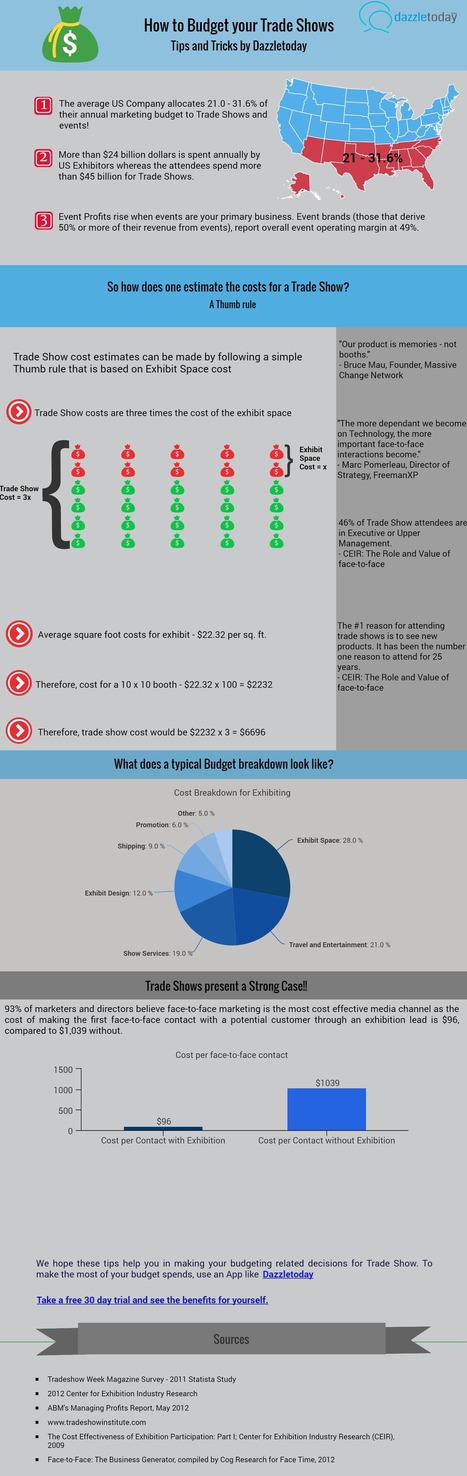
A large chunk of B2B marketing budget is dedicated to Trade Shows. Often the Trade Show budgets follow a pattern which can be broken down into a formula. The formula is a key to making your budget plans for a Trade Show. In this particular infographic, we take a look at the laws that govern Trade Show budgeting and some standard budgeting break downs that can help Exhibitors better prepare for their Trade Shows. We also take a look at why Trade Shows are the cheapest source for a face-to-face contact with your potential buyers and existing customers. So if you are an Exhibitor planning to participate in a Trade Show any time soon, this infographic is designed to help you make some key budgeting decisions for your next Trade Show. - See more at: http://blog.dazzle.today/key-trade-show-exhibitor-budgeting-trends-infographic/#sthash.4U8lO1DE.dpuf
|
|
Scooped by
Aditya Patkar
April 12, 2016 10:30 AM
|
The prep work that goes into a trade show is just as important as what happens when you arrive. If you put in the work before, during and after your event, you’ll get the most value for your efforts and the cost of attending. Here are five key things to keep in mind when getting ready for your next trade show. 1. Set realistic goals. Identify your main focus and what you hope to get out of the event. If you are a fairly new company, the goal might be increasing brand awareness and building an email database. If you’ve just launched a new product, you may be hoping to demonstrate its capabilities and jump start sales. Once you’ve established your big picture goals, set quantitative goals that you can measure, such as getting 100 attendees to disclose their contact information or selling 20 units of your new product. 2. Create a system to measure goals. Some goals are easier to measure than others. For example, knowing if you were able to add 100 new signups to your email database is obvious but gauging brand awareness is a little more complicated. If you don’t have the tools to measure your goals internally, hire a professional that can gather information such as social media engagement or the source of new traffic to your website. Having a clear idea of your ROI is essential to making marketing decisions down the road. 3. Collect feedback. If you can get attendees that stop by your booth to fill out a survey, that data could prove invaluable. You can learn important information about the buyers in your industry, and also get a better understanding of why and how attendees come to these types of events. You’ll walk away with benchmark data, allowing you to make better informed decisions in the future. Also, your new customers will see that you care about their feedback and improving their experience with your company. 4. Create a memorable experience for your audience. Trade show attendees visit a lot of booths. It’s your job to stand out from the competition, and remain relevant in their minds afterwards. Seth Godin said, “Marketing is a contest for people’s attention.” Make sure you grab it by creating a memorable experience for your audience. You can do so by catering your conversation to them. Rather than dive into your pitch, ask them questions to get to know them better, learn more about their company, and what their problems and needs are. It’s much easier to sell to someone when you know who you’re talking to and what they want. 5. Integrate social media into your event. There are only two forms of marketing that take place in real time — events andsocial media. Take full advantage of your event and combine the two to optimize exposure and extend your reach far beyond the trade show’s doors. There are many ways for you to interact on social media during your event. Here a few ideas: - Think of a memorable #hashtag to create a buzz around your booth and encourage feedback from those that stop by. Include it on display material so that everyone sees it.
- Tweet to guests that have stopped by your booth with a simple thank you or nice to meet you to keep the conversation going after they walk away.
- Highlight those that won a game or raffle at your booth to strengthen connections and get other attendees excited about stopping by.
- Search Twitter to find individuals tweeting at the event and encourage them to come stop by your booth.
6. Invest in your booth. Don’t just set up your booth with the bare minimum. Create a colorful, interesting and on-brand display that is friendly and approachable. You also want your booth to be manned by someone who is articulate, personable and familiar with the ins and outs of your company. If that person isn’t you, spend the extra money and hire a professional that looks the part and talks the talk. Having a gift bag or other type of branded takeaway is another way to guarantee attendees will remember their experience at your booth and follow up after the event.
|
|
Scooped by
Aditya Patkar
April 11, 2016 10:21 AM
|
Let’s face it. Conferences and trade shows are expensive. And now that we have dozens of national and regional conferences to choose from, we want to ensure we’re getting the best return we can from the investment we’re making. Just setting up the booth and staffing it in the hopes that the right people will come by and chat is not an effective strategy. It may have been enough in previous years when the vendor community was smaller, but now the big conferences are huge and it can take multiple days for your prospects to walk the floor of the exhibit hall in addition to attending sessions. The primary reason to invest in shows is that it puts you in the path of hundreds of potential customers in a sea of up to 25,000 attendees. Here are some strategies to ensure that you are making the most of this investment: - Be selective – perhaps consider fewer shows with a higher level of investment and interaction.
- Invest in your booth design so that whatever the size, it makes a bold statement to capture the attendance of prospects walking down the aisle.
- Sponsor a speaker – either an educator from your company or one of your customers. In addition to sponsoring the session or multiple sessions, have them at your booth at specific times at a “meet and greet” or book signing. Send out invitations and/or offer a giveaway to incentivize visitors to your booth.
- Train your booth staff to answer questions from any educator despite their geography. Regional salespeople often staff exhibit booths. All of them should be able and willing to answer basic questions. Introducing or handing off to the appropriate sales person is fine, but every visitor to your booth should receive the red carpet treatment.
- Call customers and prospects and invite them to your booth for face-to-face conversations. Provide an incentive so that they make the time to come see you.
- Take advantage of any opportunity to participate in a vendor showcase. Many education shows offer this as an opportunity to get in front of buyers and influencers. It’s an efficient use of the buyer’s time and yours as well.
There are other non-exhibit opportunities you can explore to use the conference or show as an opportunity to meet with your customers and prospects. You want to take the opportunity to assure current customers that you appreciate their business. And it is often through social situations that relationships begin that later develop into business. One of the essential ingredients to doing business with schools and districts is having an authentic relationship with them. As people, not just as educators and vendors, we like doing business with people we know and respect. Some of the other opportunities to consider include: - Holding a focus group
- Sponsoring an educator breakfast/lunch with customer presentations
- Co-sponsoring an educator evening event
- Hosting a dinner for a small group of superintendents
As you see, there are opportunities to expand your investment in shows beyond just staffing a booth that can increase awareness of the products and solutions you offer and generate high-quality leads. Just as in the virtual world, engagement is everything. Take advantage of being in the same place as so many of your customers and prospects and you’ll maximize your investment in the conference or show.
|
|
Scooped by
Aditya Patkar
April 10, 2016 11:20 AM
|
The Consumer Electronics Show (CES) draws more than 170,000 people to Las Vegas every year. If that’s your market, you only have to appeal to a small slice of those attendees to make your trade show exhibit marketing program a success – in this situation, getting traffic in your trade show exhibit isn’t a big challenge. For the rest of us, it’s a bit more challenging – but it’s not rocket science. Even shows with just a fraction of that attendance can bring you a substantial number of leads, if you know how to appeal to the prospects within that crowd. Here’s some advice on how to boost traffic in your trade show exhibit and get those prospects into your booth. 1. Provide A Charging Station:
We all use our phones so much, particularly when were away from the office, that it’s easy for them to run down in the middle of the day. You might have a spare outlet somewhere in your exhibit, but your visitors aren’t so lucky. MOD-1432 Charging Station offers your visitors a place and a reason to stop and chat! Consider how helpful you’ll be if you offer them a place to charge up. Why not make it a comfortable place where your visitors can take a break for a while? The bonus for you is having a captive audience who’ll be listening to your pitch while their phones charge up. 2. Light it up: The lighting in most trade show exhibit halls is just plain bad. Those harsh overhead lights make people look weary and products look drab. Plus, there’s no way to focus attention on what you want customers or prospects to see. Lighting kits are available for virtually every exhibit system, and they can make you—and your products—look a whole lot better. And what’s even better, they easily focus peoples’ attention where you want them to be looking. 3. Social media is your friend: You may not do much more than communicate with friends on Facebook, but your customers and prospects are doing a lot more. They’re on Facebook, Twitter, Snapchat, Vine and more. If you’re not, you’re opening a door that’ll let your competitors talk with your potential customers. If that’s not part of your plan for success, get with the program, or find someone who can function in the social media world. 4. Get The Word Out: Ask the show organizer for the email address list of attendees and send out a creative, clever and personal invitation to visit your trade show exhibit. Include details like your booth number and what you’ll be demonstrating. Here’s where the creative part comes in: instead of “For more information, contact…” try “Click ‘reply’ and ask me a question right now!” Don’t stop with your email outreach. Send personal, handwritten invitations to your biggest clients and top prospects. You can even try a two-part premium, like a case for a fine pen, with a note inside that tells the recipient to bring it to the show to pick up the pen that goes inside. 5. By Appointment Only Before the event, follow up those handwritten invitations with a call from your sales staffer to local customers and prospects, to check whether or not they’re attending the show. If they are, invite them to set an appointment time. Give a reason for this (e.g.: “We’ve got a special gift for everyone who sets an appointment”). Encourage people who receive your emailed message to sign up for an appointment time, as well. Provide them with the URL for a special landing page that shows them available appointment times. This will help ensure you get that targeted traffic in your trade show exhibit. 6. Give-Aways Work: People expect swag from companies they do business with at trade shows these days. That’s why the two-part premium I referred to above can be so successful. But not any premium item will do. Do you need another luggage tag, lanyard or thumb drive? Neither do your trade show booth visitors. Work with a well-respected premium supplier, and give them plenty of time to come up with something that works with the theme of your exhibit. Waiting until the last minute only means you’ll spend more money for something that’s not going to support your marketing message well. VK-1118 SEGUE Backlit Hybrid Exhibit with MOD-1267 Pedestal with Locking Storage 7. Graphics Are Important: Whether it’s signage on your booth’s back wall or banner stands elsewhere in the booth, your graphics have to tell your story when your staffers are busy. It’s frequently the first impression people will have of your company. Make sure it conveys what you want people to think of your organization. Focus on one clear message, not a laundry list of products, capabilities or features. 8. Wear something ugly: Sponsor an “Ugly Sweater Contest” for your trade show booth staffers. Or have everyone in the booth wear bright pink shirts or neon green bell bottoms. The point? To stand out. There’s a lot of clutter on the show floor, and it’s your job to cut through it. If dressing with a wink and a smile works in your industry, try it. 9. Take your friends to dinner: Invite your best customers to be your guests for dinner one night after the trade show at a top local restaurant. Ask hot prospects you meet during the show to join you, as well. Everyone will feel special for being invited to a party, and you and your staff will have an opportunity to get to know your customers and prospects a little better, for just the price of a dinner. (Bonus Tip) Offer your best clients a ride from the airport! As well as feeding them, why not look up your 10 biggest clients and offer to pick them up at the airport and give them a free ride to their hotel? That saves them the cost and hassle of a bus/taxi ride, and gives you 30 minutes with them in the car, to get to know them better and cement the relationship.
|
|
Scooped by
Aditya Patkar
April 9, 2016 12:18 PM
|
While it is important that businesses promote online in order to engage target consumers, there is something to be said about face-to-face interaction. THREE REASONS WHY TRADE SHOWS WILL ALWAYS BE IDEAL Social media, banners and emails play important roles in how businesses interact with consumers in today’s market. However, these platforms are lacking one of the greatest influential factors in the success of any organization: the human element. It is this instinctual connection that will drive many to use trade show services and help build personal bonds with potential consumers. For local companies large and small, these shows can greatly boost awareness as well as create leads for future sales. PERSONAL INTERACTION A trade show offers something that online ads do not. Personal interaction can only go so far in the digital world, and these kinds of connections can play an influential part in the success of virtually any business. Even online organizations could benefit from the support of local consumers. These kinds of shows are the stepping stones into gathering that target audience. TACTILE RESPONSE Most humans are tactile by nature. They can be deeply connected to an object just by simply touching it. It is also true that people are more inclined to believe in a product or service they experience for themselves. This is one of the driving points to why trade shows can be better than online advertising. Images and descriptions can only go so far when someone is truly interested in the product. Reading on the Internet why consumers should want a product is different from actually witnessing it firsthand. MENTALITY OF THE GROUP Humans gather and share a mentality in virtually any situation. This is seen through the elation of an amusement park to the somber attitudes during a funeral. Trade shows deliver a platform similar to these examples as most of the attendees are influenced by each other on an empathetic level. The way someone feels about any given product or service can be influential in the way others feel as well. It is a kind of “word-of-mouth” advertising for the mind. Many consumers will feed off the response of others simply by standing in the same area.
|
|
Scooped by
Aditya Patkar
April 8, 2016 10:15 AM
|
Trade shows are an excellent way for your business to gain exposure and meet prospective clients. But with the convention center crawling with flashy, gimmicky competitors, it's easy for the new kid on the block to overlooked. To ensure you're gaining maximum ROI from your time and money spent on booth space and making an appearance, it's best to think strategically about how you're going ensure your business is the one being talked about. Thirteen entrepreneurs from Young Entrepreneur Council (YEC) share their surefireways to make your exhibit one that attendees will remember. 1. Start long before you get there. Last year, I watched Joel Klette do this masterfully. In the weeks leading up to the event, he had conference attendees vote on swag they wanted him to handout -- logos, pencils, T-shirts, etc. He exercised the event's hashtag and put together engaging, image-rich tweets that stuck way out. He didn't have a booth but was probably more popular than those who did. Bravo!--Adam Steele, The Magistrate 2. Give away something unusual. Free corporate pens and mugs are totally unoriginal and can actually aggravate passersby, rather than entice them! You can stand out from the bland big dogs by giving away something quirkier and still putting your company's brand on it. Corporate headphones, balloons, laptop skins, socks, sunglasses, even Rubik's cubes; the options are endless, and the chances of standing out are huge!--Marvin Amberg,Caseable 3. Create buzz among attendees with humor. Remember that buzz means conversation. You want to provide customers who go past your booth with opportunities for conversation. I think "keep it positive" can fall flat. We hear positive marketing messages so often, they become dull. Step up and provide people with something humorous they can pass along, and you'll get people talking about you.--Brandon Stapper, 858 Graphics 4. See what you're up against. Do your research. Check out the "big dogs" and learn from what they're bringing to the trade show -- not just staff-wise but visually. Do they have a collection box to gain customers? Contests? Candy? These are some of the things you can look at so you can make sure you're prepared.--Jayna Cooke, EVENTup 5. Boast your "As Seen On" features. If your brand can be seen on a myriad of websites, use it as a focus point in your trade show set-up. Create a booth design that accentuates these features, with a huge shoutout to "As Seen On" right in front of trade show attendees. This will definitely get curiosity and buzz going for your brand.--Miles Jennings, Recruiter.com 6. Invest in a great display. I've seen even some of the big companies bring some really sad-looking tables to a trade show. If you want to look bigger and more invested (and more investable!) then consider this part of your marketing budget for the year. If you have something printed that looks really great, you can also save it for future shows.--Matt Doyle, Excel Builders 7. Hand out bigger reusable bags than the competition. Everyone at a trade show gives stuff away, and each presenter usually has their own bag to put their swag in. The biggest bag usually wins, becoming the receptacle for all the other bags' contents. Pony up and make it reusable, so the bag lives on beyond the trade show and won't end up in the trash like all the others.--Michael Portman,Birds Barbershop 8. Be the life of the party. Let's face it, most "big dogs" and industry events are boring. If you want to be the new kids on the block, then make your presence felt and have fun. Your competition is probably a lot less excited about the opportunity to be at the event, so make some noise. Throw an after-party, become friends with everyone, have an interactive booth, and enjoy it. Nothing beats being young at heart!--Matt Wilson, Under30Experiences 9. Create the longest line. Something as simple as putting together a well-designed shirt and giving it away for free can create immediate and long-lasting buzz; make sure it's something people want to wear, and don't be afraid to encourage them to put it on immediately. Tell them you'll buy them a beer if you see them wearing it at the networking parties after the convention day ends.--Blair Thomas, EMerchantBroker 10. Create a video about your brand. At most industry trade shows, company executives do a lot of blabbing about their company. Why not throw in a visual asset? A cool video about your company or one of your new products will impress your peers and your will be sure to make a splash at your industry trade show.--Stanley Meytin, True Film Production 11. Use creative stunts to get people's attention. The big guys often use fancy pop-up displays and don't mess with customizing anything. We beat those exhibitors every time on a very small budget. Two years ago, we partnered with the local zoo to bring two penguins to our trade show booth. People crowded around our booth from the moment the show began. We handed outpenguin-themed flyers and penguin stress balls. People STILL remember it!--Jesse Lear, V.I.P. Waste Services, LLC 12. Use design to your advantage. We're all attracted to great design, whether we know it or not. At trade shows and conventions, it's easy to have everything blend together visually. Make sure you have a booth that stands apart from the competition -- using design as a differentiator. Hire a group whose work you love and doesn't specialize in exhibit design to get the best results.--Lee Salisbury, UnitOneNine 13. Send emails in advance to attract more visitors. Whenever we do trade shows, we go through a list of attendees expected to visit, which organizers can provide to you. We send out emails to people we want to meet, and many of them will respond and stop by our booth. This helps us meet key people without wasting time during the event. In fact, we saw so many visitors at our booth using this strategy, our competitors were surprised with our numbers.--Piyush Jain,SIMpalm
|
|
Scooped by
Aditya Patkar
April 7, 2016 11:13 AM
|
Tradeshows are one of the most effective methods for communicating with your audience. 99% of marketers said they found unique value from tradeshows they did not get from other marketing mediums. Generating brand awareness, engaging new leads, and building relationships as the leads are taken through the buying cycle are the top three reasons for marketing participation. 55% of attendees purchase a product or service from information gathered at a tradeshow. So how do you design your tradeshow participation to get in on that action? The reality is, if you’re in a 10×10 booth you have less than seven physical steps as an attendee walks by to catch their attention. This is even more critical if you’re at a large tradeshow and an attendee will only walk by your booth once. Consider these seven points with every step an attendee takes away from your booth: - First and foremost, bring the experts. You’ve invested money and effort in participating in the trade show, so promote your rock star subject matter experts to gain credibility with your audience. A breakout session with the experts can go a long way to engaging leads too. Position your rock star as a consultant who can provide insight and recommendations for solving problems. And while you’re audience is in the booth, don’t forget to scan their badges. These are people that are interested in your topic and are looking for a solution, so grab their names for post event follow-up.
- SHOUT your solution and benefits from your booth design through the various pieces of content available for attendees to take home. Attendees won’t necessarily know your brand name and product offerings, so you can’t count on them coming over to talk if you end up being a service provider they don’t need. Have available later stage assets for existing leads or those that appear further down the buying cycle.
- Avoid barriers (like tables) between you and attendees at the front of your booth. Break the visual line of booths around you. A flat screen with an eye catching video or extending the line of your booth above the top of the infrastructure are two great ways to stand out.
- 20% of UBM’s POP survey attendees say that games or activities make them more likely to stop and visit a vendor’s booth during an event. While it’s critical to draw the eye of the attendees, don’t stray from your brand image. You want attendees in your booth for the right reason: they have a need for your product or solution. For example, I once saw a software company use a gorgeous model to draw attendees into their booth. The booth was flocked by attendees, but at the end of the day, that company got limited to no follow-up from those who entered the booth because they solely interacted with the model and not a subject matter expert.
- Fun tchotchkes or a raffle are always great ways to draw interest. Residual value is key when selecting a tchotchke. Think about what attendees will use or keep on their desk so they will be reminded of you as they travel down the buying cycle. Fair warning: I’ve gotten tchotchkes over the years that every attendee wanted but will never grace my workspace.
- When selecting your booth location look for high traffic areas like refreshment areas, corners, or entry and exit ways. Positioning yourself near complimentary products can also work to your advantage.
- Get social: both in person and in the digital realm. This is your chance to meet people and build relationships! So don’t sit down, instead get out there and chat! Hang out beyond the 10×10 perimeter of your booth. A friendly “hi” and a probing question go a long way to getting noticed by leads who have a need for your solution. Take pictures with booth visitors and tweet them. Include both your company twitter account as well as the hashtag for the tradeshow. It also provides another connection to you and can be a great reminder of your exchange when the attendee gets home.
Creating the perfect space to engage the right leads at a tradeshow does take preplanning and organizing. But the results will put your pipeline on cloud nine!
|
|
Scooped by
Aditya Patkar
April 6, 2016 11:09 AM
|
The time and costs associated with attending a trade show make it extremely important for exhibitors to maximize their trade show ROI. After going through the process of selecting a trade show, planning for the event and spending money, you are left with one question: who is staffing your trade show booth? Preferably, you’ll have a team of highly personable, experienced sales representatives who have memorized every aspect of your products and services. However, are these sales representatives ready to meet potentially thousands of prospective buyers over the course of a few days? What’s more, will they be able to weed out the lurkers and “freebie hunters” from the genuine interested potential buyers? How will these sales professionals interact with each other? Will they be able to maintain the energy needed to engage and pursue each “hot lead” that comes their way? This is where educating and properly preparing your booth staff can generate a significant effect on your trade show ROI. Some companies partner with or have in-house business coaches who can be brought in to work with staffers both in advance of and at the show. If your company is looking for a business coach, talk to your exhibit builder. They may be able to provide recommendations or standard training resources. Whether you outsource training or not, it is important as an event marketer, to know how to properly train trade show team members. Promote Teamwork for Stronger Trade Show ROI To create a winning trade show team, it’s essential to look for team players who are not only great sales reps, but who also work well in a group setting. Great teamwork doesn’t come easy, it will take time and effort to create and continuous effort to maintain. Tips for Teamwork: - Make sure your team members align their values and goals with each other and with your company
- Maintain a high-energy environment that promotes team-oriented solutions and offers initiatives for thinking outside the box
- Identify the diverse personality types of your team members and learn how to blend them together to make a stronger unit
- Ask veteran sales reps to mentor younger or less experienced team members
- Hold team lunches and activities before the event to encourage bonding
Improve Your Team’s People Skills People skills are essential for sales representatives on the trade show floor. Having a team of booth staffers who possess the ability to understand, relate to and interact with different types of people will undoubtedly help your brand at an event, and will help strengthen your trade show ROI. Tips for Improving People Skills: - Promote introspective thinking to help team members identify interpersonal barriers that could be stifling their success
- Teach your staffers how to filter out serious prospects from ones just looking for giveaways
- Practice listening exercises with your team to help them communicate more effectively
- Have your team study body language, which can often be more telling than verbal conversation
- Practice stress-coping techniques to help team members better handle rejection or to decompress built-up tension
|
|
Scooped by
Aditya Patkar
April 5, 2016 10:06 AM
|
Exhibiting at your first trade show can feel a lot like the first day of high school. The bell rings, everyone else seems to know where they’re going, and you’re not even sure you’re in the right building. It’s easy to get overwhelmed, especially if you’re a small company at a big show. As soon as you register for an event or sign a contract to exhibit, the mountain of tasks looms – from booking your travel and designing your booth to planning your marketing and sales strategies. Your palms start to sweat as you wonder if (and how) it will all get done. Fortunately, there are things you can do to help navigate the chaos. Follow these tips and you’ll get everything done – all before your first class. The early bird gets much more than a worm.
It’s important to register as early as possible for a trade show. You’ll not just cut down on stress, you may also cut down on costs. The sooner you start planning, the more likely you can take advantage of early bird discounts. The money you save here can then be directed into other show expenses. After you’ve booked an event, make a note of all the deadlines you need to adhere to and set calendar reminders. Some show organizers will even provide an exhibitor checklist that recommends when different tasks should be completed. Read every email and do your homework. After you register for a show, the emails will start rolling into your inbox. Event organizers often partner with outside vendors to provide free or discounted offers – like special hotel rates, coupons for area restaurants, free promotion opportunities, and more. Don’t necessarily judge these emails by their subject line. Although some may seem like an unrelated sales pitch, they could be of value to your company. Take a look before moving them to the trash bin and remember to check your spam folder so you don’t miss any important deadline reminders. You can also contact the event organizer to ask whether they are offering any pre-show webinars for exhibitors. Larger shows with a lot of moving parts will often host informational sessions to ensure exhibitors have everything they need. Look for a webinar schedule and ask your show contact whether an archived recording will be available if you can’t attend. Know your booth number and use it. Your booth number is what attendees will use to find you. Make sure that you and they know what it is. If your exhibitor packet doesn’t include your booth number, take a look at the floor plan on the trade show’s website. Find your company name and the booth number listed with it. If you still can’t locate your booth, contact the event organizer. Once you have your booth number, include it in all of your communications. Forgetting to include it is like inviting friends to a party without an address. Design your booth strategy for conversions. Event attendees have a lot of booths to visit. Make their lives on the show floor as easy as possible. A visually appealing and interactive booth design will set a strong foundation for success. However, don’t forget your strategy for converting these visitors into qualified sales leads. Establish a system ahead of time for collecting prospective customers’ information and appoint specific people to follow up on any notable conversations you have in the booth. Waiting until after the event to place these leads into your marketing program could cause you to lose out on the show’s momentum. Don’t forget about pre-event marketing. Of course, all this prep will go to waste if no one shows up at your booth. While pre-show marketing may not seem very glamorous, it is essential to meeting your event goals. In her blog post Trade Show Marketing: What to Do Before the Show, Sarah Leung states that 70% of event attendees decide on which brands and booths they’re going to visit before even setting foot on the trade show floor. On the other hand, only 10-15% of trade show exhibitors invest in pre-show marketing efforts. When planning out your marketing strategy, use a multi-channel approach that takes your different audiences’ preferences into consideration. For instance, if your goal is driving prospective customers to your booth, consider publishing a couple of announcements early on so attendees have time to add you to their agenda. If the goal is earned media attention, send out a media advisory to industry outlets covering the event. A combination of online press kits, content distribution, email campaigns, social media and other marketing tactics will help ensure you reach all of the audiences in attendance. Download Gain Targeted Audience Attention with PR Newswire for more marketing tips that’ll help you make an impression that lasts. Author Caterina Lui is a senior customer content specialist for Virtual Press Office, PR Newswire’s trade show marketing solutions division. VPO helps global event professionals, exhibitors and trade show marketing managers reach their goals through news distribution and online press kit creation. Follow Caterina at @VPOEventZone, our Twitter channel dedicated to the trade show industry
|
|
Scooped by
Aditya Patkar
April 4, 2016 9:33 AM
|
Trade Shows are about nurturing existing customer relationships, creating awareness and generating leads to create new relationships in a dynamic, high-energy environment. It is important to leverage this energy and the new connections made even after the exhibition closes down. According to the Center for Exhibition Industry Research (CEIR), 80% of tradeshow leads receive no follow up at all, which is why having a good follow up plan is imperative. A follow-up campaign is one designed to address this ignored 80 percent apart from show attendees who were not able to attend; also to ensure that no potentially qualified leads fall through the cracks. Given below is simple post-show action guide designed to deliver an effective follow-up campaign an improve post Trade Show engagement. Develop a focused communication plan before the show so it’s easier to keep the conversation going. Create an information bank and schedule regular customer communication over a 3 month period. It’s much better to continue a conversation than to rekindle one that has died out. Maintain the momentum built during the show and keep the brand top of mind by contacting customers within two weeks of the end of the show. - See more at: http://blog.dazzle.today/a-handy-guide-to-heighten-post-trade-show-engagement/#sthash.ErZxIGVG.dpuf
|
|
Scooped by
Aditya Patkar
April 4, 2016 1:34 AM
|
Despite the growing popularity of food and food truck trade shows, there is no guarantee of success when it comes to new trade show exhibitors. In fact, according to the Trade Show Bureau (TSB), roughly 40% of first-time exhibitors don’t come back. A lot of them just go, stand around not doing much, and then swear they’re never coming back. The problem for first time trade show exhibitors is they don’t realize the effort it takes before and after to make a trade show work. 10 Tips For Success For New Trade Show Exhibitors - Check out a trade show directory. Find out as much as possible about an exhibition before the show. Make certain its attendees are your target group.
- Fix a budget. Find out prices for airfare, accommodations, and the like. Also, decide what your display needs are. If your budget is tight or you’re just going to one show, you may want to consider renting a display. If you go to a lot of shows (five or more a year), buying a display may be a better option.
- Set objectives. Don’t go to the show without concrete marketing goals. Plan to meet a certain number of key customers and prospects.
- Ship ahead, and allow plenty of lead time. Don’t expect things to arrive when they’re supposed to. Plan as if your materials will get there a week or two later than your target date.
- Watch labor costs. Portable displays can usually be set up quickly and help you avoid additional labor costs. Check the show booklet carefully to see what the regulations are when it comes to setting up your own booth. As a rule, if it can be set up in 20 minutes or less with one person, you can avoid extra labor charges.
- Keep it simple. If you can’t afford a lot of extras in the booth, at least keep it uncluttered and simple. Don’t put a table in the front, blocking the entrance. Avoid having chairs in the booth (it may become too tempting to sit down). Most important: Have a banner that tells people who you are and what you do.
- Spend on lights. Don’t cut corners too closely on lighting. Many exhibit halls are poorly lit, and a dark booth is both uninviting and apt to make the company look like it doesn’t belong.
- Consider trade show training. Many firms offer training on how to sell at trade shows. Salespeople who are great on the road may feel less comfortable standing in a booth for six or eight hours a day.
- Don’t under staff. A minimum of two people is always necessary. If budgets are really tight, look at the possibility of hiring an on-site temp rather than sending a staffer to the show.
- Be aggressive. Go out into the aisles and meet people. Don’t stand there (or worse, sit) waiting for people to come to you.
|
|
Scooped by
Aditya Patkar
April 3, 2016 5:23 AM
|
She is the visionary and thought leader behind a wholly original sales model based on the systems of how people change and decide. She has taught this system to 13,000 people in the fields of sales, customer service, negotiating, coaching, and change management. Sharon Drew is a keynote speaker and decision strategist, helping companies change their internal practices to embrace collaborative decision making, ethics, values, and integrity. You might even have a fishbowl at the table or some type of contest material to collect business cards of passers by for later use in your sales process. But the worst part of doing a trade show is losing your voice. Each visitor that stops by your booth gets your pitch. You feel compelled to tell each person why your product is great, why it different from the competition (which might be located directly across from your booth and getting a lot more attention than you getting). You learned the elevator spiel and how to do a pitch in 30 seconds, so the person passing by will 1. be captivated by your information, 2. stop, and 3. make a purchase. You probably there to get some brand recognition (sales are usually not completed at trade shows) and get your material and pitch into the hands of buyers. The visitors are, after all, self selected hot prospects. Or are they? In reality, you have no idea why a person is walking by your booth. I walked around trade shows just to see how people are selling. And each time I come within a few feet of the booth, I get barraged with a pitch, data, and more information than I know what to do with. Do the sales folks know why I there? Nope. Do they ask? Nope. They just pitch and pitch and pitch. And are they cheery! If your objective is to brand your product, just being there with a great presence is carrying your visual brand forward. For that you don need anything more than to stand there and look professional. Why else might you be there? To sell product? OK. Let take a look at this. Odds are that you not going to make a sale at the show itself. You might walk away with business cards, but that doesn mean people are buyers. Here a truth: people do not make purchasing decisions based on information. I know this comes as a shock to those of you who regularly stand at booths at trade shows and pitch your hearts (and lungs) out. I say it again: pitching product, making data about your product available, will not make a sale. Oh, it will help close the sale once the buyer is at that point in the sales cycle that s/he needs data to complete his/her picture. But it will not make a sale. A sale gets made when a buyer decides to make a purchase. Selling and buying are two different activities. For some reason, sellers believe that if they sell, buyers should know how and why to buy. But that not true. Sellers concentrate on finding buyers who probably have a need, and creating some means to present their product in a way that well chosen buyers might understand or recognize a need. In other words, it a crap shoot. Buyers focus on finding solutions that will optimize their status quo. To do this they must recognize any outstanding issues that are getting in the way of an optimized work space, seek to easily correct what might be lacking, and to manage whatever changes will occur once a corrective solution is discovered. Pitching a product will address none of the above unless the buyer has already completed all of the above actions and is seeking out a solution with parameters that will match their unique dynamics. In other words, when you focus your sale on product information, you playing a numbers game. they think they might have a problem that a product similar to yours might solve, but aren sure what a solution would look like and are running around the trade show to collect possible solutions. Trade shows are wonderful opportunities to ferret out prospective buyers (usually in category 4 above) and teach them how to decide what a solution would look like. As a visitor approaches your booth, as a facilitative question that gets them to determine what missing from their status quo that, if corrected, would create an optimal solution for them. For 1 3 above, they will shift the conversation to something more personal, and you have saved your breath since you won have to pitch. When someone comes by that actually is seeking a solution, use facilitative questions to lead them through their solution discovery process. Help them discover what missing in their current environment, how they can fix the problem with familiar resources, and how to make sense of all of the systems issues that need to be managed before they can allow a solution into their culture.
|