


Ayahuasca News
220.9K views |
+0 today

 Your new post is loading...
 Scoop.it! 
Moviemaker Oliver Stone has opened up about his drug use in a candid new magazine interview, revealing he no longer takes anti-depressants but has become a big fan of Ecstasy and the hallucinogenic juice from rubber tree plants. 
Scoop.it!

Researchers at the University of British Columbia are concluding that trees are interacting with one another in a symbiotic relationship that helps the trees to survive. Connected by fungi, the underground root systems of plants and trees are transferring carbon and nitrogen back and forth between each other in a network of subtle communication. Similar to the network of neurons and axons in the human brain

Robin Woolner's comment,
June 21, 2012 1:19 AM
you might be interested in bio photons as another explanation for information exchange..... http://en.wikipedia.org/wiki/Biophoton
Scoop.it!

En la Jonquera una mujer de cuarenta años fue detenida por llevar ayahuasca del Perú.
Scoop.it!

This book offers a historical and anthropological perspective from which to understand the fragility of isolated indigenous groups in the face of contact with outside society.
Scoop.it!

Electronic edition of Whole Earth Review Fall 1989 issue on plant intelligence. A very influential classic now fully online
Scoop.it!
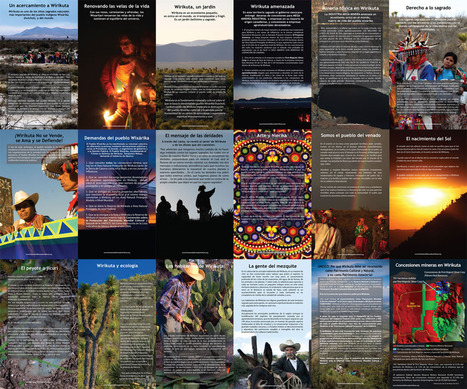
En el Frente en Defensa de Wirikuta Tamatsima Wahaa ponemos al alcance de todos información de primera mano y actualizada sobre la situación actual de Wirikuta y su defensa. En esta ocasión compartimos una serie llamada “Un acercamiento a Wirikuta” con la intención de que más personas se informen y compartan con sus familias, amigos, vecinos, compañeros de trabajo y estudio.
Scoop.it!
Aboriginal historian, activist and leader, Gary Foley, explains the do's and don't's of white activism. 100% Juice from an inspiring orator, and priceless advice for all would-be allies of Indigenous people in the struggle for justice.
Scoop.it!

Why are some people trustworthy while others cheat and lie, some generous and others coldhearted louts? Part of the answer may lie in the hormone oxytocin. In an excerpt from The Moral Molecule, Paul J.
Scoop.it!
Ibogaine, a molecule found in the root bark of a Central West-African bush called Tabernanthe Iboga, has impacted the lives of many drug addicts around the world
Scoop.it!

Summary of the legal and mediatic history of ayahuasca use up to now, with a focus on the Braziallian churches and the UK
"Journalists are drawn to sensational stories... ayahuasca is consistent, responding according to how it is approached, returning terror or wonder in kind."
Scoop.it!

Only one day to go! help us finish this important film! Ten years ago Mark Ellam, Jeronimo Mazarrasa, and Robin McKenna began to make a documentary film about what indigenous people know, and we have forgotten, about the most potent plants on earth...
Scoop.it!
Background Information Who is Querubin Queta Alvarado? Querubin Queta Alvarado (Taita Querubin) was born in the Colombian Amazon in 1932 in San Antonio de Gu...
|
Scoop.it!

Early this morning, hundreds of people began an occupation of the Belo Monte Dam site near Altamira, Brazil, in the heart of the Amazon. Our Amazon Program Director Brent Millikan is there. Watch a video and see photos of this historic event.
Scoop.it!

These facts raise two highly controverted and interconnected puzzles. How in the world did indigenous peoples in the Upper Amazon come up with the idea of combining DMT with an MAO inhibitor? And when and where did they first do it?
Scoop.it!
Os Kĩsêdjê dão o seu recado para o mundo, alertando para a destruição do meio ambiente e suas consequências sobre todos nós. uma realização AIK Produções: ht...
Scoop.it!

Three years ago yesterday, Peruvian police opened fire on a group of protesters near the town of Bagua in northern Peru. The violent clashes that ensued left 34 dead and over 200 injured in the worst violence in recent history.
Scoop.it!

A new documentary by ODECOFROC and IWGIA on the Awajún and their struggle to protect their ancestral territory...
Scoop.it!
|


|
Scooped by
Jerónimo M.M.
June 3, 2012 7:38 PM
|
Scoop.it!
.AITMs represent a profound knowledge of the human being and communication and communion with Nature.
For hundreds of years, indigenous peoples of the Americas (Peru, Colombia, USA, Ecuador, Brazil, Mexico, Bolivia and Venezuela, among others), from numerous ethnic groups (Ashaninca, Shipibo, Siona, Coreguaje, Navajo, Mazatec, Huichol, etc.) have carried out investigations and therapeutic processes, which defy western scientific methodologies. Their pragmatic results represent an undeniable patrimony for humanity and nevertheless, many plants have been taken advantage of by western industry, frequently without due respect and acknowledgement.
|
|
Scooped by
Jerónimo M.M.
June 2, 2012 4:51 PM
|
Scoop.it!

El contacto con entornos naturales beneficia la capacidad de atención y contribuye a afrontar mejor las situaciones estresantes. El Psicólogo José Antonio Corraliza explica cómo la Psicología Ambiental analiza los efectos de la naturaleza en la psique humana.
|
|
Scooped by
Jerónimo M.M.
June 2, 2012 7:18 AM
|
Scoop.it!
"In both these experiments, the amount of harmine present could not account for the total activity of the extract. The ability of harmine and harmaline to stimulate dopamine release is a novel finding."
|
|
Scooped by
Jerónimo M.M.
May 31, 2012 4:05 PM
|
Scoop.it!

Recent ayahuasca article in The Economist´s sis magazine
"Deep in the Brazilian rainforest there is a town built around a church where worshippers drink hallucinogenic tea. Alex Bellos took a trip up the Amazon to sample the high life in Céu do Mapiá..."
|
|
Scooped by
Jerónimo M.M.
May 31, 2012 2:22 PM
|
Scoop.it!
I was wondering when something like this was going to happen...
"These are links I’ve found to various ayahuasca retreats and ceremony centers in Peru and abroad.
Ayahuasca Retreats in Peru – Cusco, Iquitos, Pucallpa, Puerto Maldonado, Tarapoto
Ayahuasca Retreats in Bolivia
Ayahuasca Retreats in Brazil
Ayahuasca Retreats in Ecuador
If you have links you would like to see added please send them here."
|
|
Scooped by
Jerónimo M.M.
May 27, 2012 6:23 AM
|
Scoop.it!

If you have decided to travel to Peru or other areas in South America to drink ayahuasca, I hope that you have a wonderful experience and return safely to tell everyone about your adventures. But be aware that you will be traveling in third-world countries that often have limited resources, and wonderful experiences are less often the product of luck than of thoughtful preparation. Here are several things you can do to help ensure that your trip is safe and productive.




