


Analysing images to find what aspects evoke which feelings could allow computers to create art that packs an emotional punch...


|
artificial intelligence for students
artificial intelligence for students - postgraduate and undergraduate Curated by Scott Turner |
 Your new post is loading...

|
Scooped by
Scott Turner
November 28, 2012 4:13 AM
|
 Scoop.it!
Analysing images to find what aspects evoke which feelings could allow computers to create art that packs an emotional punch...
|
|
Scooped by
Scott Turner
November 28, 2012 4:10 AM
|
Scoop.it!

Artificial neurons and synapses placed in circuits are unlocking the potential of brain-like computing...
|
|
Scooped by
Scott Turner
November 27, 2012 7:07 AM
|
Scoop.it!

The UK's prestigious University of Cambridge is to play host to a new center where experts will analyze the possible dangers of advanced artificial intelligence. Founded by philosophy professor Huw...
|
|
Scooped by
Scott Turner
November 26, 2012 5:44 AM
|
Scoop.it!

RT @jc_gonzalez: Using the Semantic Web to Enhance the Teaching of Dance: #w3c case study http://t.co/GIOUjO6L...
|
|
Scooped by
Scott Turner
November 26, 2012 5:43 AM
|
Scoop.it!

Using an artificial intelligence technique inspired by theories about how the brain recognizes patterns, technology companies are reporting startling gains in fields as diverse as computer vision, speech recognition and the identification of...
|
|
Scooped by
Scott Turner
November 26, 2012 5:42 AM
|
Scoop.it!

Emotion based teaching is here. Studies have shown that students learn and perform better when they are happy, and feel secure.
|
|
Rescooped by
Scott Turner
from The 21st Century
November 23, 2012 3:39 PM
|
Scoop.it!
|
|
Rescooped by
Scott Turner
from academiPad
November 23, 2012 6:32 AM
|
Scoop.it!

Inspired by the award-winning 23 Things Oxford programme, 23 Things for Research is a self-directed course that aims to expose you to a range of digital tools that could help you in your personal and professional development as a researcher, academic, student or in another role. Find out more about 23 Things and discover what will be covered during the 10 weeks of the programme.
|
|
Scooped by
Scott Turner
November 20, 2012 5:05 AM
|
Scoop.it!

The Once-Hyped Semantic Web Still Bubbles Along.
|
|
Scooped by
Scott Turner
November 19, 2012 3:47 PM
|
Scoop.it!

|
|
Scooped by
Scott Turner
November 19, 2012 3:47 PM
|
Scoop.it!
|
|
Scooped by
Scott Turner
November 18, 2012 4:37 PM
|
Scoop.it!

|
|
Scooped by
Scott Turner
November 18, 2012 4:35 PM
|
Scoop.it!

|
|
Rescooped by
Scott Turner
from visual data
November 18, 2012 1:25 AM
|
Scoop.it!
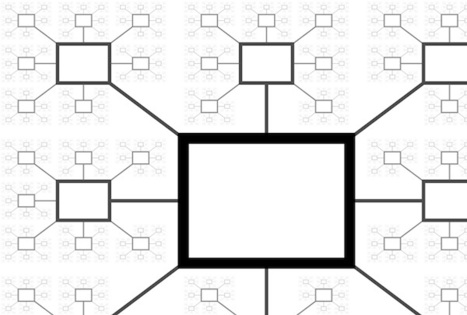
OneZoom Tree of Life Explorer... An excellent way of visualizing data... Good usage of fractals.
"Big data" is a growing issue in science and industry, as modern computing has enabled large amounts of data to be captured and stored, revolutionizing many branches of science. These advances, however, also lead to challenges, such as how to explore and visualize large data sets.
The very first blue-skies idea that could have been identified with OneZoom was that of a mind map so vast that it could contain all human knowledge. The concept involved making the information easy to explore by laying it out in ever smaller bubbles using a fractal structure and a zooming interface so that the computer never runs out of space to put the information no matter how much there is.
OneZoom is committed to heightening awareness about the diversity of life on earth, its evolutionary history and the threats of extinction. This website allows you to explore the tree of life in a completely new way: it's like a map, everything is on one page, all you have to do is zoom in and out. OneZoom also provides free, open source, data visulation tools for science and education.

The mind map concept is also showing up in a project and upcoming conference and book for organizing and making available the diversity of research information in neurobiology. From the link below you can track down that information. Also you can go to newsroom.ucla.edu and search for Dr. Silva, below.
I believe that the visual representation of complex systems is going to percolate progressively into fields less friendly to or organized as a science.
"Alcino Silva, a professor of neurobiology at the David Geffen School of Medicine at UCLA and professor of psychiatry at the Semel Institute for Neuroscience and Human Behavior at UCLA. "
UCLA researcher invents new tools to manage 'information overload' threatening neuroscienceBefore the digital age, neuroscientists got their information in the library like the rest of us. But the explosion of neuroscience research has resulted in the publication of nearly 2 million papers — more data than any researcher can read and absorb . . .
Have fun,
Ed
|
|
Rescooped by
Scott Turner
from visual data
November 16, 2012 4:54 AM
|
Scoop.it!
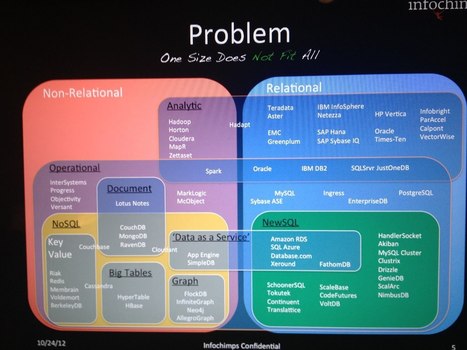
Big Data is on every CIO’s mind this quarter, and for good reason. Companies will have spent $4.3 billion on Big Data technologies by the end of 2012.
But here’s where it gets interesting.
Those initial investments will in turn trigger a domino effect of upgrades and new initiatives that are valued at $34 billion for 2013- over a 5 year period, spend is estimated at $232 billion. What we’re seeing right now is only the tip of a gigantic iceberg.
Read the original article for a closer 'look at five new technologies that are shaking things up in Big Data- the newest class of tools that you can’t afford to overlook...'
|
|
Rescooped by
Scott Turner
from visual data
November 16, 2012 4:53 AM
|
Scoop.it!
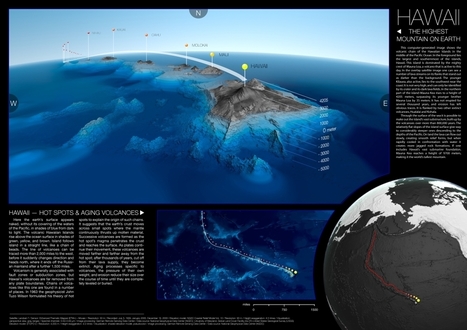
In this era of “Big Data,” businesses rely on the accumulation and analysis of raw data to help understand an uncertain environment. Yet the sheer quantity of available information can overwhelm even the most sophisticated data miner. The problem of transforming spools of statistics into decipherable figures is one all too familiar to the world of science. Scientists deal with not only big numbers, but big concepts that require complex modeling and high levels of abstraction.
The International Science & Engineering Visualization Challenge, created by the National Science Foundation and the journal Science, is an effort to recognize scientific researchers who use visualization to communicate their findings in ways that are accessible to the general public. Since 2003, awards have been handed out annually in a variety of categories, from Photography to Illustrations to Informational Graphics.
With the parallels between science and business in mind, let’s consider some past winners of the challenge and identify how these particular visualizations effectively distill data into an engaging and informative piece of art...
|
|
Scooped by
Scott Turner
November 15, 2012 11:49 AM
|
Scoop.it!

Neural Networks in Trading: It’s all About Volatility and Directionality: The development of trading strategies ...
|
|
Scooped by
Scott Turner
November 14, 2012 5:44 AM
|
Scoop.it!

It's been speculated—in big budget movies, no less—that one day mankind will never leave its computers, and will instead explore the world through virtual reality and robots.
|
|
Scooped by
Scott Turner
November 14, 2012 5:42 AM
|
Scoop.it!

Ivan Herman reports, “The W3C SPARQL Working Group has published today a set of eleven documents, advancing most of SPARQL 1.1 to Proposed Recommendation. Building on the success of SPARQL 1.0, SPARQL 1.1 is a full-featured standard system for working with RDF data, including a query/update language, two HTTP protocols (one full-featured, one using basic HTTP verbs), three result formats, and other features which allow SPARQL endpoints to be combined and work together. Most features of SPARQL 1.1 have already been implemented by a range of SPARQL suppliers, as shown in our table of implementations and test results.”
|
|
Scooped by
Scott Turner
November 14, 2012 5:41 AM
|
Scoop.it!

Desti, a spin out from SRI International, is trying to become a smart travel guide that uses natural language processing, semantic search and travel specific knowledge base to give users recommendation.
|
|
Scooped by
Scott Turner
November 13, 2012 2:52 PM
|
Scoop.it!

|
|
Scooped by
Scott Turner
November 13, 2012 4:00 AM
|
Scoop.it!

Researchers examines the true state of artificial intelligencePhys.Org"The second possibility is AI is coming, and, indeed, it's almost here.
|
|
Scooped by
Scott Turner
November 11, 2012 3:34 AM
|
Scoop.it!

|
|
Scooped by
Scott Turner
November 11, 2012 3:33 AM
|
Scoop.it!
|
|
Scooped by
Scott Turner
November 9, 2012 9:37 AM
|
Scoop.it!

About rich snippets and structured data Snippets—the few lines of text that appear under every search result—are designed to give users a sense for what’s on the page and why it’s relevant to their q...






