From icons to soup cans-trawling the Net for Things You Can Use brought to you courtesy of the Rondebosch Boys' High School Library (If you would like to receive a weekly newsletter of the latest items in this Scoop just mail me at library@rondebosch.com)
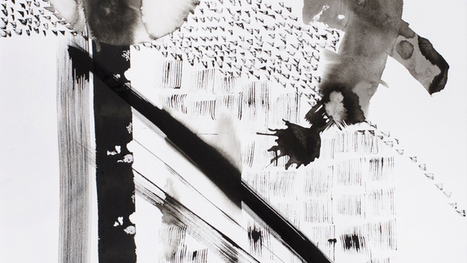
The jury characterised Wa Lehulere’s work as follows: “In his work Kemang Wa Lehulere explores questions of collective memory and seeks to uncover the traces of South African history. To this end, he not only uses the devices of revealing and writing down but also of wiping out text and pictures.
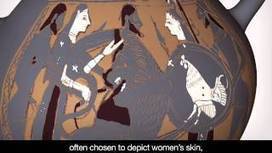
UK’s Open University has developed a fun way to market their design courses: a series of six short animations called “Design in a Nutshell” that briefly survey important movements in the arts and architecture—from the late-nineteenth century Gothic Revival to late-twentieth century Postmodermism. While the former looked far into the past, seeking to preserve tradition, the latter looked everywhere, gleefully dismantling, recycling, and recombining fragmented and irrecoverable histories.
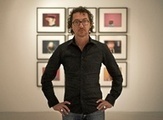
At his studio in Los Angeles, Ruwedel discusses his photographic work 'Wendover Air Force Base: Nine Bomb Craters, Utah 1999' from the series 'The Italian Navigator', in which he tracked and documented the development and testing of nuclear bombs throughout the United States. 'As a landscape photographer I have come to think of the earth as being an enormous historical archive', he has said. 'I am interested in revealing the narratives contained within the landscape, especially those places where the land reveals itself as being both an agent of change and the field of human endeavour.'
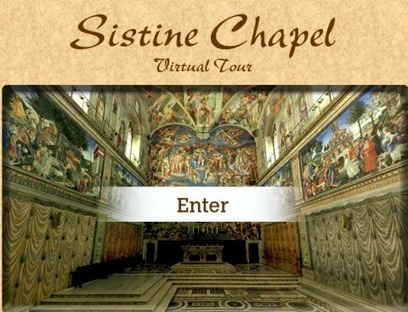
Forget the airports, the ticket lines, and the crowds. Now you can step right into the Vatican’s most sacred spaces and inspect the wonders of Renaissance art and architecture with just a click of a mouse. The Vatican has posted a series of virtual tours created by students and faculty in the communication and computing science departments at Pennsylvania’s Villanova University. The four Papal Basilicas are included, along with the smaller Sistine and Pauline chapels.
Illuminating the culture of Burning Man – the annual pilgrimage to Nevada's Black Rock Desert – as a catalyst for community, innovation and the actualization of dreams, this film offers a glimpse into the art and culture of this dynamic community with the hope to spark a dream within you.
Burning man is "an experiment in community, art, radical self-expression, and radical self-reliance" according to those who attend. If you are a creative individual you should really take a look...also, if you are sad about missing the original Woodstock, Burning Man may be a viable alternative :)
Spanish artist Nacho Ormaechea who lives and works in Paris creates beautiful digital collages by filling silhouettes of people photographed on the street with visually contradicting images. Because of the these strange juxtapositions of color, place and subject we’re left wondering what the meaning is. Are these memories or desires of these anonymous people, or are they portals to another place and time? Head over to his website to see more.
This week conceptual artist Florentijin Hofman brought his gargantuan Rubber Duck artwork to Victoria Harbour in Hong Kong. The huge inflatable duck measures nearly 46 feet tall and 55 feet long and is shown above being pulled by a tug boat only a fraction of its size. Hofman is well known for his grandiose and whimsical sculptures that seem born with the primary goal of inducing as many smiles possible. Via the artist’s website:
The Rubber Duck knows no frontiers, it doesn’t discriminate people and doesn’t have a political connotation. The friendly, floating Rubber Duck has healing properties: it can relieve mondial tensions as well as define them. The rubber duck is soft, friendly and suitable for all ages!
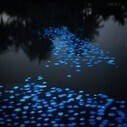
Last year artist Miya Ando traveled to Puerto Rico where she released 1,000 non-toxic resin leaves coated with phosphorescence into a small pond. During the day the leaves would “recharge” and at night would give off a ghostly, ethereal glow much like the light of a firefly. Titled Obon, the installation was inspired by a Japanese Buddhist festival of the same name that honors the spirits of one’s ancestors. The leaves were also meant to simulate Puerto Rico’s bioluminescent bays, a natural phenomenon caused by dinoflagellates, photosynthetic underwater organisms that emit light when agitated.
Incognito, he uses South Africa's streets as his canvas – but his path to renown was international.
"Contemporary artists see me as a street artist and the street artists see me as a conceptual artist,” says Robin Rhode, sitting in the atrium at the Stevenson gallery in Cape Town. Around him, his “crew” is setting up his first solo exhibition in South Africa in about 13 years. “I use the same space [the street] but I use it so differently.”
The last time South African audiences saw a dedicated Rhode exhibition was at the Market Theatre Gallery in 2000, where half the shoes from his installation were stolen. That was the same year he moved to Berlin “for love”, where he still lives with his wife and two children. However, if you are to read his life according to the international press, they would have you believe that his first solo exhibition was in New York in 2004, shortly after a residency at the Walker Art Centre in 2003 where his performance brought the house down and saw his first work sold straight into the prestigious Rubell Collection.
rAndom International's Rain Room exhibition at MoMA as part of MoMA PS1's EXPO 1: New York allows visitors to navigate through rain without ever getting wet. Each individual's movement within the installation affects rain patterns, carving a cocoon of dryness and allowing visitors to stay dry amidst downpour.
In art school, Phil Hansen developed an unruly tremor in his hand that kept him from creating the pointillist drawings he loved. Hansen was devastated, floating without a sense of purpose. Until a neurologist made a simple suggestion: embrace this limitation ... and transcend it.
Taking a cue from his own artistic journey, Phil Hansen challenges us to spark our creativity by thinking inside the box
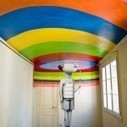
In his “ModernMantra” series, Swedish artist Thomas Broomé illustrates rooms using words as textures—for instance, a wall is covered with the word “wall.” The series is meant to convey the absuridity of how messages are communicated in film, music, advertising, and other media
When the Museum of Modern Art's senior curator of architecture and design announced the acquisition of 14 video games in 2012, "all hell broke loose." In this far-ranging, entertaining, and deeply insightful talk, Paola Antonelli explains why she's delighted to challenge preconceived ideas about art and galleries, and describes her burning wish to help establish a broader understanding of design.
Paola Antonelli is on a mission to introduce -- and explain -- design to the world. With her shows at New York's Museum of Modern Art, she celebrates design's presence in every part of life
Saloua Raouda Choucair is famous in Lebanon for bringing abstraction to the Middle East. A rare female voice in the Beirut art scene from the 1940s onwards, she has spent her career combining western abstraction with the traditions of Islamic design. But, working through civil war and ongoing unrest in Lebanon, she remains virtually unknown outside her own country.
Now, at the age of 97, this pioneer is belatedly recognised with her first major museum show. As her interlocking sculptures, textiles and paintings, both abstract and figurative, go on display at Tate Modern, we travel to Beirut to meet the artist's daughter at the apartment where Choucair's work started its journey.
SA's exhibition at this year's Venice Biennale includes works by a radically diverse group of artists - but it does not reflect an all-defining view.
There is a sense of relief and a restrained consensus among the arts community that this year South Africa will go to the Venice Biennale (the 55th International Art Exhibition) with its head held high. The history of the country’s participation in one of the foremost and biggest windows in the art world has been a fraught affair.Ostracised for decades due to apartheid, South Africa returned to Venice in 1993. Ivor Powell, writing in the Mail & Guardian, described the presentation “as a salad of South African art under apartheid; though much of the art was of real quality, the exhibition as a whole lacked perspective and curatorial intent”.
Sometimes the old ways work best. That assumption, or at least the assumption that the most centuries-tested techniques can still produce interesting results, underpins many of the Art Institute of Chicago’s Launchpad videos. The series, designed to give visitors context for the artifacts they see there, reveals the process behind the product, and some new products may come out of some very old processes indeed
In an industry dominated by male-made images, an extraordinary international project offers very personal points of view of five female photographers.
It has become one of art’s ironies that behind a great picture of a woman is a man. Even beyond fashion and beauty images, the art world is populated by male-made photography.
Damien Poulain, a London-based graphic designer and art director is aiming to dilute this gender concentration. Through his POV (Point of View) Female project, started in 2010, he promotes the work of young female photographers from a big city in the world, to give women the same exposure that their male counterparts have become accustomed to. He publishes the books through his independent Oodee house, which focuses on contemporary photography books.
Can the camera be racist? The question is explored in an exhibition that reflects on how Polaroid built an efficient tool for South Africa's apartheid regime to photograph and police black people.
The London-based artists Adam Broomberg and Oliver Chanarin spent a month in South Africa taking pictures on decades-old film that had been engineered with only white faces in mind. They used Polaroid's vintage ID-2 camera, which had a "boost" button to increase the flash – enabling it to be used to photograph black people for the notorious passbooks, or "dompas", that allowed the state to control their movements.
Built as a municipal bathhouse in the late 19th century, Les Bains-Douches would eventually become one of the hottest night clubs in Paris known simply as Les Bains, a destination for the likes of Kate Moss, Mick Jagger, Johnny Depp and even Andy Warhol. Due to some faulty construction in 2010 the building was declared a safety hazard and is now slated for complete renovation in just a few days to pave way for La Société des Bains, a new space that will open in 2014. In the meantime, owner Jean-Pierre Marois turned over the building to 50 street artists commissioned by Magda Danysz Gallery who have been working since January to turn the decaying building into an endless canvas of artwork.
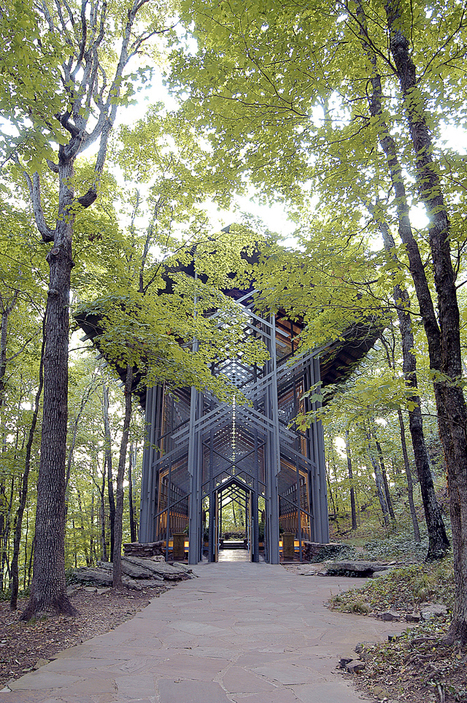
The Thorncrown Chapel in Eureka Springs, Arkansas is considered one of the crowning examples of organic architecture, a philosophy credited to Frank Lloyd Wright that promotes a harmony between the natural world and human habitation. The non-denominational chapel was designed in 1980 by an apprentice of Wright’s, architect E. Fay Jones, who employed the use of steel and glass to create a weightless, almost translucent structure that offers sweeping views in all directions of the surrounding Ozark habitat. In keeping with the organic design of the chapel Fay asked that no construction element be larger than what two people could carry through the woods by hand. Recently a power company has applied to build a 48-mile high voltage transmission line through Northwest Arkansas that will cut through the woods right next to the chapel, shattering the views and serenity offered by the extremely unique building that was placed on the National Register of Historic Places in 2000.
It’s a cold January day and you’re walking down a street in Brooklyn gnawing on a piece of gum that just passed the point of flavorful into the realm of tastelessness. In a hurry, you spit it on the ground without a second thought and continue about your day. Hours later a mysterious woman arrives and surreptitiously collects the sticky gum from the sidewalk and drops it into a clear plastic bag which she carefully labels. Flash forward a month later: you’re walking through an art gallery, and there, mounted on the wall, is a familiar face staring back at you. Astonishingly (or terrifyingly) it’s a 3D print of your face generated from the DNA you left behind on that random piece of gum that now appears in a petri dish just below the portrait. A few years ago this would seem like science fiction, the stuff of films like Gattaca, but to information artist Heather Dewey-Hagborg it’s how she makes her artwork here in 2013.
To get content containing either thought or leadership enter:
To get content containing both thought and leadership enter:
To get content containing the expression thought leadership enter:
You can enter several keywords and you can refine them whenever you want. Our suggestion engine uses more signals but entering a few keywords here will rapidly give you great content to curate.


 Your new post is loading...
















The jury characterised Wa Lehulere’s work as follows: “In his work Kemang Wa Lehulere explores questions of collective memory and seeks to uncover the traces of South African history. To this end, he not only uses the devices of revealing and writing down but also of wiping out text and pictures.