I cannot think of another illustration by a scientist or philosopher who attempts to explain their own, literal, view of the world and then offer what this looks like to the reader from inside his own head, looking out through his own eye. That's exactly whatErnst Mach is doing right here on page 15 of his influential book Die Analyse der Empfindungen, the fourth German edition ("The Analysis of Sensations and the Relation of the Physical to the Pyschical", published in Jena in 1903).
Hace poco di una clase sobre narrativa en el Master de UX del KSchool. Les quería poner este vídeo como ejemplo de que las narrativas no necesitan ser complejas.
Aquí una historia redonda alrededor de una sola pregunta: ¿Se matará?
"…the so called quinarian approach to classification that was embodied in the work of British entomologist named William Sharpe Macleay (1792-1840) but taken up almost immediately by others, principally Nicholas Aylward Vigors (1787-1840) and William Swainson (1789-1855) during the 1820s and 30s. They somehow came to believe that living things existed in natural groups of five, that such groups of five are naturally divisible into five subgroups, each subgroup into five sub-subgroups, and so on. Affinities among taxa formed circular chains…Quinarians were also convinced that similarities between taxa based on affinity as well as analogy could be indicated in the same diagram…"
Cuando era enano leia muschismos comics, ya prácticamente no compro nada, excepto *todo* lo que hace Kevin Huizenga. Todo lo que hace me encanta, desde sus comics autobiograficos, hasta las pequeñas obsiones nerd que publica en su blog. Recomendado Ganges
Collection of 1978 documents detailing the agreement and specification and code for the creation of the Apple II "DOS" (Disk Operating System), signed by Steve Jobs
I let the culture of the company get corrupted.I ignored problems instead of nipping them in the bud.I was aloof and away instead of managing or training managers.I confused everyone by sharing my daily thoughts before they had cemented into decisions.I announced decisions, then assumed they were being done, without following-up to ensure.I whimsically delegated to the wrong people, avoiding the mental work of choosing wisely.(I could list another 20 of these, but you get the idea.)
"While Jekyll 2.0 might not transpire to be an appropriate project for a publishing house to replicate, its attempt to retell a narrative with a technical edge could well inspire future digital projects: a horror novel that changes pace according to data collected from a heart rate monitor, or cuts out a room's smart lights once a climactic passage is reached, escalating the horror further."
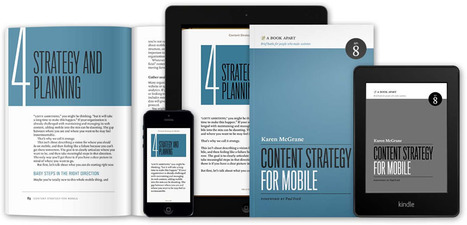
Dan Levy: "Forget responsive design. The key to multiplatform publishing success is “adaptive content,” argues Karen McGrane in her book, Content Strategy for Mobile. We spoke to the author about why she thinks all content is mobile."
"There’s a huge underserved population today who are consuming content on their phones and we’re giving them a crappy experience. We’re telling them, “Here’s how the web works for you: You have to pinch and zoom your way through sites that were designed for a much larger monitor, you’re going to get errors and the fonts are going to be really tiny.”
"Forget responsive design. The key to multiplatform publishing success is “adaptive content,” argues Karen McGrane in her book, Content Strategy for Mobile.
A great piece on the importance of having content that is viewable or playable across all devices . Matmi CEO Jeff has been pushing the "content should belong to the user and not to the device " mantra for a while.
As I grow in my visual thinking work, it’s become abundantly clear that the story is 100 times more powerful than the visuals that support it (and am I going to get in trouble for saying that!) I’ve always known that visualizing crappy content is like putting lipstick on a pig, but the overwhelming importance of story, message, narrative, and arc is becoming part of my modus operandi like never before. So how does a girl get educated on story? Well, by taking the most famous seminar on story in the world – that of Robert McKee, story professor extraordinaire.
The first color wheel has been attributed to Sir Isaac Newton, who in 1706 arranged red, orange, yellow, green, blue, indigo, and violet into a natural progression on a rotating disk. As the disk spins, the colors blur together so rapidly that the human eye sees white. From there the organization of color has taken many forms, from tables and charts, to triangles and and wheels the history.
"I sincerely believe that the user experience community should add game design to its toolbox of competencies. If we’re truly committed to creating satisfying user experiences, then there’s no reason why games, which can satisfy people so richly, should be excluded."
"Instantly recognizable to most as the default wallpaper in Windows XP, which is still, 11 years after its release, the most popular OS in the world (by some measures [1]).
Shot by Charles O'Rear on a medium format camera in 1996 and not digitally enhanced or manipulated in any way. The approximate location is 3101 Fremont Dr. in Sonoma, CA.[2]
In November 2006, Goldin+Senneby took the same picture, titling the piece After Microsoft:"
reuters: “ Norwegian public television plans to broadcast a burning fireplace for 12 straight hours from Friday evening, with firewood specialists providing color commentary, expert advice and a bit...
Hay mil razones por las que esto me parece una idea maravillosa, pero, resumiendo:
-Los humanos llevamos mas de un cuarto de millón de añois contemplando el fuego, algún cientifico ha argumentado que esa fascinación con mirrar juegos de luces sigue viva en nuestros genes, y por eso seguimos teniendo chimenas, y barbacoas cuando ya no hacen falta.
-Ambient TV. Siempre le contaba a mis estudiantes de TV interactiva la historia de ese canal de cable americano que antes de cerrar unas licencias, pusieron una cámara apuntando a un tanque de peces que tenían en la oficina, para retransmtir *algo*, cualquier cosa, hasta cerrar los contratos. Cuando llegaron los canales y quitaron el tanque recibieron una avalancha de llamadas de clientes pidiendo que volvieran a poner los peces. Tal fue la demanda que decidiron allí mismo crear un canal permanente, FishtankTV. Lejos de ser una aberración creo que esta historía dice mucho de la verdadera naturaleza de la TV, y de su función, por encima de todo, como juego de luces relajante.
-Baby TV. Ahora que tengo niñas he visto mucha TV infantil, mi preferida con mucho, es la TV que se hace paras niños pre-verbales, es lo más relajante que he visto en mi vida, sin anuncios, nin tnoticias, sin tiros, sólo colores y sonidos bonitos, me quedo empanado viendola, y después me siento bein, es TV sana, y eso si que es raro.
En ese aspecto no me extrañaría nada que la iniciativa Noruega, brillante, la mires como la mires, sea todo un extraño éxito.
Brian Eno tiene una fase célebre donde dice algo así como a los instrumentos de música electrónica les fata más Africa.
Siempre pensé que se refería al interface, los botones, teclas y potenciometros que pueblan los instrumentos de música electronica no pasan de ser herencias de controles cuyo origen era maquinaria industrial. Botonacos, knobs, ruedecillas, quedan a años luz de la respuesta táctil de un tambor, o una cuerda.
Eno tenía razón. Sin embargo parece que el layout de matriz de botones que el AKAI, via hip hop, llevó a las manos de todo dios*, tiene ya tanta solera, que ha dado a que emerjan cosas como esta:
Firebase Industries presents its new game, Arcadecraft! Manage and customize your very own arcade! Available now on Xbox Live Indie Games http://marketplace....
Information isn’t picky: Anyone, anything, or anybody can be a part of it anytime, anywhere, and by any means possible. Attention on the other hand, is finite; we only have so much of it, and in th...
Estupendo árticulo, y precioso trabajo de diseño fluido, casi parece que uno empieza a atisbar hacia donde van las cosas, y como la web se mueve más allá del abortado "multimedia" y hacia formas y presentaciones verdaderamente nativas al medio.
Unmindful use of email is probably the biggest source of infotention pollution. These tips were recommended by Media Lab director Joi Ito -- Howard
"What's the best way to train everyone around you to better e-mail habits? You guessed it: You go first. First, you say, "In order for me to make you more productive, I'm going to adopt this new policy to lighten your load…" Demonstrate a policy for a month, and if people like it, ask them to start doing it too.
Use a subject line to summarize, not describe. People scan their inbox by subject. Make your subject rich enough that your readers can decide whether it's relevant. The best way to do this is to summarize your message in your subject."
Cómo se hizo la webapp de las olimpiadas del Guardian uk
"Timelines remain one of the most useful visual mechanics to display sequenced information. They also, as we have been discovering, relate very closely to that other "visual mechanic" of our time - the stream, which, thanks to Facebook and Twitter, is emerging one of the pre-dominant, if not the dominant, metaphors for news distribution in the digital era.
So when the opportunity arose to create a "Second Screen" experience for the Olympics, which would have to display the huge variety of Olympics-related news: from blog posts, to tweets, pictures, and other data-based updates (results, medal tables, and the like), we wondered: was there a way to reimagine the timeline such that it enabled a better navigation of this voluminous stream?
César Astudillo (Oviedo, 1968) inaugura las entrevistas de Creatividad Espiritual. Astudillo, socio director de Designit, se incorporó a la empresa en el año 2006 (por aquel entonces dnx), y actualmente es director de consultoría y responsable de desarrollo de práctica, además de dirigir proyectos de diseño estratégico, imparte formación en ese ámbito y en el de la innovación centrada en las personas.
Se inició en el mundo profesional a finales de los años 80 componiendo música para videojuegos (bajo el seudónimo de Gominolas). Su carrera profesional le ha llevado a desempeñar perfiles tan variados como: dibujante de tiras cómicas en revistas (Input y PC Week), desarrollador de interfaces de usuario para aplicaciones de banca en Infoservicios, diseñador de identidad corporativa, diseñador de videojuegos en PYRO Studios y entre los años 2000 y 2006 se ha dedicado al diseño de interacción en Netjuice Consulting, Xfera Móviles y enVision.
To get content containing either thought or leadership enter:
To get content containing both thought and leadership enter:
To get content containing the expression thought leadership enter:
You can enter several keywords and you can refine them whenever you want. Our suggestion engine uses more signals but entering a few keywords here will rapidly give you great content to curate.



 Your new post is loading...