Your new post is loading...

|
Scooped by
Mel Riddile
September 2, 2017 11:44 AM
|
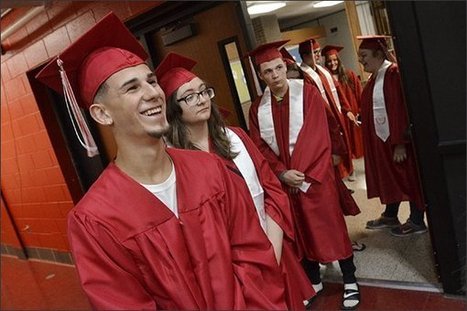
A little-noticed change in the country's main federal education law could force many states to lower their high school graduation rates, a politically explosive move no state would relish.
Indiana is the first state to be caught in the crosshairs of the law's new language, but other states are likely to be affected soon. The resulting debate could throw a sharp spotlight on a topic that's been lurking in the wings: the wildly varying levels of accomplishment signified by a high school diploma.
|
|
Scooped by
Mel Riddile
September 1, 2017 6:15 PM
|
An annual poll on national perceptions of education reveals an emphasis on services beyond traditional learning, such as mental-health support and career education.
|
|
Scooped by
Mel Riddile
September 1, 2017 5:54 PM
|
Start with a short, simple, objective statement about the other person’s behavior — what you’d like to see changed. For example: “When you interrupt me during meetings” or “When you take sole credit for the work we’ve done collaboratively.” Your goal here is to get the other person’s attention and, in doing so, minimize their defensiveness. The statement should be short, to the point, and evenhanded and unemotional enough that they can hear your message and not immediately disagree or disengage.
|
|
Scooped by
Mel Riddile
September 1, 2017 5:13 PM
|
Back then, there was a fluidity between online and offline bullying. Taunts that started at school would make their way into comments; those leaked nudes would be printed and posted on lockers and line the walls like a walk of fame; bullying that happened in person was filmed on low-res, early-gen phone cameras and shared around. The bullying was more visible, to peers, parents, and teachers, who zoomed in on what they saw—disciplining others if the abuse happened on school property.
Nowadays, according to those I've spoken to for this article, the vast majority of bullying takes place solely online, and is arguably even more insidious and widespread than it's ever been.
|
|
Scooped by
Mel Riddile
August 31, 2017 6:13 PM
|
Reflection is a natural part of learning.
We all think about new experiences–the camping on the car ride home, the mistakes made in a game, or the emotions felt while finishing a long-term project that’s taken months to complete.
|
|
Scooped by
Mel Riddile
August 29, 2017 11:56 AM
|
The combination of data and common sense show the way. A 2006 meta-analysis by a Duke University researcher found that students who did homework had better academic performance (though it was not clear which was the cause and which was the effect). But he also found that excessive homework can make kids tired and fuel negative attitudes about sch
|
|
Scooped by
Mel Riddile
August 29, 2017 11:26 AM
|
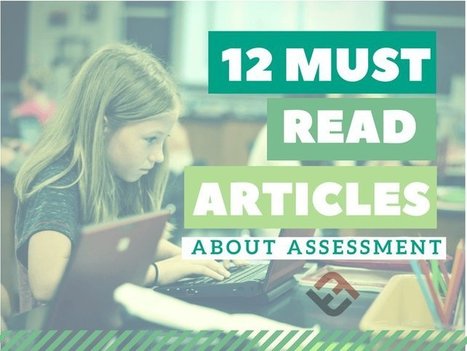
Below we’ve gathered 12 of what we consider ‘must-read’ articles about assessment. They purposely cover a variety of different angles, from purpose to function to assessment strategies. We could come up with another 12 tomorrow, and the next day, and so on, so we don’t intend for this to be an exhaustive (it’s only 12) list that is the final word on assessment. It is, rather, a good start. The list features TeachThought content, but the vast majority (8 of the 12) come from other sites and resources.
|
|
Scooped by
Mel Riddile
August 28, 2017 10:51 AM
|
Borrowing a page from the medical school world, educators at the Ed School are showing teachers and school leaders how to find common ground when it comes to learning and instruction.Illustrations by Cathy Gendron
|
|
Scooped by
Mel Riddile
August 27, 2017 12:07 PM
|
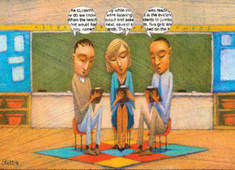
Students are doing more reading on digital devices than they ever have before. Not only are many teachers using tablets and computers for classroom instruction, but many state tests are now administered on computers, adding incentive for teachers to teach digital reading strategies. But casual digital reading on the internet has instilled bad habits in many students, making it difficult for them to engage deeply with digital text in the same way they do when reading materials printed on paper.
Devin Hess sympathizes with educators’ concerns, but believes digital reading is here to stay and teachers have a duty to equip students to engage with digital texts in meaningful ways. Hess was a middle school social studies teacher and early tech adopter in his classroom. Now he works with the UC Berkeley History-Social Science Project training social studies teachers on deep reading strategies. The techniques were developed by the Project for reading on paper, but Hess has worked to extend and further them in the digital space.*
|
|
Scooped by
Mel Riddile
August 26, 2017 1:28 PM
|
According to a University of Phoenix College of Education survey, nearly all K-12 teachers said educational technology like laptops, SMART Boards and apps, are being used in schools. Unfortunately, the survey also found that nearly one in five of those surveyed feel intimidated by students’ knowledge of tech devices, and only one in four have had significant training in integrating technology into the classroom.
|
|
Scooped by
Mel Riddile
August 20, 2017 6:27 PM
|
Most educational leaders know the research by now. Leadership does make a difference in the success students have in schools. There are meta- analyses that have investigated that. Most educational leaders also know the research about trust in schools and how that makes a difference for students. Leaders may know what to do and how to make change happen but progress comes more quickly and develops roots that are stronger when leaders are trusted and followers are energized by that trust. Trust can be difficult to gain and it is easy to lose.
Schools can no longer succeed with the curriculum, structure, methods, and targets and financing that worked even a quarter century ago. Yet, these five critical components of education have still changed very little. Deciding what has to change and knowing how to lead change is a non-negotiable talent for today's leaders. Building trust is not something that often appears on a leader's 'to do' list. Many presume it will just happen because they perceive themselves to be trustworthy. But, every day in a leader's life there are people who will be making decisions about whether (s)he is acting in a trustworthy way or not. Those opinions are an ongoing result of the responses to each and every decision made and action taken.
|
|
Scooped by
Mel Riddile
August 16, 2017 2:53 PM
|
Middle-class high-schoolers aren’t getting any smarter, but their GPAs are rising—and that’s pushing their poor peers further behind. Here’s the latest, more profound way in which wealthier students have an advantage over lower-income ones: Those enrolled in private and suburban public high schools are being awarded higher grades—critical in the competition for college admission—than their urban public school counterparts with no less talent or potential, new research shows. It’s not that those students have been getting smarter. Even as their grades were rising, their scores on the SAT college-entrance exam went down, not up. It’s that grade inflation is accelerating in the schools attended by higher-income Americans, who are also much more likely than their lower-income peers to be white, the research, by the College Board, found. This widens their lead in life over students in urban public schools, who are generally racial and ethnic minorities and from families that are far less well-off.
|
|
Scooped by
Mel Riddile
August 13, 2017 10:40 AM
|
He’s not alone in his opinion. According to national surveys, employers want to hire college graduates who can write coherently, think creatively and analyze quantitative data. But the Conference Board has found in its surveys of corporate hiring leaders that writing skill is one of the biggest gaps in workplace readiness.
That’s why so many employers now explicitly ask for writing and communications skills in their job advertisements. An analysis by Burning Glass Technologies, which studies job trends in real time by mining data from employment ads, found that writing and communications are the most requested job requirements across nearly every industry, even fields such as information technology and engineering.
|
|
|
Scooped by
Mel Riddile
September 1, 2017 6:23 PM
|
The United States would realize roughly $9 billion a year in economic gains by instituting a simple, nationwide policy change: starting public school classes no earlier than 8:30 a.m.
That's according to an exhaustive new study by the Rand Corporation, the first of its kind to model the nationwide costs and benefits of later school start times.
|
|
Scooped by
Mel Riddile
September 1, 2017 5:57 PM
|
Best content around STEM Technology selected by the EdTech Update community.
|
|
Scooped by
Mel Riddile
September 1, 2017 5:17 PM
|
Decades of scientific studies have shown even an immature brain is capable of extraordinary feats. Yet a fully developed brain is necessary for actions that adults take for granted, such as risk assessment and self-control. According to developmental psychologists, parents who better understand the stages along the way can help guide their child over the hurdles.
|
|
Scooped by
Mel Riddile
August 31, 2017 6:18 PM
|
Being a teacher requires you to be continually at the top of your game – not exhausted. Here one celebrated head outlines four approaches for managing your work-life balance
Teachers have so many skills – but the endless capacity to give, give and then give some more is probably their greatest.
Constantly tapping these vast reserves of generosity is the reason why at the end of the term teachers are exhausted.
But now we have had a few weeks off, hopefully refilling our reservoirs of goodwill, and so it is probably a good time to cook up some strategies for the new year.
|
|
Scooped by
Mel Riddile
August 31, 2017 6:07 PM
|
Sarah Brown Wessling, an English teacher at Johnston High School in Johnston, Iowa, goes behind the scenes of her prior Teaching Channel video, "Pinwheel Discussions: Texts in Conversation." By incorporating role-playing into student-led discussions, Wessling generates lively class discussions on literary texts.
|
|
Scooped by
Mel Riddile
August 29, 2017 11:32 AM
|
It may be hard to believe, but entry-level employees with a high school diploma at the popular convenience store QuikTrip make more than teachers in Oklahoma.
For four years running, the state has led the nation in tax cuts to education, outpacing second-place Alabama by double digits. Years of tax cuts and budget shortfalls mean that Oklahoma has fallen to 49th in teacher pay. Spending per pupil has dropped by 26.9% since 2008.
|
|
Scooped by
Mel Riddile
August 29, 2017 11:12 AM
|
My misconceptions were many. Yes, I understood guided reading. But I didn’t realize that guided reading wasn’t the most effective way to teacher responsively with my former 5th and 6th graders. Instead, I should have been conferring with kids regarding what they were reading independently, as well as facilitating more book reviews and recommendations. As the year progressed, I started feeling a little guilty about some of my past instructional moves. However, I was thankful that as a faculty we were learning about promising practices together and would be better educators for our students.
When the opportunity came up a year later to attend that same literacy institute, I didn’t say no.
|
|
Scooped by
Mel Riddile
August 27, 2017 12:13 PM
|
The simple truth reveals itself every year: If you have strong relationships with students who care about you as well as respect you, you will have fewer issues within your classroom. When a student has a relationship with you they choose to act different because of, among other emotions, the fear of losing the relationship
|
|
Scooped by
Mel Riddile
August 26, 2017 1:31 PM
|
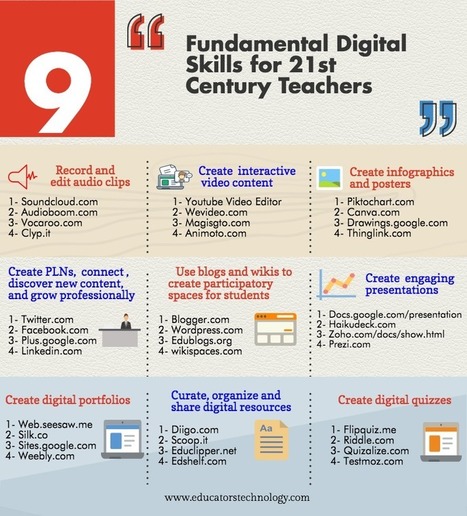
Free resource of educational web tools, 21st century skills, tips and tutorials on how teachers and students integrate technology into education
|
|
Scooped by
Mel Riddile
August 25, 2017 7:20 PM
|
When Angela Lee Duckworth was a young teacher in New York, she became obsessed with something seemingly simple yet remarkably hard to predict: why did some students "succeed" (learn the material and perform well), while others didn't? Why did certain smart kids fail to learn hard concepts, while certain less talented kids got them?
She took this inquiry with her to graduate school, where she and her team started studying both children and adults in challenging settings. As she explained in her TED talk, the research question was always the same:
"Who is successful here, and why?"
As it turned out, there was an answer. One trait rose above all others. In contexts as disparate as West Point, the National Spelling Bee, private companies, and low-income schools, the one characteristic that emerged as highly predictive of success wasn't IQ. It wasn't social intelligence, nor was it good looks, physical health, or socioeconomic status.
|
|
Scooped by
Mel Riddile
August 18, 2017 5:47 PM
|
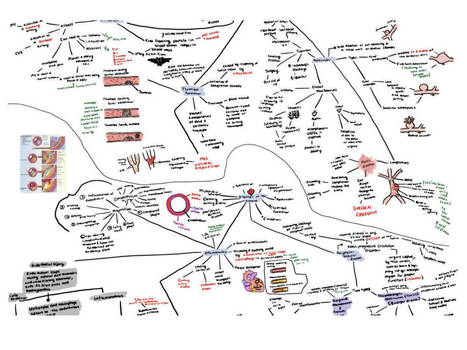
Debates over note taking tend to focus on whether devices are helpful or harmful, rather than on strategies students can use to make connections between ideas
|
|
Scooped by
Mel Riddile
August 14, 2017 5:57 PM
|
How could neuroscience help teachers? Neuroscience can help teachers understand how the brain learns new information. Even having a basic knowledge of neuroscience can inform the way teachers teach.
For example, neuroscience tells us that when children learn new information, that information goes through pathways in the brain. These pathways connect neurons together. The more connections that exist between neurons, the easier it is for the brain to access information.
What does this mean for teachers? When students learn something new, they need to be able to connect it to something they already know. This forms strong neural pathways and makes recall easier.
|