Your new post is loading...

|
Scooped by
Howard Rheingold
December 13, 2011 12:41 AM
|
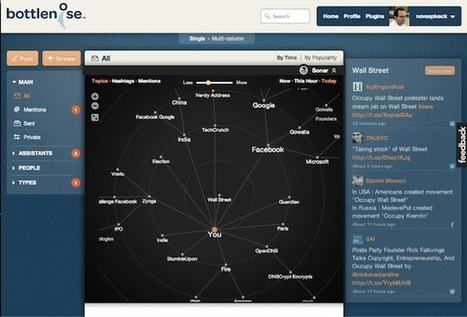
"Bottlenose is a new social media dashboard for influencers of all stripes. But it's not just for posting and reading; it helps you filter and manage your networks with semantics and machine learning. It's all Web-based, written in HTML 5 and Javascript. It does the data crunching on the browser side (for the non-pro users), so you get native performance behind these major operations reading and parsing your stream. You log in to your social networks - Twitter and Facebook only at first - and Bottlenose begins crawling your stream. You can also add RSS/Atom feeds to bring in entries from websites. Other social networks are coming soon, and you'll even be able to pull in email eventually."
|
|
Scooped by
Howard Rheingold
December 8, 2011 12:37 PM
|
"With the unprecedented levels of published information, it is very difficult for Internet users to stay up to date on what matters to them. This situation is especially dramatic for information professionals that must remain aware of new happenings in order to stay ahead of the curve. Content curation is the process of picking the most relevant and valuable content for a specific audience. There is an important human component to content discovery and curation because only users can fully understand the context of the information they are working with. Technology can support content curation by computing large volumes of information on behalf of the user by helping to discover new pieces of Web information."
|
|
Scooped by
Howard Rheingold
December 3, 2011 7:53 PM
|
"Attention is a key part of human cognition, and as such, attention to our environment allows us to sort out what information is important and what is not. By sorting this information into the appropriate categories we are able to become more effective at learning and decision-making within similar environments. Over the past few years video games have gained popularity as a spectator event with eSports (electronic sports) attracting numerous professional gamers and a constantly expanding global community. Yet, despite the increasing popularity and easily obtainable data, little research has been done to explore how experts and novices differ in their interaction within a complex Graphical User Interface (GUI) environment."
|
|
Scooped by
Howard Rheingold
December 2, 2011 1:31 PM
|
"It is no secret that big companies still uses email as their main collaborative tool. And this habit won’t change any time soon. Changing the office culture and the habits of maybe hundreds of employees may take years. But technology has moved on, and so should we. One step at a time. There are smarter and more time efficient technologies available today such as the enterprise wiki and we should all embrace it."
|
|
Scooped by
Howard Rheingold
November 25, 2011 6:20 PM
|
Social media can be an invaluable part of your business’ online marketing strategy. But one of the biggest issues that comes along with social media are the distractions.
|
|
Scooped by
Howard Rheingold
November 24, 2011 12:33 PM
|
"You can switch off a machine, you can switch off an email, you can leave the office and go on a holiday – but it's really about whether the mind has left work and switched off. Very often we're preoccupied. It's really not where we physically are, it's where we mentally are that matters"
|
|
Scooped by
Howard Rheingold
November 15, 2011 5:38 PM
|
"After years of writing about startup companies, I’m now building one myself. Specifically, I’m building a company that’s developing a technology based on some of my favorite consulting projects I’ve done for clients over the years: an app and data platform that discovers emerging topical information. It’s a learning-curve busting, “first mover’s advantage” as a service, technology for information workers who want to win. It’s about helping users “skate to where the puck is going to be, not to where it’s been.” It’s called Plexus Engine, it’s in private beta and you can sign up to be notified when it launches at PlexusEngine.com. A Plexus is a place where nerves branch and rejoin in the body and the Plexus Engine analyzes points of intersection online to detect emerging signals."

|
Suggested by
nukem777
November 14, 2011 3:28 PM
|
Constant interruptions can kill your concentration and put a crimp in your productivity. And according to recent research, you are probably suffering the tyranny of interruptions much more often than you realize.
|
|
Scooped by
Howard Rheingold
November 12, 2011 12:37 PM
|
Finding Credible Information Sources in Social Networks Based on Content & Social Structure
http://www.parc.com/content/attachments/finding-credible-information-preprint.pdf
(PDF DOWNLOAD) "A task of primary importance for social network
users is to decide whose updates to subscribe to in order to
maximize the relevance, credibility, and quality of the information
received. To address this problem, we conducted an experiment
designed to measure the extent to which different factors in online
social networks affect both explicit and implicit judgments of
credibility. The results of the study indicate that both the topical
content of information sources and social network structure
affect source credibility. Based on these results, we designed a
novel method of automatically identifying and ranking social
network users according to their relevance and expertise for
a given topic. We performed empirical studies to compare a
variety of alternative ranking algorithms and a proprietary
service provided by a commercial website specifically designed
for the same purpose. Our findings show a great potential for
automatically identifying and ranking credible users for any
given topic."
|
|
Scooped by
Howard Rheingold
November 6, 2011 5:34 PM
|
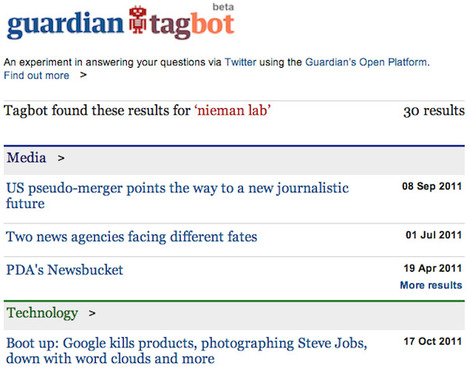
"This morning, the Guardian announced the birth of @GuardianTagBot, the living, tweeting, occasionally sleeping Twitter account that serves as the public face of the Guardian’s content API explorer. Tweet @GuardianTagBot with a search term — or a whole group of search terms — and it’ll @-reply you with a link to Guardian content that matches your query. Whether you’re looking for Nieman Lab mentions in the Guardian (who isn’t?), or wondering what Nick Clegg is up today (ditto), or concerned that David Cameron may be a lizard (um)…the bot probably has your answer."
|
|
Scooped by
Howard Rheingold
November 2, 2011 2:12 PM
|
"If you haven’t heard of it, the 10x effect is the anecdotal observation that great programmers aren’t just a little more productive than average ones (like 15-20%). They tend to be 10 times more productive. A similar effect can be found in other kinds of creative information work. Can you transform yourself into a 10x person? If you meet certain qualifying conditions (by my estimate, maybe 1 in 4 people do), I think you can. The 10x effect arises from the interaction of thrust and drag on the fundamental playing field of your life, your calendar. If you understand how this works, and learn to manage the interaction, the benefits are enormous. Managing the interaction involves a rule that is about as close to magic as I’ve ever encountered: you just prioritize longer tasks in your scheduling."
|
|
Scooped by
Howard Rheingold
October 31, 2011 3:24 PM
|
"Every day we’ll email you to ask, “What’d you get done today?” Just reply to our email to make an entry."
|
|
Rescooped by
Howard Rheingold
from attention
October 30, 2011 11:40 AM
|
"In this book, we travel inside the brains of Emily and Paul as they attempt to sort the vast quantities of information they're presented with and figure out how to prioritize, organize, and act on it. Fortunately for Emily and Paul—and for readers of Your Brain at Work—they're in good hands: David Rock knows how the brain works—and more specifically, how it works in a work setting."
|
|
|
Scooped by
Howard Rheingold
December 8, 2011 9:08 PM
|
"This is not to say that what these algorithms produce can't be considered "true" or accurate, or that some algorithms don't produce superior results than others; rather, it is to say that information seekers must examine the information available about these algorithms and the contingencies that produced them if they wish to come to reliable conclusions about that information. As such, examining these contingencies is as important a factor in digital literacy as the examination of the publication history of printed texts—the name and affiliation of the author(s), who printed it, what form it was printed in, how it was edited, etc.—was for print literacy."
|
|
Scooped by
Howard Rheingold
December 7, 2011 2:10 PM
|
Understanding what projects and tasks you need to focus on is critical for busy managers, especially at year end. PersonalBrain can help you rise above the fray so you can see the big picture and keep your priorities in order.
|
|
Scooped by
Howard Rheingold
December 3, 2011 7:50 PM
|
"If there is one general rule about the limitations of the human mind, it is that we are terrible at multitasking. The old phrase “united we stand, divided we fall” applies equally well to the mechanisms of attention as it does to a patriotic cause. When devoted to a single task, the brain excels; when several goals splinter its focus, errors become unavoidable. But clear exceptions challenge that general rule. Two weeks ago, thousands of computer game enthusiasts descended on a convention center in downtown Providence, Rhode Island, to observe some of these exceptions in action. They were attending the championships of one of the world’s hottest computer games, StarCraft 2."
|
|
Scooped by
Howard Rheingold
November 27, 2011 4:07 PM
|
"Finding relevant content is tricky business; not only is there an abundance of irrelevant content to confuse us and muddy the waters, but we often simply don’t know something exists until we see it. Traditional search fails us here because that method assumes we know what we are looking for in the first place, or that we possess the forethought to make some assumptions and pick out some key words to enter into the search bar. Perhaps what we really need are intelligent tools that suggest things to us before we even know we are looking for them. TrapIt, a new online content discovery tool, aims to meet that need. TrapIt was developed by the same minds that created and then sold Siri to Apple (the Siri technology has now been fully integrated into the iPhone 4S). Both offerings leverage artificial intelligence (AI) technology that was developed as part of the CALO (Cognitive Agent that Learns and Organizes) project, an AI project funded by the Defense Advanced Research Projects Agency (DARPA). Originally intended for military use, the cognitive software was designed to learn from experience, take orders, explain its own actions, and respond to unexpected input."
|
|
Scooped by
Howard Rheingold
November 25, 2011 2:31 PM
|
"Tabbed browsing is perhaps the best thing invented since sliced bread. It allows us to browse multiple sites at once, and keeps the interface clutter-free to a great extent. That said, things get a bit messy for those who’re into a habit of opening more than 20 times at once, a habit, which is not that uncommon. If you’re on Chrome and are finding it difficult to deal with this tab overload, here are seven Chrome extensions that might come in handy."
|
|
Scooped by
Howard Rheingold
November 17, 2011 8:18 PM
|

|
Suggested by
Beth Kanter
November 15, 2011 12:43 PM
|
Another reason to beef up your information coping skills - too much useless data can depress you....
|
|
Scooped by
Howard Rheingold
November 13, 2011 2:04 PM
|
"Like it or not, knowing how to make use of online tools without being overloaded with too much information is an essential ingredient to personal success in the twenty-first century. But how can we use digital media so that they make us empowered participants rather than passive receivers, grounded, well-rounded people rather than multitasking basket cases? In Net Smart, cyberculture expert Howard Rheingold shows us how to use social media intelligently, humanely, and, above all, mindfully. Mindful use of digital media means thinking about what we are doing, cultivating an ongoing inner inquiry into how we want to spend our time. Rheingold outlines five fundamental digital literacies, online skills that will help us do this: attention, participation, collaboration, critical consumption of information (or "crap detection"), and network smarts. He explains how attention works, and how we can use our attention to focus on the tiny relevant portion of the incoming tsunami of information. He describes the quality of participation that empowers the best of the bloggers, netizens, tweeters, and other online community participants; he examines how successful online collaborative enterprises contribute new knowledge to the world in new ways; and he teaches us a lesson on networks and network building."
|
|
Scooped by
Howard Rheingold
November 7, 2011 8:45 PM
|
"How editors and other leaders can use the StoryPad to organize information for teams You can round up information from social media and all over the web to share with your team, as if you're all surfing the web together and working on the same report."
|
|
Scooped by
Howard Rheingold
November 3, 2011 5:01 PM
|
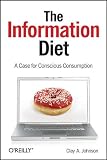
(Forthcoming book -- I read a prepub copy and recommend it as an infotention resource) "According to Google's Chairman Eric Schmidt, we create more information every two days than we did throughout human history up to 2003. How can you cope with information overload? This insightful book makes a compelling case that information overload doesn't actually exist—the real problem is information overconsumption. Just as junk food can lead to obesity, junk information can lead to a new form of ignorance. The Information Diet provides a framework for consuming information in a healthy way, by showing you what to look for, what to avoid, and how to be selective. In the process, author Clay Johnson explains the role information has played throughout history, and why following his prescribed diet is essential in today's information age."
|
|
Scooped by
Howard Rheingold
November 1, 2011 11:09 PM
|
One hour video: "Peter Drucker, the founder of the discipline of modern management, asserted that making knowledge workers productive was the key to economic survival for the developed economies. Though knowledge workers use their minds to make a living, are they ever taught to use their minds more effectively? This webinar discusses my decade-old mindfulness program at the Drucker School of Management designed to teach managers to manage themselves."
|
|
Scooped by
Howard Rheingold
October 31, 2011 3:22 PM
|
Over the past several years, our quest to extract meaning from information has taken us more and more toward the realm of visual storytelling...
|













![How a Computer Game is Reinventing the Science of Expertise [Video] | Observations, Scientific American Blog Network | Infotention | Scoop.it](https://img.scoop.it/o6txEUcf40D0CziPCN5rrTl72eJkfbmt4t8yenImKBVvK0kTmF0xjctABnaLJIm9)