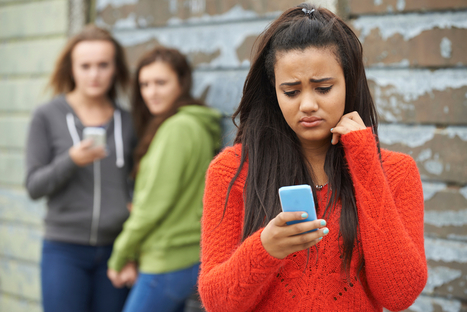
These engaging activities can spark conversations about oversharing, digital footprints, cyberbullying, and more.

 Your new post is loading...
 Your new post is loading...
Your new post is loading...
 Scoop.it!
These engaging activities can spark conversations about oversharing, digital footprints, cyberbullying, and more. 

Dikeledi's curator insight,
June 9, 2021 7:06 PM
Talks about digital footprint and digital citizenship.
Sign up to comment
Scoop.it!
From
zoom

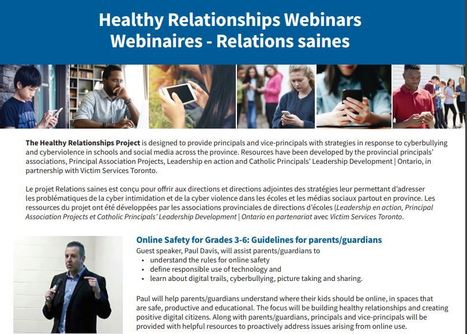
In this one hour webinar guest speaker, Paul Davis, will assist parents and guardians to:
Scoop.it!

NeedHelpNow.ca helps teens stop the spread of sexual pictures or videos and provides support along the way.
Scoop.it!

What can parents do about cyberbullying? They first need to understand the behavior, its consequences, and then how to prevent and manage it.

tyoung5@my.westga.edu's curator insight,
July 9, 2019 4:06 PM
ELAGSE9-10W1: Write arguments to support claims in an analysis of substantive topics or texts, using valid reasoning and relevant and sufficient evidence.
a. Introduce precise claim(s), distinguish the claim(s) from alternate or opposing claims, and create an organization that establishes clear relationships among claim(s), counterclaims, reasons, and evidence. b. Develop claim(s) and counterclaims fairly, supplying evidence for each while pointing out the strengths and limitations of both in a manner that anticipates the audience’s knowledge level and concerns. This article is selected for students use and is intended to pique interest in a topic for the upcoming project. It contains content they may find relevent to one of the topics that they will choose from for the assignment.
Scoop.it!

How can we be upstanders when we see cyberbullying? Check out Super Digital Citizen, a free digital citizenship lesson plan from Common Sense Education, to get your grade 4 students thinking critically and using technology responsibly to learn, create, and participate.
Scoop.it!

There is a growing crisis within children’s mental health, and this is not a term used lightly – between 2010 and 2015 there was a 50% increase in hospital admissions because of children self-harming. And in 2016 Childline reported the highest ever number of callers expressing suicidal thoughts. This is a figure that has doubled over the last five years. Damien Page, Dean of The Carnegie School of Education, Leeds Beckett University writes in The Conversation. A report by the Children’s Commissioner for England warned that more than 800,000 children were living with mental health issues in the UK, with a large proportion from vulnerable families. Issues they face include parents with alcohol addiction, involvement in the care system, as well as dangers posed by street gangs and modern slavery. As children’s mental health becomes one of society’s most pressing issues, many teachers find themselves on the frontline – with the effect being felt in schools across the country. In 2017, 79% of teachers in both primary and secondary schools reported seeing an increase in stress, anxiety and panic attacks in their pupils as well as a rise in depression, self-harm and eating disorders. But without specialist training – which isn’t currently a requirement – a lot of those working in schools feel unprepared for the challenges they are facing. With this in mind, below are a few ways schools can try and help. 1. Start talking about it Mental health needs to be integrated into the school curriculum, which will help increase understanding and reduce stigma around issues. Without this, pupils may not be aware their mental health is deteriorating and feel silenced or shamed when seeking help. If both pupils and teachers have more open discussions about mental health, issues will also be easier to identify early on, and this will help to build students’ knowledge and understanding of the subject. Ideally, mental health needs to be talked about the same way physical education or healthy eating is, because research has found that when schools adopt a comprehensive approach to discussing mental health it supports all pupils – including those who are experiencing mental health difficulties already. 2. Create a safe space Students do better in schools when they feel safe – this means ensuring that bullying incidents are low and addressed, including the rising incidents of cyberbullying. The evidence also shows that when students feel a sense of belonging, have good peer and teacher relationships, and feel listened to when they raise concerns, also helps to support positive mental health in schools. 3. Support for all Everyone in schools from the teachers to the teaching assistants, the school lunch staff to the school nurse, all have a role to play in improving the school environment – and making it more open to discussions around mental health. But they can do only do this if they are supported and healthy themselves. Looking out for the well-being of staff will itself have a positive impact on the students. And research shows that when staff are trained in mental health they are more confident in supporting their students. The same research also showed that this additional mental health training even helped to boost staff’s own resilience and job satisfaction. 4. Make sure teachers know how to help Headteachers should demand mental health training for all new teachers. And before a school takes on a new or trainee teacher, they should ask to see what mental health training they have. This could include an understanding of the risk and resilience factors for their students, how to spot the signs of mental ill health, along with how to support and get help for students at risk. This will ensure that all new teachers have a basic understanding of the mental health challenges they will face, and will make it easier for them to help pupils in need. 5. Recognise that it takes a village Looking after children’s mental health isn’t just something that can be done on a small scale, it involves a shift in the way everyone not only works together, but also communicates on issues. The good news is there are lots of additional things schools are already doing in this area, including working with parents and having staff as mentors for vulnerable students. Many schools have also introduced peer mentoring, where children are partnered up with older children who can look out for them. Running extracurricular social activities for pupils has also been shown to help have a positive impact on students, by providing a space for them to work through their emotions and develop strategies to address their challenges. Read more Five things schools can do to help pupils’ mental health Are these helpful tips? How much responsibility should teachers have? Please tell us your thoughts in comments or via Twitter ~ Tamsin Lower GCSE results likely 'due to early exam entries'

Jillian Schaibly's curator insight,
July 30, 2017 9:20 PM
This article is important for a school leader to read. Mental illness in student is on the raise and it's hard for people to see the warning signs. This would be a great professional development opportunity for a school to have on mental illness, the warning signs, how to help, and what to do if there is a serious immediate issues that happens at school.

Trisha Ahrent Beamish's curator insight,
August 6, 2017 4:40 PM
Mental health seems to bubbling to the surface as a hot topic for many educators. This scoop gives a good starting point of considerations for schools and administrative leaders to begin to reach their most vulnerable students. 
Christie Schuler's curator insight,
February 27, 2018 2:03 PM
This is a great article that talks about mental health in school aged children and offers tips on what a school can do to help minimize, prevent, or circumvent tragedies.
Scoop.it!

Lihle Mbuli's curator insight,
May 26, 2017 4:34 AM
Resources parents and educators can use to help prevent cyber-bullying.
Scoop.it!

What are the most significant signs of online or cyberbullying in the classroom? Learn the top 14 signs here.

Álvaro Carrasco González's curator insight,
December 17, 2025 11:35 AM
La detección del ciberbullying supone uno de los mayores desafíos para la comunidad educativa, dado que, a diferencia del acoso tradicional, la agresión no ocurre en el patio sino en la intimidad de las pantallas. Esta invisibilidad hace que el docente deba estar especialmente alerta a los indicadores conductuales y emocionales dentro del aula. Como señala Maite Garaigordobil (2011), catedrática experta en intervención psicológica, las secuelas del ciberacoso -como la ansiedad, la sintomatología depresiva o el descenso repentino del rendimiento académico- son a menudo las únicas "huellas" visibles que la víctima muestra en el entorno escolar.
Identificar signos como el aislamiento social, el nerviosismo al utilizar dispositivos electrónicos o cambios bruscos de humor no es solo una labor tutorial, sino una obligación ética. La escuela debe funcionar como un radar sensible; si ignoramos estas señales sutiles, estamos permitiendo que la indefensión de la víctima se cronifique y que la impunidad del agresor se normalice en el espacio virtual. 
TOÑI PANEQUE's curator insight,
January 20, 7:32 AM
El artículo resalta señales que pueden indicar la presencia de ciberbullying en el aula, como cambios en el comportamiento, aislamiento o disminución del rendimiento académico. Reconocer estos indicios es clave, ya que muchos estudiantes no expresan directamente el acoso que sufren.
En mi opinión, detectar estos signos a tiempo permite intervenir de manera efectiva, combinando apoyo emocional, educación digital y supervisión responsable. Crear un ambiente seguro y de confianza ayuda a prevenir y reducir el impacto del ciberbullying en los estudiantes. 
luciafranquelo99@gmail.com's curator insight,
January 29, 11:45 AM
El ciberacoso puede afectar al clima del aula y al bienestar del alumno. Algunas señales de alerta son cambios de comportamiento, aislamiento, tristeza, bajo rendimiento escolar, ansiedad y rechazo al uso de dispositivos digitales. Detectar estas señales a tiempo y fomentar la comunicación y el respeto es clave para prevenir y actuar frente al ciberacoso.
Scoop.it!

Tony Guzman's curator insight,
March 1, 2016 4:30 PM
This is an issue that does not get enough focus and attention. We need to help students know how to deal and respond to cyber bullying.
Scoop.it!

Dangers of Social Media For Teens Video. The Dangers Of Social Media (Child Predator Social Experiment) Stand Up to Cyberbullying. Cyberbullying. Teacher notes
Scoop.it!
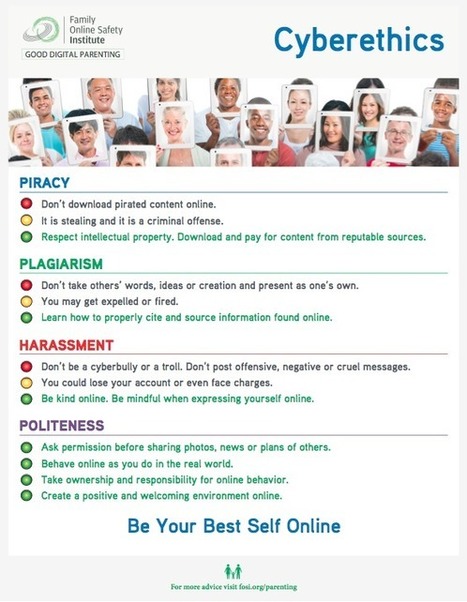
Don't hide behind the screen! Use our Cyberethics tool and encourage your family to be their authentic, best selves online.
|
Scoop.it!
From
zoom
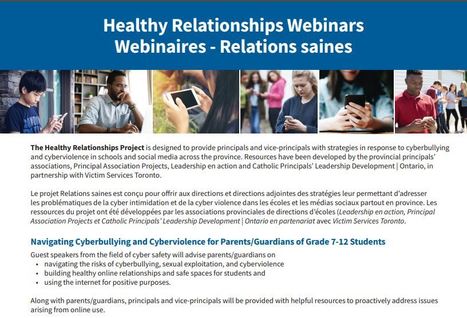
In this 1-hour webinar, guest speakers from the field of cyber safety will advise parents and guardians in grades 7 to 12 on:
Scoop.it!

GwynethJones's curator insight,
April 6, 2019 6:14 PM
"What is cyberbullying? How common is it? And what can teachers do about it? Get advice and resources to support your students."
Collen's curator insight,
May 17, 2019 6:49 AM
Cyber bullying should not be allowed and we should identify ways to avoid it. As future teachers we should learn ways to prevent cyber bullying for our future learners
Scoop.it!

Cynthia Cuellar's curator insight,
June 12, 2022 11:12 PM
I think Ana Homayoun is correct in today's time there is a low percentage of teenagers that don't have an iPhone or some type of smart device. I agree that teenagers are constantly are on their phones and parents do need to be active in monitoring their child's devices.
Scoop.it!

Cyberexclusion isn't the same as cyberbullying, but it can still hurt kids. Watch as an expert explains online social exclusion and how to stop it in this video.
Scoop.it!
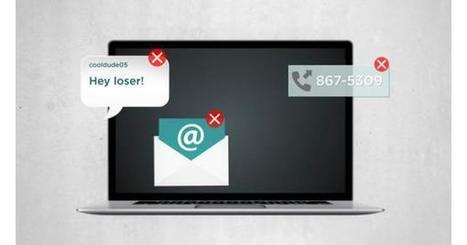
Parent's Guide: watch Common Sense Media's 5 Ways to Stop Cyberbullies advice video to help you make informed decisions with your children.

ramaphokohappy@gmail.com's curator insight,
May 21, 2024 10:23 AM
ICT plays a good role in education in this sense we must eliminate such things as cyberbullying
Scoop.it!

While MediaSmarts’ research shows that teachers place considerable importance on teaching their students digital literacy skills such as authenticating information, managing privacy, addressing cyberbullying, and being safe online, evidence suggests this is not reflected in Canadian classrooms. The intent of these resources is to support teachers in implementing digital literacy into their teaching practice and to help them to develop digital literacy lessons and activities that suit their students’ needs.
Scoop.it!
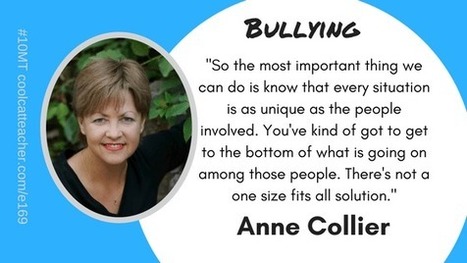
Anne Collier helps us understand the statistics on bullying and cyberbullying. We talk about targets, those who bully and how to respond when helping those embroiled in this situation. October is the month we work to take a stand against bullying, so this is a topic of emphasis this month for many of us. Today’s […]

EmmanuelRefilwe's curator insight,
May 16, 2019 11:24 AM
things you ought to know about cyberbullying
Scoop.it!

Check out these cyber bullying posters and pictures that you can use to keep students aware and help them differentiate between rights and wrongs of web!

iCoachP's curator insight,
June 20, 2016 2:01 PM
Some good posters to bring awareness to cyber bullying.

Linet' Fox's curator insight,
July 9, 2016 11:53 PM
Cyberbullying is a topic that I hope soon has no relevance. According to stop bullying.gov, about 70% of young people say they have seen bullying in their schools. 28% of U.S. students in grades 6-12 have experienced bullying along with the 20% of students in grades 9-12. Approximately 30% of young people admit to bullying others in surveys.
A utilitarian would likely emphasize the positive aspects of online communication. Not that the bullying is unimportant, but that there are much more positive encounters via the web.
Deontologists favor basic human rights, thus, emphasizing the right for all individuals to remain unharmed in any way.
Scoop.it!
Cyberbullying is an ugly fact of digital life. These videos will help you approach the subject with kids in an engaging manner that makes them think.
Scoop.it!

You can go to jail for up to two years if you're found guilty of cyberbullying in New Zealand.

Jasmine Romay's curator insight,
August 29, 2018 2:07 PM
New Zealand passed a law that could potentially cause someone to go to jail for up to two years if they are found guilty of their crimes. Cyber bullying is now a crime in New Zealand, any racist, sexist, or discrimination towards their religion or disabilities may result in jail time. Social media sites such as, Twitter and Facebook did not do their job of dealing with the complaints and any displays of cyber bullying. So, the government in New Zealand hired a new online agency to look over and deal with any reports or complaints made to the social media site. R-Yes, the source's status suggests that it is a reliable site to retrieve information from. This article was posted by an individual that is not connected to any large companies. The writer of this article,Daniel Cooper, wrote this piece to inform the public on news in other countries to maybe compare it to other selves. This feature is seen as an informative essay, it was written to educate the public and make them aware of current events around the world. A-No, the publisher did not experience cyber bullying in New Zealand nor did he experience the consequences. So, therefore ,trusting his observations and conclusions completely may be difficult. But, this writer has published multiple articles on current events ,for example; in China. He writes about different topics, for example , transportation and new creations or ways to commute in places around the world. V-No, the source has nothing to gain or lose if I believe the information they are putting out there. Daniel Cooper does not work for any big name companies or any government affiliated corporations. He is a senior editor for "Engadget" and plays/writes about technology and games. Cyber bullying is under the topic of technology and how we abuse it. But, I do not see how he can gain or lose anything from me believing that cyber bullying is now a crime in New Zealand. E-No, I do not believe that the situation requires the source to have specialized knowledge. This article is not written in a biased way, it was written for the sole purpose of informing the people and warning them. No, this source does not have any specialized knowledge, but it is possible that Daniel got his information from someone that possesses that knowledge. N-No, I do not note any bias. In the text, the editor simply briefs the social media community about New Zealand's new bill and what it entails. I would describe this story as a neutral and educational one. This article was written to display how the use of technology and how social media is getting stricter due to its effects on people and their actions. |