Your new post is loading...

|
Scooped by
Roland Schegg
January 16, 8:32 AM
|
Google is removing reviews from restaurant Google Business Profiles at unprecedented levels, reflecting a broader crackdown on review quality, authenticity, and compliance. Both positive and negative reviews are being deleted, often through automated systems that flag suspicious patterns rather than individual intent. Restaurants, which rely heavily on reviews for discovery and conversion, are particularly exposed to these changes. The trend is altering how trust is built, how local search rankings behave, and how operators must think about review strategy going forward.
Key takeaways
Restaurants hit disproportionately hard: Food and beverage businesses experience higher-than-average review deletions due to high review volume and frequent abuse patterns.
AI-driven moderation: Automated systems increasingly remove reviews that appear incentivized, repetitive, or coordinated, even when customers are real.
|
|
Scooped by
Roland Schegg
January 15, 10:16 AM
|
Google is gaining traction in the agentic protocols race with the introduction of a new standard.
Over the weekend, the search giant announced its Universal Commerce Protocol (UCP), which will carry consumers through discovery, buying and post-purchase support.
"UCP establishes a common language for agents and systems to operate together across consumer surfaces, businesses and payment providers," Vidhya Srinivasan, Google's VP and general manager of ads and commerce, wrote in a blog post.
Instead of requiring individual connections for each agent, UCP gives agents the ability to interact seamlessly, according to Google.
|
|
Scooped by
Roland Schegg
January 15, 5:03 AM
|
The hospitality industry enters 2026 with a growing consensus that fragmented technology is no longer sustainable. A conversation between Shiji and Amadeus highlights a shift away from tactical integrations toward genuinely integrated platform thinking. The focus is moving from systems that merely exchange data to environments that operate as a single, coherent whole. This evolution reflects rising operational complexity, higher guest expectations, and the need for technology that supports, rather than burdens, hotel teams.
Key takeaways
From integration to coherence: Simple system connectivity is no longer sufficient; hotels need platforms that align data, workflows, and decision-making into one operational logic.
Partnerships mature under pressure: Strategic alliances, shaped during the pandemic, now prioritize reliability, scale, and clarity over short-term feature expansion.
|
|
Scooped by
Roland Schegg
January 15, 2:10 AM
|
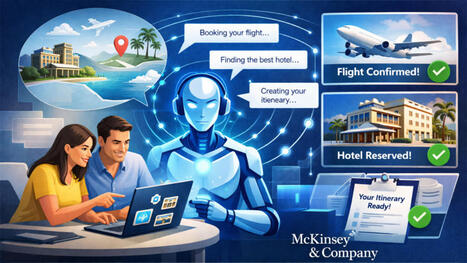
Reisen inspiriert, begeistert, öffnet Horizonte. Doch die Planung und Buchung einer Reise ist für viele Menschen eher Pflicht als Vergnügen. Ein aktueller Bericht von McKinsey & Company zeigt, wie sogenannte agentische KI diese Reibung aus dem System nehmen könnte – und damit nicht nur das Kundenerlebnis, sondern ganze Geschäftsmodelle der Reiseindustrie grundlegend verändert.
|
|
Scooped by
Roland Schegg
January 14, 5:32 AM
|
In addition to traditional SEO efforts, the increased use of AI for travel planning requires hotels to implement new strategies like Generative Engine Optimization (GEO) and Answer Engine Optimization (AEO) to ensure their property appears in the AI summaries and snippets potential guests are using to make their booking decisions.
|
|
Scooped by
Roland Schegg
January 14, 2:52 AM
|
"Travel companies are increasingly investing in artificial intelligence, but the focus is now moving from early experimentation to clear accountability. As AI becomes embedded across customer-facing and operational functions, brands are under pressure to demonstrate tangible returns on investment. The article outlines how major travel players are measuring AI ROI differently depending on use case, maturity, and strategic priority. It concludes that success will depend less on technical sophistication and more on disciplined measurement and alignment with business outcomes.
Key takeaways
AI ROI is use-case dependent: Travel brands measure returns differently across applications, with transactional use cases like customer service and revenue management being easier to quantify than exploratory or experience-driven innovations.
Financial and productivity metrics dominate: Companies prioritize direct financial impact, such as revenue uplift or cost reduction, alongside gains in productivity and efficiency enabled by automation."
|
|
Scooped by
Roland Schegg
January 14, 2:49 AM
|
"Generative AI is changing where and how travel decisions are formed, with travelers increasingly shaping preferences inside conversational AI tools rather than through traditional search results. This shift reduces the influence of classic search-based visibility and alters the role online travel agencies and hotel websites play in early discovery. As intent forms earlier and elsewhere, control over the guest journey becomes more fragmented. For hoteliers, this evolution raises strategic questions about visibility, differentiation, and how guests encounter their brand for the first time.
Key takeaways
Guest discovery is moving upstream: Travelers are increasingly forming preferences inside AI tools before visiting OTA or hotel websites, reducing the role of classic search-based visibility.
OTAs may influence decisions later: As planning happens elsewhere, platforms like Expedia and Booking.com risk losing their ability to shape guest choices early, even if they still process bookings.
Marketing costs may rebalance: Heavy OTA spending on search advertising becomes less effective as AI keeps users within conversational interfaces for longer."
|
|
Scooped by
Roland Schegg
January 13, 4:39 AM
|
Travel AI is approaching a point where improvements in language models alone deliver diminishing returns for travelers. The real constraint now lies in how AI presents information, not how well it generates text. Travel planning is emotional, visual, and non-linear, yet most AI tools rely on linear chat interfaces that struggle to support comparison and decision-making. As a result, the next wave of innovation in travel AI will be defined by interfaces that better reflect how people actually plan and experience travel.
|
|
Scooped by
Roland Schegg
January 13, 1:00 AM
|
The global OTA landscape is often discussed, as the Booking / Expedia duopoly, yet it is surprisingly rarely visualized in a global way that makes it truly actionable for hoteliers. Everyone knows the big names. Few people understand their real weight, their regional power, and how dramatically uneven the market actually is.
|
|
Scooped by
Roland Schegg
January 12, 9:35 AM
|
Like other travel industry sectors, hotels are evaluating artificial intelligence (AI) as a key investment area.
“We see a lot of investment around the guest engagement. I think really the opportunity is in automation and the moving of tasks—and it’s not necessarily taking away roles from people but enabling existing roles to be more productive, more efficient within their tasks,” James Bishop, VP of ecosystem and strategic partnerships at SiteMinder
|
|
Scooped by
Roland Schegg
January 12, 3:57 AM
|
"Google has unveiled the Universal Commerce Protocol (UCP), a new framework designed to let AI agents handle discovery, checkout, and post-purchase support directly within conversational interfaces.
Announced at the National Retail Federation conference, UCP aims to remove friction between interest and transaction by eliminating the need for multiple handoffs across systems.
While initially focused on retail, the architecture is explicitly built to support more complex transactions, including travel bookings.
The launch signals Google’s intent to shape how purchases are executed inside AI-powered experiences.
Key takeaways
Universal Commerce Protocol (UCP): A standardized transactional layer that allows AI agents to move users from discovery to purchase without switching platforms or rebuilding integrations.
In-conversation checkout: Purchases can be completed inside Google’s AI interfaces, using stored payment and shipping details from Google Wallet."
|
|
Scooped by
Roland Schegg
January 9, 7:00 AM
|
Alors que les modèles de langage atteignent un plateau de performance, l’écosystème de l’IA générative entre dans une nouvelle phase où startups et géants technologiques réorientent leurs investissements vers des territoires encore peu explorés : modèles de monde, agents intelligents, objets connectés, superintelligence… Cette recomposition du marché, marquée par la consolidation d’un oligopole et l’émergence de nouveaux usages, dessine les contours d’une transformation qui ne fait que commencer, et creuse l’écart entre ceux qui observent et ceux qui s’inscrivent dans une dynamique d’exploration / adoption.
|
|
Scooped by
Roland Schegg
January 9, 12:28 AM
|
This article explores why market forces make full Business Model Transformation unlikely, even though the technology exists and the benefits are obvious. Understanding why transformation probably will not happen through natural market evolution helps in making better strategic decisions about where to invest, what to build and which future to prepare for.
|
|
|
Scooped by
Roland Schegg
January 15, 10:56 AM
|
"Artificial intelligence can write, design, code, and complete tasks at breakneck speed. It can help business leaders draft emails, create agendas, and quickly prepare for important meetings and difficult discussions.
It can do all of that with just a few voice commands—but it still can’t do the hard work of leadership itself. Generative AI cannot set aspirations, make tough calls, build trust among stakeholders, hold team members accountable, or generate truly new ideas.
That work remains deeply human—and more important to get right than ever before, given the scope of change and uncertainty with which today’s organizations are dealing."
|
|
Scooped by
Roland Schegg
January 15, 8:03 AM
|
" Hotel distribution didn’t suddenly collapse. It’s been cracking for years. - Rising costs
- More intermediaries
- Slower responses
- More tools, less clarity
Most teams still talk about distribution as a channel problem: - OTA vs direct
- Corporate vs leisure
- Volume vs margin
But guests don’t think in channels. They think in questions, constraints, and reassurance."
|
|
Scooped by
Roland Schegg
January 15, 3:14 AM
|
"For decades, the web has been held together by a chaotic and brittle system of custom APIs. This fragmented landscape of bespoke integrations is more than just a developer headache; it is the primary bottleneck preventing the next generation of AI from reaching its potential."
|
|
Scooped by
Roland Schegg
January 14, 11:40 AM
|
As stakeholders pour resources toward hopefully gaining an AI advantage, the question remains: How are travel brands considering the return on investment (ROI)?
For giants like Expedia Group, AI presents an opportunity to lead—and there’s value to being first-to-market in terms of returns.
“This is all highly experimental, but it’s an important channel for us,” an Expedia Group spokesperson said, discussing the company’s exploration of generative engine optimization and answer engine optimization.
Meanwhile, Rob Ransom, SVP and chief strategy officer for Booking Holdings, said during an interview at the Travel Trends AI Summit 2025 that the company aims to track “most things” it implements to understand the impact.
|
|
Scooped by
Roland Schegg
January 14, 2:54 AM
|
Social media remains the leading priority for U.S. digital media professionals entering 2026, with a clear majority ranking it above all other marketing channels. Despite growing interest in influencer marketing and other digital tactics, social platforms continue to command the most attention, resources, and strategic focus. This dominance reflects marketers’ confidence in social media’s reach, measurability, and ability to support multiple objectives across the funnel. As a result, social media is shaping how marketing budgets and campaigns are planned for the year ahead.
|
|
Scooped by
Roland Schegg
January 14, 2:50 AM
|
More than two decades ago, the rise of the internet economy produced a new generation of intermediaries that reshaped industries. Aggregators like Expedia and Booking.com in travel, Zillow in real estate, and Indeed in recruiting upended established channels, creating digital marketplaces that connected fragmented supply with mass demand.
These aggregators built their power by monetizing search traffic through ads and transaction fees. They became gateways of the web, turning discovery itself into a business model that reshaped how people searched and made decisions online. Whoever controlled that discovery captured the revenue, which is why search has been the foundation of digital commerce.
|
|
Scooped by
Roland Schegg
January 13, 8:17 AM
|
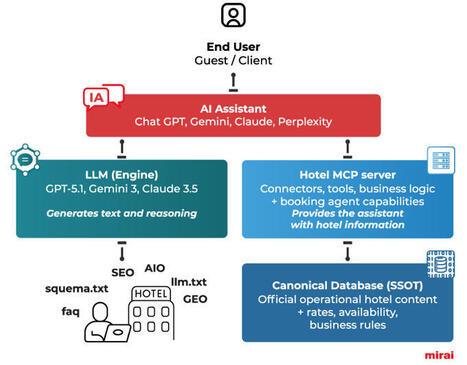
Artificial intelligence is no longer a futuristic promise. It has become an operational reality that is already reshaping hotel distribution. Yet, despite the growing excitement around AI, most hotels still face the same fundamental question: how can AI be turned into a real, sustainable competitive advantage aligned with the business? And, perhaps even more importantly: where should I start?
By now, it is clear that AI is not a standalone product or another “plugin.” It is a layer of intelligence that only creates value when it is built on a solid architecture, powered by reliable and structured data, and deeply integrated with the hotel’s core systems.
|
|
Scooped by
Roland Schegg
January 13, 4:32 AM
|
"Banks, card issuers, and loyalty platforms are increasingly becoming primary environments where travelers search, book, and redeem hotel stays. What began as card perks and points programs has evolved into full travel marketplaces embedded directly inside financial apps, where trust, daily engagement, and rewards converge. Platforms from institutions such as American Express, Capital One, Chase, Nubank, and Revolut now function as end-to-end travel booking channels. For hotels, this marks a structural shift: visibility and bookability increasingly depend on how well inventory, pricing, and availability flow into these financial and loyalty ecosystems.
Key takeaways
Banks and cards are becoming booking platforms: Travel is now embedded directly inside card and banking apps, turning products like Amex Travel, Chase Travel, Capital One Travel, and NuViagens into high-intent hotel booking environments.
Loyalty is now financial infrastructure: Points and rewards operate like a parallel currency, favoring hotels that integrate cleanly into large-scale bank and card loyalty systems rather than standalone hotel programs."
|
|
Scooped by
Roland Schegg
January 12, 11:32 AM
|
Payments are no longer a purely administrative concern for hotels; they are becoming a core part of the guest journey and commercial strategy. As traveler expectations evolve, guests increasingly judge hotels by how easy, flexible, and transparent it is to pay before, during, and after a stay. This shift means payment decisions now affect conversion, guest satisfaction, and operational efficiency. For hoteliers, treating payments as a strategic capability rather than a back-office function is becoming a competitive necessity.
|
|
Scooped by
Roland Schegg
January 12, 4:06 AM
|
Artificial intelligence is moving from isolated pilots to a strategic imperative in tourism and hospitality, according to a new PwC Middle East report. The study shows widespread experimentation with AI, but limited enterprise-wide deployment due to infrastructure, talent, and data challenges. Despite this, most organizations are already seeing measurable efficiency and performance gains. AI is increasingly aligned with national digital transformation agendas and long-term growth strategies in the region.
Key takeaways
AI adoption is widespread but shallow: A large majority of organizations are piloting or deploying AI, yet only a small fraction have achieved enterprise-wide implementation.
Legacy constraints slow scale-up: Outdated systems, skills shortages, and data governance issues remain the main barriers to broader AI integration.
Clear operational benefits are emerging: Most respondents report tangible improvements in cost efficiency and operational performance from AI use.
|
|
Scooped by
Roland Schegg
January 10, 2:01 AM
|
Model Context Protocol is becoming a prerequisite for AI travel distribution. In the agent era, not being machine-readable will be the fastest way to become invisible.
|
|
Scooped by
Roland Schegg
January 9, 5:31 AM
|
Le marché des chatbots IA connaît un bouleversement significatif. Selon le Global AI Tracker de Similarweb publié début janvier 2026, ChatGPT voit sa domination s’éroder progressivement au profit de Gemini. Une redistribution des cartes qui témoigne d’une concurrence de plus en plus intense dans le secteur de l’IA générative, mais aussi des progrès de Google face à OpenAI.
|