Em·pa·thy /ˈempəTHē/ noun. The ability to understand and share the feelings of another.
While there has been an increase in training around social-emotional learning (SEL) in K-12 classrooms, many professional development (PD) resources for educators treat SEL as a standalone subject rather than a foundational component of learning environments.
Truly incorporating SEL into classroom instruction is challenging—for both educators and students—because it demands continuous reflection and examination of everyday interactions and inclinations.
In adult life, empathy, compassion and the identification and management of emotions are integrated into everything we do. In education, empathy and compassion are paramount to student-centered learning environments and instructional design because they encourage educators to question their own assumptions while considering and supporting the demonstrated needs of students.
Michelle Stowe is a restorative practitioner, trainer and consultant. She is passionate about creating well-being and happiness in the workplace; and particularly interested in re-culturing schools and cultivating a restorative paradigm shift that honours community and connection.
Michelle also works with schools, communities and organisations that need support in resolving conflict between people. She is particularly interested in supporting others to turn towards and see themselves in one another in times of conflict. Being involved in this work allows her to feel that the life she is living is the same as the life that wants to live in her. Michelle Stowe is a restorative practitioner, trainer and consultant.
She is passionate about creating well-being and happiness in the workplace; and particularly interested in re-culturing schools and cultivating a restorative paradigm shift that honours community and connection.
Teachers can sow the seeds of tolerance in society, if they practise and preach the values of empathy – putting one-self in somebody’s shoes.
The universities should regularly host events promoting empathy. These are some of the findings of the “Academic and Intellectual Dialogue on Social Harmony, Tolerance and Education”, a study by Pak Institute for Peace Studies (PIPS), an Islamabad-based think tank, on six dialogues held with teachers of Pakistan’s higher-secondary schools and colleges from all over the country. Noted scholars and intellectuals led the dialogues.
Reschool, a non-profit, partnered with hundreds of parents, youth, educators and community partners. What did they find? Everyone struggles to empathize with students’ lives. So, we propose the wrong solutions at first. “Make them work harder”, or, “Give them more homework.”
We need to cultivate empathy before proposing solutions. The place to start is using discussion catalysts (Suzie Boss):
Screening of a thoughtful school change movie eg. Most Likely To Succeed.
Sharing of thoughtful YouTube videos eg. Ted Dintersmith’s Innovation Playlist.
Conducting brief presentations at school events with thought-provoking questions, eg. What are grades for?
Organizing student-led conferences
Hosting a book club using books about school change
Literature is a tool for teaching empathy because reading a story is a way to walk in another person’s shoes. For example, we root for Parvana in The Breadwinner series by Deborah Ellis, even as we build empathy for what it is like to live in an oppressive society.
Books like Out of My Mind by Sharon Draper, Lily and Duncan by Donna Gephart, and Brown Girl Dreaming by Jaqueline Woodson are only some of the books that can help students build empathy. (Here are more books to build empathy.) And, literature isn’t just for ELA class. Have students read a book in advisory or pair literature with world events in social studies.
Compassionate curiosity is a practice from trauma-informed teaching that asks teachers to act as non-judgmental investigators so they can better understand students. It’s an important first step in learning to respond to your students with empathy. Teacher Kyle Redford calls compassionate curiosity a “love plan” for the students in her classroom.
Imagine that a student gives you a snappy response. Instead of reacting as if you know the reason behind a student’s behavior, you pause to take a breath. You regroup, and then you ask the student genuine questions. You ask, “Is something bothering you?” and then listen with intent to the student’s response. That’s what it means to be compassionately curious.
Empathy Day on the 11th June is an annual event founded by Empathy Lab, to harness books’ empathy-building power. It aims to encourage us to read stories, build empathy and make the world a better place. We’ve put together a list of brilliant books that will help you and your class see things from someone else’s point of view and support you to build your real-life empathy skills through reading.
Md Mamunur Rashid, a lecturer at BRAC institute of Languages at BRAC University, leads a project that focuses on empathy education. The project received International Recognition at the 20th Committee on Teaching about the United Nations Conference at the UN in April 2019. This is an annual recognition to those educators who have demonstrated the ability to inspire their students to collaborate, brainstorm and implement a plan successfully across all domains of learning on selected UN topics and global issues.
After completing his Bachelor’s and Master’s in English from Jahangirnagar University, he attended New York University (NYU) as a full-bright scholar in the Foreign Language Teaching Assistant programme. During his time at NYU, he also served as the Cultural Ambassador of Bangladesh from 2017 to 2018.
Teach your child to be empathetic. Maurice Elias, the director of the Rutgers Social-Emotional Learning Lab, suggests that when a peer or a sibling is physically hurt or upset, you should encourage your child to reach out, see what’s wrong and offer to help. He says that too often, people retreat in fear when others are in distress, but those with empathy can identify with the hurt feelings and try to make the situation better.
Another way to encourage your child’s empathy is to expose them to other children and families who have fewer resources than your own family. For example, you could research poverty in the United States. 1 in 4 children living in the rural U.S. grows up in poverty, so it’s very likely that people in your own community are experiencing poverty. Watch below how one mobile clinic works to bring medical assistance to kids who need it in rural Tennessee. You could watch this video with your child and then discuss how you can be part of the solution to some of these problems.
In recent years, there have been numerous articles suggesting that empathy needs to be taught in schools. There are many reasons why incorporating empathy into the school curriculum benefits students. These reasons range from strengthening your classroom community to developing your students’ leadership skills so they may use them in their future community.
In addition, children who develop empathy skills at a young age are more likely to develop lifelong skills that will help them understand other cultures and respond positively to them.2 As schools address teaching empathy across the elementary curriculum, how can the arts, specifically music and art classes, play an important role in the learning process?
Defining Empathy Defining what empathy is in an elementary school curriculum can be challenging, as there is an ongoing debate about whether we should be teaching empathy or compassion.
You care but get frustrated. You see the same negative behaviors weighing down the class and school. You need to immediately read behaviors and cause lasting change. Students have challenges and barriers that have to be addressed.
Get ready to spark lasting change in negative behaviors and forever alter your school’s discipline procedures. We will give you a glimpse into the eyes of even your most challenging students with sure ways to connect and empower their complete success.
"In the last few years, I’ve been exploring the use of Empathy Circles with some of my organizational clients, with facilitator learning groups, and in communication workshops. I’ve been finding that it is a great introduction and warm-up for Dynamic Facilitation, one of my core practices, as it offers everyone in the room the opportunity to engage in offering listening reflections to one another.
At the same time, I’m totally excited to see that Edwin Rutsch, the creator of Empathy Circles, has been bringing his work into the arena healing political divides. My experience is that this simple-yet-powerful form is actually quite revolutionary, in the best sense of the word, and so I want to delve a bit into what I see as the underlying dynamics. But first, a brief description, followed by a distinction and clarification…"
Here are some strategies our graduates around the world use with their students to help develop both affective and cognitive empathy.
MODELING Teachers can be role models who, by example, show students the power of empathy in relationships...
TEACHING POINT OF VIEW We use the numbers 6 and 9 to teach students about different points of view....
USING LITERATURE TO TEACH DIFFERENT PERSPECTIVES In the classroom, literature can be used to help students see a situation from different perspectives..
LISTENING ACTIVELY TO OTHERS One of the most common obstacles to empathic relationships is that effective listening is difficult, and often individuals don’t listen to one another in conversation...
BEING METACOGNITIVE ABOUT ONE’S STATE OF EMPATHY Be aware of your feelings and thoughts about your ability to understand and share in the feelings of others..
Strategies for Building Empathy in Youth We can help youth see themselves as kind, considerate, and caring people, but we have to show them, through our words, actions, and decisions. Beyond this, we have to believe that the youth we serve are capable of kindness and compassion.
Below are some strategies for building empathy in youth.
Get to Know and Build Strong Relationships with Youth
Establish a Safe and Supportive Program Climate
Model Empathy
Incorporate Teamwork and Collaboration into Program Structures and Activities
Include Service-Learning and Volunteer Experiences in Your Programming
One key component of emotional intelligence is empathy which, as Dr. Judith V. Jordan explains in Relational-Cultural Therapy, is a complex skill that “allows us to ‘know’ (resonate, feel, sense, cognitively grasp) another person’s experience.”
And more than an academic abstraction, empathy is actually essential to the act of teaching. Drs. Jordan and Harriet L. Schwartz explain: “Empathy that produces change and growth in both people goes far beyond a warm and fuzzy feeling of closeness or being understood. It is the vehicle for deep learning and acknowledgment of the power of relationship.”
The problem is that we’re not all able to feel empathy all of the time, especially when chronically stressed. And teachers, with their peak levels of stress and crucial roles, are of particular concern. In “Radical Empathy in Teaching,” Jordan and Schwartz insist that though teachers do not like to imagine themselves as people who struggle to empathize with their students, “empathic failures and disconnections are undeniably part of the human experience.” Despite the barriers that teachers face, the authors assert that “[p]racticing and modeling self-care and self-empathy is not only important for our students but also for our own well-being.”
Nearly one in three U.S. students say that they have been victims of bullying. Perhaps, then, it’s no surprise that researchers at the University of Michigan have observed a 40 percent drop in empathy among teens over the past three decades.
How can educators reverse this troubling trend? Cultivating–or restoring–empathy is one place to start. As a former elementary teacher, and in my current role supporting teachers, I’ve had the opportunity to observe how students learn–and educators teach–empathy. Here are four tips for educators looking to create more empathic classrooms.
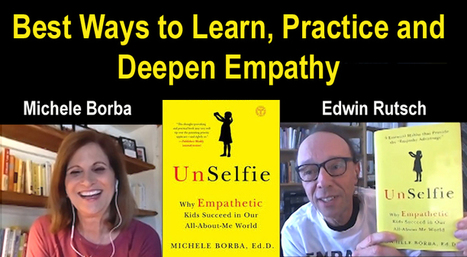
Michele Borba, is an internationally renowned educational psychologist and an expert in parenting, bullying, and character development. She is an award-winning author of twenty-two books translated into fourteen languages.
One of the foremost authorities on childhood development in the country, she is a regular NBC contributor who appears regularly on Today and has been featured as an expert on Dateline, The View, Dr. Phil, NBC Nightly News, Fox & Friends, Dr. Oz, and The Early Show, among many others. She is author of, UnSelfie: Why Empathetic Kids Succeed in Our All-About-Me World.
"Empathy is the root of humanity and the foundation that helps our children become good, caring people. But the Empathy Advantage also gives them a huge edge at happiness and success."
Empathy is a valuable skill Psychologists have highlighted empathy’s central place in the bank of social and emotional skills that young people need to thrive. Research reveals the significance of these life skills, showing that social and emotional skills are more significant for young people’s academic attainment than their IQ. Our brains are plastic and 98 per cent of us are capable of building our empathy skills at any time in our lives.
Teaching empathy is key because in doing so we alert children to ways of modifying their relationships with one another that benefit the whole school community. Anyone who has read to a class from a compelling story knows the power of it: stories cast a spell.
Researchers have identified four main attributes of what it means to be empathetic. Integrating these practices into your teaching can show students that you see what they’re going through as more than just a problem to fix.
Perspective taking. When you take a different perspective, you put aside your own feelings and reactions to see the situation through your student’s eyes. You may start by asking yourself: Do I believe the student is doing the very best he can?
Putting aside judgment. It’s easy to jump to and express conclusions about the situation based on what you see. But it’s important to step back and consider: What more do I need to learn and understand about the situation?
Trying to understand the student’s feelings. If you can, tap into your own experiences to find a way to understand what the student is feeling or to remember a time when you felt something similar. Be careful not to overdo it, however.
Each person’s experiences are his own, so saying “I know how you feel” can come across as disingenuous. If you’re struggling, ask yourself: What more do I need to learn and understand about how other people are reacting to or perceiving the situation? Communicate that you understand.
Denmark is one of the happiest countries in the world. This is according to the UN’s World Happiness Report, an important survey that since 2012 classifies the happiness of 155 countries in the world, and that for seven years has placed Denmark among the top three happiest countries on a global level. The fact that teaching empathy has been mandatory since 1993 in schools in Denmark is a factor that contributes to the happiness of the country.
Empathy helps build relationships, prevent bullying and succeed at work. It promotes the growth of leaders, entrepreneurs and managers. “Empathic teenagers” tend to be more successful because they are more oriented towards the goals compared to their more narcissistic peers.
This is Part II of a two-part series on empathy across the curriculum. You can find Part I of the series, Empathy HERE.
We asked arts educators from around the world this question: How do you teach empathy in arts classrooms? We heard from a music teacher, an art teacher, a classroom teacher, and a school principal. Here is what they said:
Incorporating music from other cultures or music written about or for world events are important aspects in teaching and eliciting empathy. Many music educators do this naturally, making a point to teach more than the notes on the page. This helps to create real-world connections that benefit students and the audience.
EMPATHY(empəTHē): TO WALK IN ANOTHER'S SHOES SO TO EXPERIENCE HOW THEY LIVE, FEEL, AND BE.
WHY IS EMPATHY IMPORTANT? Our conviction is that the best education provides youth not only with the academic skills they need to be successful, but also the social tools needed to navigate this world. An education in empathy shows students that seeing the world through another's eyes is essential to personal growth. To practice and experience walking in another’s shoes demonstrates the importance of shedding at-risk behaviors in order to help others. When empowered to find empathy opportunities students will build self-worth by contributing to a cause greater than themselves.
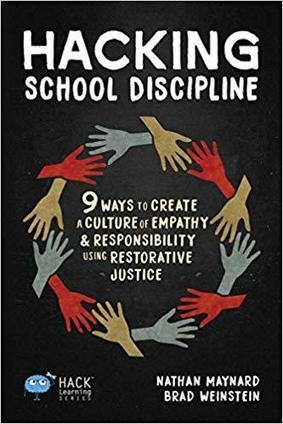
Eliminate old-school punishments and create a community of responsible, productive learners
Are you or your teachers frustrated with carrots and sticks, detention rooms, and suspension--antiquated school discipline practices that simply do not work with the students entering our classrooms today? Our kids have complex needs, and we must empower and embrace them with restorative practices that not only change behaviors but transform students into productive citizens, accountable for their own actions.
Replace traditional school discipline with a proven system, founded on restorative justice In a book that should become your new blueprint for school discipline, teachers, presenters, and school leaders Nathan Maynard and Brad Weinstein demonstrate how to eliminate punishment and build a culture of responsible students and independent learners
In Hack Learning Series Book 22, you learn to:
Reduce repeated negative behaviors
Build student self-regulation and empathy
Enhance communication and collaboration
Identify the true cause of negative behaviors
Use restorative circles to reflect on behaviors and discuss impactful change
Regional schools are looking at new methods for dealing with troubling behavior, including adopting restorative practices that turn disciplinary actions into learning experiences that promote empathy.
The new approach can break the cycle of misbehavior and reduce the risk of depression and suicidal thoughts by promoting a sense of belonging and safety among students.
University of California, Berkeley is delighted to announce a Free Online Course on Empathy and Emotional Intelligence at Work. This course delves into the social and emotional skills that sustain positive relationships at work.
In this course, you will find out research-based skills to strengthen empathy. The course also gives explanations about the psychological and neuroscientific roots of supportive, compassionate behaviors. This course will start on January 7, 2019.
To get content containing either thought or leadership enter:
To get content containing both thought and leadership enter:
To get content containing the expression thought leadership enter:
You can enter several keywords and you can refine them whenever you want. Our suggestion engine uses more signals but entering a few keywords here will rapidly give you great content to curate.


 Your new post is loading...