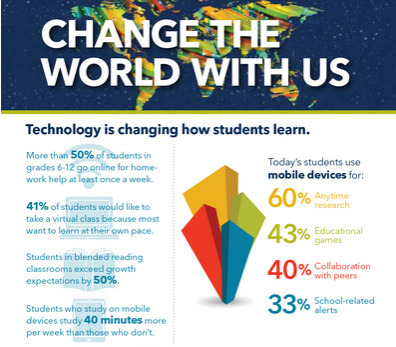
Mobile devices are ubiquitous in American high schools, and their use is harder to regulate than old-fashioned note passing. But here's why teachers should be paying closer attention. A look at the pros and cons of cell phones in the classroom...are they a benefit or a distraction? Can students learn when they are also sending out text messages?
When is a test not a test? Apparently when you don’t realize that it is a test. This article explores the good about testing, the bad about testing, and ways we can evaluate without testing, raising the questions "What does evaluation look like without testing?" and "Is there future possibility for the implementation of testless education?" The use of embedded assessments (think gamification) as discussed, specifically the model used at the "Quest to Learn (Q2L) schools in New York and Chicago"
Infogr.am is a super-simple tool for data visualization - creation of interactive infographics and charts... Another tool to create infographics...they just seem to keep coming. This one provides a range of themes and says more features will be coming soon.
Beeclip EDU is a fun and easy-to-use scrapbooking app that promotes student creativity, self-expression, and imagination. *Add photos and videos by dragging them to your scrapbook page * Insert additional pages This is a new tool (to me) and so far the choices are somewhat limited but it appears that more will be added. There is a free account available for teachers.
"Today, we’re proud to launch “Mozilla Webmaker,” a new program to help people everywhere make, learn and play using the open building blocks of the web. The goal: help millions of people move from using the web to making the web. Concretely, Mozilla Webmaker will offer: 1) Tools. Authoring tools and software, designed and built with our community. From supercharging web video with Popcorn, to remixing with Hackasaurus, to making your own web pages with Thimble..." We often speak about having our students be creators on material for the web (as opposed to movers of material that is already on the web). This new program from Mozilla will provide tools, projects and a community that will help us help ourselves and our students become creators on the web.
"New generations of learners require new methods of teaching. As computer and Internet use become more widespread among students of all ages, educators must be prepared to adapt to the needs of this interactive and innovative generation. Gaming provides an excellent alternative to traditional learning activities...
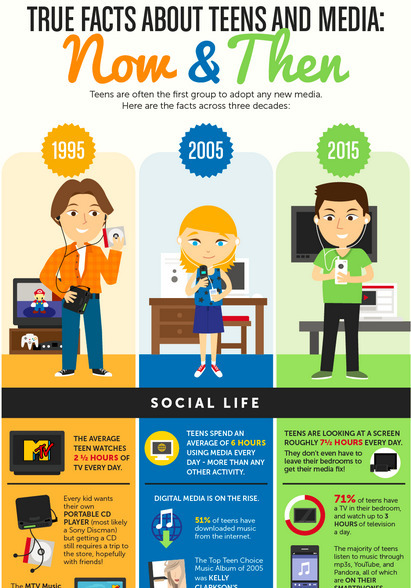
Summer - a time to kick back, relax, recharge, read a good book or two, or a time to challenge yourself, take a new course, earn some money...there are many choices. This infographic explores a variety of ideas that students in college may explore for the summer, but many are options they share are also good for students in high school (and also for teachers!).
It’s a small world after all, and Education Development Center has published a helpful free guide on distance education for teacher training—including discussion on mobile devices—Distance Education for Teacher Training: Modes, Models and Methods. The guide details modes of distance education (from television and online learning to Web 2.0 mobile technologies), models of effective programs and best practices from distance education projects and programs in over 100 countries, with an emphasis on the U.S., Australia, Asia, Africa and Latin America.
"Rapid technology change is here to stay. No sense in trying to change the way the world works–at least when you’re messing with the wallets of major corporations. This kind of change introduces threats to education, which we talked about in part 1. There is likely very little that can be actively done to reduce these threats, as they are first economic issues. But we can begin to understand them better." The five issues explored in this article are: * Increases need for persistent, informal “PD” * Arms “fringe” adoption resistance * Swells adoption cost * Emphasizes role of learner * Exposed needs or new thinking habits Part 1 of this series, "3 Threats of Rapid Technology Change" is located at http://edudemic.com/2012/05/3-threats-of-rapid-technology-change/.
"When it comes to using technology in school, the tension between what students and parents want and what schools allow is becoming more apparent — and more divisive. Students want more control over how they use technology in school, but many classrooms are still making it difficult. That’s according to the most recent Speak Up 2011 report, “Mapping a Personalized Learning Journey,” which reflects the views of more than 416,000 K-12 students, parents, and educators nationwide surveyed on how technology can enhance the learning environment..."
"From the May 21st issue of Fortune Magazine (article not online yet), comes this quote from Fred Smith, founder and CEO of FedEx: Fisch continues this post with some questions about this specific quote and asking if "getting an education in general, is solely about job preparation." Much food for thought...
Have you heard about Common Sense Media's posters on digital citizenship? This one is geared to elementary school students. This poster would be great to share with students (and their families) to promote conversation about issues that they may face online. You may download copies at the site.
|
There are more new ways to learn a language today than ever before, thanks in part to these startups.
"It's about teaching; it's about learning; it's about elementary math. Mathlanding (ML) is designed with the elementary math specialist/coach/mentor and teacher in mind. It's a dynamic resource to help support the professional development needs of elementary educators in building mathematical knowledge and instructional practice. The site is created to provide organized access to high quality resources and tools that support teaching and learning of elementary mathematics."
"...Grockit, a social learning company that up ’til now has been focused on test prep. Today, Grockit introduces Learnist which it describes as “a way for anyone to share what they know” and which I’m sure every tech blogger, myself included, will use the “Pinterest for education” comparison." This site is in beta but they are accepting requests for invites. The possibilities of this, locating online resources, annotating them and ordering them in a logical sequence is something that many folks are already doing with other tools. This one alos allows sharing and commenting. I am looking forward to trying it out in the near future.
Are you looking at incorporating project-based learning (PBL) in your classroom? Here are five great resources from Edutopia. The main article shares a story about "a high school devoted to teaching every subject to every student through project-based learning ." Perhaps you might ask why use PBL? "From the moment a project is introduced, students are responsible for figuring out what they need to know and for doing the legwork to find the information, analyze it, and present it. Teachers are there every step of the way to guide students through the process and to provide workshops to help clarify any concepts." In addition to this story you may also access the following resources: * A Step-by-Step Guide to Effective PBL * Research-Based PBL Strategies * Resources and Strategies for PBL Start to Finish *Video: One Project Start to Finish An amazing collection of resources in one location!
"It’s that time again, time to cram and review for the SAT Subject Tests. I teach at a college prep school. Many of the more selective colleges and several state universities require students to submit subject test scores as a part of the college application. Therefore, we have to have our students ready for these content focused tests... Every state requires high school students to take a US History survey course. Given the shortness of the school year and the increasing body of US History (every year we add another year of events, people and topics) we have to make choices. Not so for the makers of the SAT Subject Test. Every event, every President, every person of note is of equal importance and equally likely to show up on the examination..."
"The April 24, 2012 Brookings Institute report, How Blogs, Social Media, and Video Games Improve Education, by Darrell West, examines research and best practices to provide an enlightening overview of the ways in which these popular technologies make education (at all levels) more engaging and effective...the Brooking report provides another opportunity to examine the ways in which gaming can enhance education in general. Here’s how the report sees gaming integrating with education, with some additional insights..."
"I love people discussing education. It means they are concerned, it means they care about how children and youngsters are being thaught. Sad thing is that quite often you still hear things that are in fact popular myths that have been debunked by science for years. Even more sad is that while I can understand this from someone who hasn’t studied educational sciences or who isn’t a teacher, I often read this kind of myths even in textbooks used in teacher training! Ok, just to help out, some examples of myths that I have heard over and over again and sometimes make me feel I just want to start throwing things..." If nothing else this post may make you question some of what you believe when we speak of “truths” in education which may be myths. I think it is important to look at the many sides of these issues, and this post certainly will help with that.
"A new Center on Education Policy report, Student Motivation—An Overlooked Piece of School Reform, pulls together findings about student motivation from decades of major research conducted by scholars, organizations, and practitioners... Researchers generally agree on four major dimensions that contribute to student motivation (below). At least one of these dimensions must be satisfied for a student to be motivated. The more dimensions that are met, and the more strongly they are met, the greater the motivation will be." Four Dimensions of Motivation: 1. Competence 2. Control/Autonomy 3. Interest/Value 4. Relatedness For more information read the article.
"As a result of inhabiting a different world than teachers, policymakers make a consequential error. They and a cadre of influentials confuse teacher quality with teaching quality, that is, the personal traits of teachers—dedicated, caring, gregarious, intellectually curious—produce student learning rather than the classroom and school settings. Both are important, of course, but policymakers and their influential camp followers have accentuated personal traits far more than the organizational and social context in which teachers teach daily. So if students score low on tests, then who the teachers are, their personal traits, credentials, and attitudes come under close scrutiny, rather than the age-graded school, neighborhood demography, workplace conditions, and resources that support teaching. The person overshadows the place.[i]" This article goes on to explore the concept of quality teaching (and teaching quality), what is good teaching, what is successful teaching, and more. There is more to consider as we look at these issues than meets the eye.
"Digital learning tools provide both exciting opportunities and difficult challenges for teachers. Which tools are best? How can I best use technology to engage students? Are online games a distraction or an essential tool for learning? Many teachers disagree on these fundamental issues. To address these questions, JogNog surveyed more than 150 teachers and principals. This survey identifies the best practices for digital learning for teachers across the country, along with a listing of the challenges of using digital learning in the classroom and beyond." The survey is fairly small in number, however, the information that is shares does provide information about some of the myths surrounding digital learning.
"I have come up with 108 ways to use word clouds in the classroom. I have tried to include almost every subject. These are a collection of ideas shared with me, various readings, and a lot of my own brainstorming...In order to better understand some of the advanced uses I suggest you may wish to read Part One of this series entitled, 12 Valuable Wordle Tips You Must Read." Lists for use of word clouds in All Subject, Science, Language Arts, Social Studies, Math, Health, PE, Family and Consumer Science, Art and Music, Foreign Language, and Applied Arts are included.

This post is written by a student who chose to drop out of school. Quoting from the article: "The good news is that it worked. I’ve developed a wide range of interests and skills, with my lifelong field of choice being software. I have a software development job that I love, I have no student debt, and I feel secure about my long-term future... The bad news is that along the way, I discovered that public schools are not prepared to fairly compete for their students’ attention. This has resulted in a long series of slightly traumatizing events. From the prescription drugging, to the humiliation of being singled out from the rest of my peers, to the threats of litigation, it’s been a long road..." Read on and allow this article to challenge some notions you may have.
"Cell phones are a terrific tool to support student engagement and achievement in reading and writing. To follow are some ideas explaining how teachers are doing just that by using cell phones in the way they are most commonly used among youth -- for texting and group texting. We will also look at a newly emerging trend...using cell phones to write novels."
|
| 1 | 2 | 3 | 4 | ![]() |
64 |
|
Next |