 Your new post is loading...

|
Scooped by
Howard Rheingold
April 16, 2019 2:09 PM
|
This course introduces the intellectual framework for augmented collective intelligence, from the invention of writing to the emergence of global multimedia networks, and, in parallel, introduces online practices that can extend the knowledge-gathering and sense-making capabilities of individuals and groups.
The digital media and networks billions use today were originally conceived as tools for augmenting human intellect and supporting collective intelligence in service of solving civilization-threatening problems. Although the dark sides of social media behavior, surveillance capitalism, and consumer culture have occluded the view of these original motivations, tools and techniques for using digital media to amplify minds and communities exist -- although methods for using them are not widely taught.
|
|
Scooped by
Howard Rheingold
August 27, 2015 2:21 PM
|
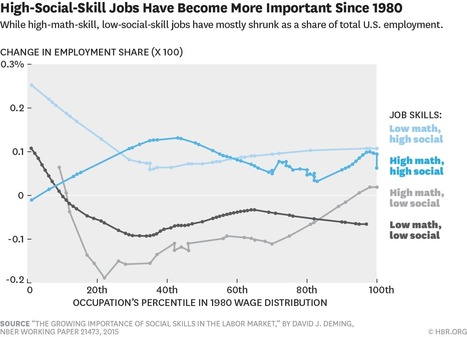
"A new NBER working paper suggests it’ll be those that require strong social skills — which it defines as the ability to work with others — something that has proven to be much more difficult to automate. “The Growing Importance of Social Skills in the Labor Market,” shows that nearly all job growth since 1980 has been in occupations that are relatively social skill-intensive — and it argues that high-skilled, hard-to-automate jobs will increasingly demand social adeptness."
|
|
Scooped by
Howard Rheingold
July 13, 2015 2:20 PM
|
The two aspects of being human that set us apart from other mammals are metacognition and the deep desire to belong or feel felt. Our sense of needing to belong to a group is an inherited part of our neurobiology, and collaboration with others is the desired outcome. Metacognition is our brains' miraculous innate ability to self-assess, think about our thinking, and reshape our perspectives.
Feeling the emotions of others, social acceptance, and cooperation are critical to our early development of the identity and industry stages. Author and motivational speaker Daniel Pink states that the future belongs to conceptual cooperative thinkers.
|
|
Scooped by
Howard Rheingold
February 2, 2015 5:27 PM
|
The IBM computer Deep Blue’s 1997 defeat of world champion Garry Kasparov is one of the most famous events in chess history. But Kasparov himself and some computer scientists believe a more significant result occurred in 2005—and that it should guide how we use technology to make decisions and get work done.
In an unusual online tournament, two U.S. amateurs armed with three PCs snatched a $20,000 prize from a field of supercomputers and grandmasters. The victors’ technology and chess skills were plainly inferior. But they had devised a way of working that created a greater combined intelligence—one in which humans provided insight and intuition, and computers brute-force predictions.
|
|
Scooped by
Howard Rheingold
June 14, 2014 12:58 PM
|
"
The Collective Intelligence Handbook [tentative title]
Thomas W. Malone and Michael S. Bernstein (Editors)
Collective intelligence has existed at least as long as humans have, because families, armies, countries, and companies have all--at least sometimes--acted collectively in ways that seem intelligent. But in the last decade or so a new kind of collective intelligence has emerged: groups of people and computers, connected by the Internet, collectively doing intelligent things. In order to understand the possibilities and constraints of these new kinds of intelligence, a new interdisciplinary field is emerging. This book will introduce readers to many disciplinary perspectives on behavior that is bothcollective and intelligent. By collective, we mean groups of individual actors, including, for example, people, computational agents, and organizations. By intelligent, we mean that the collective behavior of the group exhibits characteristics such as, for example, perception, learning, judgment, or problem solving."
|
|
Scooped by
Howard Rheingold
April 15, 2014 5:04 PM
|
Alex Pentland says data, sensors and smartphones are opening the door to what he calls “social physics.” It is the subject of his new book, about the implications of being able to monitor and measure the flow of ideas in companies, markets and communities as never before. The payoff, he says, should be the acceleration of the pace of innovation.
"As the regular General Assemblies are where all constituents gather to listen and contribute to the discussions using the methodology of the ‘stack’, which allows anyone seeking to propose a group or report on current activities, joins a queue and takes their turn to speak. This allows each their turn to vocalise and articulate for all to hear and vote on. In a ‘leaderless’ holarchic society, the necessity for a self organising infrastructure to support the intrinsic momentum, and the forum to voice the fomenting processes of each, are both vital components. What is being revealed here is the desire for a new manner of building community, responsive to those who have been inspired to collaborate, as working groups become the lifeblood of the movement."
Via june holley
|
|
Scooped by
Howard Rheingold
February 5, 2014 5:24 PM
|
"IFTTT can be combined with Evernote to make a powerful collaborative research tool, because it allows you to combine the collaboration and cloud-access of Evernote with the easy access to information offered by RSS feeds. Here’s an example: My public forum debate team is researching the Middle East for debates in November. The Council on Foreign Relations runs a blog called “Middle East Matters,” which you can subscribe to via RSS. So first I created an Evernote folder call “Middle East Matters,” then shared it with all the members of the team. Then I created a recipe so that every time a new item is pushed out by the “Middle East Matters” RSS feed, IFTTT creates a new note in Evernote out of that item. Voilà! I have now effortlessly shared the latest updates from the Middle East with my PF team."
|
|
Scooped by
Howard Rheingold
January 24, 2014 2:08 PM
|
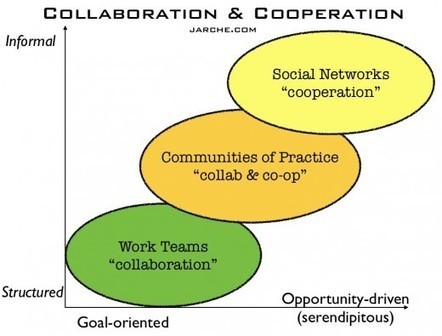
"Real network models are new modes, not modifications of the old ones, and cooperation is how work gets done. Some examples: Wirearchy: a dynamic multi-way flow of power and authority based on information, knowledge, trust and credibility, enabled by interconnected people and technology. Heterarchies are networks of elements in which each element shares the same “horizontal” position of power and authority, each playing a theoretically equal role [wikipedia]. Chaordic refers to a system of governance that blends characteristics of chaos and order. The term was coined by Dee Hock the founder and former CEO of the VISA credit card association [wikipedia]."
|
|
Scooped by
Howard Rheingold
January 9, 2014 4:39 PM
|
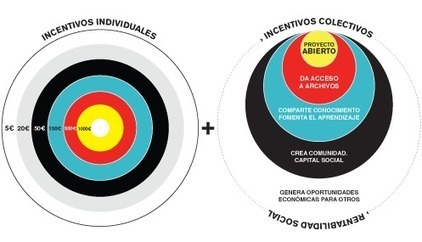
"Goteo is a social network for crowdfunding and distributed collaboration (services, infrastructures, microtasks and other resources) for encouraging the independent development of creative and innovative initiatives that contribute to the common good, free knowledge, and open code. A platform for investing in "feeder capital" that supports projects with social, cultural, scientific, educational, technological, or ecological objectives that generate new opportunities for the improvement of society and the enrichment of community goods and resources."
|
|
Scooped by
Howard Rheingold
December 17, 2013 9:04 PM
|
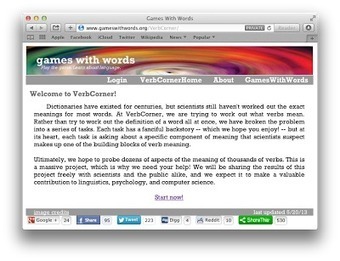
"When researchers look at the aspects of meaning that matter for grammar across different languages, many of the same aspects pop up over and over again. Does the verb describe something changing (break vs. hit)? Does it describe something only people can do (own, know, believe vs. exist, break, roll)? Does it describe an event or a state (frighten vs. fear)? This is too suspicious of a pattern to be accidental. Researchers like Steven Pinker have argued that language cares about these aspects of meaning because these are basic distinctions our brain makes when we think and reason about the world (see Stuff of Thought). Thus, the structure of language gives us insight into the structure of thought"
|
|
Scooped by
Howard Rheingold
December 6, 2013 3:43 PM
|
"Humans obviously evolved a much wider range of communication tools to express their thoughts, the most important being language," said John Hoffecker, a fellow at the University of Colorado's Institute of Arctic and Alpine Research. "Individual human brains within social groups became integrated into a neurologic Internet of sorts, giving birth to the mind." There is abundant fossil and archaeological evidence for the evolution of the human mind, including its unique power to create a potentially infinite variety of thoughts expressed in the form of sentences, art and technologies," according to Hoffecker. "He attributes the evolving power of the mind to the formation of what he calls the "super-brain," or collective mind, an event that took place in Africa no later than 75,000 years ago."
|
|
Scooped by
Howard Rheingold
November 17, 2013 2:24 PM
|
|
|
|
Scooped by
Howard Rheingold
March 28, 2019 2:38 PM
|
As part of the daily grind at the Centre for Collective Intelligence Design we come across a lot of interesting research and examples of collective intelligence. In our monthly blog (this is the first one) we share a rundown of some of the most interesting stuff we’ve come across.
|
|
Scooped by
Howard Rheingold
July 25, 2015 4:03 PM
|
3. Modern hunter-gatherers are ever vigilant against free-riding and elite-exploitation (both as dangerous to team survival as any predator). They rigidly enforce social rules to ensure skilled cooperators fare better than self-maximizers. For example: Another stakeholder distributes meat, not whoever made the kill. Rule-enforcement techniques = ridicule, shaming, shunning, and, ultimately, exile or execution.
|
|
Scooped by
Howard Rheingold
June 2, 2015 4:01 PM
|
What if we were to reframe the situation? What if, rather than asking the traditional question—What tasks currently performed by humans will soon be done more cheaply and rapidly by machines?—we ask a new one: What new feats might people achieve if they had better thinking machines to assist them? Instead of seeing work as a zero-sum game with machines taking an ever greater share, we might see growing possibilities for employment. We could reframe the threat of automation as an opportunity for augmentation.
The two of us have been looking at cases in which knowledge workers collaborate with machines to do things that neither could do well on their own. And as automation makes greater incursions into their workplaces, these people respond with a surprisingly broad repertoire of moves. Conventional wisdom is that as machines threaten their livelihood, humans must invest in ever higher levels of formal education to keep ahead. In truth, as we will discuss below, smart people are taking five approaches to making their peace with smart machines.
|
|
Scooped by
Howard Rheingold
August 27, 2014 2:09 PM
|
GroupMap's easy and effective online group brainstorming tools with visual templates puts your ideas against everyone's ideas on one single unique platform.
|
|
Scooped by
Howard Rheingold
June 2, 2014 5:22 PM
|
Recent experience with government-convened hackathons has generated insights into the methods and instruments used to design effective mass collaboration efforts.
|
|
Scooped by
Howard Rheingold
April 15, 2014 2:07 PM
|
"The human species can be defined by its special ability to manipulate symbols. Each great augmentation in this ability has brought enormous economic, social, political, religious, epistemological, educational (and so on) changes. I think that there has been only 4 of these big changes. The first one is related to the invention of writing, when symbols became permanent and reified. The second one corresponds to the invention of the alphabet, indian numerals and other small groups of symbols able to represent “almost everything” by combination. The third one is the invention of the printing press and the subsequent invention of electronic mass media. In this case, the symbols were reproduced and transmitted by industrial machines. We are currently at the beginning of a fourth big anthropological change, because the symbols can now be transformedby massively distributed automata in the digital realm. My main hypothesis is that we still did not have invented the symbolic systems and cultural institutions fitting the new algorithmic medium. "
|
|
Scooped by
Howard Rheingold
February 8, 2014 7:57 PM
|
Spurned by universities, a scientist plans to raise $1.5 million through online solicitations to try to find treatments for rare metabolic disorders.
|
|
Scooped by
Howard Rheingold
January 26, 2014 1:58 PM
|
"FOLDIT IS PART of a growing trend toward citizen science: enabling ordinary people, often without formal training, to contribute to scientific research in their spare time. The range of involvement varies. Some citizen scientists donate idle time on their home computers for use in solving problems large in scale (the search for intergalactic objects, as in Einstein@home) or small (folding proteins). Other projects encourage participants to contribute small bits of data about themselves or their environments. The Great Sunflower Project, for instance, provides a platform for logging and sharing observations of pollinators like bees and wasps. Still other efforts enlist laypeople to tag and analyze images: Eyewire, for example, a game developed by Sebastian Seung ’86, Ph.D. ’90, a professor of computational neuroscience at MIT, involves participants in mapping neurons in the brain."
|
|
Scooped by
Howard Rheingold
January 9, 2014 4:58 PM
|
"Imagine if Twitter were to digest for you the range of agreement, disagreement, and mood of your friends. By pre-digesting information -- self-synthesizing, if you will -- modern maps have been able to foreshadow coming revolutions in information. Unlike the web tools of the early 2000s – chat rooms, forums, wikis, blogs, and podcasts – crowd-sourced maps actually analyze the data given to them, sorting social information into patterns of local, regional, and global patterns. The maps do not merely collect information, as a “memory hole” like Wikileaks does; rather, the maps show the community back to itself, revealing hot-spots of local corruption and pollution, giving activists the tools to target particular places with investigation or protest."
"Levy is currently working on a research program, called IEML (Information Economy Meta Language). IEML is a metalanguage and proposes itself as the language of collective intelligence. As a metalanguage it differs fundamentally from natural languages we know. This can be best understood in the way it is conceived. Natural languages are, in the first place, the results of a process of documenting the spoken word. A metalanguage is artificial and is a result of formalizing ideas, instead of words. The practice of formalizing ideas in a universally adopted metalanguage is well established in the realm of natural sciences. For centuries now, ideas are being documented in terms of formulas, numbers, equations, molecules etc. There is a finite, well structured toolset at the hands of every natural scientist. "
Via juandoming, luigi vico
|
|
Scooped by
Howard Rheingold
December 8, 2013 3:14 PM
|
"Stanford computer scientists have created a website to help organizers plan events that are more likely to succeed or allow them to pull the plug on impending flops before they occur. The website, called Catalyst, is based on a behavioral science concept known as the threshold model of collective action, which posits that people may be reluctant to commit to participating in activity until they see others taking part, at which point interest surges and the activity becomes successful. But if participation doesn’t reach this threshold point, the event is likely to fail. Catalyst builds this principle into software. The website allows people to enter a few details, such as date, time, description of the event and the number of participants needed to make it a success. If signups don't hit this threshold point by the deadline, Catalyst emails organizers and would-be participants a warning."
|
|
Scooped by
Howard Rheingold
December 4, 2013 12:50 PM
|
"The VE wiki continuously monitors and measures how well structured are the groups that collaborate on its pages. If needed, it can also be used to maintain collaborative work within certain levels of equity and evenness. Thus the tool serves a double purpose. On the one hand, it can be used as a monitoring tool, for understanding how collaboration is structured. On the other, it can be employed for adjusting collaboration along particular parameters desired by the instructor or site administrator. The wiki is built around the MediaWiki platform, through which content can be edited by any user, including non-registered ones, all changes are permanently stored, and access to information that was edited or added is instantaneous. In addition, all pages come with “talk” areas, which allow discussions and interactions about the editing process. This makes it well adapted for collaborative work, especially of a textual nature."
|


 Scoop.it!





















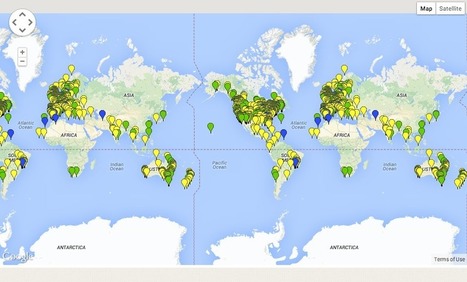

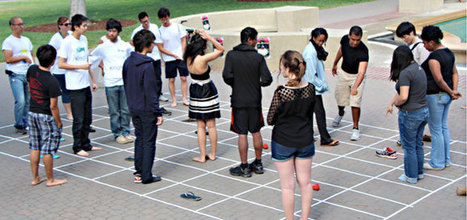







Tools for groups to exercise their collective intelligence abound. This course introduces the use of social bookmarking & curation tools as collective intelligence methods -- along with a foundational knowledge of intellectual augmentation.