Your new post is loading...
|
Scooped by
Gust MEES
|
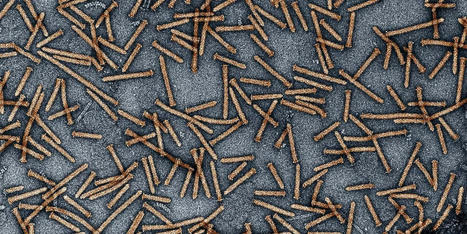
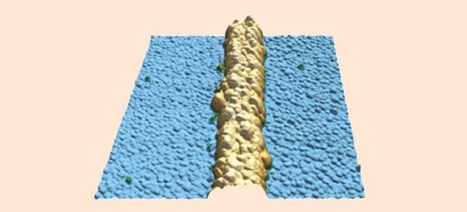
There's big news in the world of tiny things. New research led by University of Cincinnati physics professors Howard Jackson and Leigh Smith could contribute to better ways of harnessing solar energy, more effective air quality sensors or even stronger security measures against biological weapons such as anthrax. And it all starts with something that's 1,000 times thinner than the typical human hair – a semiconductor nanowire.
Read more at: http://phys.org/news/2013-04-crystal-corners-nanowire-potential-semiconductor.html#jCp
|
Scooped by
Gust MEES
|
(Phys.org) —Researchers are developing a new type of semiconductor technology for future computers and electronics based on 'two-dimensional nanocrystals' layered in sheets less than a nanometer thick that could replace today's transistors.
|
Scooped by
Gust MEES
|
Des chercheurs espagnols du CSIC et de l'Université de Saragosse ont réussi à produire des nanocables magnétiques en trois dimensions qui ont démontré leur potentiel d'utilisation...
|
Scooped by
Gust MEES
|
What you need to know about nanotechnology, check them and wonder...
|
Scooped by
Gust MEES
|
Scientists are using a novel fabrication process to create ultra-efficient solar energy rectennas capable of harvesting more than 70 percent of the sun's electromagnetic radiation and simultaneously converting it into usable electric power. ===> "The solar power conversion device under development by this collaboration of two universities and an industry subcontractor has the potential to revolutionize green solar power technology by increasing efficiencies, reducing costs, and providing new economic opportunities," Zimmerman says. <===
Researchers have developed a nanoparticle paste which can be injected into the defect and results in improved healing. The trick: the researchers have combined synthetic calcium phosphate with DNA.
|
Scooped by
Gust MEES
|
Relier des connexions optiques ultrarapides à des processeurs ou des mémoires classiquement électroniques : c'est une voie de recherche activement explorée.
|
Scooped by
Gust MEES
|
(Phys.org)—Portable, accurate, and highly sensitive devices that sniff out vapors from explosives and other substances could become as commonplace as smoke detectors in public places, thanks to researchers at University of California, Santa Barbara. Read more, very interesting...: http://phys.org/news/2012-11-nanotech-device-mimics-dog-nose.html
|
Scooped by
Gust MEES
|
|
Scooped by
Gust MEES
|
|
Scooped by
Gust MEES
|
(Phys.org)—Researchers at Rice University have refined silicon-based lithium-ion technology by literally crushing their previous work to make a high-capacity, long-lived and low-cost anode material with serious commercial potential for rechargeable... Read more, very interesting...: http://phys.org/news/2012-11-boost-silicon-based-batteries.html
|
Scooped by
Gust MEES
|
|
Scooped by
Gust MEES
|
|
|
Scooped by
Gust MEES
|
New research from the Max Planck Institute shows that silicon nanowires become doped with unexpectedly large amounts of aluminum during growth, increasing their conductivity and defying the laws of thermodynamics.
Long considered to be exclusively the product of science fiction, today some people believe nanotechnology is about to reaches its potential, and drastically change the world.
Via Szabolcs Kósa, michel verstrepen
|
Scooped by
Gust MEES
|
A tiny sponge in the boodstream could stop poisons from bacterial infections and snakes -- and might solve the problem of antibiotic resistance.
|
Scooped by
Gust MEES
|
Un étudiant de 16 ans de Calgary au Canada a reçu mardi un prix pour ses recherches sur une thérapie utilisant des nano-particules d'or qui, injectées à un cancéreux et chauffées, tuent les cellules malades, a annoncé le laboratoire français...
|
Scooped by
Gust MEES
|
La bioélectronique du futur pourrait bien reposer sur l’utilisation de transistors à effet de champ fabriqués avec du graphène.
|
Scooped by
Gust MEES
|
Most flexible polymers are inherently flimsy. When you look at their micro-structures it's easy to see why: They look like piles of entangled spaghetti strands.
|
Scooped by
Gust MEES
|
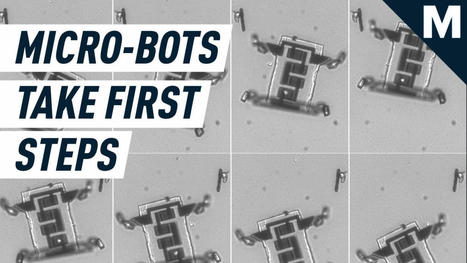
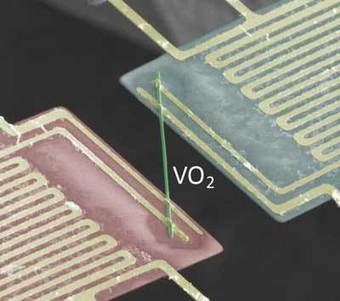
Nanotechnology has promised us a fantastic world where miniature factories would build devices atom by atom. A recent report describes a new kind of microactuator made from vanadium oxide.
|
Scooped by
Gust MEES
|
|
Scooped by
Gust MEES
|
|
Scooped by
Gust MEES
|
|
Scooped by
Gust MEES
|
|
Scooped by
Gust MEES
|
A technology that would enable low-cost, high efficiency solar cells to be made from virtually any semiconductor material has been developed by researchers with the U.S. Department of Energy (DOE)'s Lawrence Berkeley National Laboratory (Berkeley Lab) and the University of California (UC) Berkeley. This technology opens the door to the use of plentiful, relatively inexpensive semiconductors, such as the promising metal oxides, sulfides and phosphides, that have been considered unsuitable for solar cells because it is so difficult to taylor their properties by chemical means. Read more at: http://phys.org/news/2012-07-photovoltaics-semiconductor.html#jCp
|
Check also:
- http://www.scoop.it/t/21st-century-innovative-technologies-and-developments?tag=Nano