Your new post is loading...
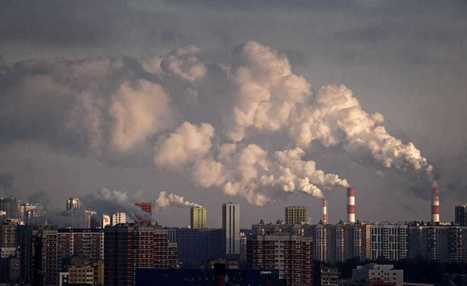
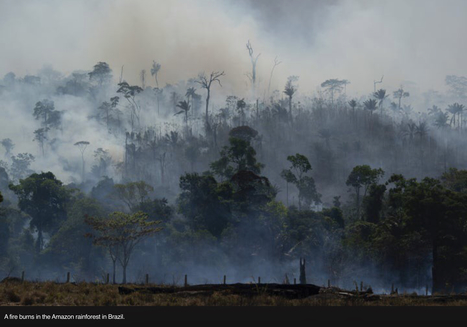
"The world has squandered so much time mustering the action necessary to combat climate change that rapid, unprecedented cuts in greenhouse gas emissions offer the only hope of averting an ever-intensifying cascade of consequences, according to new findings from the United Nations." --------------- "Amid that growing pressure to act, Tuesday’s U.N. report offers a grim assessment of how off-track the world remains. Global temperatures are on pace to rise as much as 3.9 degrees Celsius (7 degrees Fahrenheit) by the end of the century, according to the United Nations’ annual “emissions gap” report, which assesses the difference between the world’s current path and the changes needed to meet the goals of the 2015 Paris climate accord." ——————— "Should that pace continue, scientists say, the result could be widespread, catastrophic effects: Coral reefs, already dying in some places, would probably dissolve in increasingly acidic oceans. Some coastal cities, already wrestling with flooding, would be constantly inundated by rising seas. In much of the world, severe heat, already intense, could become unbearable. Global greenhouse gas emissions must begin falling by 7.6 percent each year beginning 2020 — a rate currently nowhere in sight — to meet the most ambitious aims of the Paris climate accord, the report issued early Tuesday found. Its authors acknowledged that the findings are “bleak.” After all, the world has never demonstrated the ability to cut greenhouse gas emissions on such a scale."
——————— “'Every year of delay beyond 2020 brings a need for faster cuts, which become increasingly expensive, unlikely and impractical,” the report states. “Delays will also quickly put the 1.5C goal out of reach.'”
——————— "On Monday, the intergovernmental World Meteorological Organization reported that levels of greenhouse gases in the atmosphere had hit a record high and that the trend “means that future generations will be confronted with increasingly severe impacts of climate change."
——————— "Niklas Höhne, a German climatologist and founding partner of NewClimate Institute, which created the Climate Action Tracker, a tool that tracks whether nations are meeting their goals, said Tuesday’s report demonstrates in painful detail how past inaction has made the urgency around climate change more dire. 'We are not a little bit off, we are far off from where we should be,' Höhne said in an email. 'The longer action is delayed, the higher cuts will be required. We cannot wait another 10 years.'"
Via Dennis Richards
Former ABC News anchor Sam Donaldson reacts to a new impeachment poll from Quinnipiac University showing public opinion over whether President Donald Trump should be removed from office.
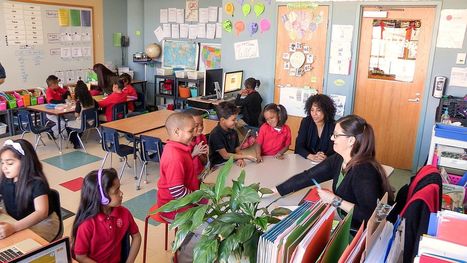
Using three stations effectively—teacher-led, online, and offline—should provide your students with plenty of ways to collaborate.
Via Tom D'Amico (@TDOttawa) , Jim Lerman
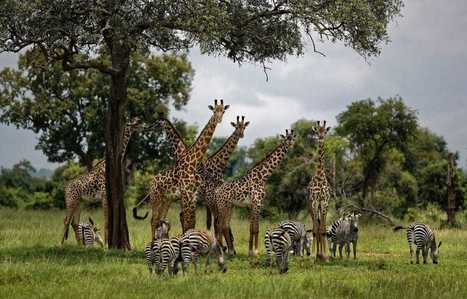
-- Nature is in more trouble now than at any other time in human history, with extinction looming over 1 million species of plants and animals, scientists said Monday in the United Nations’ first comprehensive report on biodiversity.
It’s all because of humans, but it’s not too late to fix the problem, the report said.
Species loss is accelerating to a rate tens or hundreds of times faster than in the past, the report said. More than half a million species on land “have insufficient habitat for long-term survival” and are likely to go extinct, many within decades, unless their habitats are restored. The oceans are not any better off.
“Humanity unwittingly is attempting to throttle the living planet and humanity’s own future,” said George Mason University biologist Thomas Lovejoy, who has been called the godfather of biodiversity for his research. He was not part of the report.
“The biological diversity of this planet has been really hammered, and this is really our last chance to address all of that,” Lovejoy said.
Conservation scientists from around the world convened in Paris to issue the report, which exceeded 1,000 pages. The Intergovernmental Science-Policy Platform on Biodiversity and Ecosystem Services (IPBES) included more than 450 researchers who used 15,000 scientific and government reports. The report’s summary had to be approved by representatives of all 109 nations.
Some nations hit harder by the losses, like small island countries, wanted more in the report. Others, such as the United States, were cautious in the language they sought, but they agreed “we’re in trouble,” said Rebecca Shaw, chief scientist for the World Wildlife Fund, who observed the final negotiations.--
"… the ADL reported it had received complaints of nearly 80 hate crimes in Massachusetts schools in September, a rate that far exceeded the handful of complaints typically received during the first month of school — and these were just the hate crimes known and documented by the ADL. As the current president of MASS, I encouraged our executive board members to share their experiences with uncivil behavior in their schools. The massive burden today’s school leaders face could be felt in their collective response.
As we talked, an urban superintendent shared a picture of a Nazi swastika painted on the bleachers at her school. Another urban superintendent spoke about a student arriving at school on the first day carrying a copy of Mein Kampf and shouting “Heil Hitler!” as he gave his teachers the Nazi salute.
A superintendent from a middle-class community talked about how her efforts to be proactive backfired when she shared an informational resource created by her school system’s legal counsel with guidelines for educators to use to promote civility in public schools. The law firm was berated by a school committee member for ostensibly taking a political position. When it came time to approve the transgender policy shortly after, this same superintendent said she was apprehensive to bring it to her school committee for fear of backlash, yet it passed with barely a conversation.
A superintendent from an affluent school community 30 miles west of Boston summed up our feelings well. “I used to know what to do as a superintendent,” he said, “but I don’t have a damn clue what I’m supposed to do or how I’m supposed to lead anymore.”
An Emotional Response
During this meeting, one of my superintendent colleagues who had just visited a Nazi concentration camp on a trip to Poland with his colleagues was moved to tears. He emotionally recounted his experiences during the tour, and he shared a quote that a guide shared with his group after their visit to one of the gas chambers in Auschwitz:
'I am a survivor of a concentration camp. My eyes saw what no person should witness: gas chambers built by learned engineers. Children poisoned by educated physicians. Infants killed by trained nurses. Women and babies shot by high school and college graduates. So, I am suspicious of education. My request is: Help your children become human. Your efforts must never produce learned monsters, skilled psychopaths or educated Eichmanns. Reading, writing, and arithmetic is important only if they serve to make our children more human.' (Excerpt of a letter by a Holocaust survivor to educators, in Teacher and Child by Haim Ginott, child psychologist and author, published on the website of the Holocaust and Humanity Center.)
The words weighed heavily on every superintendent in the room. Apathy breeds learned monsters, and indifference to intolerance threatens our very existence. How do we disrupt a generation from repeating the atrocities of the past? If we are serious about helping our children become more human, superintendents and school leaders must tact-fully confront issues of incivility both large and small, and settle for nothing less than a culture of respect for all."
* Julie Hackett is superintendent of the Taunton Public Schools in Taunton, Mass and President of Massachusetts Association of School Superintendents Twitter: @tpssuper
WHEN D.C. COUNCIL member Charles Allen (D-Ward 6) introduced legislation in 2015 to lower the voting age to 16, he was pretty much laughed down. He recalled the skeptical questions: “‘How can you convince me that a 16-year-old is mature enough, smart enough, engaged enough?” The bill died in committee.
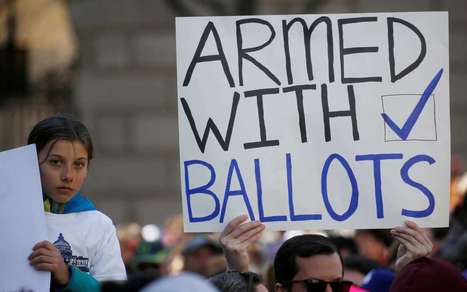
When the proposal was reintroduced this week, a majority of council members signed on as co-sponsors and Mayor Muriel E. Bowser (D) expressed support. One reason for the different reception — and why the nationwide push for lowering the voting age has been reinvigorated — is the thoughtful and influential activism of young people following February’s mass school shooting in Parkland, Fla.
Upending decades of political tradition is clearly provocative, and the council should proceed carefully in deciding whether to allow 16- and 17-year-olds to vote in local and federal elections. A case could be made that 16-year-olds lack the life experience to make informed choices. But we think a more compelling argument can be made in favor of lowering the voting age as a measure that could encourage lifelong civic engagement.
I teach at a big state university, and I often receive emails from software companies offering to help me do a basic part of my job: figuring out what my students have learned.
If you thought this task required only low-tech materials like a pile of final exams and a red pen, you’re stuck in the 20th century. In 2018, more and more university administrators want campuswide, quantifiable data that reveal what skills students are learning. Their desire has fed a bureaucratic behemoth known as learning outcomes assessment. This elaborate, expensive, supposedly data-driven analysis seeks to translate the subtleties of the classroom into PowerPoint slides packed with statistics — in the hope of deflecting the charge that students pay too much for degrees that mean too little.
It’s true that old-fashioned course grades, skewed by grade inflation and inconsistency among schools and disciplines, can’t tell us everything about what students have learned. But the ballooning assessment industry — including the tech companies and consulting firms that profit from assessment — is a symptom of higher education’s crisis, not a solution to it. It preys especially on less prestigious schools and contributes to the system’s deepening divide into a narrow tier of elite institutions primarily serving the rich and a vast landscape of glorified trade schools for everyone else.
Without thoughtful reconsideration, learning assessment will continue to devour a lot of money for meager results. The movement’s focus on quantifying classroom experience makes it easy to shift blame for student failure wholly onto universities, ignoring deeper socio-economic reasons that cause many students to struggle with college-level work. Worse, when the effort to reduce learning to a list of job-ready skills goes too far, it misses the point of a university education.
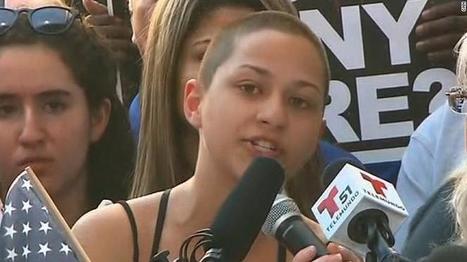
In an emotional rally Saturday in Fort Lauderdale, politicians and Marjory Stoneman Douglas students called for a ban on weapons like the one used to kill 17 people at the Florida high school, and urged voters to kick out lawmakers who oppose the move or who take money from the National Rifle Association.
In a fiery speech, senior Emma Gonzalez demanded national lawmakers do something to prevent mass school shootings.
"We certainly do not understand why it should be harder to make plans with friends on weekends than to buy an automatic or semiautomatic weapon," Gonzalez, who huddled in an auditorium during Wednesday's shooting, said at the rally outside a federal courthouse.
Gonzalez, whose palpable anger burst out in her words, demanded that laws change because she said they have not, while guns have changed.
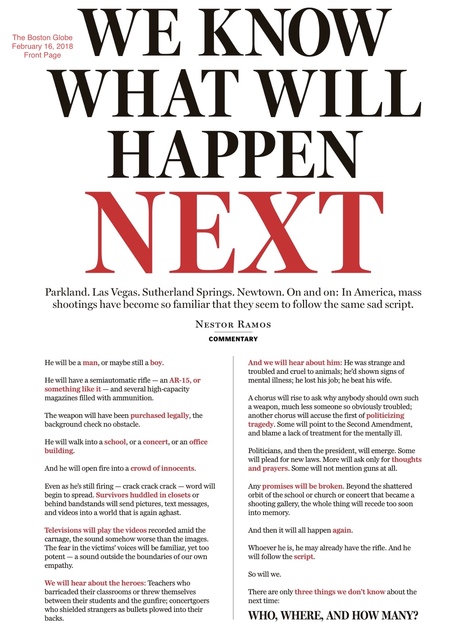
He will be a man, or maybe still a boy.
He will have a semiautomatic rifle — an AR-15, or something like it — and several high-capacity magazines filled with ammunition.
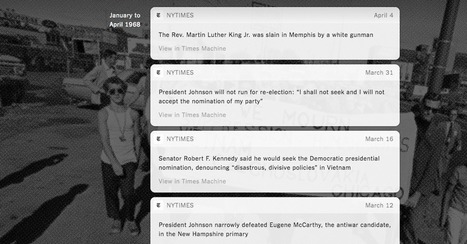
It was a violent year. Liberals reeled, a war dragged on and protests raged. People got all their news from radio, TV and newspapers. But what if they’d had phones vibrating with modern news alerts?
The world of science is unpredictable and ever-changing, but as a team that writes about science day in, day out, we can't help but notice certain trends in research.
So this year - which also happens to be ScienceAlert's 10th anniversary - we thought we'd try our hand at predicting some of the big science news of 2018 before they happen for once. You know, just so we can tell you we told you so later.
Most of these are based on well-established science, a few are wildly speculative, and some are just blatantly obvious. Don't email us if any of them don't come true.
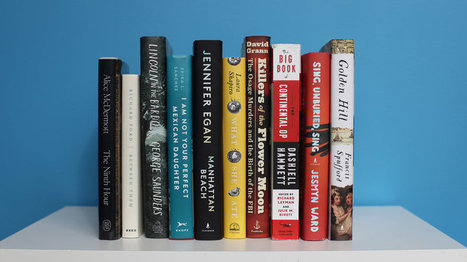
"For a chaotic year, I'm offering a chaotic "Best Books" list — but I think my list is chaotic in a good sense. These books zing off in all directions: They're fresh, unruly and dismissive of the canned and contrived.
Sing, Unburied, Sing
by Jesmyn Ward
Jesmyn Ward's gorgeous and bleak novel, Sing, Unburied, Sing, takes readers on the great American road trip. But unlike Jack Kerouac's carefree roadster, Ward's junker is loaded down with a baby in a car seat, a couple of ghosts, a package of crystal meth and the oppressive weight of racism — past and present.
A host of narrators take turns telling this tale, but the most compelling voice belongs to Jojo, a 13-year-old biracial boy who's forced to grow up too fast; in the process, he comes to a deeper understanding of how he's valued — or used — by members of his family."
It’s been a bumpy road for science in 2017, and now’s a good time to reflect on what makes science so great: Stories of discovery and wonder, and the majesty of nature and space. From women codebreakers during WWII, to Oliver Sacks on consciousness, to a graphic novel about theoretical physics, there’s something for everyone on this year’s list of best science books. Maria Popova, founder of Brain Pickings, and Deborah Blum, director of the Knight Science Journalism program, join Ira to wrap up the best science books of 2017. Check out their picks below.
|
More than 11,000 scientists from around the world issued a dire warning Tuesday that the world must take immediate action to fundamentally alter a range of human activities to avert "untold suffering due to the climate crisis."
In a statement published in the journal BioScience, the scientists declared that the Earth is facing a "climate emergency" and that, despite continued warnings about "insufficient progress" over the last several decades, greenhouse gas emissions are continuing to increase and posing "increasingly damaging effects on the Earth's climate."
They wrote: "An immense increase of scale in endeavors to conserve our biosphere is needed to avoid untold suffering due to the climate crisis."
The group, which includes experts from 153 countries, cited increases in human and livestock populations, meat production, world gross domestic product, tree cover loss, air travel, fossil fuel consumption, and carbon dioxide emissions as factors that have contributed to the crisis.
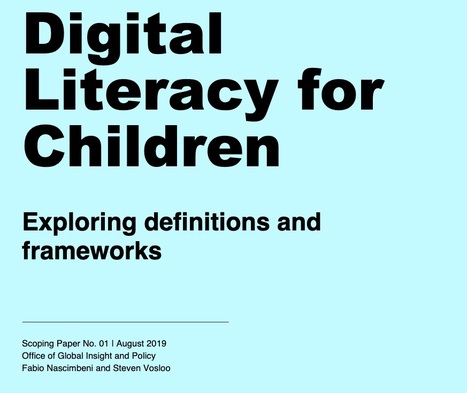
In the area of children's digital literacy, policy, research and practices are converging from a risk and safety paradigm towards rights-based approaches to children’s active digital media practices. In fact, research is starting to show that the benefits associated with children’s online participation seem to overtake the risks connected to being online
Via Nik Peachey
This is the age of misinformation and fake news. Here are the best unbiased fact-checking sites so that you can find the truth.
Via John Evans
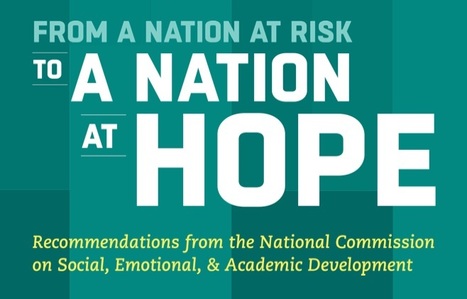
After two decades of education debates that produced deep passions and deeper divisions, we have a chance for a fresh start. A growing movement dedicated to the social, emotional, and academic well-being of children is reshaping learning and changing lives across America. On the strength of its remarkable consensus, a nation at risk is finally a nation at hope.
Familiar arguments over national standards and the definition of accountability are not as relevant as they once were. The federal Every Student Succeeds Act passed in 2015 devolved a great deal of authority and power to states and communities—placing the future of education more directly in the hands of parents, teachers, and school leaders. This presents an obligation and an opportunity.
Devolution creates an obligation on the part of adults to use their influence in creative, effective ways to serve every student. Local control is not a release from rigor and responsibility; it is the broader distribution of responsibility. This sense of obligation should extend to all of the adults who constitute a child’s whole universe.
Devolution also creates a tremendous opportunity to get beyond the rutted debates of the last generation and to seek solutions that are both hopeful and unifying.
We began with the simple intention of listening—really listening—to young people, parents, teachers, school and district leaders, community leaders, and other experts. This document, in many ways, is a report from the nation. What we heard is profoundly hopeful. There is a striking confluence of experience and science on one point: Children learn best when we treat them as human beings, with social and emotional as well as academic needs. As one teacher put it, “I don’t teach math; I teach kids math.” To reach a child’s mind, we must be concerned for the whole person.
More specifically, children require a broad array of skills, attitudes, and values to succeed in school, careers, and in life. They require skills such as paying attention, setting goals, collaboration, and planning for the future. They require attitudes such as internal motivation, perseverance, and a sense of purpose. They require values such as responsibility, honesty, and integrity. They require the abilities to think critically, consider different views, and problem solve. And these social, emotional, and academic capacities are increasingly demanded in the American workplace, which puts a premium on the ability to work in diverse teams, to grapple with difficult problems, and to adjust to rapid change.
Helping children to learn these traits and skills may sound ambitious. But it is—and has always been—central to the educational enterprise. It is the reason that education begins with concerned and involved parents, who provide emotional support and set high expectations. It is the reason that community institutions that mentor children and encourage self-respect are essential allies of parents and schools. It is the reason that good teachers can change lives, helping students find unsuspected gifts and inner purpose. And it is the reason that everyone involved in education shares an amazing calling: to foster in children the knowledge, skills, and character that enable children to make better lives in a better country.
This calling is an honor, but not an elective. Since all education involves social, emotional, and academic learning, we have but two choices: We can either ignore that fact and accept disappointing results, or address these needs intentionally and well.
The promotion of social, emotional, and academic learning is not a shifting educational fad; it is the substance of education itself.
The promotion of social, emotional, and academic learning is not a shifting educational fad; it is the substance of education itself. It is not a distraction from the “real work” of math and English instruction; it is how instruction can succeed. And it is not another reason for political polarization. It brings together a traditionally conservative emphasis on local control and on the character of all students, and a historically progressive emphasis on the creative and challenging art of teaching and the social and emotional needs of all students, especially those who have experienced the greatest challenges.
In fact, the basis of this approach is not ideological at all. It is rooted in the experience of teachers, parents, and students supported by the best educational research of the past few decades. More than nine in 10 teachers and parents believe that social and emotional learning is important to education.1 At least two-thirds of current and recent high school students think similarly.2 As one student said, “Success in school should not be defined just by our test scores … but also by the ability to think for ourselves, work with others, and contribute to our communities.”
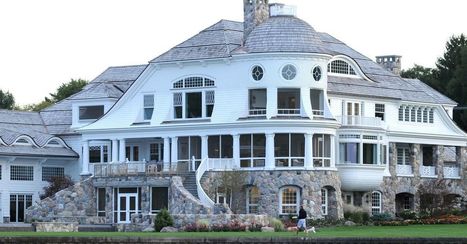
”Two weeks ago, somebody untied Secretary of Education Betsy DeVos’s $40 million yacht from its mooring. It got me thinking about another opulent display of wealth owned by DeVos: her 22,000-square-foot nautical-themed summer mansion, located in Holland, Michigan. Just a few more years of climate change and it’ll be floating too.
My mission for the past three years as the creator of the architectural humor blog McMansion Hell has been to unpack what makes mansions like DeVos’s so terrible, from both an architectural and social standpoint. It’s bad enough that we have a president who oversaw a massive redistribution of wealth toward the already wealthy through tax breaks. What’s worse is that obscenely wealthy people like him waste all their money building pseudo-castles and other eclectic tragedies, all while wagging their finger at the rest of us telling us to eat cake.
Trump official and fellow rich person DeVos just rolled back Obama administration loan forgiveness rules for students defrauded by for-profit colleges. It’s unsurprising that she doesn’t want to forgive the student loan debts of those defrauded by for-profit colleges considering that she got her net worth of more than $1 billion from her husband’s company, the multilevel marketing giant Amway, which is often described as a cult. Meanwhile, her brother Erik Prince owns the Blackwater firm, which essentially sells mercenaries. As we can see, we are not dealing with nice people.”
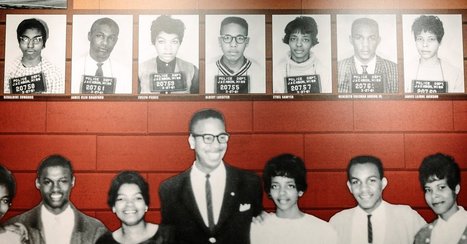
Woven through documentation of violence in the galleries is a parallel record of resistance, throughout the South and specifically in Jackson. In 1961, nine African-American students from nearby Tougaloo College challenging segregation at Jackson’s main public library staged a read-in until they were removed by the police. In the same year, anti-segregationist Freedom Riders arrived in the city, in successive waves, by bus and were herded into jails: enlarged mug shots of dozens of riders, among them the veteran Georgia Congressman John Lewis, paper a gallery wall.
Behind much of the local protest was the organizational work of the activist Medgar Evers, field secretary for the Mississippi branch of the N.A.A.C.P., and a Jackson resident. On June 12, 1963, returning home from a night meeting, he was gunned down in his driveway. The museum has a terse, tense documentary film on Evers projected in a darkened alcove. At its conclusion, a spotlight suddenly hits an object in a case on the wall: the Enfield .30-06 caliber the rifle that killed him.
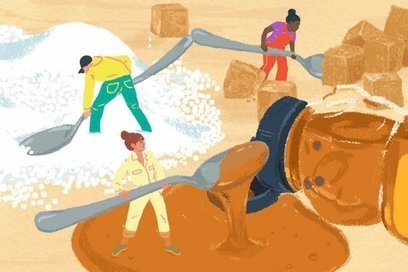
If you’re like most Americans, you eat more sugar than is good for you. But it’s entirely possible to eat less sugar without sacrificing much — if any — of the pleasures of eating. Surprising as it may sound, many people who have cut back on sugar say they find their new eating habits more pleasurable than their old ones. This guide will walk you through why sugar matters, how you can make smart food choices to reduce sugar consumption, and how you can keep your life sweet, even without so many sweets.
"Donald Trump has turned the political world upside down, again and again, like a kid flipping a coin. Every day we wake up to either a new scandal or several lingering ones.
It is astounding. It is maddening. It is numbing.
At this moment, he is embroiled in a scandal of a six-figure payment to a porn star who goes by the name Stormy Daniels and who, at one point, gave an interview in which she claimed that the two were engaged in an extramarital sexual affair.
He is also embroiled in a scandal over why a top aide, Rob Porter, accused of physically assaulting his two ex-wives, was allowed to remain on the White House staff even after these allegations had been brought to the attention of the White House by the F.B.I.
Exacerbating this scandal is the fact that the official White House timeline about the events leading to Porter’s resignation turned out to be a lie, according to sworn testimony on Tuesday by the F.B.I. director Christopher Wray. It is also exacerbated by the fact that after Porter resigned, Trump praised him, and initially failed to say anything about domestic violence in general, reserving that condemnation for a week later, when he said, “I’m totally opposed to domestic violence of any kind.”
And of course, there is the omnipresent issue of Russia attacking our elections in 2016 and the investigation into whether anyone in the Trump orbit colluded or cooperated with the Russians, conspired to commit a crime, lied to officers or tried to obstruct justice.
That’s just the big three at the moment. We also mustn’t forget that the president has never released his tax returns, he refused to sever ties with his businesses, and he is burning through our money going to golf courses or his properties with decadent regularity. He also defended Nazis and was disrespectful to the hurricane-ravaged people of Puerto Rico.
And Trump has lied about pretty much everything. As The Washington Post reported in November: “In the past 35 days, Trump has averaged an astonishing nine [false or misleading] claims a day. The total now stands at 1,628 claims in 298 days, or an average of 5.5 claims a day.”
Any of this would have crippled another president, but not Trump. In a perverse way, Trump appears to benefit from the sheer volume of his offenses. They overwhelm many Americans’ ability to process and track, maintain outrage or even fact-check.
This may rightfully be called Trump’s Deluge Doctrine of American Politics, a thing that many of us never properly feared because we never thought it possible. We never thought a man of such moral depravity and such little respect for propriety, protocol and honesty would ever be president.
But the storm is upon us; we are in it.
I must continue to submit that although I disagree vociferously with Trump on policy, my objection here isn’t about policy or partisanship. This is a fight for the soul of the country.
When more than a third of the country — among them many who once considered themselves part of the “moral majority” — stand with a man who is the literal antithesis of all the values they once professed, that is a problem for America. They are no longer interested in the health of the democracy. Their mission and objectives have veered into a dark place where vision is short and risks and dangers are multiple.
I know that it is a fool’s errand to try to convince these people that honesty, valor and character are fundamental requirements of the American presidency, and when they are lost from the office, the country itself is in peril.
As Trump himself said during the campaign, “I could stand in the middle of Fifth Avenue and shoot somebody and I wouldn’t lose voters.” The enduring truth of that outrageous claim is a permanent stain that his supporters must carry.
These people are not only hypocrites; they are au pairs to his obscenity.
Who else would they have allowed to get away with paying off a porn star?
Who else would they have allowed to refuse to sufficiently acknowledge that the country had been attacked, with profound consequences and continued threat, by another country?
The director of national intelligence, Dan Coats, said Tuesday at a Senate Intelligence Committee hearing:
“There should be no doubt that Russia perceived that its past efforts as successful and views the 2018 U.S. midterm elections as a potential target for Russian midterm operations.”
He continued:
“We need to inform the American public that this is real, that this is going to be happening, and the resilience needed for us to stand up and say we’re not going to allow some Russian to tell us how to vote, how we ought to run our country.”
But Wray testified at the same hearing that he had never been “specifically directed by the president” to prevent Russia from interfering in our elections.
That is a jaw-dropping statement. As the Harvard professor of constitutional law Laurence H. Tribe wrote on Twitter:
“F.B.I. director Wray just testified in the Senate that — despite Russia’s ongoing intrusions into our electoral systems — Potus has never charged the F.B.I. with protecting U.S. elections from Russia! Let that sink in. That’d be like F.D.R. doing nothing in response to Pearl Harbor.”
Let me be clear: Any president who refuses to protect Americans from a foreign threat is himself a domestic threat.
How can any of this be sustained? How can it be rationalized? How can it be tolerated?
America, what is left of it, is slipping away a little bit more every day, with a blessing and a wave from the truculent Trump supporters who simply get giddy whenever liberals lament.
This is the politics of the petty, where people dance and shout as the republic burns.
We patriots and dissidents, we many, we strong, we steadfast, are the last hope the country has of returning to what remains of a pre-Trump America, where porn stars weren’t paid off, accused wife beaters weren’t valorized and our president showed more allegiance to our country than to another."
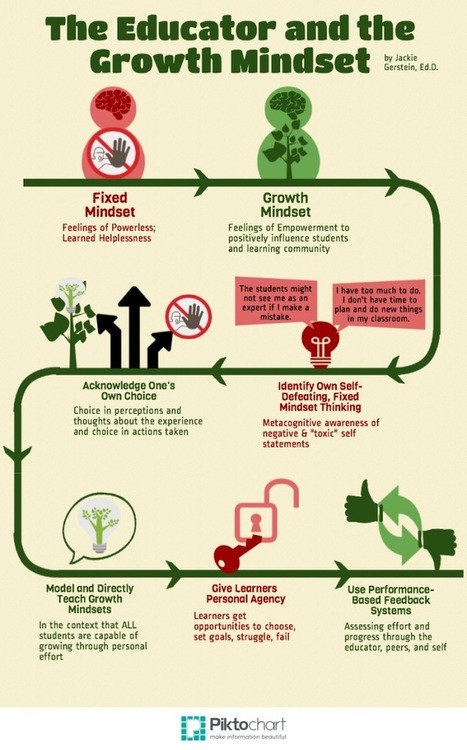
I had the great privilege of facilitating a staff workshop on growth mindsets for the teachers and staff at Carlos Rosario International School and more recently at ISTE 2015. Participants were given access to the slide deck in order interact with the slides and resources during the workshop. What follows are the activities along with…
“Our annual survey of the best books includes 10 we think are exceptionally rewarding and 100 more notable titles you shouldn’t miss.”
“Vladimir Putin has inspired a number of books seeking to explain his remarkable rise — and his remarkable hold on power. Few accounts are as ambitious, insightful and unsparing as Gessen’s “The Future Is History.” This is a sweeping intellectual history of Russia over the past four decades, told through a Tolstoyan gallery of characters. It makes a convincing if depressing case that Homo Sovieticus, the unique species created a century ago with the Bolshevik Revolution, did not die out along with the Soviet Union. What makes the book so worthwhile are its keen observations about Russia from the point of view of those experiencing its heavy-handed state. Gessen’s provocative conclusion that Putin’s Russia is just as much a totalitarian society as Stalin’s Soviet Union or Hitler’s Germany may not convince all readers. But you don’t need to agree with this assessment to find her book a sad, compelling indictment of the country where she was born, a country so traumatized by its monstrous past that it seems intent on repeating it. “
What would you like to read?
Use the filters below to explore more than 350 titles NPR staff and critics loved this year. (You can also combine filters!) Want even more recommendations? Check out our favorite books from 2016, 2015, 2014, 2013, 2012, 2011, 2010, 2009, 2008
Staff Picks
Biography & Memoir
Book Club Ideas
Comics & Graphic Novels
Cookbooks & Food
Eye-Opening Reads
Family Matters
For Art Lovers
For History Lovers
For Music Lovers
Funny Stuff
Historical Fiction
Identity & Culture
It’s All Geek To Me
Kids' Books
Ladies First
Let's Talk About Sex
Love Stories
Mysteries & Thrillers
Nonfiction
Essays/Poetry/Short Stories
Rather Long
Rather Short
Realistic Fiction
Science!
Science Fiction & Fantasy
Seriously Great Writing
Tales From Around The World
The Dark Side
Young Adult
‘Tis the season to inspire the budding scientists in your life with science stories and inquiry adventures. Whether it’s learning the basics of rocket science (for babies), exploring the diversity of life on earth, or soaring into the solar system, these children’s books are a perfect launch pad for exploration. We’ve also brainstormed some activities to do at home or in the classroom with the curious kiddos in your life after you’ve finished reading (and Science Friday’s Team Educate has plenty of other resources for you, too).
|