Your new post is loading...
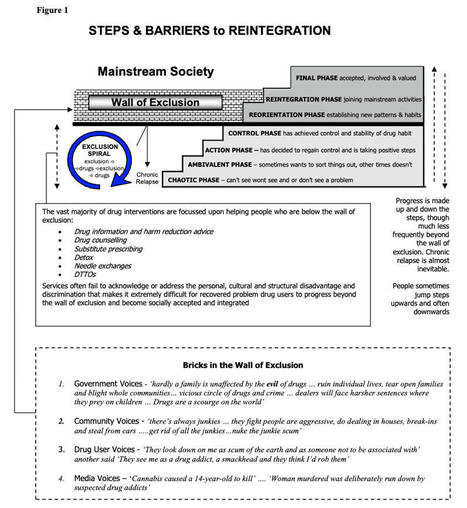
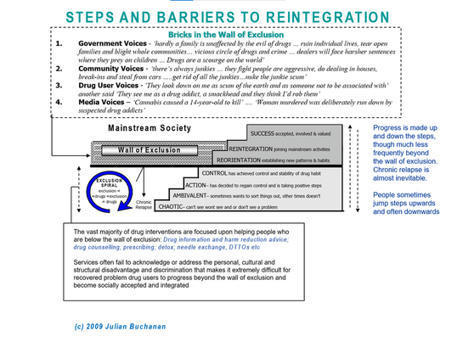
Considerable attention is given to addressing the physical and psychological aspects of drug dependence - some suggest it's a disease called 'addiction'. This paper entitled 'Barriers to Recovery: Stigma & Discrimination' given at the New Zealand Drug Symposium 'Through the Maze: Making Treatment Better' http://www.youtube.com/user/nzdrugfoundation?feature=watch argues that the social context is much overlooked, and illustrates how problem drug use is to a large extent a social construct, exacerbated by criminalisation, exclusion, stigma and discrimination. If you want to follow the PREZI Slide Presentation used in the lecture which can also be copied and used click on this link: http://prezi.com/p3fuglzqymmg/barriers-to-recovery-stigma-discrimination/
The truth now about the big stories then
Review by Organisation of American States on illicit drugs 'could mark beginning of the end' of prohibition
Dispensaries selling cannabis chocolates and bath salts, 'bud-tenders' advising on the best blends, even a marijuana university.
Because the study design is observational and the data are cross-sectional, no strong causal conclusions can be drawn. However, there is evidence of lower marijuana use in the presence of SDT, and evidence of higher use of illicit drugs other than marijuana. Until further research can clarify the apparent opposing associations, schools should approach SDT with caution.
TALLAHASSEE, Florida (AP) - A federal appeals court has upheld a temporary ban on a law requiring drug testing of Florida welfare recipients. The 11th U.S. Circuit Court of Appeals in Atlanta on Tuesday ruled that a lower court was right to temporarily halt enforcement of the drug-testing program. The opinion said the state of Florida hadn't shown a "substantial special need" for such mandatory drug testing. Florida officials have argued that testing is necessary because it would deter drug use by those receiving welfare. Opponents say drug testing as a condition of getting welfare benefits is an unconstitutional search and seizure... (click pic to continue reading)
Via Billy Corben, Chad Smith
A global advocacy campaign to raise awareness of the harms that are being caused by the criminalisation of people who use drugs.
Findings: Most of the users in the qualitative sample sought a legal alternative to cannabis (their drug of choice) to avoid positive drug test screenings and criminal sanctions. Many were attending abstinence-only drug treatment programmes, under community corrections, or were seeking a career in the US military. These individuals were randomly drug tested and knew that the metabolites of synthetic cannabis are not detected in standard urine drug screenings.
Conclusions: US drug policies – the prohibition of marijuana and the proliferation of drug testing – have led users to seek out legal highs. Read More: http://informahealthcare.com/doi/abs/10.3109/09687637.2012.749392?utm_source=dlvr.it&utm_medium=twitter&#.UY0XIXN0Sp4.twitter
Leading European and international experts will meet in Lisbon from 6–8 May to review the state of the art of a rapidly-developing scientific discipline known as ‘drug wastewater analysis’. The event, ‘Testing the waters: the first international multidisciplinary conference on illicit drugs and wastewater’, is being organised by the EU drugs agency (EMCDDA), in collaboration with: the EU-funded SEWPROF project; the Italian Mario Negri Institute; and the Norwegian Institute for Water Research
Prenoxad Injection, the world's first licensed emergency treatment for acute opioid related overdose for use at home or other non-medical settings. Prenoxad Injection is a Prescription Only Medicine (POM) containing a solution of naloxone hydrochloride. It is intended for emergency use for the complete or partial reversal of life-threatening respiratory depression following the administration of natural or synthetic opioids. Naloxone is an 'opioid antagonist' medicine with an excellent safety and efficacy profile following use over more than four decades
Newsbeat has been given access to a drug consumption room in Frankfurt as Brighton & Hove Council consider opening a similar one.
Before jumping to conclusions and mandating drug tests for anyone receiving welfare, we should consider some of the financial repercussions.
Via ReGenUC
|
Will the new definition mean we stop blaming addicts for their behaviors?
This Retro Report video lays out how limited scientific studies in the 1980s led to predictions that a generation of children would be damaged for life. Those predictions turned out to be wrong.
How professionals and societies deal with drugs and drug consumption is premised on how abuse is defined. The “War on Drugs” approach promotes the belief that “any use is abuse” where the currently illicit drugs are concerned. Regrettably, any distinction between use and abuse has been notably absent from most public policy decisions on drug issues. Even a cursory review of both supply and demand reduction policies of the past century reveals a startling lack of awareness of this distinction. The failure of differentiation undermines prevention, treatment, and the criminal justice system. Treatment, thus, tends to show a bias toward ineffective models such as “boot camps” and “tough love”. It has contributed to controversy over maintenance treatments, such as methadone, buprenorphine, and heroin, which have proven to be highly effective for some addicted persons. It leads to treatment options for the addictions being far more limited and constrained than is typical in other areas of health care. Admittedly, studying non-problematic drug use has been a challenge, but clearly the use of illegal drugs is often not harmful, any more than is moderate alcohol use. Addiction is a fatal disease for some and that disease should be the focus of our policies.
Read More: http://informahealthcare.com/doi/abs/10.3109/09687637.2012.682231?prevSearch=allfield%253A%2528Nicholson%2529%2Band%2B%2528allfield%253A%2528drug%2Beducation%2529%2529&searchHistoryKey=
In the first part, he said, "we follow the entire process of drugs in the region, the only part of the world in which all of its stages are present in a dominant way: cultivation, production, distribution and the final sale of controlled substances. In each stage we review the various forms this activity assumes, as well as its environmental impact and the reaction of the State, its implications and its limitations." He said this part of the Report examined "the consumption of the different drugs in our countries, their effects on social exclusion and the exercise of human rights, the possible forms of treatment and prevention practiced today and, again, the reaction of our States.”
War on drugs hitting poor women hard. The Thai government's notion of a war on drugs has done little to solve the actual problem and has led instead to a larger number of women in prison.
About 85 per cent of female inmates are being held for drug-related offences and Thailand is said to have the world's highest number of women prisoners - almost 19,000 - after the United States....
The Vote is a monthly current affairs debate show filmed ‘as live’ before a studio audience.Every four weeks, two teams led by Duncan Garner and Guyon Espiner will go head-to-head over a big issue facing New Zealand.
Via ReGenUC
That's what psychiatrist Allen Frances, chair of the DSM-IV task force, has to say about DSM-5.
Via ReGenUC
A major U.S. private prison operator known for inmate abuse, violations, and disregard for the truth reported a 56-percent spike in profit in the first quarter of 2013, due in part to its new strategy for drastically reducing its taxes, the...
Extracts from my submission: Clause 62 states the supply of unapproved substance will be an offence subject to a max of 2 years prison. This seems unnecessarily punitive and risks increasing the expensive and failed prison system by introducing new offences. The committee should consider financial penalties alone as appropriate for these offences. The offence of supplying an ‘unapproved’ psychoactive substances should be viewed similar to supplying unregulated tobacco and alcohol. Clause 63 states that personal possession of any ‘unapproved’ substance is an offence subject to a max penalty of $500. This is seriously retrogressive step that will do more harm than good. Responsibility and punishment for risky unapproved psychoactive substances should lie not with the user but with the supplier. There should be no penalty for possession.[8]
Clause 69 empowers the police or appointed 'Enforcement Officers' to enter premises without a warrant on suspicion of unapproved substances. This is an unnecessary breach of human rights. Such powers should only be granted when the risk to the wider public was considerable and it was in the public interest. The threat posed by the production or possession of psychoactive substances does not justify this breach of human rights. Conclusion This Bill provides an exciting opportunity to deliver drug regulation for new psychoactive substances rather than extend prohibition. However, unless changes are made there is a risk this legislation will create a new ‘approved’ and ‘outlawed’ legal high market, replicating the present failed division between commercially supported legal drugs (alcohol, caffeine & tobacco) and tough law enforcement and punishment against illegal drugs (cannabis, ecstasy and methamphetamine).
It’s your turn for your weekly Weight Watchers weigh in. You’re dreading it, remembering your kid’s birthday party and those other times when you busted your diet. You step on the sc
Liberalized drug laws are on the rise, with Chicago decriminalizing marijuana possession, the Illinois House approving pot for medical use and two states legalizing the substance altogether.
Via ReGenUC
Disgraced Pennsylvania judge Mark Ciavarella Jr has been sentenced to 28 years in prison for conspiring with private prisons to sentence juvenile offenders to their prison in exchange for millions of dollars More here - on video: http://www.youtube.com/watch?v=bRJXsadRkKs
|