|
More men are thinkers rather than feelers, and more women are feelers rather than thinkers. Little wonder when it comes to communication in the workplace, men and women often have difficulty in effectively communicating, and those of the same sex with opposite preferences, also experience the same problem.
Until thinkers and feelers recognise their differences, and learn to effectively communicate with each other, communication in the workplace will always be full of pitfalls, for all involved.
This excellent article, offers three tips each for thinkers and feelers, to help each to improve the outcome of their communications with the other. . . Via claire butterworth, Daniel Watson
Here are 10 quick tips to help you add polish at the podium, enjoy your public speaking experience and influence your listeners.
Customer complaints are inevitable. If you run a business that sells to the public no matter how great your goods or services are the old adage will eventually be proven true: You cannot please 100% of the people 100% of the time. Most customer concerns can be dealt with simply by complying with the person’s reasonable requests. From time-to-time, however, you will come across those customers who will demand something that simply is unwarranted or impossible to deliver. No matter the issue at the heart of the complaint it is important to remember these rules when resolving your customer service issues: . . .
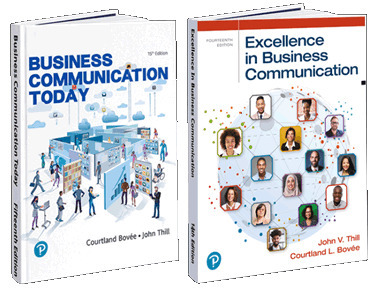
Are you looking for a textbook with the perfect balance of timeless principles and cutting-edge practices? Excellence in Business Communication, 10th Edition, offers this perfect balance, because it helps students master the fundamentals of professional communication while also preparing them for the broader expectations they'll encounter in today's workplace. This video takes you step-by-step through the 30 elements included in this text that will help you become a better business communication instructor. Excellence in Business Communication has been used by over 2 million students to help them master essential skills for succeeding on the job. This tenth edition extends that tradition by offering an unmatched set of tools that simplify teaching, promote active learning, and stimulate critical thinking Via Bovee & Thill's Online Magazines for Business Communication
Communication is an integral part of any work or life situation. Learning to be an effective communicator is a valuable productivity tool, one that is unfortunately commonly overlooked. The consequences of poor communication can be disastrous; wasted time, hurt feelings, misunderstandings, unproductive meetings, ineffective teamwork, and lack of progress towards goals. In order to be successful communicators we need to keep in mind some basic guidelines that are applicable in most instances of work, social or home environments. . .
Quite often when you are listening to a speaker, teacher or seminar leader, you are thinking to yourself that this person is either a really good presenter or a boring one. For some reasons you are not totally sure of, you have put that person in your mind in one of these two classifications. . .
I spent the majority of my high school and college years as a Market Research Interviewer — i.e., telephone survey girl. And now my husband is a Customer Relations Specialist in his company’s Retention Department — meaning his job is to call up customers who’ve canceled, find out why, and (if possible) try to get them to change their minds.Let’s just say we both have plenty of experience dealing with angry people. And when you’ve done it enough, you do more than just build up a thick skin — you also learn a few strategies that help bring a hostile person down to earth. Whether you’re faced with an upset client, a co-worker meltdown, or one of those bosses who communicates solely by yelling, keeping these pointers in mind can help de-escalate even the most volatile of situations. . .
Why are some presentations spellbinding and some not? Well, this is the question Nancy Duarte takes on in this video as she shares with the audience the secret of an excellent presentation. In this fascinating talk Nancy Duarte explains the model that she developed for designing transformative presentations. She explains the essential qualities of an excellent presentation by analyzing the speeches of Martin Luther King and Steve Jobs. She reminds us that the only way to spread important ideas is to make sure that one is communicating his or her ideas effectively using strong presentation skills.
Learn proper international business card etiquette in this video.
Presenting to a group of employees or to investors are important activities for a business owner or manager, and letting nervousness prevent you from delivering what you need to deliver, is something you want to do your utmost, to prevent.
Whether it is inexperience, fear, lack of preparation or any other factor making you nervous, there are ways you can overcome nervousness, and make a professional presentation.
This excellent article offers 12 tips to help you overcome your nervousness and prevent you from delivering a poor presentation. Via Kenda Morrison, Daniel Watson
In reality, of course, it's not always possible to meet in person, so email wins out. How, then, do people react to persuasion attempts over email? Persuasion research has uncovered fascinating effects: that men seem more responsive to email because it bypasses their competitive tendencies. Women, however, may respond better in face-to-face encounters because they are more 'relationship-minded'. But is this finding just a gender stereotype?
|
The definition of emotion is a rather dubious one: “an affective state of consciousness in which joy, sorrow, fear, hate, or the like, is experienced.”
In short, emotion is how we feel, whether that is anger, fear, sadness, happiness, anxiety, guilt, shame or jealousy. Emotion is complicated, and sometimes given a bad rap.
The word ‘emotional’ has a myriad of negative connotations associated with it; usually it’s a sign of weakness or lack of self-control. However, humans are a fundamentally emotional species. We laugh, we cry, we smile, we seethe and we emphasize.
The use of emotion should be thoughtfully considered when preparing a presentation. When used correctly, it can significantly strengthen a presentation’s message. . . Via Donna Lipman
Are you covering the right topics for your course to be considered up to date? For example, are you giving adequate coverage to social media and electronic communication? Find out now if your course measures up.
Via Bovee & Thill's Online Magazines for Business Communication
Meetings can be like torture chambers. But they don't have to be. Web conferencing company SalesCrunch has created a guide to meetings. It's gathered the data from its management software, which tracks things like if people are really paying attention (looking at the screen or not), and if follow-up materials are opened. . .
Here is an interesting website that lists English idioms relating to food.
Have you noticed how obsessed we all are with getting things right? Not only that, but doing the right thing quicker and better than ever before. Everywhere you turn, there are books, magazines and blogs dedicated to making sure we have the secrets of success so we don’t screw up. In the face of all this rampant perfectionism, it’s easy to overlook the importance of being OK without getting it wrong now and then. . .
Leading business bloggers say the perceived authenticity of a CEO plays a critical role in how they assess a leader's abilities and performance overall . . . Asked to name the top 5 phrases that raise concerns about a lack of authenticity, the bloggers cited the following:
The teaching of business communication is undergoing a transformation because of six dramatic changes that are explained in this video. These factors shape a different workplace in the 21st century and require students to learn new and better ways to communicate. For example, the trend away from the old communication model as a monologue, as in a typical sales letter, to the new communication model as a dialogue, such as on Facebook business page, is not a fad. It's a fundamental shift in the way we communicate. Companies are no longer in control of their messages and must adapt to a world in which customers and other stakeholders demand to participate in and influence the conversation.
See all six of Bovee & Thill's Online Magazines Business Communication 2.0: Social Media and Electronic Communication http://www.scoop.it/t/business-communication-2-0-social-media-and-electronic-communication Teaching a Modern Business Communication Course http://www.scoop.it/t/teaching-a-modern-business-communication-course Teaching Business Communication and Employment http://www.scoop.it/t/teaching-business-communication-and-employment Teaching Visual Communication http://www.scoop.it/t/teaching-visual-communication Teaching Business and Interpersonal Communication http://www.scoop.it/t/teaching-business-and-interpersonal-communication Teaching Business Communication and Workplace Issues http://www.scoop.it/t/teaching-business-communication-and-workplace-issues Plus: News about Bovee & Thill Online Magazine http://www.scoop.it/t/news-about-bovee-thill Visit Bovee & Thill's Business Communication Blog at http://boveeandthillbusinesscommunicationblog.com Visit Bovee & Thill's YouTube Channel at http://www.youtube.com/BoveeandThill Visit Bovee & Thill on Pinterest at http://pinterest.com/courtland_bovee/business-communication-pictorial-gallery-on-pinter Via Bovee & Thill's Online Magazines for Business Communication
The legal jargon with respect to digital copyrights can be confusing – especially since different countries have their own laws and regulations.
With this post, we hope to dispel a few myths and pull together a complete list of resources for teachers and students to use when blogging and working with content online. Via Gust MEES
The World Wide Web is growing at rapid pace. On average, more than a billion new pages are added to it every day. To give you an idea of how big world wide web is, this video, 60 Seconds, will cover some really interesting facts about websites that we use on a day-to-day basis.
|
| 1 | 2 | 3 | 4 | ![]() |
7 |
|
Next |