Your new post is loading...
U.S. Trade Representative Jamieson Greer said on Friday that no new tariffs are planned on foreign semiconductors, while underscoring the need to protect the domestic industry as part of broader efforts to bolster American manufacturing. Greer made the remarks at an event celebrating the expansion of a Micron Technology facility located in the District of Columbia suburbs, stressing the administration’s commitment to reshore key technology production.
TAIPEI, May 23 (Reuters) - Nvidia CEO Jensen Huang said on Saturday that his forecast of a $200 billion market for CPUs includes China, signalling Nvidia still sees significant long-term demand in the market amid ongoing U.S.-China technology tensions. Central processing units have taken centre stage as companies and businesses gravitate towards agentic AI - systems that perform autonomous functions - broadening demand beyond graphics processing units, or GPUs, that are used to train large models.
- Rural broadband providers must prepare for operational excellence as BEAD builds shift from planning to execution
- Small providers face pressure to run leaner businesses while managing funding, compliance and growth
- Satellite is a near-term solution for rural gaps, but consolidation and scale will define who lasts
AI dominated Fiber Connect 2026 in Orlando, but broadband did make it into a few discussions, especially those focused on what's become of the $42.5 billion Broadband Equity, Access and Deployment (BEAD) program. Money has started to roll out, which is a good thing, but now smaller broadband operators are facing operational reality, according to Adrian Fitzgerald. “If the first round was deployment…the second round is really going to be non-deployment,” said Fitzgerald, who is chief revenue officer at JSI, a consultancy firm that supports Tier 3 operators. “They have to prepare for operational excellence.”
Wisconsin’s Governor Tony Evers announced Tuesday that the state will invest an additional $60 million to “expand access to high-speed internet in unserved communities through the State Broadband Expansion Grant Program.”
The state’s press release said that the funding is primarily needed to ‘close gaps’ and deliver service to locations ‘not served’ by BEAD. Citing the SBO, the release goes on to directly point the finger at BEAD and the changes to the program that occurred with BOB…“at least 30,000 locations in Wisconsin would remain unserved” and are left in need of state funding. Not surprisingly, the NTIA fired back with a statement:
Today, Senators Ben Ray Luján (D-N.M.) and Edward J. Markey (D-Mass.) introduced the “Digital Opportunity Foundation Act” to establish a nonprofit foundation to help close the digital divide by leveraging public and private investments. Rep. Doris Matsui (D-Calif.) introduced a companion bill in the U.S. House. To accomplish this, the bill would supplement federal digital inclusion efforts by awarding grants that provide training and education, and overall promote policies to enhance digital equity outcomes across the nation. It would also provide local funding to help connect those in danger of missing out on all the opportunities the internet provides, including telehealth, education, and career training. Public Knowledge applauds Sen. Luján and Rep. Matsui for championing those who need devices and training to participate in our digital world. The following can be attributed to Alisa Valentin, Broadband Policy Director at Public Knowledge:
FRANKLIN COUNTY, Mo. – A marathon hearing in Franklin County on Monday wrapped up after more than 13 hours of public testimony. Residents packed East Central College in Union to weigh in on proposed data center regulations and two rezoning requests. The meeting started Monday morning and lasted until after 10 p.m. County leaders heard hours of public comment from people on both sides of the issue, with each speaker given three minutes to talk. The meeting was long and emotional, ending with county leaders not making a decision. In a previous meeting back in March, a hearing discussing data centers lasted more than 10 hours. The big question from the meeting is whether these data center projects will move forward and when county commissioners will take this up again.
- “The subscriber experience is not fiber. The subscriber experience is Wi‑Fi," Broadband Forum's CEO told Fierce Network at Fiber Connect
- AI is part of a "jigsaw," not a standalone killer app
- Operators must fix data models and service layers before AI can deliver real value
AI was the topic thread that ran through most of the conversations and presentations at Fiber Connect in Orlando this year. It seems that AI has finally given purpose to years of fiber investment. Huzzah! But Craig Thomas, CEO of Broadband Forum, said the industry should approach that idea with caution because AI is not the be-all, end-all savior of the fiber industry. “I think it is part of a jigsaw,” Thomas said. “But it doesn’t stand alone. It can’t stand alone.” Anyone who's been in the industry for a while knows that it's spent years searching for a “killer app” to justify massive fiber builds. AI, with its explosive demand for compute and bandwidth, seems like the obvious answer.
I. What Fiber Broadband Actually Delivers Property Values and the Tax Base The connection between fiber access and residential property values is one of the most consistently documented findings in broadband economics. Studies across diverse markets show that homes in fiber-served areas command a 3 to 7 percent premium over otherwise comparable properties. For Florida communities where the median home value is approximately $400,000, that range represents $12,000 to $28,000 in added value per unit. From a community finance perspective, this is taxable value. A deployment covering 5,000 homes at a conservative 3 percent appreciation adds $60 million to the local assessed base. That translates into recurring property tax revenue, without new infrastructure costs to the city, that compounds over time. Communities that capture this effect early capture it for longer.
Gen Z is officially surpassing Baby Boomers in new business startups, with AI helping young entrepreneurs launch companies faster while reporting record happiness levels. Forget quiet quitting. The youngest generation in the workforce isn’t disengaging from work—they’re rewriting the rulebook entirely, launching businesses at record rates and reporting happiness levels that would make their corporate-ladder-climbing predecessors jealous. New survey data from VistaPrint’s 2026 Small Business Happiness Report paints a striking portrait: 84 percent of U.S. small-business owners describe themselves as happy or very pleased in their work and lives. Among Gen Z founders specifically, that number climbs to an extraordinary 94 percent—nearly universal contentment from a generation that’s notoriously hard to please in a traditional office environment. But before chalking this up to youthful optimism, consider what the data actually shows: Gen Z entrepreneurs aren’t just happy—they’re thriving through a gauntlet of very real challenges that would test even the most seasoned founder.
It’s too late for the Late Show, but we can still stop the guys who killed it. While cleaning up my office yesterday, I discovered a wrinkled placard that had fallen behind my bookshelf. It was a souvenir from the 2010 “Rally to Restore Sanity and/or Fear” — the spoof protest march that Jon Stewart and Stephen Colbert organized, which brought more than 200,000 people out to the National Mall. My Free Press colleagues and I showed up that day to attract a few new recruits, hoping to seize on the fake protest to build our ranks for the next real one. The crowd’s outrage at extremism and the disastrous state of our political discourse was very real, but it never went anywhere. The event was ultimately just a bit — a performance of a protest, produced by Paramount. A pre-MAGA Kid Rock was the closing act. How quaint. Perhaps finding this wrinkled old sign was a sign — a moment of serendipity on the day Colbert’s Late Show was airing its final episode. Or maybe it’s just a reminder that in its long-running battle against sanity, fear is winning in a rout.
Researchers at the company found representations inside of Claude that perform functions similar to human feelings. Claude has been through a lot lately—a public fallout with the Pentagon, leaked source code—so it makes sense that it would be feeling a little blue. Except, it’s an AI model, so it can’t feel. Right? Well, sort of. A new study from Anthropic suggests models have digital representations of human emotions like happiness, sadness, joy, and fear, within clusters of artificial neurons—and these representations activate in response to different cues. Researchers at the company probed the inner workings of Claude Sonnet 4.5 and found that so-called “functional emotions” seem to affect Claude’s behavior, altering the model’s outputs and actions.
Commencement AI booing reflects growing class revolt now tightly tethered to AI -- whether the technology's biggest proponents like it or not. You may have noticed that anger at AI is white hot right now. For a bunch of reasons I've already discussed. It's particularly and unsurprisingly hot among young Americans, who can't find jobs, homes, health care, or much of anything else to give them a leg up in a country hollowed out by historic levels of corruption.
They're being told, usually by people who already have theirs, that they should be more excited about the latest evolutions in software automation. "Why aren't you more interested in nuanced conversations about the latest evolutions in software automation," fans of the latest evolutions in software automation will ask.
As if the world isn't on fire.
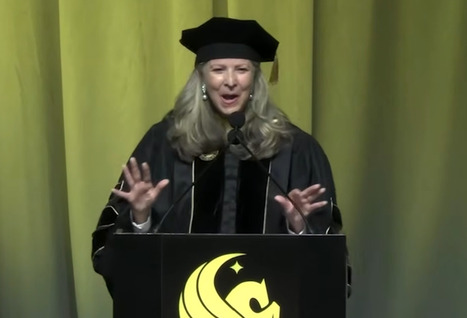
It's all starting to bubble over. A few weeks ago a speaker giving a commencement address at the University of Central Florida was loudly booed after she proclaimed that improvements in software automation should be viewed as the "next industrial revolution." From the video, Orlando-based executive Gloria Caulfield was clearly surprised at the level of anti-AI animosity demonstrated by the class of 2026.
UPDATE 5/20: The FCC today voted 3-0 to consider revamping rules regarding $1.6 billion in subsidies to rural ISPs. The vote was 3-0, though Democratic Commissioner Anna Gomez cautioned against relying too heavily on satellite providers like Starlink to handle rural broadband. Original Story:
SpaceX is telling the Federal Communications Commission to consider ending a $4.5 billion fund that subsidizes voice and broadband in rural areas, arguing that Starlink has solved the connectivity gap by offering fast speeds at competitive rates.
“The Commission’s universal service programs must adapt to a reality where the long-standing problem of high-speed broadband network access has effectively been solved, rendering most legacy High-Cost support mechanisms redundant,” the company wrote in the Wednesday letter. The FCC is moving to modernize the High-Cost program under the Universal Service Fund, which subsidizes access to voice and broadband services. The High-Cost program specifically distributes funding to telecommunications providers in rural and remote areas to not only deploy their services but also keep prices down for local consumers. SpaceX tells the FCC to wind down a program that offers subsidies to ISPs serving rural areas since access 'has effectively been solved' with Starlink. Detractors aren't sure that's true.
|
May 22 (Reuters) - The dual-class share structure outlined in SpaceX's IPO filing, which grants CEO Elon Musk outsized control, has revived one of Wall Street's oldest debates - that of corporate governance. While such structures are hardly unusual in corporate America, particularly among founder-led companies, few issues are so fiercely criticized by governance watchdogs. Supporters argue visionary founders should be insulated from short-term market pressures, while critics warn that concentrating power in the hands of insiders weakens accountability.
We speak with journalist Karen Hao, author of Empire of AI, about the Trump administration’s alliance with tech billionaires, efforts to regulate artificial intelligence technology, and rising local opposition to data centers across the United States.
“In 2025, these data center protests successfully stalled over $100 billion worth of these facilities,” says Hao. “It really does cut across political lines.”
Hao recently launched The AI Resist List with a group of fellow journalists, researchers and technologists. It’s a collaborative project to track and reshape how artificial intelligence is deployed around the world.
- FCC approval exempts Nokia’s Beacons and Optical Network Terminal (ONT) Beacons including future variants, from Covered List restrictions.·
- Nokia commits to manufacturing its next-generation Wi-Fi 8 gateways in the United States.·
- Conditional approval and manufacturing commitment supports uninterrupted deployment
Dallas, Texas – Nokia today announced that its Beacons and ONT devices have received conditional approval from the FCC’s Public Safety and Homeland Security Bureau, formally exempting these platforms, including future variants, from the FCC Covered List of restrictions on foreign-made consumer Wi-Fi routers. Nokia’s Beacons and ONT Beacons are deployed by service providers across North America to deliver high-performance broadband to millions of subscribers. The approval allows operators to continue deploying without disruption, maintain rollout momentum, and invest with confidence in their broadband networks.
Washington, D.C. – Today, U.S. Senator Ben Ray Luján (D-N.M.), Ranking Member of the Senate Commerce Committee’s Subcommittee on Telecommunications and Media, and U.S. Representative Doris Matsui (D-Calif.) introduced the bicameral Digital Opportunity Foundation Act of 2026. This legislation would establish a nonprofit foundation that would leverage public and private investments to expand digital opportunity nationwide, ensuring that people can access, adopt, and effectively use modern digital tools, broadband, and other emerging technologies. The bill is co-sponsored by U.S. Senator Edward J. Markey (D-Mass.). The Foundation for Digital Opportunity will supplement the work of the National Telecommunications and Information Administration (NTIA) and the Federal Communications Commission (FCC) to award grants, support research, provide training and education, engage with stakeholders, collect data, and promote policies that improve digital opportunities. The Foundation will be governed by a Board of experts specializing in digital opportunity, technology, and telecommunications, representing diverse communities across the United States.
TO CHANNEL ONE of Elon Musk’s favourite science-fiction authors, SpaceX is a product of infinite improbability. When Mr Musk began, few would have predicted that a startup could design a liquid-fuelled rocket and put it in orbit. Nor that an engineer would be able to get a rocket’s booster to return to Earth, land upright on its own tail and be re-used. And no one has yet recovered a rocket’s second stage, which must withstand 1,500°C or so during atmospheric re-entry. Having pulled off the first unlikely feat in 2008, six short years after its founding, and the second in 2015, SpaceX will try to use a launch due on May 21st to show that it can carry off the third, too. If the test fails by the time you read this, SpaceX will try again—and again, until it succeeds or runs out of money. Success will be vital if Mr Musk is to realise his vision of dominating artificial intelligence, apparently by using space-based computers launched by SpaceX to satisfy AI’s ravenous hunger for data-processing. To pay for his dream, on May 20th the company filed the prospectus that has started the countdown clock for an initial public offering next month worth about $75bn. This will be the biggest listing in history. In two ways, the IPO is infinitely improbable, too. It is inspiring in that Mr Musk aims to carry off yet more seemingly impossible feats of engineering. And it is worrying in that he is asking investors to trust their savings to a lossmaking outfit with hardly credible financial plans over which he will have total control.
LAKE LURE, N.C. (WLOS) — The Town of Lake Lure now has a new cell site and new AT&T fiber availability. This means Lake Lure has broadband coverage for the area. The new cell site includes band 14 spectrum, which is high-quality, meant for first responders to connect to the critical information they need.
As SpaceX’s $1.6 trillion direct-to-device ambition threatens to bypass legacy carriers entirely, the telecommunications industry is organizing around AST SpaceMobile as its definitive shield. The SpaceX S-1 filing is their public declaration that the traditional telecommunications business model has entered a terminal phase. By valuing its connectivity segment opportunity against a $1.6 trillion Total Addressable Market, SpaceX is not signaling a partnership with telcos but their replacement, to the fullest extent that physics allows. This transition may not be completed in 12 or 24 months, but the 10-year ambition is clear. Faced with this orbital expansion, the industry is frantically seeking a counterweight, and market sentiment has converged on AST SpaceMobile as the only viable alternative. It is time to examine what AST SpaceMobile brings to the table in terms of its corporate strategy, technological architecture, and partnership framework, and to assess whether it offers telcos a path to maintaining their relevance.
NextEra's $67 billion takeover of Dominion shows the problem with utilities. We spend a lot, and get little in return. Why? Utility monopolies profit from gold-plating, waste and inefficiency. If there’s one obvious thing about this political moment, it’s that voters are furious about paying so much for electricity. In 2023, 70 million adults chose to forego food and medicine so they could afford their utility bills. Powerlines found dozens of significant rate hikes last year, as the price of electricity went up at one and a half times the rate of general inflation. Voters have had enough, telling pollsters that electric utility prices are at crisis levels, and blaming excess profits for the problem.
This week in broadband builds: News from Ethos Broadband, TWN Communications, WideOpenWest, Shentel, Comcast, Charter, Empire Fiber Internet and Wire 3. Ethos Broadband connects rural Chimayo New Mexico's Office of Broadband Access and Expansion (OBAE) held a ribbon-cutting ceremony alongside Ethos Broadband this week, celebrating the completion of Ethos' fixed wireless access (FWA) deployment in the rural community of Chimayo, located in Rio Arriba County. The project was awarded a $1.3 million Student Connect grant from the state in February 2025 to deploy the fixed wireless network, which now delivers service to 173 rural student households in the Española Public School district. According to a press release, connected student households will receive broadband connectivity at no cost for three years. Ethos Broadband, an Albuquerque, New Mexico-based ISP, is an operating division of Sacred Wind Enterprises, which was acquired by Commnet Broadband – a subsidiary of ATN International – in 2022. Related: Fiber Broadband Association pitches framework for HFC-to-FTTP upgrades
There is a glimmer of hope that ISPs that won state grants that were funded from the Capital Project Fund (CPF) can get an extension of six months to complete grant construction. The Capital Project Fund was created by the 2021 American Rescue Plan Act (ARPA) and provided almost $10 billion to states and territories for making broadband-related grants. The program was administered by the Department of the Treasury, which gave block grants to States. Each State then made awards through State Broadband grant programs to ISPs. I’ve seen estimates that CPF grants have funded projects to bring new broadband infrastructure to roughly 2 million rural passings. The grants could also be used to purchase devices like laptops and computers for qualifying households. The final approved use of the funds was to construct or improve physical community hubs where citizens can remotely access work, education, and telehealth services.
Lake Zurich, IL residents and businesses will be getting another choice for high-speed broadband internet services. The village board Monday approved an agreement allowing Ezee Fiber Texas LLC to use the public rights of way to install a villagewide fiber optic network in town. Ezee Fiber joins i3 Broadband in receiving the board’s backing for installation of a fiber optic network. “We certainly welcome the opportunity of providing the residents with a choice of higher speeds to take advantage of all the things that are on the internet, which consumes a tremendous amount of bandwidth,” said Assistant Village Manager Michael Duebner.
SpaceX’s IPO filing reveals a $1.6 trillion bet that Starlink can bypass terrestrial networks, and defy the laws of telecom economics. The financial press is currently tying itself in knots trying to reverse-engineer the math behind SpaceX’s proposed $1.75 trillion IPO valuation. The short answer? The math does not work. Not on today’s fundamentals, anyway. At a blistering 94x price-to-sales multiple, you are not buying a rocket company; you are buying a religious belief in a $28.5 trillion Total Addressable Market according to SpaceX's filing.
|