Many actors, writers and other creative people are considered shy or introverted, or identify themselves as one or both. They are not the same thing, of course, although many people may talk about others, or themselves, as “shy” when they are perhaps introverted.
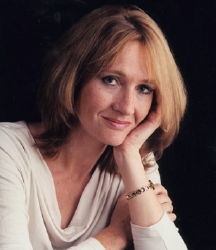
"To my immense frustration, I didn’t have a pen that worked, and I was too shy to ask anybody if I could borrow one…” J.K. Rowling about first developing "Harry Potter."
"Some of the titular outsiders featured in Alissa Quart’s new book...are crazy."
"Even if you don’t consider yourself an outsider or a rebel, Quart’s book has several lessons for creative work, particularly when it comes to making art outside a heavily commercial system."
Her book: Republic of Outsiders: The Power of Amateurs, Dreamers and Rebels. http://buff.ly/169QlGx
Alissa Quart read at age 3, wrote her first novel when she was 7, and “writes about pressures put on children, especially gifted children and prodigies, that encourage perfectionism, performance anxiety and lifelong feelings of not being able to keep up.” - From post: Failure and personal growth and achievement http://talentdevelop.com/1146/
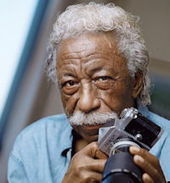
Gordon Parks (1912-2006) was often referred to as a Renaissance man, as noted in an obituary, and lived up to the label: “In addition to his photography, film work and poetry, he composed a symphony, sonatas, concertos, film scores, and wrote novels, instructional photography manuals, essays and three memoirs."
“I hope I’m becoming more eccentric. More room in the brain.” Musician Tom Waits
Being eccentric – choosing not to be more safely mundane – can help our creative thinking and courage.
As psychologist Robert Ornstein, PhD has noted, “If you spend too much time being like everybody else, you decrease your chances of coming up with something different.”
By Kristen Fischer. "Find something that inspires or motivates you and use it to fuel your creativity and boost your joy. Look for the little things and see how big they can become!"
Book: When Talent Isn't Enough: Business Basics for the Creatively Inclined: For Creative Professionals, Including... Artists, Writers, Designers, Bloggers, ... to Freelance or Run Their Own Business Paperback by Kristen Fischer. http://buff.ly/14NJQj1
In the preface to a photography book, singer–songwriter, poet and visual artist Patti Smith describes the experience of many creators.
“The artist, in turn, sacrifices his leisure, the pleasure of being vague, of drifting half-present or merging unconsciously with the terrain. For the artist is driven, is one apart, estranged from all save his one eye."
"I'm extremely excited and extremely nervous," says the designer, one of five celebrities taking part in Canon's "Project Imaginat10n," of helming a love story/fantasy inspired by 10 user-generated photographs.
J.K. Rowling spoke in her Harvard Commencement Address about the power of our imagination for creativity and innovation, and understanding other people.
One of psychologist C.G. Jung‘s concepts is “active imagination.” Jungian analyst John Beebe comments about it being “a kind of dialogue between conscious and unconscious.”
Creative and highly talented people often have imaginational intensity – an ability tapped into by Rowling and so many other artists.
Shelley Carson, Ph.D. of Harvard University teaches and conducts research on creativity, psychopathology, and resilience. Topics in our audio podcast interview related to the creative mind and developing creativity include some of Dr. Carson’s seven brain activation patterns she discusses in her new book Your Creative Brain. [Also see links to video and posts with more quotes.]
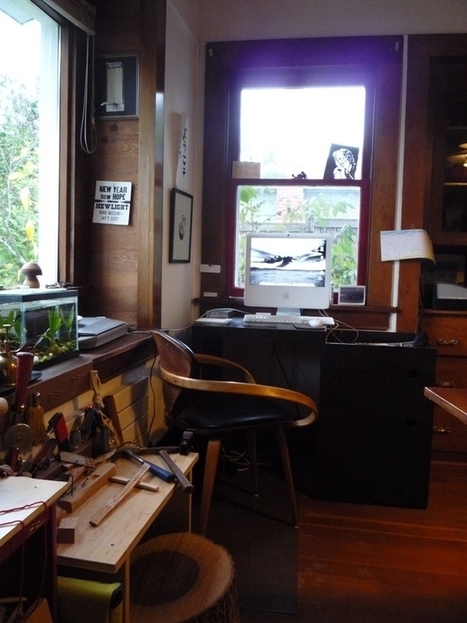
From tiny writing desks to giant painting studios, the only thing all of these creative studios have in common is that they inspired their successful inhabitants to create greatness.
J. K. Rowling wrote much of the first "Harry Potter" in coffee shops. George Orwell chose to write Nineteen Eighty-Four while living in Barnhill (1946-1949), an abandoned farmhouse on the isle of Jura in the Inner Hebrides. - From Solitude is not pathology for the high sensitivity personality http://talentdevelop.com/3558/
As you scroll through, you cannot help but notice how many look out ont nature. Since I now look at the Olumpic Mountains and the Puget Sounds from my windows, I know why. Nature, even looking at her and lsitening to the birds cry, small the freshness, I am restoried, inspired and guided in what matters most.
There were very few workspaces which were shown cluttered. Fung Shui says that a cluttered room leads to cluttered mind. It does for me I know. These creative people have sparse or orderedly work spaces.
How beautiful to reflect on why my workspace is so inspiring to me. Have you found yours?
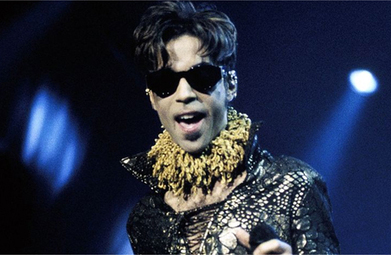
Martin Howard: It's not just the preserve of Albert Einstein and Prince – eccentric behaviour benefits society and helps us live longer
"Eccentricity. We all know it when we see it. Chances are high some of you reading this are eccentric, and we British are quietly proud to lead the world in producing Grade-A loons. National icon Oscar Wilde, for example, used to take a lobster on a lead for walks."
“I hope I’m becoming more eccentric. More room in the brain.” Musician Tom Waits / Being eccentric can help our creative thinking and courage. As psychologist Robert Ornstein has noted, “If you spend too much time being like everybody else, you decrease your chances of coming up with something different.” - From post: Being eccentric and creative http://developingmultipletalents.com/101/being-eccentric-and-creative/
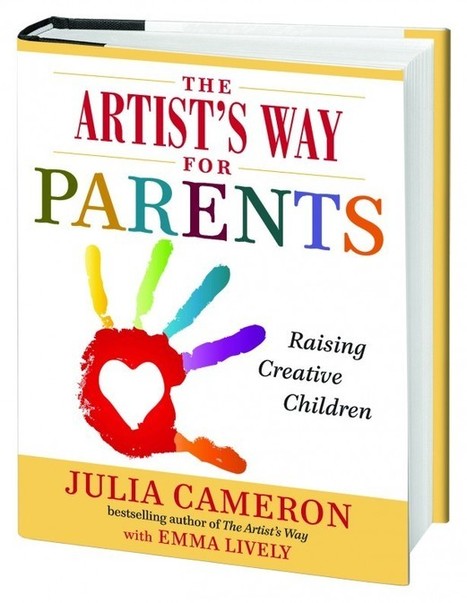
Julia Cameron notes “Children are naturally creative, and their gifts can be anything. We need to stop thinking in terms of the future and start thinking about what makes them happy now."
The Artist's Way for Parents: Raising Creative Children by Julia Cameron, Emma Lively. - [The book] "focuses on creative cultivation, where we consciously — and playfully — put our children on a healthy creative path toward the future.” — Julia Cameron http://buff.ly/151xJyV
I am always grateful for being given the opportunity to nuture my creativity when I was a child. Because it has given me the strength and driving force to overcome many obstacles towards my life acheivements. I desire to inspire others to keep on track of their creative paths. Thank you for sharing this with us. http://creativeflowevolution.com/
In the spirit of ideas worth spreading, TEDx is a program of local, self-organized events that bring people together to share a TED-like experience. At a TED...
Her book: inGenius: A Crash Course on Creativity - "Contrary to common belief, creativity is not a gift some of us are born with. It is a skill that all of us can learn. International bestselling author and award-winning Stanford University educator Tina Seelig has worked with some of the business world’s best and brightest, who are now among the decision-makers at companies such as Google, Genentech, IBM, and Cisco." http://buff.ly/13EgfYm
Creating may be at times a collaboration, and it can be helpful to get input from others, but many artists say they create primarily to please themselves.
What happens if you realize you are smarter and more capable than most people? Do you celebrate being exceptional, or try to hide?
One of the many inspiring quotes by Steve Jobs: "Everything around you that you call life was made up by people that were no smarter than you, and you can change it, you can influence it, you can build your own things that other people can use."
But Jobs also recognized he was exceptional. “It was a very big moment that’s burned into my mind. When I realized that I was smarter than my parents..."
Susan K. Perry is a social psychologist and author of many articles and non-fiction books. She comments about writing her first work of fiction.
'Over time, this fictional world has become so familiar to me, that it seems to truly exist “out there,” overlapping my own, rather more ordinary, life.'
'But it’s been hard work to make it as good as I feel it is now...I learned so much during this long process that I’m truly glad I dared to write fiction.'
“My Adderall helps me think so much clearer.” [From an ADD forum.]
Who wouldn’t want that?
Steven Zeitchik says in his article about the movie “Limitless” that “down-on-his-luck New York writer Eddie (Bradley Cooper) ”takes a magic potion – a “miracle street narcotic in the form of a translucent pill, NZT that enhances mental performance beyond any reasonable expectation. (Yes, it’s fictional.)”
By Cheryl Arutt, Psy.D., a clinical psychologist in Los Angeles, specializing in creative artist issues, trauma recovery, and fertility.
"I am continually amazed at the work of the unconscious in the minds of creative artists. The capacity to hold many details in the conscious, wakeful mind may seem limited; the unconscious is capable of holding far more."
One of the many stimulating comments by Ken Robinson: "The third misconception is that creativity is just about letting yourself go, kind of running around the room and going a bit crazy. Really, creativity is a disciplined process that requires skill, knowledge, and control. Obviously, it also requires imagination and inspiration."
In one of my related posts: "Ken Robinson: Do schools kill creativity?" - I include quotes of his, such as: "We are educating people out of their creativity. By the time they get to be adults, most kids have lost that capacity to take a chance. They have become frightened of being wrong." http://talentdevelop.com/69/sir-ken-robinson-do-schools-kill-creativity/
In one of my related posts: "Ken Robinson: Do schools kill creativity?" - I include quotes of his, such as: "We are educating people out of their creativity. By the time they get to be adults, most kids have lost that capacity to take a chance. They have become frightened of being wrong." http://talentdevelop.com/69/sir-ken-robinson-do-schools-kill-creativity/
Emma Thompson: “I’m very lucky I write as well. I don’t see how I could be as effective a mother as I’d like to be if I had to go away and act all the time."
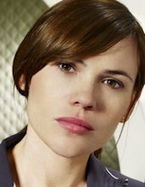
“I’m an only child and I’m just a real loner kind of person, and yeah, kinda dark. But I’m happy. Not sad. I’m just shy and nervous… I was a loner in high school. I keep to myself, but I love life.” Actor Clea DuVall
Creative performers have three seeming contradictions - energy/rest, extroversion/introversion, and openness/sensitivity, along with other key traits, notes cognitive psychologist Scott Barry Kaufman.
“I just thought making movies was something done by geniuses, and I was very clear that I wasn’t one of those.” Jane Campion
When “The Artist’s Way” author and creativity coach Julia Cameron has asked people to list ten traits they think artists have, their responses have included: “Artists are broke,” “Artists are crazy,” “Artists are drug-addicted” and “Artists are drunk.” Other myths and ideas about being an artist:
To get content containing either thought or leadership enter:
To get content containing both thought and leadership enter:
To get content containing the expression thought leadership enter:
You can enter several keywords and you can refine them whenever you want. Our suggestion engine uses more signals but entering a few keywords here will rapidly give you great content to curate.


 Your new post is loading...